Raman essay and Open-Access

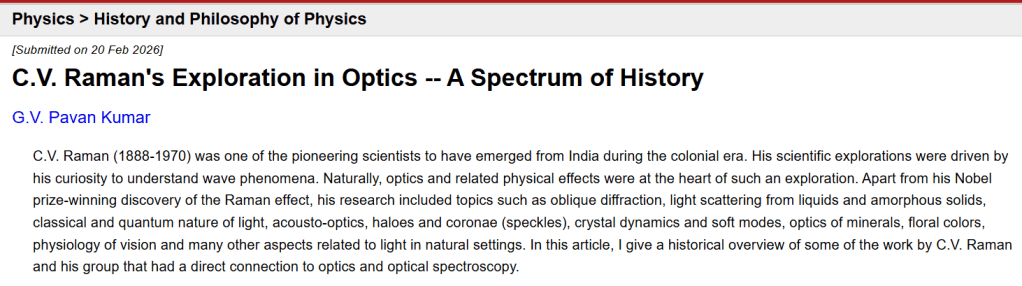
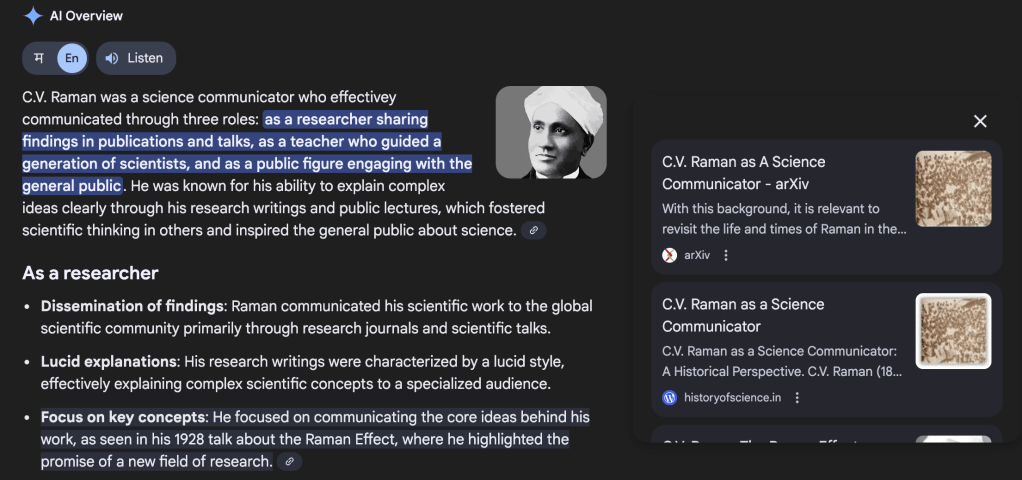
I see that the essay I wrote on CV Raman and made open access (thanks to Resonance, which published it) has been used by several educators on YouTube, including some in Indian languages. Also, the Google AI overview shows the published essay as the main reference for a search related to Raman’s science communication (see slideshow below).

I am glad to see that making one’s writing open to all has positive effects. Open-access, not just for readers, but also for authors, is beneficial. Especially in India, paywalls for science are a detriment.

My worry is that open-access publishing has been mainly driven by commercial publishers that extract huge funds from the publishing authors. This defeats the purpose of open science, especially when the research of an author is publicly funded. Added to that, Indian researchers and writers cannot afford to pay huge sums for publishing articles and books.

The publication landscape (including journals and books) across the world needs an introspection. Open-access model is effective only when the readers and authors have access to that model. Otherwise, the model becomes a paywall for authors.

Conversation with A.R.Venkatachalapathy

Welcome to the podcast, Pratidhavani – Humanizing Science

A. R. Venkatachalapathy is a prolific historian, writer and Professor whose work explores the social and cultural history of colonial Tamil Nadu. In 2024, he was awarded the Sahitya Akademi Award. 

His notable books include “In Those Days There Was No Coffee,” “The Province of the Book,” “Tamil Characters,” and “Swadeshi Steam,” which examines V.O. Chidambaram Pillai’s role in anti-colonial maritime resistance. His scholarship spans Tamil literature, publishing history, and intellectual culture, blending rigorous archival research with literary analysis.

In this episode, we explore his intellectual journey as a historian and bilingual author.

History of Maths in India – a good book

In recent years, this has been one of the best books on the history of mathematics in India. The late Prof. Divakaran was a theoretical physicist and a scholar.

This book is also an excellent example of how a scientist can present historical facts and analyse them with rigour and nuance. Particularly, it puts the Indian contribution in the global context and shows how ideas are exchanged across the geography. The writing is jargon-free and can be understood by anyone interested in mathematics.

Unfortunately, the cost of the book ranges from Rs 8800 to Rs 14,000 (depending on the version), which is a shame. Part of the reason why scholarly books, particularly in India, don’t get the traction is because of such high cost. This needs to change for the betterment and penetration of knowledge in a vast society such as India.

There is a nice video by numberphile on Prof. Divakaran and his book:

Random Walks in Polarization

I have been teaching polarization of light in my optics class. In there, I introduced them to matrix representation of polarization states. One of the standard references that I use for explanation is a 1954 paper in American J. Physics, by McMaster titled: “Polarization and the Stokes Parameters.”

While skimming through the pdf of the journal paper, I found an excerpt from a 1954 book, which quotes Fresnel writing to Thomas Young:

Further, I knew from the past that S. Chandrasekhar (astrophysicist) had a role in rejuvenating Stokes vector formalism in radiative transfer. Below is his description from AIP oral history archives (May 1977):

I started the sequence of papers, and almost at the time I started it, I read the paper by Wick in which he had used the method of discrete coordinates,* and I realized at once that that method can be used in a large scale way for solving all problems. So that went on. I have always said and felt that the five years in which I worked on radiative transfer [1944 – 49] is the happiest period of my scientific life. I started on it with no idea that one paper would lead to another, which would lead to another, which would lead to another and soon for some 24 papers — and the whole subject moved with its own momentum.” (emphasis added)

He further states how he rediscovered Stokes polarization vector formalism:

All this had a momentum of it own. Then suddenly I realized one had to put polarization in; the problems of characterizing polarized light — my rediscovery of Stokes original paper, writing on Stokes parameters and calling them Stokes parameters for the first time

Chandra further adds that the Stokes formalism was almost forgotten for 50 years, and he had a role in resurrecting it.

Next, there was some noise on social media where some one questioned the utility of matrix multiplication. For them, below is a wonderful review article by McMaster (again), to explore from polarization viewpoint, and realize the power of non-commutative matrix algebra:

Finally, the original paper by Stokes on his formalism, which is hard to find (thanks to paywall). But, classic papers are hard to suppress, and I found the full paper on internet archives.

Below is a snapshot:

Enjoy your random walk !

‘We’gnana !

Recently, I saw the following tweet from the well-known historian William Dalrymple.

Congrats to the listed authors, who deserve rewards (and the money) for their effort.

I have 3 adjacent points to make:

1) India badly needs to read (and write) more on science and technology. Here, I am not referring to textbooks, but some popular-level science books (at least). Generally, educated Indians are exposed to science only through their textbooks, which are mostly dull, or, in this era, YouTube videos, which have a low signal-to-noise ratio. Good quality science & tech books at a popular level can add intellectual value, excitement, and expand scientific thinking via reading, not just in students, but also in adults.

2) In India, most of the non-fiction literature is dominated by the social sciences, particularly history (as seen in the best-seller list). I have no problem with that, but non-fiction as a genre is a broad tree. Indian readers (and publishers) can and should broaden this scope and explore other branches of the tree. Modern science books (authentic ones), especially written in the Indian context, are badly in need. I hope trade publishers are reading this!

3) Most of the public and social media discourse in India does not emphasize (or underplays) the scientific viewpoint. Scientific literature and scientific discourse should become a central part of our culture. Good books have a major role to play. Remember what Sagan’s Cosmos did to American scientific outlook, and indirectly to its economic progress. The recent Nobel in economics, especially through the work of Joel Mokyr, further reinforces the connection between science, economics and human progress. This realization should be bottom-up, down to individual families and public places.

One of the great scientists, James Maxwell, is attributed to have said: “Happy is the man who can recognise in the work of today a connected portion of the work of life and an embodiment of the work of Eternity.

Science, with its rich, global history and philosophy, in the form of good books, can connect India (and the world) to the ‘work of eternity’, and make us look forward.

Embedding science within culture, in a humane way, can lead to progress. Science books have a central role to play in this.

विज्ञान (Vignana) should transform to ‘We’gnana !

Meghnad Saha – lest we forget

Meghnad Saha (6 October 1893 – 16 February 1956), of the fame of Saha’s ionization formula, was born this day. In 1993, a postage stamp in India was released commemorating his birth centenary.

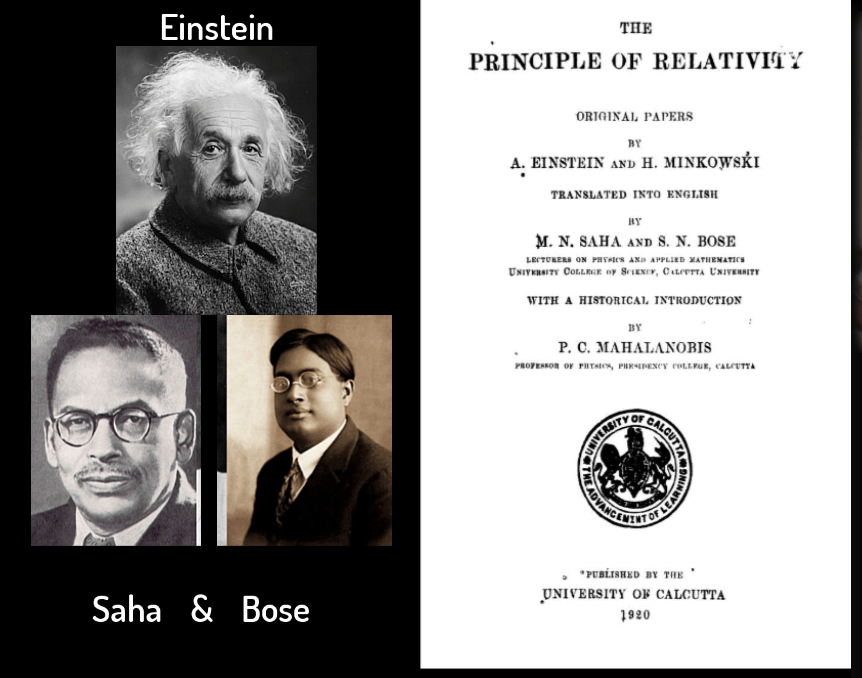
Saha was an astrophysicist with a broad knowledge and appreciation of various branches of physics. One of the earliest English translations (1920) of the papers on relativity by Einstein and Minkowski was written by Meghnad Saha and S.N.Bose.

At the beginning of the book, Mahalanobis introduces the topic with a historical introduction. He begins with a thoughtful discussion on experiments that eventually ruled out the presence of ether, and it sets the stage as follows:

Lord Kelvin writing in 1893 in hig preface to the English edition of Hertz’s Researches on Electric Waves, says many workers and many thinkers have helped to build up the nineteenth century school of plenum, one ether for light, heat, electricity, magnetism; and the German and English volumes containing Hertz’s electrical papers, given to the world in the last decade of the century, will be a permanent monument of the splendid consummation now realised.”

Ten years later, in 1905, we find Einstein declaring that “the ether will be proved to be superflous”. At first sight the revolution in scientific thought brought about in the course of a single decade appears to be almost too violent. A more careful even though a rapid review of the subject will, however, show how the Theory of Relativity gradually became a historical necessity.

Towards the beginning of the nineteenth century, the luminiferous ether came into prominence as a result of the brilliant successes of the wave theory in the hands of Young and Fresnel. In its stationary aspect, the elastic solid ether was the outcome of the search for a medium in which the light waves may “undulate.” This stationary ether, as shown by Young, also afforded a satisfactory explanation of astronomical aberration. But its very success gave rise to a host of new questions all bearing on the central problem of relative motion of ether and matter.

Saha, in various capacities, took a stance against British colonialism. Although it affected some opportunities, he continued to do science and was recognized for his outstanding contributions. As Rajesh Kochhar mentions:

Saha had wanted to join the government service, but was refused permission because of his pronounced anti-British stance. For the same reason, the British government would have liked The Royal Society to exclude Saha. It goes to the credit of the Society that it ignored the pressures and the hints, and elected him a fellow, in 1927. This recognition brought him an annual research grant of £300 from the Indian government followed by the Royal Society’s grant of £250 in 1929 (DeVorkin 1994, p. 164).

Saha led a tough life. He not only had to face suppressive British colonial rule but also academic politics and battles (versus Raman, no less). His knowledge of physics, his contributions to Indian science, and his commitment to people (he was a politician too) were significant. Let me end the blog with a few lines from Arnab Rai Choudhuri’s article, which nicely summarizes Saha’s work (specifically his ionization formula), and his scientific life:

Saha’s tale of extraordinary scientific achievements is simultaneously a tale of triumph and defeat, a tale both uplifting and tragic. Saha showed what a man coming from a humble background in an impoverished colony far from the active centres of science could achieve by the sheer intellectual power of his mind. But his inability to follow the trail which he himself had blazed makes it clear that there are limits to what even an exceptionally brilliant person could achieve in science under very adverse circumstances.

India and Indian science should remember Meghnad Saha.

Gandhi, Tagore and Celebration of Ideas

One of the books that I have enjoyed reading over the years is  The Mahatma and The Poet – Letters and Debates between Gandhi and Tagore 1915-1941’ compiled and edited by Sabyasachi Bhattacharya. The theme of the book is centered around the intellectual exchanges between M.K. Gandhi and Rabindranath Tagore on a variety of topics, including education, scientific outlook, philosophy and human dignity. Sabyasachi introduces the book with an overview of letters and debates and emphasizes that ‘The intellectual quality of the dialogue between Mahatma Gandhi and Rabindranath Tagore is such that it possesses an enduring interest. In these pages, I have tried to situate their debates, in private letters and in public statements, in the historical context of India’s national life and the cultural and political discourse of those times.’(page 20)

The book has a rich intellectual texture and showcases two minds that are open to ideas and not hesitant to express them. As Sabyasachi mentions that:‘…. the differences between them were real and at the same time they shared a common highground above the terrain of differences. Despite their differences on many crucial questions, they were willing to learn from each other.’(page 34) It shows what two engaging minds can reveal not only about themselves, but also about the place and time in which they live and operate. In there, we learn something that was a hallmark of Gandhi’s life: he was open to criticism and changed his mind in the light of evolving times and thoughts, as Sabyasachi indicates with an example:

‘Gandhi was equally open to candid criticism. It is possible that in some respects his outlook evolved, in response to the debates with Tagore. Consider, for instance, his: approach in Hind Swaraj: “I believe that the civilization India has evolved is not to be beaten in the world. Nothing can equal the seeds sown by our ancestors…. India remains immovable and that is her glory…. India has nothing to learn from anybody else and this is as it should be.” One can compare that with his later pronouncements, most notably his reply to Tagore in 1921, a truly memorable statement: “I do not want my house to be walled in all sides and my windows to be stuffed. I want the culture of all the lands to be blown about my house as freely as possible. But I refuse to be blown off my feet by any.’ (page 36)

A snapshot from the book: The Mahatma And The Poet.

Gandhi is many things to many people, some positive and some negative. For me, what stands out is his ability to utilize philosophical ideas such as ahimsa (non-violence) and satyagraha (pursuit of truth) for a political goal and effectively communicate it to a large population in that era. He may well have failed in this era, but he remains an excellent benchmark for human dignity across the world, even today. In that sense, he represents ‘the swadeshi’ in all of us and yet appeals to the whole world, just as Tagore does.

The book (freely available online) is a great read; it is a visit not only to the past, but also into the depths of two human minds, and perhaps into the depths of oneself. After all, ideas too need celebration.  

Gardner’s Synthesis

Once in a while, during my research, I come across writing by scholars from other disciplines that gives me a perspective that not only helps me to grasp the complexity of learning across disciplines, but also resonates with some thoughts on education.

Howard Gardner is one such academic who works on developmental psychology and has researched extensively on cognition and education. He has written ~30 books and ~1000 articles, and blogs regularly, even at the age of 82 or so. His recent book is titled A Synthesizing Mind.

Howard Gardner is a renowned Harvard academic and, as his book describes him as follows:

“Throughout his career, Gardner has focused on human minds in general, or on the minds of particular creators and leaders. Reflecting now on his own mind, he concludes that his is a ‘synthesizing mind’—with the ability to survey experiences and data across a wide range of disciplines and perspectives. The thinkers he most admires—including historian Richard Hofstadter, biologist Charles Darwin, and literary critic Edmund Wilson—are exemplary synthesizers. Gardner contends that the synthesizing mind is particularly valuable at this time and proposes ways to cultivate a possibly unique human capacity.”

While exploring the book and the related material, I came across an interview with Howard Gardner. In there, he is conversing about the theme of the book and discusses the synthesis of thought across disciplines. One of the pertinent aspects of learning is to know how innovation can be fostered by cross-disciplinary exploration without diluting disciplinary rigour. As Gardner says:

“I am not opposed to disciplinary learning—indeed I am an enthusiastic advocate. Any person would be a fool to try to create physics or psychology or political science from the start. But if we want to have scholars or professionals who are innovative, creative—and innovation is not something that we can afford to marginalize—then they cannot and should not be slaves of any single discipline or methodology.”

As a physicist, I can relate to this thinking within my discipline, and how innovative ideas, over the ages, have emerged by bringing ideas from mathematics, engineering and biology into physics. Particularly, the combination of biology, physics and mathematics is one of the most exciting frontiers of human exploration today, and Gardner’s words apply well in this scenario.

Going beyond science, I am always intrigued and amazed by artists (especially musicians) who can create art that simultaneously draws the attention of specialists and generalists. This is not a trivial achievement, and as a scientist, I am always trying to understand how artists resonate so well with the public. Gardner, in the abovementioned interview, frames this problem by looking at the goals of science and arts, and draws a contrast that is worth noting:

“Most scholars and observers like to emphasize the similarities between the arts and the sciences, and that is fine. But the goals of the two enterprises are different. Science seeks an accurate and well supported description of the world. The arts seek to capture and convey various aspects of experience; and they have no obligation other than to capture the interest and attention of those who participate in them.

Of course, there are some individuals who excel in both science and art (Leonardo is everyone’s favorite example). But most artists—great or not—would not know their way around a scientific laboratory. And most scientists—even if they like to play the violin or to draw caricatures or to dance the tango—would not make works of art or performances that would interest others.”

I partially agree with this assessment, as I know a few scientists who are deeply involved in various forms of art (including music) and do it very well, even at the professional level. In a way, Gardner is re-emphasizing the “two cultures” debate of C.P. Snow. My own thoughts on this viewpoint are ambivalent, as I see science, arts and sports as important pursuits that cater to different facets of the human mind. Of course, when it comes to expertise, the division may matter. There is a lot more to learn about the interface of art and science, at least for me.

Anyway, Gardner is a fabulous writer, and his blogs and books are worth reading (and studying) if one is seriously interested in understanding how to synthesize thought across disciplines.

Since we are discussing synthesis of thought, which is a kind of harmony, and coming together, let me end the blog with a line from Mankuthimmana Kagga by the Kannada poet-philosopher D.V. Gundappa:

ಎಲ್ಲರೊಳಗೊಂದಾಗು ಮಂಕುತಿಮ್ಮ” (Eladaralongodhagu manku thimma)

which loosely translates to: oh fool…be one among all (blend into world, living in harmony).

Harmony of disciplines and minds – how badly the world needs it today?

When Chandra wrote to Hawking

Learning is a lifelong process, and even the best researchers have to update their knowledge as and when they come across new information. Subrahmanyan Chandrasekhar was undoubtedly one of the most accomplished mathematical astrophysicists in the 20th century, and his range of topics covered almost all aspects of astrophysics.  Chandra (as he was known) was a lifelong learner, and took up new topics within astrophysics, researched them deeply, and wrote definitive books on them, which are still of great utility even today. In his research process, Chandra consulted various scholars across the world, irrespective of their age, and learned new things.

In 1967, Chandra, aged 57, wrote a letter to a 25-year-old researcher, Stephan Hawking, to learn more about his work ‘on the occurrence of singularities in cosmology’. In this letter, which is written in a desperate tone, Chandra mentions that he is grappling with some mathematical aspects of Stephen Hawking’s work and is asking him for references that he can consult to understand his papers. Chandra describes reading Hawking’s papers as  ‘climbing a staircase moving downwards’. Below, I reproduce the letter (from the University of Chicago archives).

 To this letter, Hawking dutifully replies (see below), suggesting specific books on topology and differential geometry. Hawking also suggests some of his published papers. Hawking himself downplays his knowledge of mathematical aspects related to the work, and mentions that it improved after he consulted the mentioned books. Below, I reproduce the handwritten letter (from the University of Chicago archives).

There are two aspects that are interesting to note:  one is the fact that even accomplished researchers have to learn and relearn many things as they get exposed to new information, which calls for humility and setting aside egos, and the second aspect is that ideas are built on existing ideas available at that time, and a major part of it is to learn from papers, books and of course communicating with people, as Chandra did in this case.

Science, after all, is a human endeavor.

Conversation with Kollegala Sharma

Welcome to the podcast Pratidhavani – Humanizing Science

Kollegala Sharma is a renowned science communicator and prolific Kannada writer, celebrated for making science accessible through articles, books, radio dramas, podcasts, and translations. A former chief scientist at CSIR-CFTRI Mysore, he has received prestigious awards for his exceptional contributions, including pioneering India’s first Kannada science podcast and editing the state’s popular science magazine, Kutuhali.

In this conversation (in English), we discuss what motivates him to do what he does so well…communicate science…

Spotify link

References:

Akka TV, dir. 2022. Lecture 107 | Science Journalism : Introduction | Shri. Kollegala Sharma. 44:38. https://www.youtube.com/watch?v=031_4I0W9I8.

“Amazon.In.” n.d. Accessed August 6, 2025. https://www.amazon.in/Books-Kollegala-Sharma%60/s?rh=n%3A976389031%2Cp_27%3AKollegala%2BSharma%2560.

“CFTRI.” n.d. Accessed August 8, 2025. https://cftri.res.in/faculty_detail/2062.

Falling Walls Foundation, dir. 2020. Breaking the Wall to Language, Geography and Social Separation. 05:12. https://www.youtube.com/watch?v=_nscnJFd–8.

Kollegala Sharma | Mysuru Literature Festival. n.d. Accessed August 6, 2025. https://www.mysuruliteraturefestival.com/lit-fest-2024/kollegala-sharma/.

Mandram, dir. 2018. Science and Language – Dr Kollegala Sharma. 27:49. https://www.youtube.com/watch?v=dSqO-AOu9io.

Spotify. n.d. “Learn and Unlearn.” Accessed August 6, 2025. https://open.spotify.com/show/1JYHPAvzx3RuWcO8hL6Cjy.

X (Formerly Twitter). 2025. “(4) Kollegala Sharma (@kollegala) / X.” July 27. https://x.com/kollegala.

YouTube. n.d. “Kollegala Sharma.” Accessed August 6, 2025. https://www.youtube.com/channel/UCCtB6my4ohaYOnQvBRnPEuA.