Once in a while, during my research, I come across writing by scholars from other disciplines that gives me a perspective that not only helps me to grasp the complexity of learning across disciplines, but also resonates with some thoughts on education.
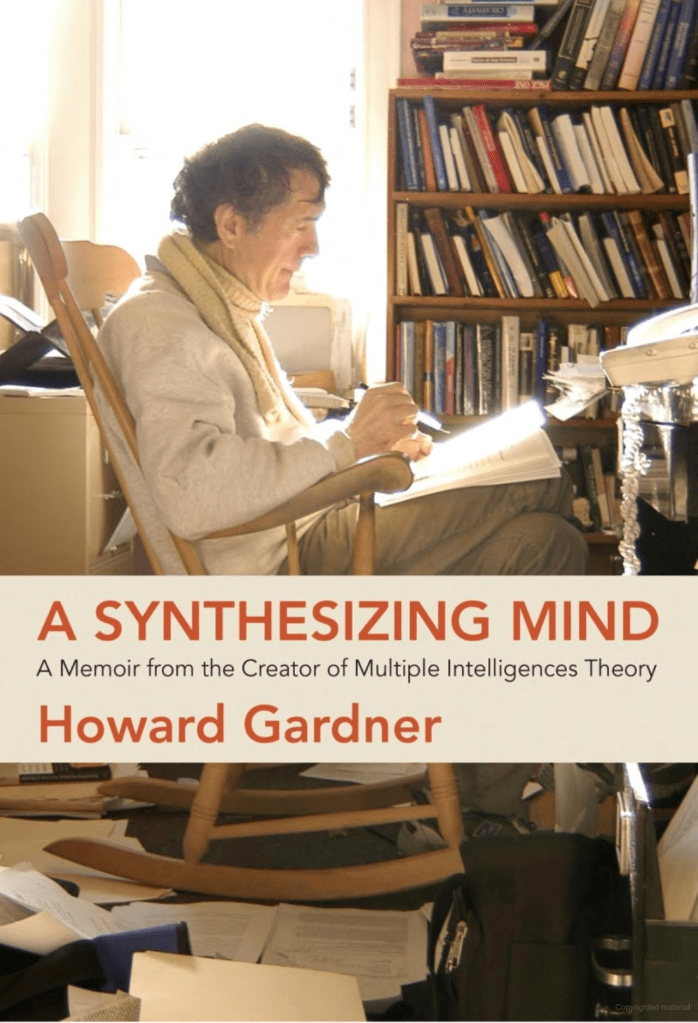
Howard Gardner is one such academic who works on developmental psychology and has researched extensively on cognition and education. He has written ~30 books and ~1000 articles, and blogs regularly, even at the age of 82 or so. His recent book is titled A Synthesizing Mind.
Howard Gardner is a renowned Harvard academic and, as his book describes him as follows:
“Throughout his career, Gardner has focused on human minds in general, or on the minds of particular creators and leaders. Reflecting now on his own mind, he concludes that his is a ‘synthesizing mind’—with the ability to survey experiences and data across a wide range of disciplines and perspectives. The thinkers he most admires—including historian Richard Hofstadter, biologist Charles Darwin, and literary critic Edmund Wilson—are exemplary synthesizers. Gardner contends that the synthesizing mind is particularly valuable at this time and proposes ways to cultivate a possibly unique human capacity.”
While exploring the book and the related material, I came across an interview with Howard Gardner. In there, he is conversing about the theme of the book and discusses the synthesis of thought across disciplines. One of the pertinent aspects of learning is to know how innovation can be fostered by cross-disciplinary exploration without diluting disciplinary rigour. As Gardner says:
“I am not opposed to disciplinary learning—indeed I am an enthusiastic advocate. Any person would be a fool to try to create physics or psychology or political science from the start. But if we want to have scholars or professionals who are innovative, creative—and innovation is not something that we can afford to marginalize—then they cannot and should not be slaves of any single discipline or methodology.”
As a physicist, I can relate to this thinking within my discipline, and how innovative ideas, over the ages, have emerged by bringing ideas from mathematics, engineering and biology into physics. Particularly, the combination of biology, physics and mathematics is one of the most exciting frontiers of human exploration today, and Gardner’s words apply well in this scenario.
Going beyond science, I am always intrigued and amazed by artists (especially musicians) who can create art that simultaneously draws the attention of specialists and generalists. This is not a trivial achievement, and as a scientist, I am always trying to understand how artists resonate so well with the public. Gardner, in the abovementioned interview, frames this problem by looking at the goals of science and arts, and draws a contrast that is worth noting:
“Most scholars and observers like to emphasize the similarities between the arts and the sciences, and that is fine. But the goals of the two enterprises are different. Science seeks an accurate and well supported description of the world. The arts seek to capture and convey various aspects of experience; and they have no obligation other than to capture the interest and attention of those who participate in them.
Of course, there are some individuals who excel in both science and art (Leonardo is everyone’s favorite example). But most artists—great or not—would not know their way around a scientific laboratory. And most scientists—even if they like to play the violin or to draw caricatures or to dance the tango—would not make works of art or performances that would interest others.”
I partially agree with this assessment, as I know a few scientists who are deeply involved in various forms of art (including music) and do it very well, even at the professional level. In a way, Gardner is re-emphasizing the “two cultures” debate of C.P. Snow. My own thoughts on this viewpoint are ambivalent, as I see science, arts and sports as important pursuits that cater to different facets of the human mind. Of course, when it comes to expertise, the division may matter. There is a lot more to learn about the interface of art and science, at least for me.
Anyway, Gardner is a fabulous writer, and his blogs and books are worth reading (and studying) if one is seriously interested in understanding how to synthesize thought across disciplines.
Since we are discussing synthesis of thought, which is a kind of harmony, and coming together, let me end the blog with a line from Mankuthimmana Kagga by the Kannada poet-philosopher D.V. Gundappa:
“ಎಲ್ಲರೊಳಗೊಂದಾಗು ಮಂಕುತಿಮ್ಮ” (Eladaralongodhagu manku thimma)
which loosely translates to: oh fool…be one among all (blend into world, living in harmony).
Harmony of disciplines and minds – how badly the world needs it today?


 VISMAYA - History & Philosophy of Physics