Below are some of the discussions related to my reading and teaching:
How to Build Atomic LEGOs?
In ~8min, I try to explain how and why to build atomic Legos and their potential applications.
The video is for non-experts.
Reference for further reading:
Geim, A. K., and I. V. Grigorieva. ‘Van Der Waals Heterostructures’. Nature 499, no. 7459 (2013): 419–25. https://doi.org/10.1038/nature12385.
Teaching & Meaning
What adds meaning to my academic work?
Perhaps, an anonymous feedback on your teaching is one of them….
“very well taught course at a well defined pace. The interesting way various different aspects and fields in Optics was introduced was fascinating, made us so very keen on knowing more! The mind maps at the beginning of every topic, the indexes professor made was a great way to keep the bigger picture in mind and helped us glide through it. The assignment was also a great way to make us go through materials without feeling it it be imposing, rather finding it more interesting! Thank you so much Sir for this amazing course, the enthusiastic way in which you taught, all the great conversations you engaged in with us, and opened our eyes to explore so much more in this field! thank you!!“
I had a diverse class (BS-Physics majors, MS Quantum Tech, iPhD) with 110+ students, and I am glad a lot of students enjoyed the course this time.
I am a bit overwhelmed by the positive feedback I received on my teaching methods. For sure, I learnt about the subject as much as they did.
And as I always say: there is more to learn…for all of us..
Human interaction zindabad :-)
Create to Understand
Below are two quotes on the blackboard of Feynman’s office in Caltech which were found just after his death.
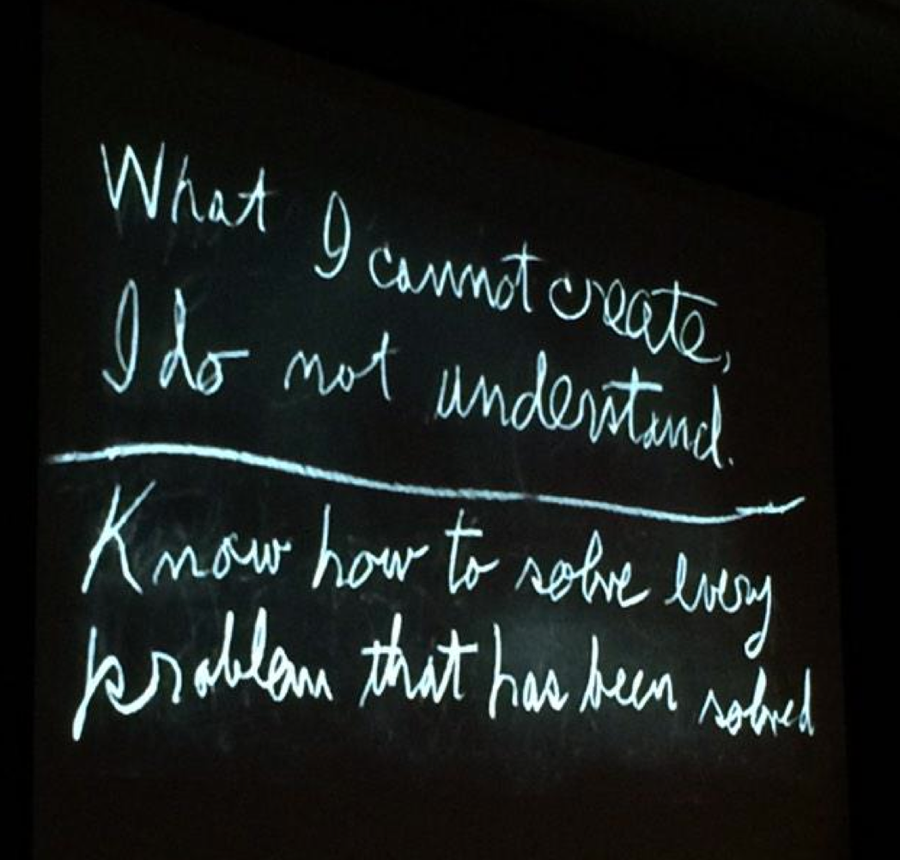
The first of these quotes by Feynman is a guiding principle for anyone who wants to learn. The second quote is an idealistic one, but a good approach to becoming a ‘problem-solving’ researcher. Feynman was a master of this approach.
From a philosophy of science perspective, researchers can be both ‘problem creators’ and ‘problem solvers’. The latter ones are usually famous.
Michael Nielsen, a pioneer of quantum computing and champion of open science movement, has an essay titled: Principles of Effective Research, in which he explicitly identifies these two categories of researchers, and mentions that “they’re not really disjoint or exclusive styles of working, but rather idealizations which are useful ways of thinking about how people go about creative work.”.
He defines problem solvers as those “who works intensively on well-posed technical problems, often problems known (and sometimes well-known) to the entire research community in which they work.” Interesting, he connects this to sociology of researchers, and mentions that they “often attach great social cache to the level of difficulty of the problem they solve.”
On the other hand, problem creators, as Nielsen indicates, “ask an interesting new question, or pose an old problem in a new way, or demonstrate a simple but fruitful connection that no-one previously realized existed.”
He acknowledges that such bifurcation of researchers is an idealization, but a good model to “clarify our thinking about the creative process.”
Central to both of these processes is the problem itself, and what is a good research problem depends both on the taste of an individual and the consensus of a research community. This is one of the main reasons why researchers emphasize defining a problem so much. A counterintuitive aspect of the definition of the problem is that one does not know how good the ‘question’ is until one tries to answer and communicate it to others. This means feedback plays an important role in pursuing the problem further, and this aptly circles back to Feynman’s quote: “What I cannot create, I do not understand”.
Physics Ideas for Entrepreneurs
Starting a new (ad)venture
A YouTube channel dedicated to discussing physics ideas for entrepreneurs
I bring ideas from an ocean of physics and present them to anyone interested in using them for business and entrepreneurship. These are not physics lectures, but discussions on ideas with a perspective of economic utility.
As with all my ventures, it is open source.
Join me in this journey, and please share and subscribe
The first video is out:
Raman essay and Open-Access
I see that the essay I wrote on CV Raman and made open access (thanks to Resonance, which published it) has been used by several educators on YouTube, including some in Indian languages. Also, the Google AI overview shows the published essay as the main reference for a search related to Raman’s science communication (see slideshow below).

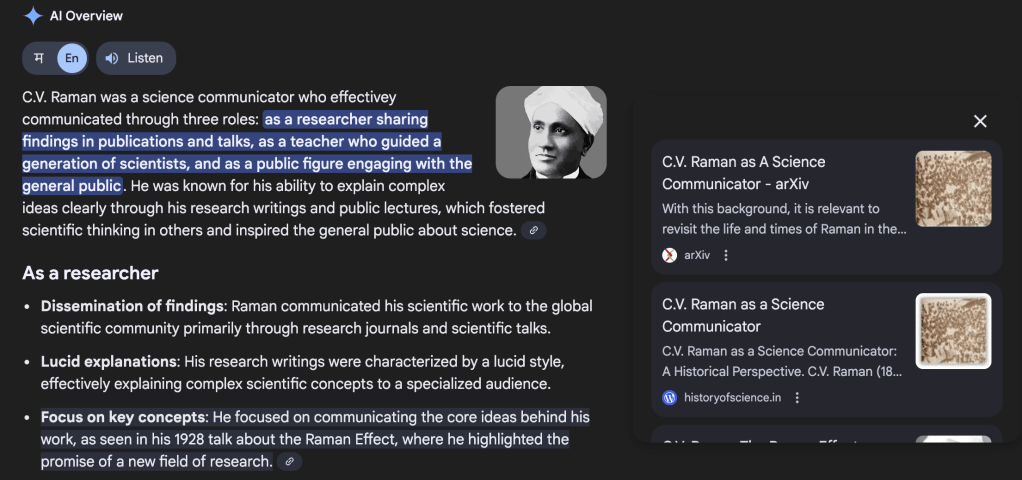
I am glad to see that making one’s writing open to all has positive effects. Open-access, not just for readers, but also for authors, is beneficial. Especially in India, paywalls for science are a detriment.
My worry is that open-access publishing has been mainly driven by commercial publishers that extract huge funds from the publishing authors. This defeats the purpose of open science, especially when the research of an author is publicly funded. Added to that, Indian researchers and writers cannot afford to pay huge sums for publishing articles and books.
The publication landscape (including journals and books) across the world needs an introspection. Open-access model is effective only when the readers and authors have access to that model. Otherwise, the model becomes a paywall for authors.
Opinion on maths
From my Substack conversation

Quantum Optics – teaching in Jan 2026
More than 22 years ago, I started my journey as a research student in theoretical physics – Quantum Electrodynamics (QED) + Radiative Transfer (MSc summer project at the Indian Institute of Astrophysics), and my special paper in the MSc final semester was QED. Later in my PhD, I branched into experiments on light scattering (Raman, Mie & Rayleigh).
Over the years, QED and quantum optics have always been at the back of my mind while studying, researching and teaching.
Come January, I will be teaching a course on Quantum Optics to MS(Quantum Tech), MS-PhDs, and 4th-year physics UGs
I designed the first course on this topic at IISER Pune about a decade ago with the able inputs from Prof. Rajaram Nityananda, and I have taught the course a few times. Now, after a few years, I will teach it again.
With the emergence of quantum sci & tech, there is a new impetus and excitement on this topic.
Having said that, the foundations of the topic remain the same, and Quantum Optics has a wonderful history and philosophy associated with it…and where better to start than Dirac’s classic (see below).
Look out for ‘quantum blogs’ in 2026…

Betty Archdale – 1939 cricket picture – Kannada magazine
This may be a rare pic:
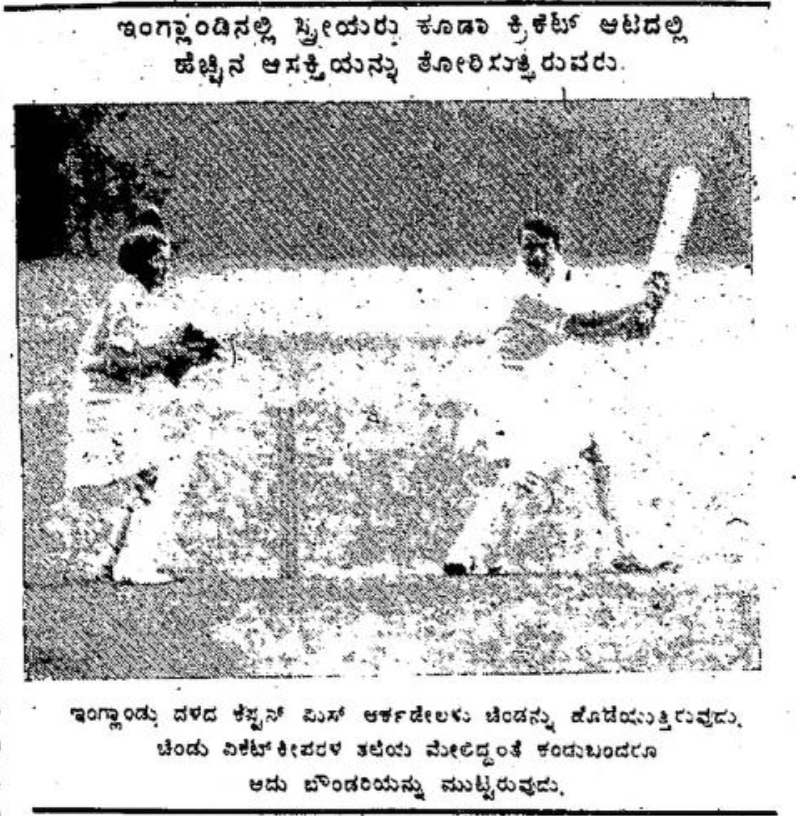
In 1939, a Kannada magazine – Swadeshabhimani – reported on growing interest in women’s cricket.
Pictured is a shot by Betty Archdale, the then women’s cricket captain in England (according to the caption in the picture).
A copy of the magazine can be found here:
https://archive.org/details/karnataka-state-archives-RGVlcGFrMTA0MjYz-RGVlcGFrMQ/page/n23/mode/2up
Conversation with Satish Patil
Welcome to the podcast, Pratidhavani – Humanizing Science
Satish Patil serves as Professor at the Solid State and Structural Chemistry Unit (SSCU), Indian Institute of Science (IISc), Bangalore. His research centers on organic electronics, pioneering air-stable n-channel conjugated polymers and band-like transport in these materials. The Organic Electronics Research Group, under his leadership, advances semiconducting polymers for organic solar cells, field-effect transistors, TADF, singlet fission, and energy storage devices through molecular design and synthesis.
In this conversation, we explore his intellectual journey so far.
References:
Patil, Satish. Satish Patil | The Solid State and Structural Chemistry Unit. n.d. Accessed 27 November 2025. https://sscu.iisc.ac.in/patil/.
Organic Electronics Research Group | SSCU. n.d. Accessed 27 November 2025. https://oe-sscu.iisc.ac.in/.
‘Satish Patil – Google Scholar’. Accessed 27 November 2025. https://scholar.google.com/citations?user=Tyfe7LcAAAAJ&hl=en.
‘(4) Satish Patil | LinkedIn’. Accessed 27 November 2025. https://www.linkedin.com/in/satish-patil-a665733a/?originalSubdomain=in.
X (Formerly Twitter). ‘Satish Patil (@SatishIISc) / X’. 31 October 2025. https://x.com/satishiisc.
 VISMAYA - History & Philosophy of Physics