Indian Philosophy and Independent thought

Today we mark the 75th anniversary of Indian independence from the British colonial rule. For a country of our population and size, it is indeed a great achievement that we have sustained to be a democratic nation. We continue to be a work in progress and there is a lot to learn and look forward to.

India today is awash in the tri-colour flag, which marks a symbol of our identity.

This symbol has a deeper philosophical meaning, and it has been wonderfully described by one of the great Indian philosopher Sarvepalli Radhakrishnan (also first vice-president of India, and subsequently President of India) as follows :

“Bhagwa or the saffron colour denotes renunciation of disinterestedness. Our leaders must be indifferent to material gains and dedicate themselves to their work. The white in the centre is light, the path of truth to guide our conduct. The green shows our relation to soil, our relation to the plant life here on which all other life depends. The Ashoka Wheel in the center of the white is the wheel of the law of dharma. Truth or satya, dharma or virtue ought to be the controlling principles of those who work under this flag. Again, the wheel denotes motion. There is death in stagnation. There is life in movement. India should no more resist change, it must move and go forward. The wheel represents the dynamism of a peaceful change.”

Dr. S. Radhakrishnan, Constituent Assembly of Independent India

The metaphor of wheel to go forward is noteworthy. It essentially states that we as a society should be forward-looking and evolve our thoughts as we make progress. Such a call for evolution of thought and progress is not alien to our civilization.

Lest we forget – Indian philosophy is not just a spiritual literature, it has immense depth and discussion on rationality and logic, and places emphasis on debates and arguments. So much so, that even our great, ancients poets such as Kalidasa uphold this rational spirit in their writings. To quote from his famous Malavikaagnimitram :

पुराणमित्येव न साधु सर्वंन चाऽपि काव्यं नवमित्यवद्यम्।

सन्तः परीक्ष्यान्यतरत् भजन्तेमूढ्ः परप्रत्ययनेयबुद्धिः ॥

-मालविकाग्निमित्रम् (महाकवि कालिदास)

The translation (source) from Sanskrit means :

All poems are not good only because they are old. All poems are not bad because they are new. Good and wise people examine both and decide whether a poem is good or bad. Only a fool will be blindly led by what others say.

-Malavikaagnimitram (Great Poet Kaalidaas)

My hope is that we as a society get inspired by these calls for rationality, and adapt empathy, humility, logical and scientific thinking as some of the core principles our lives. This is not only for a better India, but also for a better world.

After all, as one of ancient Indian philosophical text (Maha Upanishad, 6.71–75) says :

अयं निजः परो वेति गणना लघुचेतसाम्!!

उदारचरितानां तु वसुधैव कुटुम्बकम् !!

which is transliterated as :

This is mine, that is his, say the small minded,

The wise believe that the entire world is a family.

Dear Indian people….Happy 75th Independence Day !

Roadmap for optical tweezers is on arxiv

I am delighted to share the arxiv link to Roadmap For Optical Tweezers : https://arxiv.org/abs/2206.13789

This document brings together researchers from 52 different affiliations across the globe to look into the accomplishments and future directions of optical tweezers.

My contribution towards roadmap appears on page 136, topic number 31 on — Raman scattering in (thermo)plasmonic tweezers.

In there, I discuss how plasmonic platforms can be used to generate attractive optothermal forces to trap and interrogate molecules and nanoparticles, down to single copy limit. I also discuss the challenges and opportunities of such a process.

Optical tweezers is one of the most powerful optical tools that finds utility not only in fundamental physics, but also in diverse applications including biology and medicine.

Ever since the Nobel prize-winning work of Arthur Ashkin, optical tweezers have evolved and continues to evolve into various forms. This roadmap article aims to capture this evolution, and to discuss the emerging capabilities and challenges of optical tweezers.

A big thank you to

Giovanni Volpe
Onofrio M. Maragò
and Halina Rubinzstein-Dunlop

for their leadership in this field and for the herculean task of coordinating and editing this roadmap….

The roadmap has been submitted to Journal of Physics : Photonics (IOP)

New paper : Microsphere can narrow emission from a 2D material on a mirror

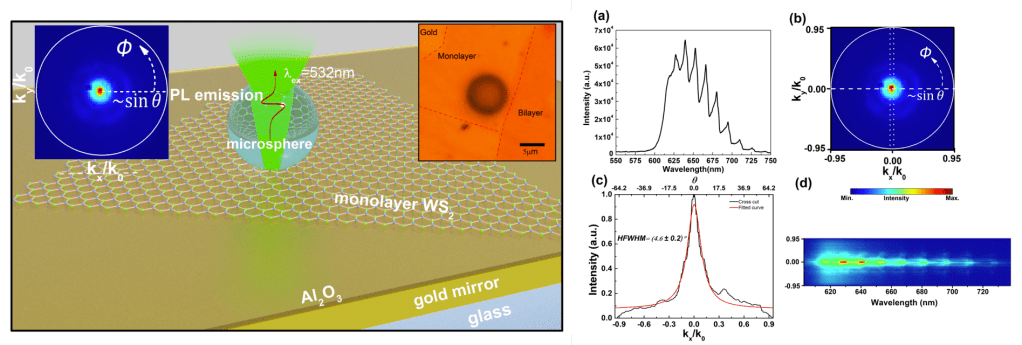
We have new paper appearing in Applied Physics Letters on how a dielectric microsphere placed on a 2D material deposited on a mirror can act as an optical antenna (see left panel for the schematic of the geometry and an optical image of the realized antenna).

The experimental and simulation efforts were mainly driven by our dynamic PhD student Shailendra Kumar Chaubey, who is very passionate about nanophotonics of 2D materials. He along with Sunny Tiwari and Diptabrata Paul explicitly show how experimental parameters such as sphere size and location of focusing can influence the photoluminescence emission from a WS2 monolayers. The experiments were mainly possible thanks to our collaboration with my colleague Atikur Rahman and his student Gokul, who continue to produce fantastic 2D materials for our nanophotonics study.

Interestingly, the emission from the WS2 monlayers can be as narrow as 4.6 degrees (see right side panel of the figure) which is one of the narrowest angular spread at room temperature. We also capture the energy-momentum photoluminescence spectra from WS2 monolayers, which is convoluted with the beautiful whispering gallery modes of the microsphere (see parts (a) and (d) of the figure).

We envisage such ’emission engineering’ using a simple microsphere can be further harnessed to control emission from quantum and nonlinear photonic 2D materials. Also, it raises new questions on how local photonic density of states can be tailored by altering the local environment around quantum emitters in solid state materials.

Arxiv version of the paper : https://arxiv.org/abs/2110.10387

12 Years as a faculty member in India – 12 lessons

Today I complete 12 years as a faculty member at IISER-Pune. I have attempted to put together a list of some lessons that I have learnt so far. A disclaimer to note is that this list is by no means a comprehensive one, but a text of self-reflection from my viewpoint on Indian academia. Of course, I write this in my personal capacity. So here is it..

  1. People first, infrastructure next – As an experimental physicist, people and infrastructure at working place are of paramount importance. When I am forced to prioritize between them, I have chosen people over infrastructure. I am extremely fortunate to have worked with and continue to work with excellent students, faculty colleagues, and admin staff members. I think a good work place is mainly defined by the people who occupy it. I am no way neglecting the role of infrastructure in academia, especially in a country like India, but people have a greater impact in academic life than infrastructure.
  2. Create internal standards – In academia, whether you like it or not, there will be evaluations and judgments on your research and teaching. Generally, every academic ecosystem has its own standards for evaluating people. These standards are generalized principles and are not customized to an individual. Therefore, it was important for me to realize what good work meant and how to judge myself. As long as internal standards are high, and are properly met with consistency, the external evaluation becomes secondary. This attitude totally frees up the mind, and helps me to get better compared to my previous self. This also means I can appreciate others work without having to compare myself to them.
  3. Constancy and Moderation – When it comes to any work, it is important to be consistent over a long period of time. An equally important aspect is to moderate the amount of work done for a period. Most of the important work in research happens in units of months if not years. Therefore, constant effort with moderation keeps the motivation high, and makes the work enjoyable. Binge-working is attractive, but for intellectual work it is ineffective.
  4. Writing is a great tool to think – One of the most underestimated tools of thinking is writing. Not just formal writing, but the process of external articulation of thought on paper does wonders. Countless times, I have obtained, clarified and developed my thoughts only after I started writing about it. Writing is integral part of research and not just a communication tool.
  5. Importance of philosophy – Ever since I was an undergrad, I have been interested in philosophy of science. I had never taken a formal course on philosophy, but I have gradually started appreciating the role of philosophy of science. Specifically, it has catered to my question on ‘why I do what I do?’
  6. Teaching as social responsibility – In the Indian academia, scientific social responsibility is a buzz word. For me, the greatest social responsibility as an academic comes in the form of teaching. In larger scheme of things, some how we tend to neglect the impact of conventional teaching on students. Also, this impact is not easily measured. But the joy one obtains seeing a student do well is priceless. This local impact is what I value more because the feedback is there to see, right in front of you.
  7. Science, sports and arts : a trinity – I love outdoor sports including running, swimming, cricket etc. Equally, I enjoy listening to music, reading poetry and appreciating any form of art from any culture. I have found that it has not only made me a better person, but also has positively impacted my work. Taken as a trinity, these human endeavours continue to enrich our lives.
  8. Emphasis on mental and physical health – The most important policy that I have set in my research group is this: To do effective and enjoyable work, your mental and physical health should be good. There is no point in doing good work at the expense of your health. Therefore the priority will always be good health followed by good work.
  9. Social media : effective if used properly – Social media has a unique reach. If you are in India, and you want to connect to the scientific world, social media is an excellent platform. Given the size and diversity of India, social media can also reach people from various backgrounds and languages. If used responsibly, social media can have great impact on how science is communicated within India and how India connects to the scientific world.
  10. Renewed interest in applied mathematics and coding – During my BSc (Maths, Physics, Electronics) and MSc (Physics), I had excellent training and exposure in mathematics. During the lock-down period, I rejuvenated my interest in applied mathematics (especially nonlinear dynamics) and have started coding too. This has added a new impetus to my research and should reflect in the coming years.
  11. Professor as a post-doc – A research strategy I found useful in my work is to treat myself as a post-doc in the lab. Given that, in India retaining a long-term post-doc is difficult, many of the skills and thought processes cannot be effectively transferred in lab. A long term research problem needs sustained effort in the lab. As an experimental faculty it is easy to get caught up in activities outside the lab and lose touch with the (optical) bench work. Thanks to the lock-down period, I was the only one in the lab for almost 6 months,and I restarted my experimental work. I value that time and I see great benefit in this approach.
  12. Self-mentoring – A lot of academic advice is written by people working in the west. A few of them are general and applicable to Indian academia, but many of them are not. In such a situation, as an academic I try to derive inspiration by reading, especially about people who have done great work in India. I have been deeply influenced by people such as M. Visvesvaraya and Ashoke Sen. 

Sagan’s quote

Keynote address at CSICOP conference in 1987. “Do Science and the Bible Conflict?” Book by Judson Poling, p. 30, 2003

Even before the age of social media, Carl Sagan played a prominent role in communicating science to the public. His book ‘Cosmos’ is a classic, and his public lectures (a few are on YouTube) are certainly worth watching.

For me what is very impressive about Sagan’s communication is that he is not condescending by any means. This attitude is probably one the most important aspect in communicating science to society. The moment the public feels that scientific thinking is an elitist’s endeavour, they tend to repel.

Not only was Sagan an excellent scientist, but also a person who articulated the role of science in society, especially by contrasting it to religion and politics. A very famous quote of his is reproduced here, that highlights the value of scientific thinking, and how it elevates the human mind.

Quote reference: Keynote address at CSICOP conference in 1987. “Do Science and the Bible Conflict?” Book by Judson Poling, p. 30, 2003

Black hole image and optical vortex – an analogy

The recent image of the black hole at the center of the milky way has been spectacular. When I teach a course, I generally emphasize analogies across the sub-disciplines of physics. In the below video I draw some analogies between black hole image and an optical vortex.

About the black hole images : https://iopscience.iop.org/journal/2041-8205/page/Focus_on_First_Sgr_A_Results

Some work from our group on optical vortex : ACS Photonics 6, 1, 148–153 (2019) https://doi.org/10.1021/acsphotonics.8b01220

Book on singular optics : https://www.google.co.in/books/edition/Singular_Optics/H-WVDQAAQBAJ?hl=en&gbpv=1&printsec=frontcover

Science paper on optical analog of event horizon https://www.science.org/doi/epdf/10.1126/science.1153625

Scientific Philosophy and Mental Health

Many a times, we are oblivious to the impact that Science has on an individual mind. It gets drowned in the collective impact. Curiosity is probably the most natural feeling of humans. If done right, Science cultivates and elevates this feeling. It may positively impact mental well-being too.

Increasingly, in Indian academia, mental well-being of all the stakeholders (students, faculty, admin etc.,) has emerged as an urgent and important issue that needs attention. Especially in a country such as India, where a loose order emerges out of chaos in almost all aspects of life, it is important to stay connected with oneself. Scientific curiosity may cater to this vital need.

The connection with oneself via science, or broadly speaking with any form of curiosity (arts/sports), is something we must harness. A major part of human development is to connect with oneself AND with the society. In this age of social media, sometimes, we may forget the former and focus only on the later. We will have to remind ourselves that being curious about anything is not being ‘childish’ but being human. Scientific curiosity and questioning is fundamental to our living, and this affects everything we do in our life.

To conclude let me quote from Bertrand Russell’s The Value of Philosophy :

Philosophy is to be studied, not for the sake of any definite answers to its questions, since no definite answers can, as a rule, be known to be true, but rather for the sake of the questions themselves; because these questions enlarge our conception of what is possible, enrich our intellectual imagination, and diminish the dogmatic assurance which closes the mind against speculation; but above all because, through the greatness of the universe which philosophy contemplates, the mind also is rendered great, and becomes capable of that union with the universe which constitutes its highest good.”

Science as in philosophy, does cater to the highest good of humanity. What we under-appreciate is that it goes beyond the call, and impacts an individual’s mind. Academia should be a place to foster such an impact at various levels: individual, local and global. Perhaps that is the meaning of an “University”.

More surprises in Optical Momentum…

Electromagnetic momentum is a topic with rich history dating back to Maxwell, Poynting, Minkowski, Abraham, Einstein, and many more1.
It has also led to new questions, and an intriguing controversy in electromagnetism2.

An interesting and contemporary question to ask is: what is the behavior of optical momentum in artificial materials ?

One class of artificial materials is the near zero-refractive index (NZI) materials.

What are NZI materials ? The general definition of refractive index from a material view point is that it is proportional to square root of a product: dielectric permittivity (ε) and magnetic permeability (μ) of the given material.

n = (εμ)½ 

 If either of these material values go to zero at a given wavelength of light, then the refractive index goes to zero or close to zero. Such a situation creates new opportunity for enhanced or supressed light-matter interaction. See this popular review on NZI materials3

A recent theoretical paper4 addresses the consequence of evolution of optical momentum in NZI media.
This analysis has thrown a few fundamental surprises that are fascinating such as : absence of interference in Young’s double slit experiments, and some new opportunities in optical cloaking thanks to quantum nature of light. To quote the authors4 :

being inside an NZI materials would lead to an infinite uncertainty on position and zero uncertainty on momentum. Conceptually, this implies that since the resolution is poor and no correct image can be formed, an object of any shape and material can be “hidden” in a NZI material.

There are a few more interesting prospects, and of course, all of them are yet to be verified with experiments.

If you are interested in this topic, I strongly recommend this recent, popular level article5

1.           M. Buchanan, “Minkowski, Abraham and the photon momentum,” 2, Nature Phys 3(2), 73–73, Nature Publishing Group (2007) [doi:10.1038/nphys519].

2.           S. M. Barnett and R. Loudon, “The enigma of optical momentum in a medium,” Philosophical Transactions of the Royal Society A: Mathematical, Physical and Engineering Sciences 368(1914), 927–939, Royal Society (2010) [doi:10.1098/rsta.2009.0207].

3.           “Optics & Photonics News – Zero-Index Platforms: Where Light Defies Geometry,” <https://www.optica-opn.org/home/articles/volume_27/july_august_2016/features/zero-index_platforms_where_light_defies_geometry/> (accessed 5 May 2022).

4.           M. Lobet et al., “Momentum considerations inside near-zero index materials,” 1, Light Sci Appl 11(1), 110, Nature Publishing Group (2022) [doi:10.1038/s41377-022-00790-z].

5.           “Exotic Materials Through Momentum’s Looking-Glass,” <https://www.optica-opn.org/home/newsroom/2022/may/exotic_materials_through_momentum_s_looking-glass/> (accessed 5 May 2022).