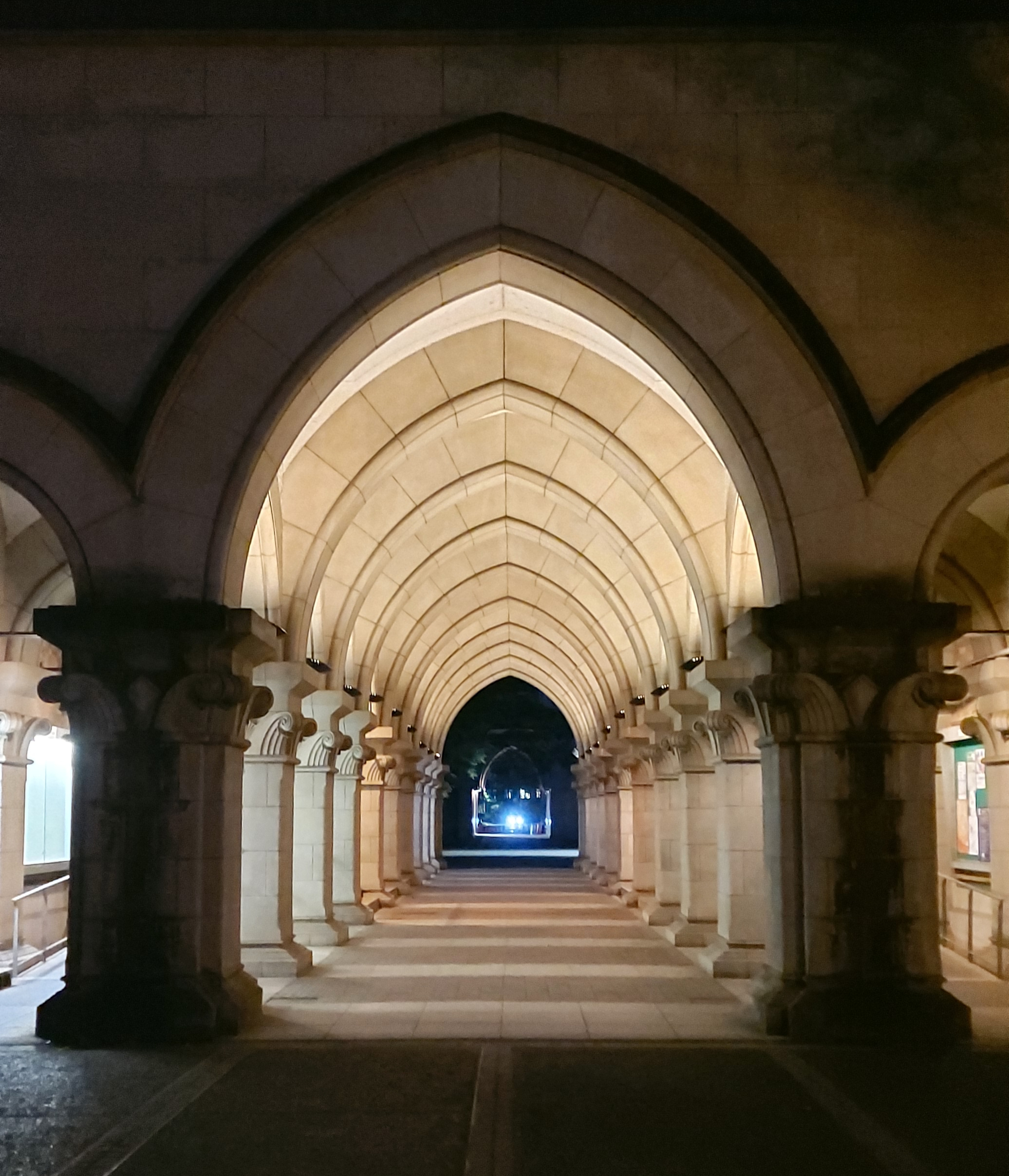
Wonderful Japanese-Gothic architecture at The University of Tokyo
I gave two talks in Tokyo.
First was on 24th April at Department of Applied Physics, Faculty of Advanced Engineering, Tokyo University of Science. My host was Prof. Yutaka Sumino. I spoke about “Soft Matter in Opto-Thermal Gradients“. I gave a short introduction to opto-thermal perturbations and potentials, and discussed some of our work on opto-thermophoretic trapping and Brownian dynamics. The audience contained a few master students too, and I really enjoyed discussing some concepts related to Brownian motion in an optothermal trap, and related experiments. Also, I had a very interesting discussion with Sumino and his students on their experiments on Janus particles.
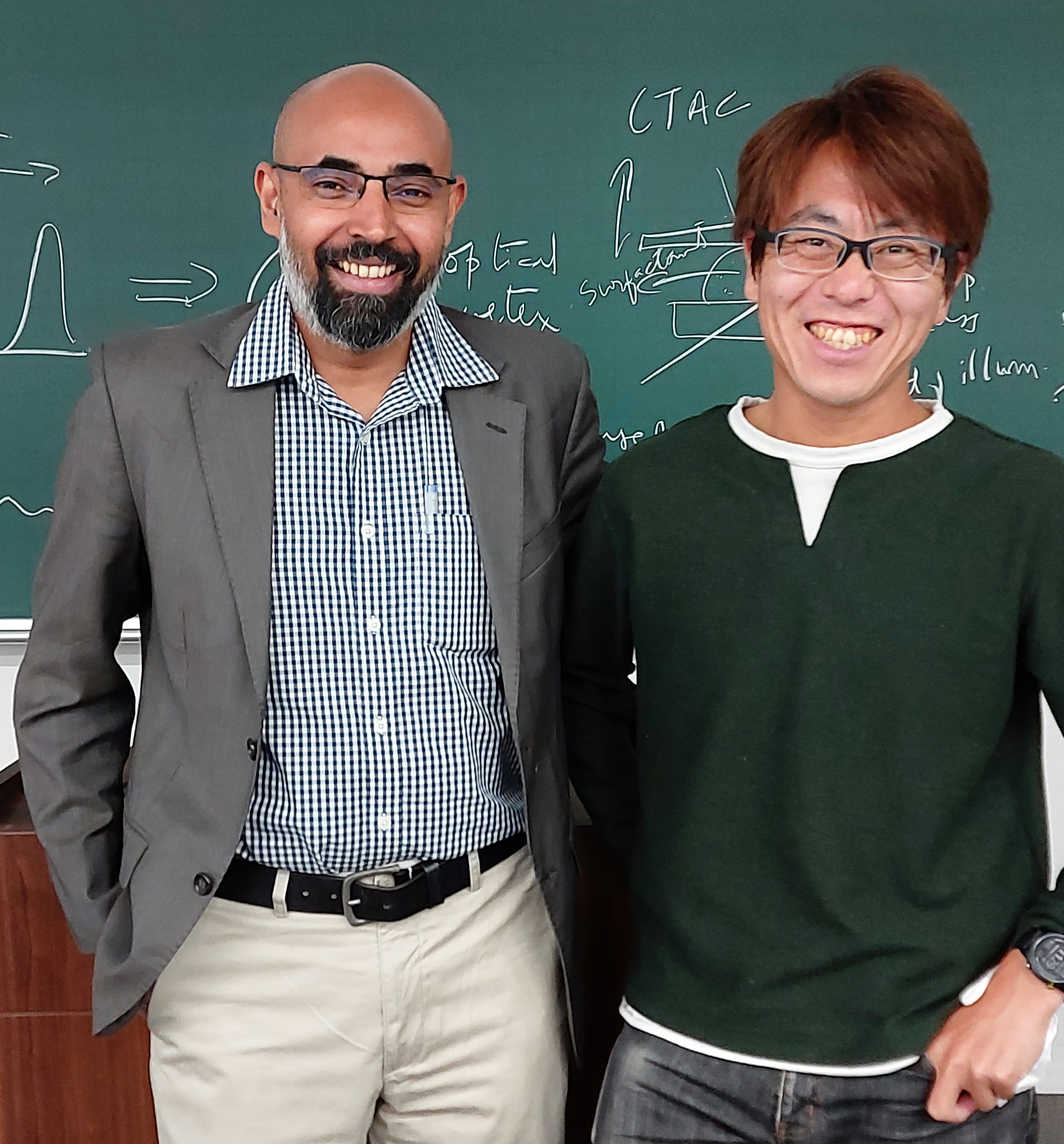
with Yutaka
with Yutaka”s group
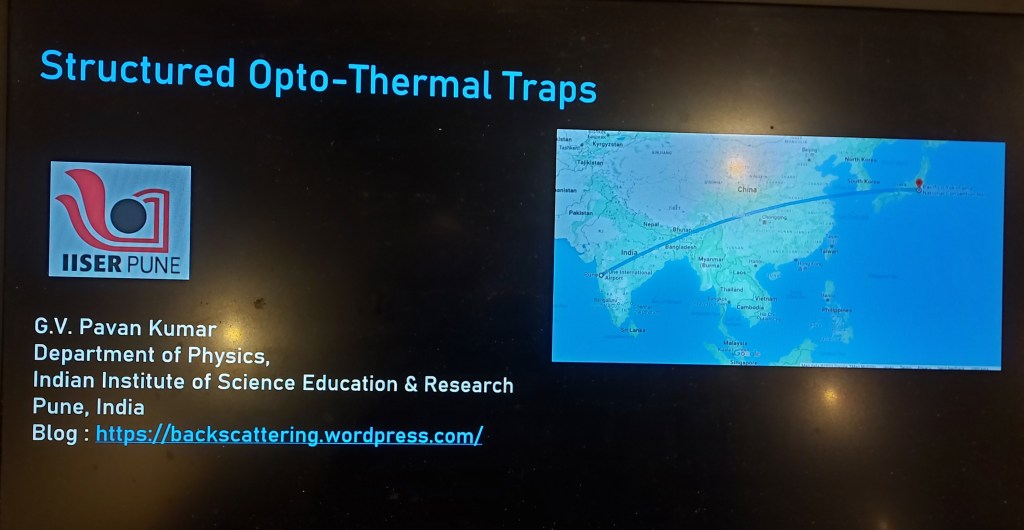
The second talk was on 25th April at Department of Physics, University of Tokyo. My host was Prof. Kazumasa Takeuchi. I spoke about “Soft Matter in Opto-Thermal Gradients : Evolutionary Dynamics and Pattern Formation“.
This talk was also announced on Japan’s statphys mailing list, and also live-casted over zoom. I discussed about the origins of optothermal effects in a laser trap, and how it can lead to some interesting dynamics and pattern formation in soft-matter system. Specifically, I highlighted the concept of Hot Brownian motion, and how it can be influenced using thermo-plasmons. The talk and discussion went on for almost 2 hours, and I really loved it. Also, Takeuchi and his students gave an overview of their work including a live demonstration on turbulence in liquid crystals, and it was fantastic.
Here is the video blog on the Cup Noodles Museum at Yokohama. I visited this place recently, and was inspiring. Also, has some connections to history of science and scientists. Some notes/references at the end.
We had a great discussion after the talk… spoke on how temperature gradients can be harnessed for optical manipulation in colloidal fluids… which further leads to some interesting Brownian dynamics
The 10th Optical Manipulation and Structured Materials Conference (OMC2023) was superb….learnt a lot. This was part of Optics & Photonics International Congress 2023
Thanks to Prof. Takashige Omatsu for the invitation and amazing Japanese hospitality…
Below is a video blog featuring Halina Rubinsztein-Dunlop as part of history of optical manipulation. Also pictured in the blog are : Giorgio Volpe (UC, London) and Agnese Callegari (University of Gothenburg). Pictures taken at OMC 2023 in Yokohama, Japan.
Friese, M.E.J. et al. (1998) ‘Optical alignment and spinning of laser-trapped microscopic particles’, Nature, 394(6691), pp. 348–350. Available at: https://doi.org/10.1038/28566.
He, H. et al. (1995) ‘Direct Observation of Transfer of Angular Momentum to Absorptive Particles from a Laser Beam with a Phase Singularity’, Physical Review Letters, 75(5), pp. 826–829. Available at: https://doi.org/10.1103/PhysRevLett.75.826.
What you see in this image (observed on 6th April 2023, 7.13am, Pune, India) is the emergence of sunlight from clouds in a peculiar expanding beam of rays. Such rays are called crepuscular rays.
The etymology of the word –
crepuscular (adj.)
figurative use, “dim, indistinct,” is attested from 1660s; literal use, “pertaining to or resembling twilight,” from 1755, from Latin crepusculum “twilight, dusk,” related to creper “obscure, uncertain,”
These rays are generally observed during the twilight and persist for a short time. The location of observation is close to the horizon, although I sighted it at a reasonable angle above the horizon (on Dr. Homi Bhabha road, in front of IISER-Pune Pashan gate).
There is a large class of optical phenomena including sunbeams and moonshines, which are exclusively observed at twilight. For more details read this article by Shields, Janet. “Sunbeams and Moonshine.” Optics and Photonics News 5, no. 7 (July 1, 1994): 57. https://doi.org/10.1364/OPN.5.7.000057.
One may think this phenomenon is related to some kind of diffraction, but it is not. It mainly arises due to the linear perspective of how we visualize this optical effect in an open sky. Of course light scattering has some interesting role in this observation. A very nice discussion on this can be found in an article by Bohren, Craig, and Mark L. Sowers. “Simple Experiments in Atmospheric Physics.” Weatherwise 45, no. 2 (May 1, 1992): 34–38. https://doi.org/10.1080/00431672.1992.9925919.
A Surprise in Western Ghats
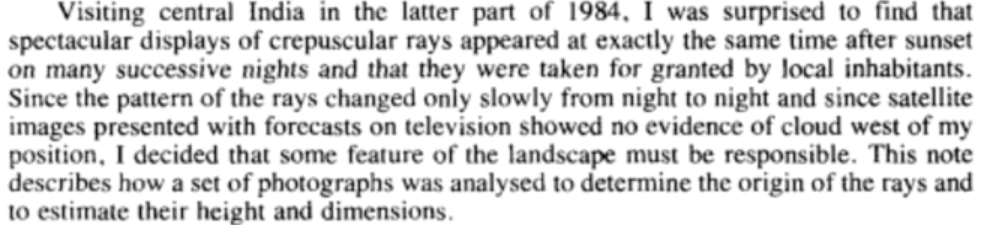
Western ghats are known to show this optical effect. In the year 1984, J. L. Monteith, a researcher who was visiting India from Goddard space center, USA (which is part of NASA) made an interesting and surprising observation. Below I reproduce his text –
For more details on this observation, read this paper by Monteith, J. L. “Crepuscular Rays Formed by the Western Ghats.” Weather 41, no. 9 (September 1986): 292–99. https://doi.org/10.1002/j.1477-8696.1986.tb03862.x.
Interestingly, such rays have also been periodically found in China and was reported as early as 1888 ! See this remarkable observation by Doberck, W. “Crepuscular Rays in China.” Nature 37, no. 959 (March 1888): 464–464. https://doi.org/10.1038/037464b0. Doberck also makes a connection to a historical text by Homer, in which Greek mariners describe the beautiful skies with peculiar rays.
Around 2011, the crepuscular rays were simulated in a laboratory and further corroborated using numerical simulations. In order to mimic the behavior of clouds, “artificial fogs and milk–water solutions” were used and interesting quantitative observations were made. For more details read : Gedzelman, Stanley David, and Michael Vollmer. “Crepuscular Rays: Laboratory Experiments and Simulations.” Applied Optics 50, no. 28 (October 1, 2011): F142–51. https://doi.org/10.1364/AO.50.00F142.
Atmospheric and meteorological optics are fascinating topics with some historical connections. For interested readers I highly recommend the following (fascinating and readable) books :
Bohren, Craig F. Clouds in a Glass of Beer: Simple Experiments in Atmospheric Physics. Courier Corporation, 2001.
What Light Through Yonder Window Breaks?: More Experiments in Atmospheric Physics. Courier Corporation, 2006.
Minnaert, M. The Nature of Light and Colour in the Open Air. Revised ed. edition. New York, N.Y: Dover Publications, 1954.
Minnaert, Marcel. Light and Color in the Outdoors. Translated by L. Seymour. Corrected edition. New York: Springer, 1993.
I recently read an interview of Lorraine Daston, a reputed historian of science on “Does Science Need History?” She was interviewed by the philosopher Samuel Loncar
The long-form discussion is about history of science and how and why it is relevant not only to the public but also to the practicing scientists.
In the later part of the interview , I found an interesting and important observation made by Lorraine :
“One of the greatest achievements of science, contrary to what anyone would have thought not just circa 1700 but circa 1800, is the creation of the only effective international governance system that we have. In the face of two planetary crises—climate change and a global pandemic—it has not been the UN, it has not been the G8, that got together to diagnose the problem and suggest a solution. It has been the international community of scientists, and I would be extremely loath in any way to undermine the only example of semi-effective international governance we have.”
This is probably one of the important comments on science I have come across in recent times. In an age where nation-states are still fighting (big and small) wars, this is indeed a profound reminder on what truly is the instrument of effective (inter)national governance.
Do check out the whole interview. It has many interesting strands, branches and discussion including philosophy of science, publishing and some great references to explore. As I have mentioned previously in my blogs, part of the reason why I blog is to bring out the human side of doing science. Interviews like these reinforces this thought, and encourages me as scientist to look into the history of science as not something decoupled from the science itself, but as a part of ones research in understanding why we, as human beings, are interested in science. In my opinion, our science education (and research) will be vastly enriched by including and emphasizing history of science as integral part of science. Frequently, I have also found that some of the best commentaries and criticism on science as human endeavor emnating from historians of science.
After all, it was history of science which opened our eyes towards understanding the structure of scientific revolutions. Hence Science + History —> better Science, and perhaps better human beings !
A particular example of this is the discovery of graphene, and how it has evolved into one of the most important topics in condensed matter science. Nowadays graphene is used as ‘Lego’ blocks to build higher order structures and the so-called ‘Van der Walls’ heterostructures are one of the most exciting applications of 2D materials. What started as a playful project in the lab has now turned out to be an important part of emerging technologies.
Two important inferences can be drawn from the playful attitude towards doing science :
First is that making modular elements and stacking them creatively can lead to emergence of new structures and function. Anyone who has used lego blocks can immediately relate to it.
Second is that toys are powerful research and teaching aids. Please note, that I emphasized research and teaching here. This is because toy-models are ubiquitous in research, and they help us create modular state of a problem in which unnecessary details are discarded and only the essential parts are retained. This way of thinking has been extremely powerful in science and technology (for example : see ball and stick models in chemistry and mega-construction models in civil engineering )
When it comes to toys and education, there is no better example than the remarkable Arvind Gupta (see his TED talk). His philosophy of using toys as thinking aids is very inspiring. Being in Pune, I have had a few opportunities to attend his talks and interact with him (as part of an event at science activity center at IISER-Pune), and I found his approach both refreshing and implementable. Importantly, it also showed me how creativity can emerge from constraints. To re-emphasize this, let me quote APS news article on Andre Geim :
“Geim has said that his predominant research strategy is to use whatever research facilities are available to him and try to do something new with the equipment at hand. He calls this his “Lego doctrine”: “You have all these different pieces and you have to build something based strictly on the pieces you’ve got.””
Now this is an effective research strategy for experiments in India !
Chomsky et al., have some very interesting linguistic and philosophical points on chatGPT/AI and their variants (see NYT link).
To quote
“The human mind is not, like ChatGPT and its ilk, a lumbering statistical engine for pattern matching, gorging on hundreds of terabytes of data and extrapolating the most likely conversational response or most probable answer to a scientific question. On the contrary, the human mind is a surprisingly efficient and even elegant system that operates with small amounts of information; it seeks not to infer brute correlations among data points but to create explanations.”
The philosophical and ethical viewpoints expressed in this article are indeed noteworthy. What probably is even more important is the linguistic viewpoint which amalgamates language with human thought process, and that is what makes this article more interesting and unique.
My own take on Chatgpt has been ambivalent because I do see tremendous potential, but also some obvious faults in it. About a couple of months ago, I did try to play around with it, especially in the context of some obvious questions I had on optical forces, and the answers I got were far from satisfactory. At that time, I assumed that the algorithm had some work to do, and it was probably in the process of learning and getting better. The situation has not changed for better, and I do see some major flaws even now. Chomsky’s article highlighted the linguistic aspects which I had not come across in any other arguments against artificial intelligence-based answer generators, and there is some more food for thought here.
This is indeed an exciting time for machine learning-based approaches to train artificial thought process, but the question remains whether that process of thought can somehow emulate the capabilities of a human mind.
As humans, a part of us want to see this achievement, and a part of us do not want this to happen. Can an artificial intelligence system have such a dilemma?
Today is India’s National Science Day. It celebrates the discovery of Raman effect on 28th February, 1928.
For more details on the discovery of the effect, and various human aspects related to it : you can see my past blogs here, here, here and here.
In this blog, I will briefly discuss about some of the work that directly influenced Raman’s thinking that further led to a remarkable discovery that we know by his name.
All creative pursuits are motivated by ideas from the past. No one gets their ideas in vacuum. All of us are influenced by the information which we perceive and receive. This means consciously or subconsciously the world that we are creating, both in our minds and in reality, is fundamentally influenced by the information in the world.
The discovery behind the Raman effect is no exception to this particular principle. In his formative years, C V Raman was heavily influenced by the research of Rayleigh and Helmholtz, and some classical thinkers including Euclid. Raman was also closely following the development of quantum mechanics in the early 1920s, and he was keenly studying the theoretical and experimental developments in this field.
Compton scattering was as outstanding experimental achievement that revealed two aspects of light-matter interaction. First, it demonstrated inelastic scattering of electromagnetic radiation interacting with a quantum object (in this case free electrons) in the laboratory frame. Second is that it laid a foundation to revisit the wave-particle duality of light from an experimental viewpoint. Raman and Krishnan’s main paper on light scattering starts by explicitly referring to Compton effect, and motivates observation for optical analogue of Compton scattering.
“In interpreting the observed phenomena, the analogy with the Compton effect was adopted as the guiding principle. The work of Compton had gained general acceptance for the idea that the scattering of radiation is a unitary process in which the conservation principles hold good.”
Next is the Kramers-Heisenberg formula. This mathematical description gives the scattering cross section of a photon interacting with a quantum object (in this case electron). This formula uses second-order perturbation theory, and evokes the famous ‘sum of all the intermediate states’ for non-resonant optical interaction. PAM Dirac played a vital role in deriving this formula from a quantum mechanical framework of radiation. An important and logical consequence of this formula is the emergence of stimulated emission of radiation, and this has had deep implications in understanding LASERs. Raman was keenly studying the formula and made a brilliant conceptual connection between laboratory observation and this formula that revealed the scattering cross-section.
Again to quote from Raman’s Nobel lecture:
“The work of Kramers and Heisenberg, and the newer developments in quantum mechanics which have their root in Bohr’s correspondence principle seem to offer a promising way of approach towards an understanding of the experimental results.”
The above two concepts were important ideas that motivated Raman scattering experiments. Importantly it highlights the jugalbandi between theoretical intuition with concrete experimental observations, which forms the bedrock of modern physics.
Newton famously mentioned about the discoveries he made by ‘standing on the shoulders of the giants’. Various people involved in creative pursuits including scientists acknowledge the fact that new ideas emerge from convergence/mutation of old ideas. The harder part of creativity in science, or for that matter any art form, is to choose the right ideas to combine so that the ’emergent’ new idea has greater value compared to the individual parts. In that sense, science is a great form of creative activity that not only combines old ideas to create new valuable ideas, but also transforms the perspective of the individual seed ideas. Thus ideas combine and evolve.
So let us combine good ideas and evolve. Happy Science Day !



 VISMAYA - History & Philosophy of Physics