- Pratidhvani – Introduction
- Inspirations from Japan
- Six Jugalbandis of Scientific Research
- Science, Rationality and Compassion
- Ashkin’s Story – no prize to Nobel prize
- Importance of Failed Experiments
- Two Chandrasekhars and their students
- Gripping History of Laser Invention
- An Indian Prof’s 15 lessons
- Let go… the ego!
- A call from Varanasi
- 6 reasons why I do Science
- Leonardo, Rayleigh & Blue Sky research
- Heaviside को Maxwellian क्यों कहा जाता है?
- Sadi Carnot & Thermodynamics
- Masterpiece: The Book of Optics by al-Haytham
- CV Raman and Quantum Mechanics
- Gerhard Herzberg – scientific life
- Why Read Books in the age of the internet?
- Listening spell-bound to Prof. Raman
- Science + History = ??
- Physics & Pratidhvani
- Daniel Dennett on Criticism
- Icons of Science in India – some thoughts
Conversations with Scientists, Historians, Philosophers, Writers etc.
PRATIDHVANI – HUMANIZING SCIENCE
- Conversation with Aditi Sen (De)
- Conversation with Sutirth Dey
- Conversation with Seema Sharma
- Conversation with Nagaraj Balasubramanian
- Conversation with Saptarshi Basu
- Conversation with Amitabh Joshi
- Conversation with Ranjini Bandyopadhyay
- Conversation with E Arunan
- Conversation with Kaneenika Sinha
- Conversation with Arindam Ghosh
- Conversation with M.S. Santhanam
- Conversation with Biman Nath
- Conversation with Vishwesha Guttal
- Conversation with Sudeshna Sinha
- Conversation with Dibyendu Nandi
- Conversation with Kasturi Saha
- Conversation with Sourabh Dube
- Conversation with Srabanti Chaudhury
- Conversation with Nirmalya Kajuri
- Conversation with Jasjeet Singh Bagla
- Conversation with Angshuman Nag
- Conversation with Nirmal Raj
- Conversation with Neeldhara Misra
- Conversation with Ashish Arora
- Conversation with Shivakumar Jolad
- Conversation with Atikur Rahman
- Conversation with Susmita Adhikari
- Conversation with Suresh Govindarajan
- Conversation with B. Ananthanarayan
- Conversation with Akhlesh Lakhtakia
- Conversation with Anisa Chorwadwala
- Conversation with Deepak Dhar
- Conversation with Sandhya Koushika
- Conversation with Umakant Rapol
- Conversation with Jayant Murthy
- Conversation with Sudipta Maiti
- Conversation with Snigdha Thakur
- Conversation with Mayurika Lahiri
- Conversation with Sundar Sarukkai
- Conversation with Dibakar Roy Chowdhury
- Conversation with Arnab Mukherjee
- Conversation with Devapriya Chattopadhyay
- Conversation with Venu Gopal Achanta
- Conversation with Guruswamy Kumaraswamy
- Conversation with Pushkar Sohoni
- Conversation with Neeraja Dashaputre
- Conversation with Sreejith G.J.
- Conversation with Jeevanjyoti Chakraborty
- Conversation with Sivarama Krishnan
- Conversation with Pramod Pillai
- Conversation with Joy Mitra
- Conversation with Joyee Ghosh
- Conversation with Harinath Chakrapani
- Conversation with Sunil Nair
- Conversation with Urbasi Sinha
- Conversation with Anindita Bhadra
- Conversation with Anindya Datta
- Conversation with Subhankar Bedanta
- Conversation with Ganesh Bagler
- Conversation with Chinmay Tumbe
- Conversation with Gautam Menon
- Conversation with Chaitra Redkar
- Conversation with Aninda Sinha
- Conversation with Bhaskaran Muralidharan
- Conversation with Ayan Banerjee
- Conversation with Sangeeta Kale
- Conversation with Siddharth Tallur
- Conversation with Karishma Kaushik
- Conversation with Samrat Mukhopadhyay
- Conversation with Vivek Polshettiwar
- Conversation with Vinita Gowda
- Conversation with K. Sridhar
- Conversation with Bejoy Thomas
- Conversation with Vijaykumar Krishnamurthy
- Conversation with Shubashree Desikan
- Conversation with Vipul Dutta
- Conversation with Robert T. Pennock
- Conversation with Shivprasad Patil
- Conversation with Kollegala Sharma
- Conversation with Arka Banerjee
- Conversation with Aparna Deshpande
- Conversation with Amit Agarwal
- Conversation with Vijay Chikkadi
- Conversation with Jyotishman Dasgupta
- Conversation with A.R.Venkatachalapathy
- Conversation with Satish Patil
- Conversation with Chaitanya Athale
- Conversation with Srubabati Goswami
- Conversation with Krishnendu Sengupta
- Conversation with Siddhesh Kamat
- Conversation with Debarati Chatterjee
- Conversation with Renny Thomas
All Episodes
Pratidhvani – Humanizing Science
(also on YouTube, Spotify, Apple podcast)
Namaste, Hola, & Welcome from G.V. Pavan Kumar.
Pratidhvani (ಪ್ರತಿಧ್ವನಿ/प्रतिध्वनि) means reflection or resonance (of sound). Here, the aim of the podcast is to resonate with knowledge & humanize science.
The podcast has two themes:
1) History & Philosophy of Physical Sciences & Technology,
2) Conversations with people related to their intellectual journey & themes mentioned in 1)
Below is the link to all the episodes. Italicized ones are solo episodes
- Pratidhvani – Introduction
- Inspirations from Japan
- Six Jugalbandis of Scientific Research
- Science, Rationality and Compassion
- Ashkin’s Story – no prize to Nobel prize
- Importance of Failed Experiments
- Two Chandrasekhars and their students
- Gripping History of Laser Invention
- Conversation with Aditi Sen (De)
- Conversation with Sutirth Dey
- Conversation with Seema Sharma
- Conversation with Nagaraj Balasubramanian
- Conversation with Saptarshi Basu
- Conversation with Amitabh Joshi
- Conversation with Ranjini Bandyopadhyay
- An Indian Prof’s 15 lessons
- Conversation with E Arunan
- Conversation with Kaneenika Sinha
- Conversation with Arindam Ghosh
- Conversation with M.S. Santhanam
- Conversation with Biman Nath
- Conversation with Vishwesha Guttal
- Conversation with Sudeshna Sinha
- Conversation with Dibyendu Nandi
- Conversation with Kasturi Saha
- Conversation with Sourabh Dube
- Conversation with Srabanti Chaudhury
- Conversation with Nirmalya Kajuri
- Conversation with Jasjeet Singh Bagla
- Conversation with Angshuman Nag
- Conversation with Nirmal Raj
- Let go… the ego!
- A call from Varanasi
- 6 reasons why I do Science
- Conversation with Neeldhara Misra
- Conversation with Ashish Arora
- Conversation with Shivakumar Jolad
- Conversation with Atikur Rahman
- Conversation with Susmita Adhikari
- Conversation with Suresh Govindarajan
- Conversation with B. Ananthanarayan
- Conversation with Akhlesh Lakhtakia
- Conversation with Anisa Chorwadwala
- Conversation with Deepak Dhar
- Leonardo, Rayleigh & Blue Sky research
- Conversation with Sandhya Koushika
- Conversation with Umakant Rapol
- Conversation with Jayant Murthy
- Heaviside को Maxwellian क्यों कहा जाता है?
- Conversation with Sudipta Maiti
- Conversation with Snigdha Thakur
- Conversation with Mayurika Lahiri
- Conversation with Sundar Sarukkai
- Conversation with Dibakar Roy Chowdhury
- Conversation with Arnab Mukherjee
- Conversation with Devapriya Chattopadhyay
- Conversation with Venu Gopal Achanta
- Conversation with Guruswamy Kumaraswamy
- Conversation with Pushkar Sohoni
- Conversation with Neeraja Dashaputre
- Conversation with Sreejith G.J.
- Sadi Carnot & Thermodynamics
- Masterpiece: The Book of Optics by al-Haytham
- CV Raman and Quantum Mechanics
- Conversation with Jeevanjyoti Chakraborty
- Conversation with Sivarama Krishnan
- Conversation with Pramod Pillai
- Conversation with Joy Mitra
- Conversation with Joyee Ghosh
- Conversation with Harinath Chakrapani
- Conversation with Sunil Nair
- Conversation with Urbasi Sinha
- Conversation with Anindita Bhadra
- Conversation with Anindya Datta
- Conversation with Subhankar Bedanta
- Conversation with Ganesh Bagler
- Conversation with Chinmay Tumbe
- Conversation with Gautam Menon
- Gerhard Herzberg – scientific life
- Conversation with Chaitra Redkar
- Conversation with Aninda Sinha
- Conversation with Bhaskaran Muralidharan
- Conversation with Ayan Banerjee
- Why Read Books in the age of the internet?
- Conversation with Sangeeta Kale
- Conversation with Siddharth Tallur
- Conversation with Karishma Kaushik
- Conversation with Samrat Mukhopadhyay
- Conversation with Vivek Polshettiwar
- Listening spell-bound to Prof. Raman
- Conversation with Vinita Gowda
- Science + History = ??
- GHoP 001 Engineering Civilizations
- GHoP 002 Physics Portal of Aristotle
- Conversation with K. Sridhar
- GHoP 003 Maths, Mechanics & Eureka
- Physics & Pratidhvani
- Conversation with Bejoy Thomas
- Conversation with Vijaykumar Krishnamurthy
- GHoP 004 Hero’s Journey in Mechanics
- Conversation with Shubashree Desikan
- Conversation with Vipul Dutta
- Conversation with Robert T. Pennock
- Conversation with Shivprasad Patil
- Conversation with Kollegala Sharma
- Conversation with Arka Banerjee
- Conversation with Aparna Deshpande
- Conversation with Amit Agarwal
- Conversation with Vijay Chikkadi
- Conversation with Jyotishman Dasgupta
- Conversation with A.R.Venkatachalapathy
- Conversation with Satish Patil
- Daniel Dennett on Criticism
- Conversation with Chaitanya Athale
- Icons of Science in India – some thoughts
- Conversation with Srubabati Goswami
- Conversation with Krishnendu Sengupta
- Conversation with Siddhesh Kamat
- Conversation with Debarati Chatterjee
- Conversation with Renny Thomas
CV Raman and Quantum Mechanics
Masterpiece: The Book of Optics by al-Haytham
Sadi Carnot & Thermodynamics
Current Science – Editorial Board
I have joined the editorial board of Current Science (Indian Academy of Sciences)

Look forward to papers on the listed topics in the physical science section.
Hints Before a Discovery: The Case of Neutrons
In the late 1920s, the quantum theory of matter was still under construction. Questions such as what are the constituents of a nucleus of an atom were pertinent. The then understanding was that a nucleus was made of protons and electrons. Yes, you read it right. People thought that electrons were part of an atomic nucleus. But those were the times when quantum theory was evolving, and many ‘uncertainties’ persisted. For example, if one considered a nitrogen nuclei, it was postulated that it had 14 protons and 7 electrons.
The other important aspect during that time was the question of spin statistics, including that of nuclei, which was under exploration. The classification of nuclear spin in terms of Fermi-Dirac statistics or Bose-Einstein statistics was under study, and researchers were trying to sort it from theoretical and experimental viewpoints. Going back to the example of nitrogen nuclei, it was categorized to obey Fermi-Dirac statistics.
Enter Rasetti and his Raman Spectra
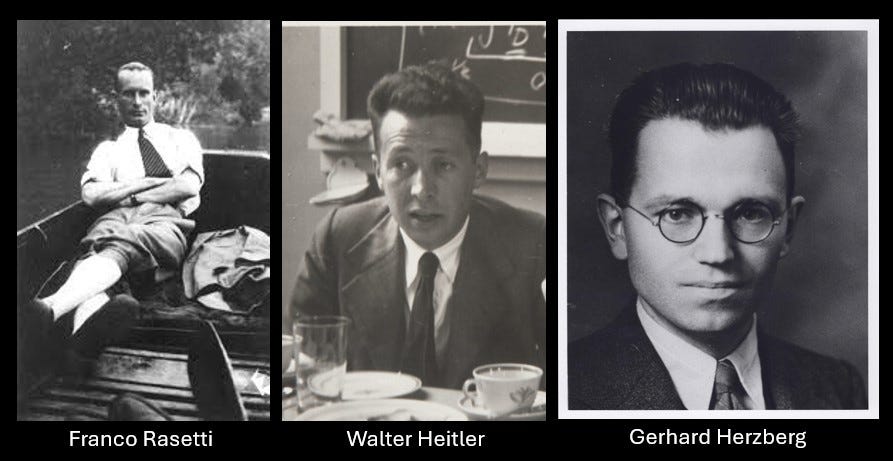
With this backdrop, let me introduce you to Franco Rasetti. Franco was an Italian physicist who was visiting Caltech in the US on a research fellowship. This was 1929, and many exciting quantum thoughts were in the air. C. V. Raman had just discovered an inelastic scattering process in the visible frequency spectra of molecules, and there was interest in understanding the quantum nature of the interaction between light and matter. Motivated by this, Rasetti set up an experiment at Caltech to probe Raman spectral features of molecular gases. Rasetti was an elegant experimentalist and, later, went on to become a close associate of Enrico Fermi and played a crucial role in the nuclear fission experiment[I].
Coming back to the work of Rasetti’s experiment, he took up the problem of understanding the Raman effect in diatomic gases (nitrogen and oxygen) and wrote a series of papers[ii]. Among them, he published his observations on rotational Raman spectra of diatomic gases (nitrogen and oxygen). Specifically, he performed a series of experiments and recorded beautiful spectral features of rotational lines of diatomic nitrogen. In that work, Rasetti discussed the specific selection rules from an experimentalist viewpoint and identified that the even lines in the spectral features were much more intense compared to the odd lines.
Guys from Gottingen
During the same year, working in Göttingen as postdocs of Max Born were Walter Heitler and Gerhard Herzberg. These two gentlemen studied the paper of Rasetti with great interest and went on to write an interesting paper in Naturwissenschaften (in German)[iii]. The translated title of the paper was “Do Nitrogen Nuclei Obey Bose Statistics”.
In that paper, Heitler and Herzberg studied rotational Raman features of nitrogen molecules and compared them to hydrogen molecules. They considered arguments based on the symmetry of the eigenfunctions and associated them with statistics (Fermi or Bose). Hydrogen nuclei obeyed Fermi-Dirac statistics, whereas Nitrogen counterpart did not. From the analysis of symmetry, they found that Rasetti’s observation contradicted the convention that Nitrogen nuclei obey Fermi-Dirac statistics. So, with this contrast, they clearly indicated that the nuclei of nitrogen should obey Bose-Einstein statistics, provided Rasetti’s experiments were correct.
How was the discrepancy resolved?
In 1932, James Chadwick[iv] went on to discover the neutron, and this discovery laid the foundation for understanding the constituent of a nucleus. With the new observation, one had to account for the presence of neutrons inside the nucleus. In the context of Nitrogen nuclei, it was found that it contained 7 protons and 7 neutrons, and the total spin was 1 (in contrast to spin ½ of hydrogen). This ascertained that Nitrogen nuclei obeyed Bose-Einstein statistics and removed the discrepancy from the observed rotational Raman spectra of Rasetti.
3 takeaways
What can we learn from this story? The first aspect is that experiments and theory go hand in hand in physics. They positively add value to each other and connect the real to the abstract thought. Second, it emphasizes the importance of careful observations and their interpretation. The third lesson is that Rasetti, Heitler and Herzberg were all young people and learned from each other’s work. They were essentially post-docs when they did this work, and we are still discussing it today.
Sometimes, good work has a long life.
[i] https://en.wikipedia.org/wiki/Franco_Rasetti
[ii] https://www.nature.com/articles/123205a0
https://www.pnas.org/doi/epdf/10.1073/pnas.15.3.234
https://www.pnas.org/doi/epdf/10.1073/pnas.15.6.515
Stern-Gerlach experiment – the first picture
During the formative years of quantum mechanics (early 1900s), the spin and orbital angular momentum of atoms were found to be quantized by theoretical arguments. Experimental proof was lacking.
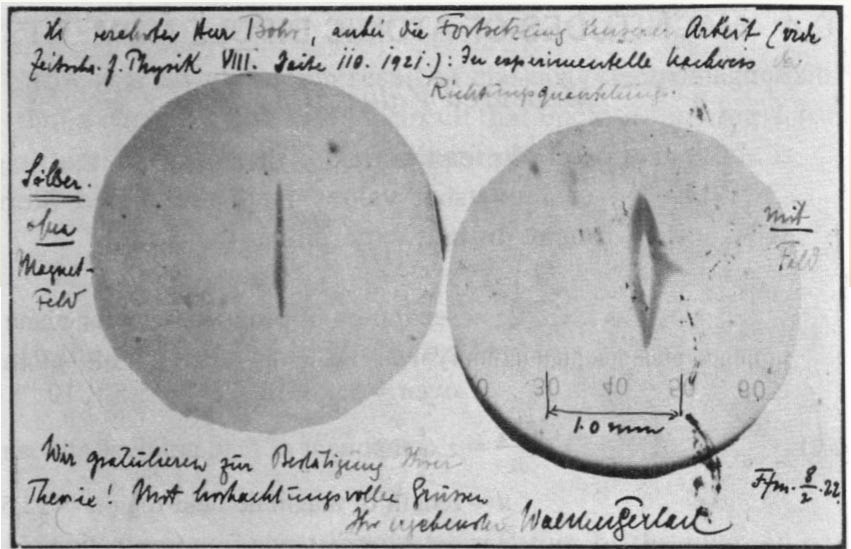
Stern-Gerlach experiment provided the first experimental proof in 1922. They took a beam of neutral silver atoms and deflected them through an inhomogeneous magnetic field.
Silver atoms have an unpaired electron in their outermost orbit. If they were to obey quantum mechanics, they should exhibit a spin of +1/2 or -1/2. When subjected to an external magnetic field, the electrons with +1/2 or -1/2 should spatially split into two. That is exactly what Stern and Gerlach observed, and below is the first picture of the same.
To quote the authors:
Gerlach’s postcard, dated 8 February 1922, to Niels Bohr. It shows a photograph of the beam splitting, with the message, in translation: “Attached [is] the experimental proof of directional quantization. We congratulate [you] on the confirmation of your theory.” (Courtesy AIP Emilio Segrè Visual Archives.)
This experiment was one of the most important observations in quantum mechanics and further confirmed the quantization of spins, which is now common knowledge in physics.
Superstitions – Kepler, Galileo & Newton
Superstition is a belief system or behavior of an individual that cannot be justified with evidence and logic. It is usually associated with people who do not (or do not want to) think critically. From the history and philosophy of science, we learn that a few famous thinkers of the past had some form of belief that can be termed superstitious. Of course, they were products of their times and environments, but it is always interesting to learn about the contradictions.
Take, for example, Kepler, Galileo and Newton. They were 3 important figures who laid the foundation of classical mechanics (along with many other things). But they also had their pet beliefs that were neither logical nor scientific.
In the preface of his book, Karl Popper has to say about the superstition of the 3 individuals mentioned:
Each of the three intellectual giants was, in his own way, caught up in a superstition. (‘Superstition’ is a word we should use only with the greatest caution, knowing how little we know and how certain it is that we too, without realizing it, are caught up in various forms of superstition.) Galileo most deeply believed in a natural circular motion – the very belief that Kepler, after lengthy struggles, conquered both in himself and in astronomy. Newton wrote a long book on the traditional (mainly biblical) history of mankind, whose dates he adjusted in accordance with principles quite clearly derived from superstition. And Kepler was not only an astronomer but also an astrologer; he was for this reason dismissed by Galileo and many others.
Of course, I am bringing this up not to justify any superstition. But to highlight the fact that people whom we call ‘heroes’ are humans and have their beliefs and flaws. We may derive inspiration from their work, but not all aspects of their character may be suitable for emulation.
We will have to adapt what is good and discard what is not. You may ask: what is the definition of ‘good’? Well, that is a topic for a different debate, but in this context, I would say ‘good’ are the ideas and methods developed by the abovementioned that are testable and falsifiable. Karl Popper may be happy with that definition.
 VISMAYA - History & Philosophy of Physics