Humanizing Science – A Conversation with a Student

Recently, I was talking to a college student who had read some of my blogs. He was interested in knowing what it means to humanize science. I told him that there are at least three aspects to it.

First is to bring out the wonder and curiosity in a human being in the pursuit of science. The second was to emphasize human qualities such as compassion, effort, mistakes, wrong directions, greed, competition and humour in the pursuit of science. The third thing was to bring out the utilitarian perspective.

The student was able to understand the first two points but wondered why utility was important in the pursuit of humanizing science. I mentioned that the origins of curiosity and various human tendencies can also be intertwined with the ability to use ideas. Some of the great discoveries and inventions, including those in the so-called “pure science” categories, have happened in the process of addressing a question that had its origin in some form of an application.

Some of the remarkable ideas in science have emerged in the process of applying another idea. Two great examples came into my mind: the invention of LASERs, and pasteurization.

I mentioned that economics has had a major role in influencing human ideas – directly or indirectly. As we conversed, I told the student that there is sometimes a tendency among young people who are motivated to do science to look down upon ideas that may have application and utility. I said that this needs a change in the mindset, and one way to do so is to study the history, philosophy and economics of science. I said that there are umpteen examples in history where applications have led to great ideas, both experimental and theoretical in nature, including mathematics.

Further, the student asked me for a few references, and I suggested a few sources. Specifically, I quoted to him what Einstein had said:

 “….So many people today—and even professional scientists—seem to me like someone who has seen thousands of trees but has never seen a forest. A knowledge of the historic and philosophical background gives that kind of independence from prejudices of his generation from which most scientists are suffering. This independence created by philosophical insight is—in my opinion—the mark of distinction between a mere artisan or specialist and a real seeker after truth..”

The student was pleasantly surprised and asked me how this is connected to economics. I mentioned that physicists like Marie Curie, Einstein and Feynman did think of applications and referred to the famous lecture by Feynman titled “There is Plenty of Room at the Bottom(1959).

To give a gist of his thinking, I showed what Feynman had to say on miniaturization:

There may even be an economic point to this business of making things very small. Let me remind you of some of the problems of computing machines. In computers we have to store an enormous amount of information. The kind of writing that I was mentioning before, in which I had everything down as a distribution of metal, is permanent. Much more interesting to a computer is a way of writing, erasing, and writing something else. (This is usually because we don’t want to waste the material on which we have just written. Yet if we could write it in a very small space, it wouldn’t make any difference; it could just be thrown away after it was read. It doesn’t cost very much for the material).”

I mentioned that this line of thinking on minaturization is now a major area of physics and has reached the quantum limit. The student was excited and left after noting the references.

On reflecting on the conversation, now I think that there is plenty of room to humanize science.
‘We’gnana !

Recently, I saw the following tweet from the well-known historian William Dalrymple.

Congrats to the listed authors, who deserve rewards (and the money) for their effort.

I have 3 adjacent points to make:

1) India badly needs to read (and write) more on science and technology. Here, I am not referring to textbooks, but some popular-level science books (at least). Generally, educated Indians are exposed to science only through their textbooks, which are mostly dull, or, in this era, YouTube videos, which have a low signal-to-noise ratio. Good quality science & tech books at a popular level can add intellectual value, excitement, and expand scientific thinking via reading, not just in students, but also in adults.

2) In India, most of the non-fiction literature is dominated by the social sciences, particularly history (as seen in the best-seller list). I have no problem with that, but non-fiction as a genre is a broad tree. Indian readers (and publishers) can and should broaden this scope and explore other branches of the tree. Modern science books (authentic ones), especially written in the Indian context, are badly in need. I hope trade publishers are reading this!

3) Most of the public and social media discourse in India does not emphasize (or underplays) the scientific viewpoint. Scientific literature and scientific discourse should become a central part of our culture. Good books have a major role to play. Remember what Sagan’s Cosmos did to American scientific outlook, and indirectly to its economic progress. The recent Nobel in economics, especially through the work of Joel Mokyr, further reinforces the connection between science, economics and human progress. This realization should be bottom-up, down to individual families and public places.

One of the great scientists, James Maxwell, is attributed to have said: “Happy is the man who can recognise in the work of today a connected portion of the work of life and an embodiment of the work of Eternity.

Science, with its rich, global history and philosophy, in the form of good books, can connect India (and the world) to the ‘work of eternity’, and make us look forward.

Embedding science within culture, in a humane way, can lead to progress. Science books have a central role to play in this.

विज्ञान (Vignana) should transform to ‘We’gnana !

Have You Seen the Bird Flying? by D. R. Bendre

ಕನ್ನಡ ರಾಜ್ಯೋತ್ಸವದ ಶುಭಾಶಯಗಳು

Reproducing one of Da. Ra. Bendre’s Kannada poems titled “ಹಕ್ಕಿ ಹಾರುತಿದೆ ನೋಡಿದಿರಾ?” which translates to Have You Seen the Bird Flying?

A comment on the poem: In my reading, this poem is a metaphor for the exploration of the universe through the exploration of a bird. The poet periodically asks: “Have you seen the bird flying?”, thereby motivating the reader to observe what the bird may be seeing and doing. It is a poem read by school children, but there is a deeper philosophical meaning in asking humans to look up at the sky and realize the flight of a bird in themselves. YouTube also has the original audio of Bendre reciting the first few lines of the poem, and it is worth listening to.

Below is the poem, followed by a decent translation.

“ಹಕ್ಕಿ ಹಾರುತಿದೆ ನೋಡಿದಿರಾ?”

ಇರುಳಿರುಳಳಿದು ದಿನದಿನ ಬೆಳಗೆ
ಸುತ್ತಮುತ್ತಲೂ ಮೇಲಕೆ ಕೆಳಗೆ
ಗಾವುದ ಗಾವುದ ಗಾವುದ ಮುಂದಕೆ
ಎವೆ ತೆರೆದಿಕ್ಕುವ ಹೊತ್ತಿನ ಒಳಗೆ
ಹಕ್ಕಿ ಹಾರುತಿದೆ ನೋಡಿದಿರಾ?

ಕರಿನೆರೆ ಬಣ್ಣದ ಪುಚ್ಚಗಳುಂಟು
ಬಿಳಿ-ಹೊಳೆ ಬಣ್ಣದ ಗರಿ-ಗರಿಯುಂಟು
ಕೆನ್ನನ ಹೊನ್ನನ ಬಣ್ಣಬಣ್ಣಗಳ ರೆಕ್ಕೆಗಳೆರಡೂ ಪಕ್ಕದಲುಂಟು
ಹಕ್ಕಿ ಹಾರುತಿದೆ ನೋಡಿದಿರಾ?

ತಿಂಗಳಿನೂರಿನ ನೀರನು ಹೀರಿ
ಆಡಲು ಹಾಡಲು ತಾ ಹಾರಾಡಲು
ಮಂಗಳಲೋಕದ ಅಂಗಳ ಕೇರಿ
ಹಕ್ಕಿ ಹಾರುತಿದೆ ನೋಡಿದಿರಾ?

ಮುಟ್ಟಿದೆ ದಿಙ್ಮಂಡಲಗಳ ಅಂಚ
ಆಚೆಗೆ ಚಾಚಿದೆ ತನ್ನಯ ಚುಂಚ
ಬ್ರಹ್ಮಾಂಡಗಳನು ಒಡೆಯಲು ಎಂದೋ
ಬಲ್ಲರು ಯಾರಾ ಹಾಕಿದ ಹೊಂಚ
ಹಕ್ಕಿ ಹಾರುತಿದೆ ನೋಡಿದಿರಾ?

Translation (ChatGPT):

Have You Seen the Bird Flying?
(by D. R. Bendre — English rendering)

Night after night melts into day,
All around, above and below —
the world moves on and on,
as the moment of awakening opens —
Have you seen the bird flying?

It has a tail dark as rainclouds,
and feathers white, shining bright;
its wings on either side
are tinted with colors of gold and light —
Have you seen the bird flying?

It drinks the silvery water of the moon,
to play, to sing, to soar;
it enters the courtyard of the blessed world —
Have you seen the bird flying?

It’s touched the edge of the horizon,
stretched its beak to the farthest reach;
who knows — since when it has tried
to break open the universe itself —
Have you seen the bird flying?

Some writing advice (mainly physics) for UG students

Some writing advice (mainly physics) I shared with my undergraduate class. This may be useful to others.

  1. Equations, data and figures make meaning when you include a context. This context is expressed using words. Symbols and data by themselves cannot complete the meaning of an argument, unless one knows the context. A common mistake undergraduates make in an exam is to answer questions using only symbols and figures and assume the reader can understand the context.
  2. One way to treat writing in physics (in this case, an exam paper or an assignment) is to imagine you are talking to a fellow physics student who is not part of the course you are writing about. This means you can assume some knowledge, but not the context. Anticipate their questions and address them in the text you are writing. This model also works while writing research papers with some caveats.
  3. While you refer to equations, data and figures in your assignment, make sure you cite the reference at the location of the content you are discussing. Merely listing the references at the end of the document does not make the connection. Remember, while talking, you never do this kind of referencing.
  4. It is useful to structure your arguments with headings, sub-headings and a numbered list. This gives a visual representation of your arguments. You may not find this kind of structured writing in novels, other forms of fictional writing and also in some literature related to social sciences, but in natural sciences with dense information, this will be very useful. Always remember, while writing science (or any form of nonfiction writing), clarity comes before aesthetics.

Also, below is another blog related to written assignments.

Blog highlighted by SciRio

A nice article by @RutujaUgale in @Sci_Rio that discusses public engagement by scientists as influencers of scientific thought.

Thanks, Rutuja, for profiling my blog, ‘Vismaya’.

Here is my quote from the article:

For me, there are two implications of doing science. One is that science is extremely useful to society, and the second is that it is a good, thoughtful way of living one’s life. Communicating the second implication is important to me, and I do this by researching, writing, and podcasting about the history and philosophy of science (physics in particular). This path helps people understand the human element of doing science and reveals a context. Some of my blogs (filtered here) discuss why I do science and how I do it. More than ‘influencing’ the audience, I am interested in inviting them to explore science by themselves via their own curiosity. That is one reason why my blog is called VISMAYA.”

Link to the full article.

Gardner’s Synthesis

Once in a while, during my research, I come across writing by scholars from other disciplines that gives me a perspective that not only helps me to grasp the complexity of learning across disciplines, but also resonates with some thoughts on education.

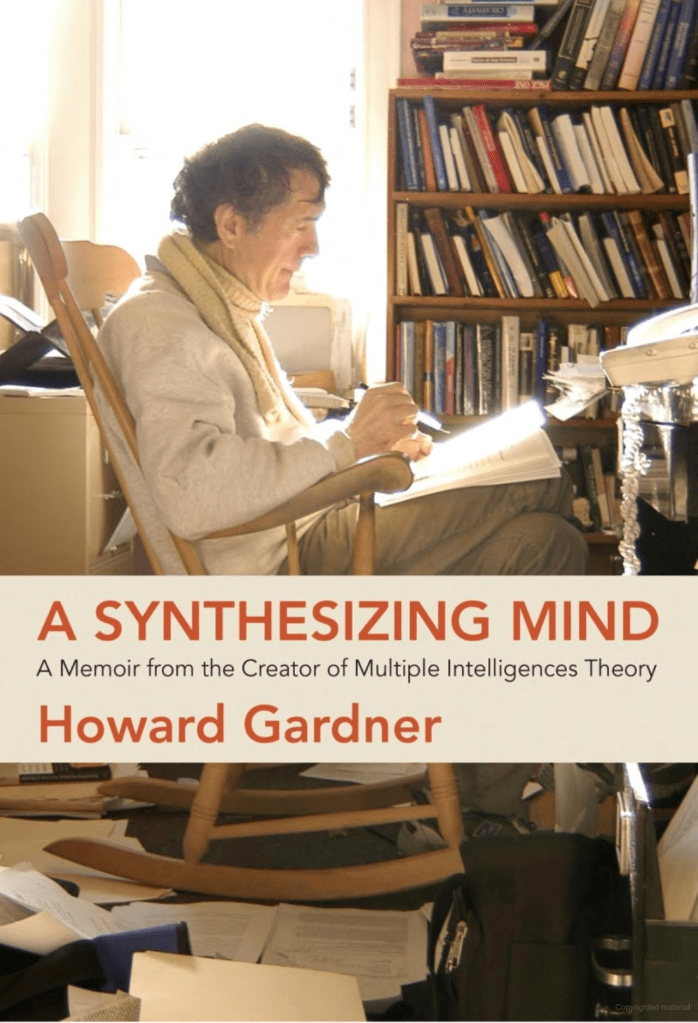
Howard Gardner is one such academic who works on developmental psychology and has researched extensively on cognition and education. He has written ~30 books and ~1000 articles, and blogs regularly, even at the age of 82 or so. His recent book is titled A Synthesizing Mind.

Howard Gardner is a renowned Harvard academic and, as his book describes him as follows:

“Throughout his career, Gardner has focused on human minds in general, or on the minds of particular creators and leaders. Reflecting now on his own mind, he concludes that his is a ‘synthesizing mind’—with the ability to survey experiences and data across a wide range of disciplines and perspectives. The thinkers he most admires—including historian Richard Hofstadter, biologist Charles Darwin, and literary critic Edmund Wilson—are exemplary synthesizers. Gardner contends that the synthesizing mind is particularly valuable at this time and proposes ways to cultivate a possibly unique human capacity.”

While exploring the book and the related material, I came across an interview with Howard Gardner. In there, he is conversing about the theme of the book and discusses the synthesis of thought across disciplines. One of the pertinent aspects of learning is to know how innovation can be fostered by cross-disciplinary exploration without diluting disciplinary rigour. As Gardner says:

“I am not opposed to disciplinary learning—indeed I am an enthusiastic advocate. Any person would be a fool to try to create physics or psychology or political science from the start. But if we want to have scholars or professionals who are innovative, creative—and innovation is not something that we can afford to marginalize—then they cannot and should not be slaves of any single discipline or methodology.”

As a physicist, I can relate to this thinking within my discipline, and how innovative ideas, over the ages, have emerged by bringing ideas from mathematics, engineering and biology into physics. Particularly, the combination of biology, physics and mathematics is one of the most exciting frontiers of human exploration today, and Gardner’s words apply well in this scenario.

Going beyond science, I am always intrigued and amazed by artists (especially musicians) who can create art that simultaneously draws the attention of specialists and generalists. This is not a trivial achievement, and as a scientist, I am always trying to understand how artists resonate so well with the public. Gardner, in the abovementioned interview, frames this problem by looking at the goals of science and arts, and draws a contrast that is worth noting:

“Most scholars and observers like to emphasize the similarities between the arts and the sciences, and that is fine. But the goals of the two enterprises are different. Science seeks an accurate and well supported description of the world. The arts seek to capture and convey various aspects of experience; and they have no obligation other than to capture the interest and attention of those who participate in them.

Of course, there are some individuals who excel in both science and art (Leonardo is everyone’s favorite example). But most artists—great or not—would not know their way around a scientific laboratory. And most scientists—even if they like to play the violin or to draw caricatures or to dance the tango—would not make works of art or performances that would interest others.”

I partially agree with this assessment, as I know a few scientists who are deeply involved in various forms of art (including music) and do it very well, even at the professional level. In a way, Gardner is re-emphasizing the “two cultures” debate of C.P. Snow. My own thoughts on this viewpoint are ambivalent, as I see science, arts and sports as important pursuits that cater to different facets of the human mind. Of course, when it comes to expertise, the division may matter. There is a lot more to learn about the interface of art and science, at least for me.

Anyway, Gardner is a fabulous writer, and his blogs and books are worth reading (and studying) if one is seriously interested in understanding how to synthesize thought across disciplines.

Since we are discussing synthesis of thought, which is a kind of harmony, and coming together, let me end the blog with a line from Mankuthimmana Kagga by the Kannada poet-philosopher D.V. Gundappa:

ಎಲ್ಲರೊಳಗೊಂದಾಗು ಮಂಕುತಿಮ್ಮ” (Eladaralongodhagu manku thimma)

which loosely translates to: oh fool…be one among all (blend into world, living in harmony).

Harmony of disciplines and minds – how badly the world needs it today?

A bit of advice…to students

To paraphrase something I tell my students, especially when they are starting a research project –

There are certainly many people in the world who think better than us. But the competition reduces when it comes to the people who take their thoughts and ‘do’ something with them. Novelty of ideas is in the novelty of connections of ideas. There is always more scope for new connections of old ideas.

Generally, the game is won not in out-thinking, but in out-doing. This does not mean that doing excludes thinking. In fact, many times, doing fosters thinking.

Writing in the age of AI

A contemporary question of interest: How can artificial intelligence (AI) influence writing?

Writing has two consequences – 1) a writer processing information and communicating it to an audience; 2) a reader processing the author’s information.

The first part has an element of personal touch, just like any art or craft (for example, pottery). One does write (or create a pot) partly because it gives some pleasure and helps one to understand something in the process. There is a gain of knowledge in writing. This pleasure and wisdom through writing cannot be replaced by an external agency like AI. This is because external tools like AI are assistants of thought, not internal replacements of thought. In that sense, no external tool can replace any amateur activity because something is done for the sake of the process. Writing as a tool of self-reflection cannot be replaced by something external.

So, where is the threat? Actually, it is professional writing which is under partial threat from AI. Wherever the end product is more important than the process of writing, AI can gain prominence, provided it is accurate. It is still a partial threat because a professional writer can create questions and combinations that may arise out of individual experiences. Those lived experiences are derived from “life“, and AI cannot be a substitute for such an internal experience.

Writing, like many human endeavors, is both internal and external. The former makes us human, and that is hard to replace. After all, the A in AI stands for artificial.