Some writing advice (mainly physics) for UG students

Some writing advice (mainly physics) I shared with my undergraduate class. This may be useful to others.

  1. Equations, data and figures make meaning when you include a context. This context is expressed using words. Symbols and data by themselves cannot complete the meaning of an argument, unless one knows the context. A common mistake undergraduates make in an exam is to answer questions using only symbols and figures and assume the reader can understand the context.
  2. One way to treat writing in physics (in this case, an exam paper or an assignment) is to imagine you are talking to a fellow physics student who is not part of the course you are writing about. This means you can assume some knowledge, but not the context. Anticipate their questions and address them in the text you are writing. This model also works while writing research papers with some caveats.
  3. While you refer to equations, data and figures in your assignment, make sure you cite the reference at the location of the content you are discussing. Merely listing the references at the end of the document does not make the connection. Remember, while talking, you never do this kind of referencing.
  4. It is useful to structure your arguments with headings, sub-headings and a numbered list. This gives a visual representation of your arguments. You may not find this kind of structured writing in novels, other forms of fictional writing and also in some literature related to social sciences, but in natural sciences with dense information, this will be very useful. Always remember, while writing science (or any form of nonfiction writing), clarity comes before aesthetics.

Also, below is another blog related to written assignments.
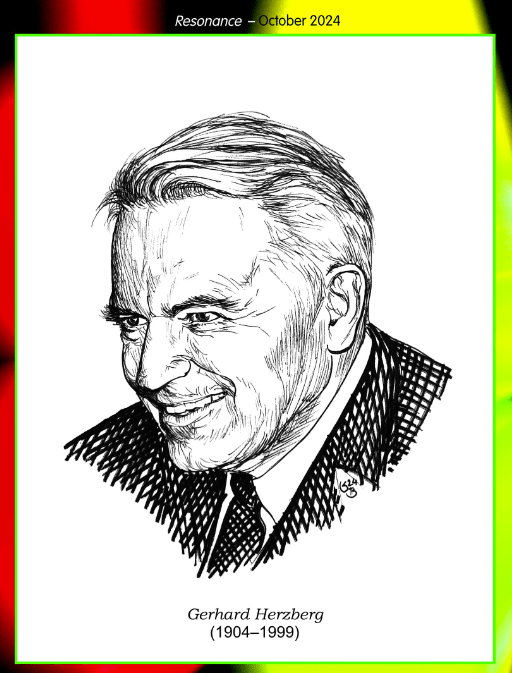
Article on Gerhard Herzberg

The October 2024 issue of Resonance, Journal of Science Education

highlights the life and science of Gerhard Herzberg.

He was one of the greatest molecular spectroscopists who laid the foundation of atomic and molecular quantum mechanics and deeply impacted molecular astrophysics and astrochemistry.

He lived an extraordinary life, first in Europe learning quantum mechanics and then escaping 1930s Germany as his wife was of Jewish origin. Then, he settled in Canada to build and lead his lab, which was considered the ‘mecca of spectroscopy’ at NRC, Ottowa.

I wrote a sci-biography article about him in this issue

Link to full edition: https://www.ias.ac.in/listing/articles/reso/029/10

If you don’t know – Resonance is a pedagogical journal published by the Indian Academy of Sciences. It is a true open-access journal. Free to read and does not charge the authors to publish.

Do explore the past editions. There are some absolute gems. https://www.ias.ac.in/listing/issues/reso

Critical thinking in Indian STEM students

Toys, Geim and Gupta

Recently I came across an editorial in Nature Physics, titled as Physics is our playground, which emphasized how playfulness has had an important role in some of the major inventions and discoveries in physics.

A particular example of this is the discovery of graphene, and how it has evolved into one of the most important topics in condensed matter science. Nowadays graphene is used as ‘Lego’ blocks to build higher order structures and the so-called ‘Van der Walls’ heterostructures are one of the most exciting applications of 2D materials. What started as a playful project in the lab has now turned out to be an important part of emerging technologies.

Two important inferences can be drawn from the playful attitude towards doing science :

First is that making modular elements and stacking them creatively can lead to emergence of new structures and function. Anyone who has used lego blocks can immediately relate to it.

Second is that toys are powerful research and teaching aids. Please note, that I emphasized research and teaching here. This is because toy-models are ubiquitous in research, and they help us create modular state of a problem in which unnecessary details are discarded and only the essential parts are retained. This way of thinking has been extremely powerful in science and technology (for example : see ball and stick models in chemistry and mega-construction models in civil engineering )

When it comes to toys and education, there is no better example than the remarkable Arvind Gupta (see his TED talk). His philosophy of using toys as thinking aids is very inspiring. Being in Pune, I have had a few opportunities to attend his talks and interact with him (as part of an event at science activity center at IISER-Pune), and I found his approach both refreshing and implementable. Importantly, it also showed me how creativity can emerge from constraints. To re-emphasize this, let me quote APS news article on Andre Geim :

“Geim has said that his predominant research strategy is to use whatever research facilities are available to him and try to do something new with the equipment at hand. He calls this his “Lego doctrine”: “You have all these different pieces and you have to build something based strictly on the pieces you’ve got.””

Now this is an effective research strategy for experiments in India !

Basic advice to undergrads: written assignments

Below is some basic advice I shared with my undergraduate class (Physics majors/Optics). This may be useful to other students here.

  • Do not copy a text verbatim, unless you are quoting the text as it is, with reference at that location.  If you use a source, then write a summary in your own words and cite the original source at the location of your text.
  • In the absence of primary data (which you generate originally), you will be using secondary sources such as research papers, books and internet content. For scholarly purposes (including assignments), it is better to use journal articles and books as references. Wikipedia is essentially a tertiary reference. Although some entries are good, wikipedia content is generally taken from a book or a research paper. Identify that source and use it for your assignment and reference. Directly citing wikipedia (which is usually not peer reviewed by experts) is not a general practice in scientific literature. 
  • When you take a figure or equation from a secondary resource (paper, book, internet), it is important that you cite the source in figure caption/equation location.
  • In an assignment, I am mainly interested in reading what you think about the topic under consideration. Feel free to put down your thoughts and compare and contrast it to the literature you use. This is where the thinking + learning happens.
  • For some general advice on referencing, especially for online communication, have a look at my blogpost.
  • To appreciate importance of written communication in learning, have a look at another blogpost.

54. End-sem email to my class

Below is an email I sent to my introductory-optics class of 77 students (third-year undergraduates) on the final day of my course, which was today. Although the course was completely online, I did enjoy interacting and discussing with them on various topics on optics and photonics.

———————

Dear All,


Today is the final day of the optics course – PH3134, and I hope all of you have gained some knowledge from the online interaction we had over the past months. 


Optics is one of the most fascinating areas of science, and historically one of the oldest topics in physics. Yet, it continues to throw new surprises in contemporary research. I hope some of you will pursue research in optics and related areas. Even otherwise, do remember that optics plays a vital role in understanding and implementing various aspects of science and technology. Its relevance has remained high for centuries, and will remain so for the foreseeable future. 

I know many of you are at home, and conditions are not ideal for studies. So, thank you for keeping up your interests even during these tough times. I highly appreciate it.


An important take away for me as a teacher/researcher (from every course I teach) is that what we have discussed and studied is just a metaphoric drop in a mighty ocean of knowledge. That means there is a lot to learn for all of us. Do keep learning beyond the coursework. There is no limit for that.


Light up the world !

best wishes,

Pavan

Letter to My Undergrad Students

This semester I was teaching an advanced physics lab course (4th year BS-MS). Below is an email I sent to them. You may find it interesting :

IMG-20200311-WA0002

Image of a plasma discharge experiment in the UG physics lab at IISER-Pune


Dear Students of PHY430,

I hope all of you are doing fine and staying safe where ever you are. Given that we are part of an advanced lab course, compensating for the lost time via internet is not feasible. To fill in the gap, I am writing to you about something you may find interesting and useful. So here it is:

  • Ventilators : By now you may be very familiar with this terminology. Essentially, it is a medical device that helps you to mechanically breathe, and has turned out be a vital component in fighting the extreme medical cases of COVID epidemic. In this regard, I want to inform about the efforts of my colleagues Sunil Nair and Umakant Rapol, who are actively involved in design and development of low-cost ventilators. As you may recognize, both of them are experimental physicists, and their knowledge and intuition has been put to excellent use during the pandemic. In an essence, their involvement in this venture shows how a strong foundation in physics can not only solve deep queries in fundamental aspects of science, but also can cater to an emergency situation. This is one of the important lesson of this course : the skills and knowledge that you gain as part of experimentation in a lab can be transferred and implemented to solve problems outside a lab.
  • A Book recommendation: Talking about experimental skills, I thought of recommending an excellent book by Matthew Crawford titled “Shop Class as Soulcraft: An Inquiry Into the Value of Work”. This is a kind of an autobiographical exposition by the author, who majored in Physics, obtained a Ph.D. in political philosophy, and worked in policy circles of Washington D.C. for a brief period, and quit this job to become a motorcycle mechanic and an academic author. This book dives deep into the philosophy of why working with hands (and brains) is a deeply satisfying venture as a career and life-style. If you are not able to read the book, here is an excellent excerpt by the author himself.
  • Lab reports: Do send me the report of the experiments that are due to be evaluated. I know some of you may or may not have good access to internet, so timelines can be flexible (2 weeks from today). Also, you may not have access to research material. In that case, do co-ordinate with your lab partners, and let me know if I can be of some help in this regard.

Finally, keep your experimental spirits high. After all, everything at home is a kind of lab equipment to explore

Smile

Stay safe,

Pavan