Halina Rubinsztein-Dunlop – History of Optical Manipulation

Below is a video blog featuring Halina Rubinsztein-Dunlop as part of history of optical manipulation. Also pictured in the blog are : Giorgio Volpe (UC, London) and Agnese Callegari (University of Gothenburg). Pictures taken at OMC 2023 in Yokohama, Japan.

Some relevant links at the end :

Notes :

Professor Halina Rubinsztein-Dunlop (2023). Available at: https://smp.uq.edu.au/profile/204/halina-rubinsztein-dunlop (Accessed: 19 April 2023).

Halina Rubinsztein-Dunlop‬ – ‪Google Scholar‬ Available at: https://scholar.google.se/citations?user=4_sqVfYAAAAJ&hl=en (Accessed: 19 April 2023).

‘Halina Rubinsztein-Dunlop’ (2023) Wikipedia. Available at: https://en.wikipedia.org/w/index.php?title=Halina_Rubinsztein-Dunlop&oldid=1145639271 (Accessed: 19 April 2023).

seminal papers :

Friese, M.E.J. et al. (1998) ‘Optical alignment and spinning of laser-trapped microscopic particles’, Nature, 394(6691), pp. 348–350. Available at: https://doi.org/10.1038/28566.

He, H. et al. (1995) ‘Direct Observation of Transfer of Angular Momentum to Absorptive Particles from a Laser Beam with a Phase Singularity’, Physical Review Letters, 75(5), pp. 826–829. Available at: https://doi.org/10.1103/PhysRevLett.75.826.

Geo-fractal…somewhere over south India

I am always amazed to see fractal-like patterns….this one at a geographical scale…captured somewhere over south India..

I took the photo on my trip back to Pune from IIT Madras…

Thanks to IIT-M physics department for their invitation for colloquium…

Special thanks to Basudev Roy and Nirmala for hosting…. greatly enjoyed the discussion with many faculties and students..

In my talk, I mainly spoke on topics at the interface of statistical optics, Brownian motion and pattern formation..
Was delighted to see (and meet) Profs. Balki, Suresh Govindarajan Sunil Kumar Arnab Pal and many more in the audience.

The photo, retrospectively, captures the essence of the science discussed…

Hot Brownian Colloids – talk

On 19th Jan 2023, I gave a ~40 min talk on “Hot Brownian Colloids in Structured Optical Tweezers” in a very interesting conference on Frontiers in Non-Equilibrium Physics (FNEP) held at Institute of Mathematical Sciences, Chennai.

I mainly spoke about emergent Brownian dynamics of laser-heated colloids under optical confinement. Below is the link to the talk.

I concluded my talk quoting P W Anderson’s essay “More is Different

“The constructionist hypothesis breaks down when confronted with the twin difficulties of scale and complexity.  The behavior of large and complex aggregates of elementary particles, it turns out, is not to be understood in terms of a simple extrapolation of the properties of a few particles.

Instead, at each level of complexity entirely new properties appear, and the understanding of the new behaviors requires research which I think is as fundamental in its nature as any other.”

P.W. Anderson  ‘More is Different’
Science, 177, 4047 (1972)

More is not only different, but also wonderful !

A Random Walk in Edinburgh

Diffusion is a simple yet fascinating physical phenomenon.  By merely observing how an object moves around in a medium as a function of time, there is a lot of stuff one can learn about the environment, about the diffuser and about the interaction between diffuser and its environment.  Over the last few days, I have been studying some papers related to trajectory of individual nanostructures in liquid environment, and have learnt some interesting aspects such as sub-diffusion and super-diffusion.

Concomitantly, I came across one of the better poems I have read in recent times on travelling: Childe Harold’s Pilgrimage by Lord Byron George. This is a long poem, but a couple of stanzas are worth a read:

There is a pleasure in the pathless woods,
There is a rapture on the lonely shore,
There is society where none intrudes,
By the deep Sea, and music in its roar:
I love not Man the less, but Nature more,
From these our interviews, in which I steal
From all I may be, or have been before,
To mingle with the Universe, and feel
What I can ne’er express, yet cannot all conceal.

Roll on, thou deep and dark blue Ocean—roll!
Ten thousand fleets sweep over thee in vain;
Man marks the earth with ruin—his control
Stops with the shore;—upon the watery plain
The wrecks are all thy deed, nor doth remain
A shadow of man’s ravage, save his own,
When for a moment, like a drop of rain,
He sinks into thy depths with bubbling groan,
Without a grave, unknelled, uncoffined, and unknown

       These two readings (of the paper and the poem) were on the same day, and I felt a connection between diffusion and travelling. It kept lingering on my mind for the next few days, and I felt going deeper and exploring it further. So, I went back to my archived files on my laptop and started exploring some photographs I have taken over the years of travel. During this exploration, I found some of my travelogue related to Scotland when I visited that beautiful country in June 2013. During that trip, I and some of my colleagues were mainly visiting Glasgow University. During the last leg of the trip, we visited the University of Edinburgh and Edinburgh city for a day.

      It was a bright, sunny day on 21 June 2013 (generally 21 June is the longest day of the year). We took an early morning train from Glasgow to Edinburgh. Around 9am in the morning, we were at University of Edinburgh, and we visited the departments of physics and chemistry. This was followed by talks by us and a few researchers at the university. After our interaction and lunch, we had about 5 to 6 hours to spend in the city of Edinburgh before we could take our train back to Glasgow. So, we went to the city centre, and I decided to visit the travel information desk. I wanted to know if I could see around the city within 5 hours or so, and what places could I visit on feet. One of my favourite activities, especially when I am travelling alone, is to take a random walk around the city (of course with a map), and explore the places on feet. I have found these “on-feet” explorations can closely connect you to the place, and importantly slows one down so that one can pause, observe and grasp the local environment in its details. In an essence, this “confined Brownian motion” can lead to some interesting insight and thoughts.

        Coming back to Edinburgh, I gathered all the information of possible sites I could visit on feet within 4 to 5 hours, and here are a few things I explored during the walk:

  1. Statue of Sherlock Holmes:

Although a fiction-character, Sherlock Holmes has a real statue in Edinburgh! Anybody who has read Sherlock Holmes also knows its author Aurthur Conan Doyle cannot miss this place. Close by to the Holmes’ statue is a pub named The Conan Doyle (see below)
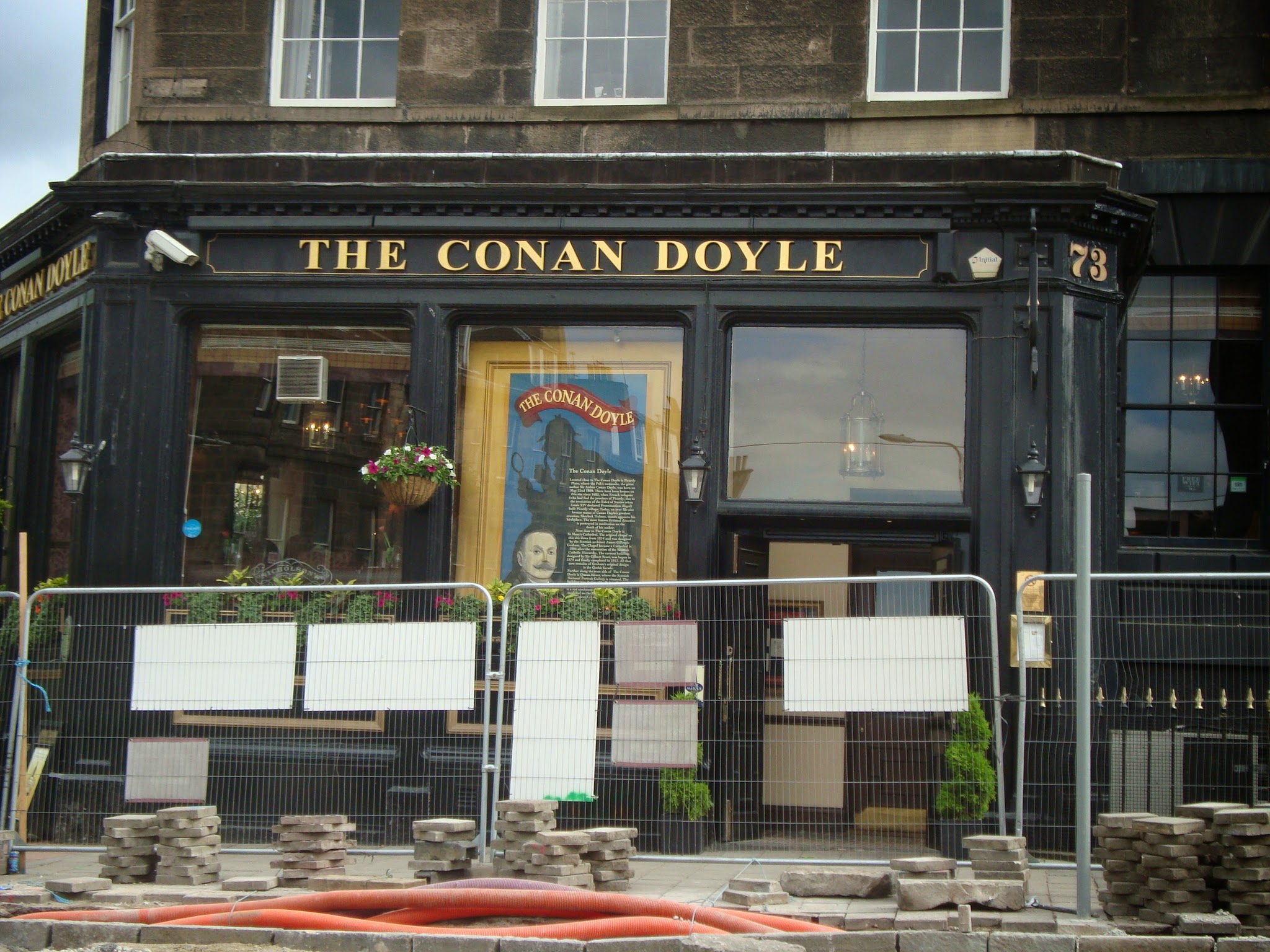
Conan doyle

  1. Bronze statue of Adam Smith:

Adam Smith

A 10 feet long monument of Adam Smith cannot be ignored. The celebrated economist, philosopher and author of “The Wealth of Nation”, is one of jewels in the crown of Scotland.

  1. Statue of James Clerk Maxwell:

Interestingly, this was the hardest thing to find in the city. It was at a remote corner of the town, and very few people knew that there is indeed a statue of Maxwell in Edinburgh city. It took me almost 45 to 60 minutes to explore the statue. I was almost about to give up, but somehow I did not want to….so I went ahead, and found this statue of the celebrated physicist. It was a happy moment!

  1. The famous Scotch Wishky trail:

Whisky trail

How could one miss this! This was one of the easiest things to find on my path, and what I found inside this trail was nothing short of breath-taking variety of Scotch.

  1. The cliff edge:

Sky and green

This was strictly-speaking not during the walk in the city, but just before that, and is perhaps the picture that has stuck in my mind all the while when I think about Scotland. Unconsciously, when I think of diffusion in space and time, this is the same picture that comes back to my mind. There is something unique about a person at cliff edge, all by himself exploring his universe…I find it kind of philosophical and fascinating…..and also goes well with abovementioned poem.

Brain is a strange thing. It forces us to connect the unconnected, and the above content is just an example. Towards the end of the trip, I sat on the train back to Glasgow. I started listening to the music on my headphone, and the song on my playlist was Hotel California. As I relaxed back in the seat, I was struck by these lyrics :

Last thing I remember, I was
Running for the door
I had to find the passage back to the place I was before
‘Relax’ said the night man,
‘We are programmed to receive.
You can check out any time you like,
But you can never leave!’

I had checked out of Edinburgh, but my mind has never left that random walk…..


Polluted air…..why do we care ?

Delhi
Delhi airport : A peek from the widow of the flight at around 9.30 in the morning

If you are an Indian researcher, you cannot escape a visit to Delhi. For the last few years, I have been visiting Delhi for various research related reasons: conference, grant meeting etc. A few days ago I had an opportunity to visit Delhi for a half-a-day meeting.

For me, Delhi embodies a rich feeling of delicious north Indian (street) food, extreme temperatures (by Indian standards), loud taxi music, an assorted flavor of Hindi dialects, and of course, national politics. Of late, Delhi also has gained a lot of attention in another matter: pollution. In winters, for several years now, smog (smoke + fog) has been a major problem, and has drastically perturbed the lives of Delhi citizens. This problem is not confined to Delhi. Various parts of India are not doing great either.

Anyway, as soon I landed in Delhi, it was foggy (see picture), and the visibility was poor. Clearly, there was something in the air, and it was not pleasant.  I wondered about all the kids who travel to school in such an air, and the possible effects on their health. There were several questions running through my mind:  Why is the polluted air the way it is ? How does one quantify pollution? What are the effective methods to detect pollution, and how can it be contained effectively? I knew some scientific aspects of air pollution, but I was curious about how at all air quality was measured and quantified. Below are some facts related to pollution and some interesting connection to light scattering.

There are several reasons for air pollution. In India, some of the major reasons include crop and biomass burning, emission from automobiles and industries, dust etc. There are mainly 8 kinds of pollutants: PM10, PM2.5, NO2, SO2, CO, O3, NH3, and Pb. A majority of the problems are caused by the so-called particulate matter. These tiny objects which can cause severe harm to human beings can be mainly classified as PM10 and PM2.5, where PM stands for particulate matter and the numbers 10 and 2.5 represents the size of such particles in microns. To give you a comparison, the width of our hair is approximately 100 microns in thickness. So imagine a particle which is thinner than your hair entering your respiratory system. This inhalation causes severe trouble to your lungs and the worst part is that it can cause irreversible damage to the inner walls of your respiratory tracts. Even more disturbing fact is that smaller the size of the particle deeper is the penetration in to our system, and greater harm it does to human well-being.

So, how to detect these small particulate matter? There are several ways to detect these tiny objects of which I found two methods to be interesting and effective.

First one is based on light scattering. Generally, the instrument used to monitor air quality using light scattering is called as nephlometer (In Greek nephos means cloud). This is a powerful and compact instrument that can continuously detect and monitor density of particulate matter. The measurement is based on Mie scattering (named after Gustav Mie, more about him in future), where the size of the scatterer is generally comparable to the wavelength of light. It assumes that the scattering particles are spherical in nature and isotropic in composition. It works on the basic principle that when you shine light through smog (at the ground level), the intensity of the scattered light carries characteristic signature of the size of the particle and its concentration. More specifically, the intensity of the scattered light depends on two important ratios. One is the ratio of particle size to wavelength of light and second is the ratio of refractive index of the particle to its surrounding medium. By calibrating the instrument for known particles and concentrations, the unknown size and concentration of the pollutant can be determined. (If you are interested to learn more, see this old research paper). As mentioned earlier, the measurement assumes the scatterer to be spherical and isotropic, which is not the usual case in the air. So corrections due to variation in shape and compositions have to be taken into consideration in this measurement. However, one of the major advantages of this measurement is that it is quick and portable, and hence a lot of air quality measurements are based on these instruments.

Alternatively, if one needs very accurate measurement of particle size, the instrument to use is Tapered Element oscillating microbalance (TEOM).  In this a tiny piece of tapered glass acts like a tuning fork. This tuning fork vibrates at a specific frequency which can be measured with reasonable accuracy. As one may guess, if something is moving, the speed of movement can be affected by adding weight on the moving object. In this case, the vibrating piece changes its frequency as soon as a small particle is in contact with it. The difference in the frequency is now related to the mass of the particle. Thus by using simple physics, one can obtain a powerful instrument to monitor air quality. Apart from the above-mentioned methods, there are various approaches to monitor air-pollution. Each of them have pros and cons, and are utilized depending on the situation.

Coming back to my Delhi trip, I finished my work, and headed towards the airport in a taxi. I casually asked the driver whether he was worried about the pollution in his city. He did mention that it was a concern, but after a brief pause he grinned and said – “odd-even phir sae shooru ho ra hain, business badega” (odd-even is starting gain, business will go up (note: odd-even was eventually stalled this time)). I grinned back at the driver, and remembered a quote of Charles Kettering : “The only difference between a problem and a solution is that people understand the solution”.