63. Pattern formation in my kitchen

If you allow oil to diffuse through a patterned paper napkin on a plate, you can print that pattern on most of the dry plates in a kitchen ( steel plate in this case). In the image, the darker regions are oil soaked, and the ligher circular regions are devoid of oil. Essentially, the patterns are evident due to contrast in refractive index

58. Optothermal Pulling of colloids using Nanowire Plasmons – my talk at Compflu 2021

Linked is my recorded-talk presented at Compflu 2021 today (13th Dec) in the session : Active and Living Matter.

I discuss our recent work on optothermal pulling, trapping and assembly of micro-colloids under the influence of thermoplasmonic field of a single silver nanowire.

The talk was recorded on 2nd Dec 2021, so the reference on conclusion-slide is not updated.

57. Single nanoparticle driven thermoplasmonic tweezer : single-molecule SERS

We have a new paper published in Journal of Physical Chemistry Letters on “Single Molecule Surface Enhanced Raman Scattering in a Single Gold Nanoparticle-Driven Thermoplasmonic Tweezer”

Thanks to the fantastic effort by Sunny Tiwari, and excellent support by Utkarsh Khandelwal (former IISER-P undergrad) and Vandana Sharma from my group, we have been able to combine single molecule Raman scattering with a specialized nanoscale optical tweezer.

The uniqueness of this tweezer platform  is that the optical trapping process is driven by the thermo-plasmonic potential created by a SINGLE, 150nm GOLD NANOPARTICLE. Concomitantly, the same field can be used to perform single-molecule Raman spectroscopy. Kind of  “ek teer mae do shikar” strategy Smile

Using this system, not only we push the limits of optothermal trapping of a single nanoparticle (see video) at low laser powers, but also create a platform for deterministic transport of reversible colloidal assembly in a fluid.

We envisage that our nanometric plasmonic tweezer can be harnessed to trap and tweeze biological entities such as single virus and bacteria. Another possible application of our study is to create reconfigurable plasmonic metafluids in physiological and catalytic environments, and to be potentially adapted as an in vivo optothermal tweezer.

All the videos related to this study can be found on our lab’s Youtube channel : https://www.youtube.com/playlist?list=PLVIRTkGrtbrvs7BaNsaH6tjPpzLUizyMI

DoI of the published paper : https://doi.org/10.1021/acs.jpclett.1c03450

preprint version on arxiv : https://arxiv.org/abs/2109.04281

52. Optothermal pulling and trapping..with nanowire plasmons

We have a new paper published in the journal ‘Soft Matter’ titled : Optothermal pulling, trapping, and assembly of colloids using nanowire plasmons

When a silver nanowire is optically illuminated under certain conditions, they propagate surface plasmons. These surface electromagnetic waves not only propagate light at subwavelength scale, but also generate heat along the nanowire.

A question of interest to us: can we use the quasi one-dimensional optothermal potential of a nanowire-plasmon to trap and assemble soft, microscale matter ?

Motivated by this question – Vandana, Sunny and Dipta from my research group, performed optical trapping based experiments to show an interesting pulling and trapping effect on dielectric colloids (see video). Furthermore, by increasing the concentration of the colloids, an emerging two dimensional crystal was observed. Interestingly, the formation of this two dimensional assembly was found to be sensitive to the optical polarization at the excitation point on the nanowire.

Thanks are also due to other co-authors: my colleague Vijayakumar Chikkadi and his student Rathi for helping us to implement the particle tracking code on python.

Optical trapping and tweezing is a fascinating area of research. By adding plasmons to the mix of things, these optical effects become intriguing. Importantly, they facilitate a platform to explore questions in non equilibrium statistical mechanics including optically driven active matter…

Afterall, more is different…

DOI of article : https://doi.org/10.1039/D1SM01365C

Link to arxiv preprint: https://arxiv.org/abs/2109.09557

All videos here :

27. Question of Life

This link has an interesting article by Paul Davies on an emerging question in science : “Does new physics lurk inside living matter?”
Ever since Schrodinger asked and wrote about “What is Life ?”, biology has always been within the grasp and underneath the metaphoric lens of physicists. Although this question has always drawn attention of physicists, a serious effort to address it was lacking in mainstream physics. This situation has changed, especially in past decade or so, thanks to evolution of physical tools and biology going quantitative and welcoming physics into their life…literally.
In recent times, many of the questions in biology have been re-casted as questions in mainstream physics, which makes it very appealing for researchers who wish to quantitatively measure things in a complex systems, and understand the mechanistic aspects of life and life-like objects (think bio-robots). Importantly, biology has readily offered a spectacular platform by opening itself for quantitative scrutiny. With new experimental tools, and a broad theoretical base of statistical physics, physics of living systems has arrived as a major sub-domain of physics.
From a physical science viewpoint, it is important to know how we go about addressing the questions raised by Davies in his article. The answer may be found by addressing some auxiliary questions at interface of soft matter science, fluid dynamics, statistical physics and information science. This pool of answers may get us closer to the frontiers of biology, and who knows, it may shine light on new questions, which would have otherwise gone unnoticed by the biologists themselves.
In my opinion, the experimental tools to address these questions need to come from various branches of science including chemistry, molecular, organism and evolutionary biology. As you may see, it requires an inclusive effort from various disciplines of science and technology, and mainstream physics has a vital role to play.
Time has also come, especially for the Indian physics community, to take this question seriously, and integrate with the above-mentioned domains, and pursue this fascinating aspect of life-science. A mere glance at any new issue of Phys Rev Lett or Nature Physics clearly says that biology has arrived in physics…big time…
After all, humanity is curious to know : what is life ? Physics may have some interesting answer(s)…

25. Ants@IISER as Active Matter

Nowadays, collective motion in active matter is one of the happening topics in the science of condensed matter, with a motivation in understanding biology at scales spanning from molecules to flock of birds. There is also a lot of contemporary research in active and driven natural systems and soft-robots at various length scales. Of my own interest is to understand how light can drive collective motion in synthetic colloids and other soft-systems in a fluid, and how they can lead to emergence of new assemblies.


Today, when I was walking in the IISER Pune campus, I came across a group of ants carrying food (see video above). It is amazing to see how coordinated is the movement of ants when carrying an object which is much larger than their individual weight (see video). One of the observations you can make is that how ants change their collective direction with minimum communication. How they do it is a fascinating question to explore. Undoubtedly studying such collective motion can lead to deeper understanding of not only the behaviour of ants and non-equilibrium systems, but also in designing adaptable soft-robots for various environments.

IISER Pune campus is quite rich in flora and fauna, and there is a lot to learn just by looking around the natural resources on campus. I hope to explore this rich environment in the context of soft matter systems, and report to you in this blog.


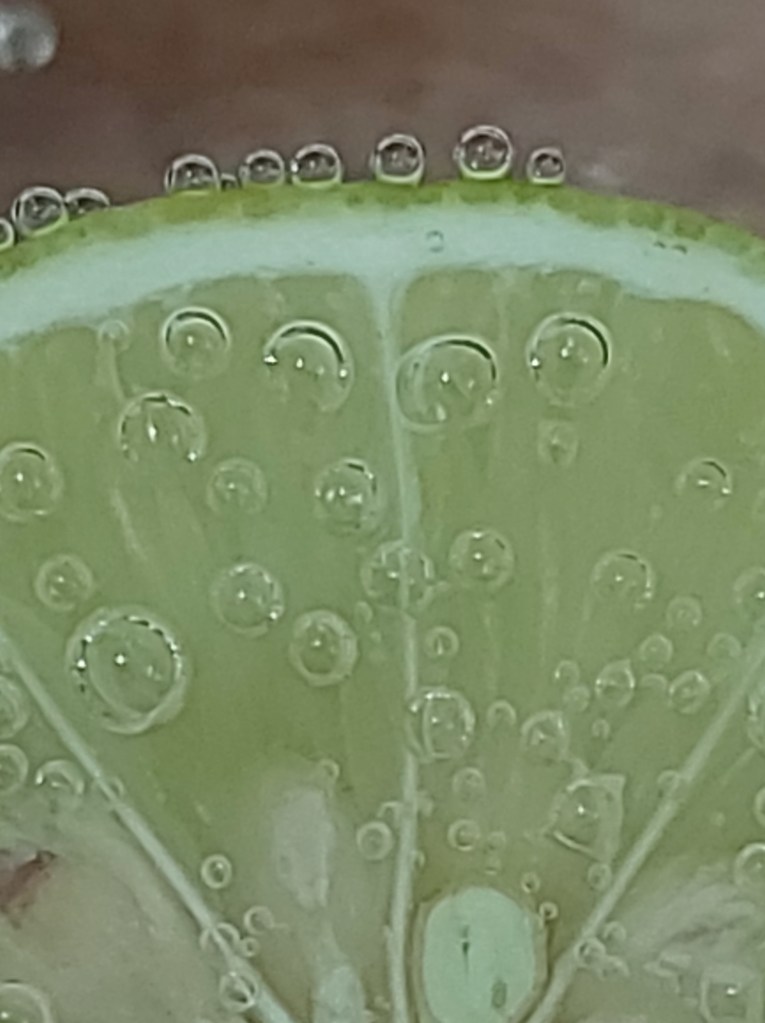
24. Bubbles in nimboo soda

Bubble assembly at a curved lemon-soda interface

One of the fascinating things about liquid-solid interface is that it gives a platform for fluids to assemble in a variety of geometries that can be tailored by changing the properties of the interface. Among the formations, bubble generation and assembly are intriguing aspects. If you observe the bubbles at the interface of a lemon slice dipped in soda(image above), they are almost spherical in shape, indicating a large contact angle.

How fluids interact on a solid surface depends on an important concept called as wetting. Associated with this wettability is the contact angle between a droplet/bubble and the solid beneath it. Based on the measure of this contact angle, one can classify how well or otherwise a drop/bubble can wet on a solid.

For a water droplet resting on a solid surface, larger contact angles, close to 90 degree, indicates that the surface is hydrophobic in nature. A lotus leaf is an excellent example of a hydrophobic surface. If the angle happens to be, say around 10 degrees, then the liquid spreads very easily on the surface and hence it is called as hydrophilic surface.

This kind of classification of surfaces based on wetting has a huge implication in studying liquid-solid interfaces including blood flow, capillary phenomena in plants, and of course in paint and printing industry, and many more.

Recently, I came across a research paper-highlight which connects the formation of bubbles to the energy problem. It always amazes me how simple concepts in science can inspire research problems and lead to fundamental questions and applications.

Let the bubbles rise..

ps: thanks to wordpress app, I have been able to write and post this blog directly from my mobile phone. That makes it quick and easy 😬

Continue reading “24. Bubbles in nimboo soda”

23. Falling droplets….

Below is a video I took on falling water droplets from a tap at my home. Observe how a large drop detaches itself from the tap and falls down, not as a single drop, but as a series of droplets with certain degree of periodicity associated with it. The video was shot at around 960 frames per second.


Why does this happen ? A simple answer is : to minimize surface energy. Interestingly, the transition of a large drop to smaller droplets is mediated via formation of a liquid tread, which further breaks up into smaller droplets. This tread (not evident in my video) takes the form of an instability, and facilitates the process of minimizing the free energy. The nature of this breakup depends on parameters such as surface tension, viscosity, density and geometry of the liquid thread. The initial conditions, such as the opening of the tap and pressure of the flow, too play a critical role in determining the droplet formation.

Actually, the problem of falling droplets has a rich history, which dates back to the times of Leonardo da Vinci (who else Hot smile), who made innumerable observations on the fluid flow (see some comments from his notebook here). There are many other people who have contributed towards our understanding of this problem. In the current literature, this instability problem is generally know as Plateau-Rayleigh instability, name after the two who played a vital role in quantifying this phenomenon and generalizing it to fluid jets.

In recent times, thanks to high speed photography, our visualization and hence deeper understanding of this instability problem has enormously increased. This understanding is fantastically communicated in a public lecture titled “The life and death of a drop” (see embedded video below) given by Sidney Nagel. This video has some spectacular movies captured by high speed camera ( > 10,000 frames per second) and looks at the falling droplet problem from the viewpoint of basic physics. 


Why is this interesting problem ? Apart from the aesthetic and curiosity, the problem of fluid jets and their evolution is of great relevance in understanding fundamental processes of fluid dynamics, including astrophysical situations.  Also, the problem of fluid droplets, their instability and splashing is of huge relevance in applications such as ink jet printing, wall painting, water reservoir management, blood flow analysis and many other problems in physiology and biomedicine. 

What strikes me about the falling droplets is its simplicity and universality. It reminds me of a poem by Emily Dickinson:

Simplicity

How happy is the little stone
That rambles in the road alone,
And doesn’t care about careers,
And exigencies never fears;
Whose coat of elemental brown
A passing universe put on;
And independent as the sun,
Associates or glows alone,
Fulfilling absolute decree
In casual simplicity.

Colloids in Choreographic Time Crystals

Christmas, Christmas Ornament, Concept, Snowflake

Image courtesy: Pixabay – creative commons license

Crystal to time crystal : Periodic arrangement of atoms in the form of a crystal is well known to us. The periodicity in conventional crystal is  with respect to its spatial co-ordinates. An interesting question is : what if  the periodicity of a crystal is also considered in temporal co-ordinates, that is with respect to time ? Such crystals, in which  atoms (or their equivalents) repeat both in space and time are called time-crystals (specifically space-time crystals).

Origins : Although the term “time crystal” was used in biological context in 1970s, it was a research paper by Alfred Shapere and Frank Wilczek in 2012 which brought this interesting concept into mainstream physics. Wilczek, a Nobel laureate, also postulated the concept of quantum time crystal, which has added great impetus to this exploration. These theoretical concepts were experimentally probed and verified by Zhang’s group at UC Berkeley using ions in a cylindrical arrangement. Since then, there is a lot of research activity in this area. My colleagues at IISER-Pune – Sreejith and Mahesh, have created a new variety of time crystals by subjecting periodic NMR pulses to spins in star-shaped molecules .  

    I should also mentioned that after Wilczek’s results were published, Patric Bruno criticized the quantum counterpart based on No-Go theorem argument. There are some interesting debates which are still going on regarding the thermodynamic aspects of these crystals. Also many new applications have been proposed and tested based on the initial predications. To know more about the history and current trends in time-crystals, I suggest a recent, comprehensive review article.

Choreographic (time) crystals : Dance is something inherent to humans, and may be to other living beings. As per google dictionary, the term choreography means the sequence of steps and movements in dance or figure skating, especially in a ballet or other staged dance. In a choreographic time crystal, the movement of atoms (or their equivalent) are in a sequence of steps and co-ordinated, just as in a dance sequence. This means the spatial and temporal co-ordinates of this crystal varies in a predictable way, and hence represents a space-time crystal.  Such a concept was proposed in a paper in 2016. An interesting issue discussed in this theoretical paper is how Bragg’s diffraction law can be modified and adapted to probe such choreographic crystals. Modification of this law in necessary as atoms in a dancing lattice are in constant motion, and to obtain snapshots of the moving atoms one needs a capture protocol (diffraction in this case).

Colloidal dance : Atoms are tiny objects. If we need to probe the spatial and temporal evolution of atoms in a crystals, then we require sophisticated imaging tools (such as scanning tunneling microscope) to track atoms in space and time in an ultra-high vacuum condition. Is there any alternative, cheaper method to this approach? The answer is yes (with some caveats). One way is to utilize colloids (micron-scale objects floating in a fluid)  and treat them as big atoms. This is of course  an approximation, as colloids are classical objects, but many of the physical concepts that are applicable to atoms may be scaled up to colloidal size, and this scaling has been verified and harnessed to mimic and study collective behavior of atoms.

   Coming back to choreographic time crystal, the obvious question to ask is: can we use colloids to visualize the dance of this crystal ? A recent paper in PRL (arxiv version) addresses this question with numerical simulations. The authors first propose an experimental scheme to create a choreographic optical lattice using light as a tool. They hypothesize optical potential wells that can evolve both in space and time, and numerically study the evolution of colloids in such a choreographic time crystal. An important finding from their study is that they identify three phases of dynamics, in which the interaction between the potential-well  and the colloids is weak, medium and strong. In these three phases, they observe chiral looping of colloids, liquid-like behavior and colloidal choreography. I strongly recommend to have a look at the amazing simulation videos for the three simulated regimes of interaction : weak , strong , medium.

Summary : What I have described above is a metaphorical snapshot of how concepts in physics such as time crystals, optical lattice and colloids can come together on a single platform to collectively give something, which is not feasible to obtain by any of the individual entity. The concept of crystal itself is a manifestation of this ‘emergence’ philosophy. In an essence these ideas are both a tribute to, and reinforcement of, the concept:  “More is Different”…..  adieu Anderson….

Updates – COVID times

First of all, my condolences to all people who have lost someone directly or indirectly due to pandemic. Second, my salutations to all the health and essential workers who are striving hard to keep the world breathing. Third, my sympathies to all the free-willing minds who have been locked down. This outbreak has indeed changed our lives and life-style, and has confined most of the humankind spatially, and has metaphorically frozen us in time. Also, it has given us some time for self-introspection on what it is to be an individual in a society, and how actions of individuals and local community can affect the globe. In an essence, what we may be witnessing is a classic case of butterfly effect.

So, what am I up to in the past month or so ?

  • Research work: Now that all my research-group members are away from the institute, it has had an effect on our research. Although online platforms have kept us connected, and we are making slow progress in writing some papers and performing some computer simulations, it can never substitute two important things: experimental work in a lab, and the in-person interaction during research. On personal research front, I have been studying some interesting concepts on liquid crystals, and their related meso-photonics effects. That will be a topic of another blog in future.
  • COVID-related research: For the past year of so, I have been informally interacting with some researchers at Bharat Electronics Limited, Pune on topics related to nanphotonics and optofluidics. Thanks to the recent developments, we have initiated collaboration on research related to COVID. We will be exploring some on-chip optical microscopy and plasmonic methods to detect and interrogate pathogens in our local environment (including virus and virus-like particles). I will update you as we make some progress.
  • An interesting book: Over the past fortnight or so, I have been reading an interesting book titled : Fizzics – The Science of Bubbles, Droplets and Foams. It is a semi-technical/popular science book written by F. Roland Young, who has done considerable research on bubble cavitation and sonoluminescence. This book has some fascinating discussion on questions such as:
  • What is the origin of the sound when we crack our knuckles ?
  • Why and how do bubbles rise in a bottle of champagne ?
  • How to compute a math puzzle using a soap film ?
  • and many more…
  • My posts going further – Henceforth, I wish to post short blogs more frequently. Once in a while, I will post longer essays.

cheers and stay safe !