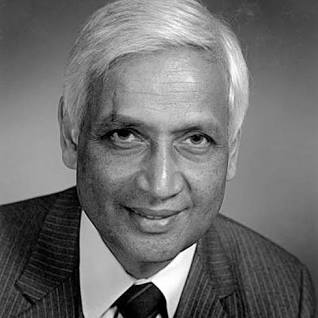
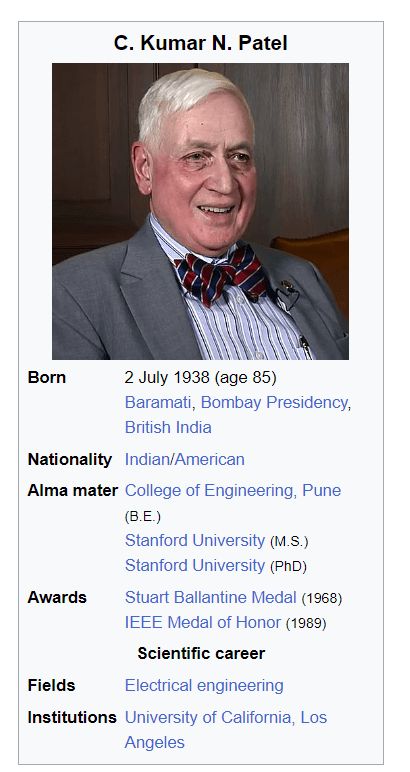
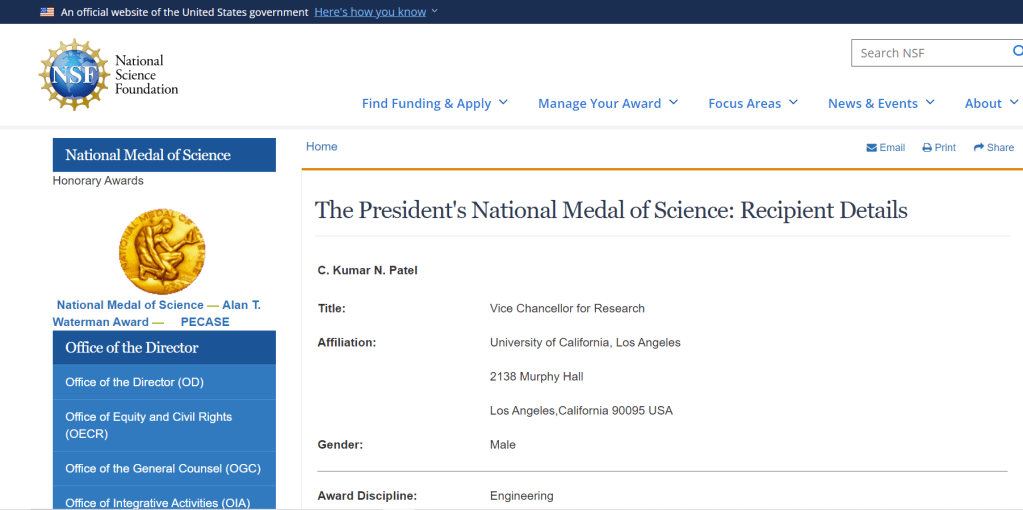
Happy Deepavali: let’s celebrate (laser) light! Did you know there is a connection b/w Baramati, Pune city & the first-ever CO2 lasers? Kumar Patel, the inventor of one of the most powerful lasers, was born in Baramati & did his BE at the College of Engineering, Pune!
Chandra Kumar Naranbhai Patel had an illustrious career. From Pune, he moved to Stanford University for his PhD and then worked at Bell Labs, where he created his CO2 laser. See him describe the invention:
One of the reasons to celebrate Diwali is the move from darkness(ignorance) to light(knowledge). I hope humanity moves toward peace, knowledge and harmony with nature guided by compassion and science. Baramati-born Kumar Patel has shown us one of the ways.
Kannada – ನಿಮಗೆಲ್ಲರಿಗೂ ದೀಪಾವಳಿಯ ಶುಭಾಶಯಗಳು
Marathi – तुम्हा सर्वांना दीपावलीच्या हार्दिक शुभेच्छा
Marie Curie (7 November 1867 – 4 July 1934) and CV Raman (7 November 1888 – 21 November 1970) were born on this day. Both were extraordinary scientists and strong characters.
Marie Curie led an extraordinary life, and her dedication to science was unparalleled. She led a tough life in a male-dominated society and became a great scientist. Previously, I have written about her in one of my blogs on lab writing: https://backscattering.wordpress.com/2018/11/11/expression-as-exploration/
Scientists are human beings. For me, understanding their scientific life history in the context of their society & environment is fascinating. There is always something to learn from their past, not only from their achievements but also from their mistakes.
Scientific research is a creative pursuit. As researchers, we are always looking out for new ideas and inculcate them in our work. One way to get new ideas is to explore existing ideas and bring them together with certain degree of uniqueness and utility. As part of this exploration, scientists communicate with each other and gain some new knowledge. Therefore, as researchers, we encourage and value cooperation as part of our work culture.
Over the past couple of decades, I have been greatly benefited, motivated, and inspired by many of my fellow-colleagues across the globe. Dr. Zijie Yan was one of them. I never met Zijie in person, but I and my research group have read many of his interesting papers related to optical trapping and binding of plasmonic nanoparticles. I have been following his work ever since he was a post doc at University of Chicago, and found his work creative, interesting, and illuminating, to say the least.
In 2020, during the pandemic, we exchanged a few emails related to some technical details of trapping plasmonic colloids, and he was very generous and forthcoming in sharing his knowledge. He gave me some important leads into the wavelength-dependence of trapping capabilities, and suggested a few references. These leads were very beneficial for us to build upon some concepts and techniques that we were developing in my lab, which further led to some publications. After we published some of our results, I sent him our pre-prints, and thanked him for his input.
When I heard the sad news of Yan’s untimely death at University of North Carolina (UNC) at Chapel Hill, I was shocked. As you may, know this was caused by gun shooting (allegedly by his own graduate student). What a tragic news.
USA has great universities. In late 2000s, I spent two of my post-doctoral years in the US (Purdue University), and it was a pleasure living and working there. As an intellectual ecosystem, USA still leads the way, and it has been home to so many scientists and intellectuals from across the world. As with any society, USA has some flaws, and among them gun violence is turning out to be a major hurdle to its own progress and values. I sincerely hope that sanity will prevail among a large section of American society, and somehow this meaningless and violent aspect of their society is eliminated.
Sometimes, we take peace of mind for granted, but it is probably the most important pre-requisite to work. It is also a timely reminder for all of us in this world to emphasize the importance of humanness, compassion and rationality. Violence is never an answer.
Zijie was emerging as one of the stars in our research community, and what a shame that we have lost him so early. Let me end with the first few sentences of Zijie’s reply to my email in 2020:
“Dear Pavan,
Thank you for your interest on our research! Glad to hear someone from the community……”
My thoughts are with his family and well-wishers.
Goodbye Zijie. We, as a community, will remember you.
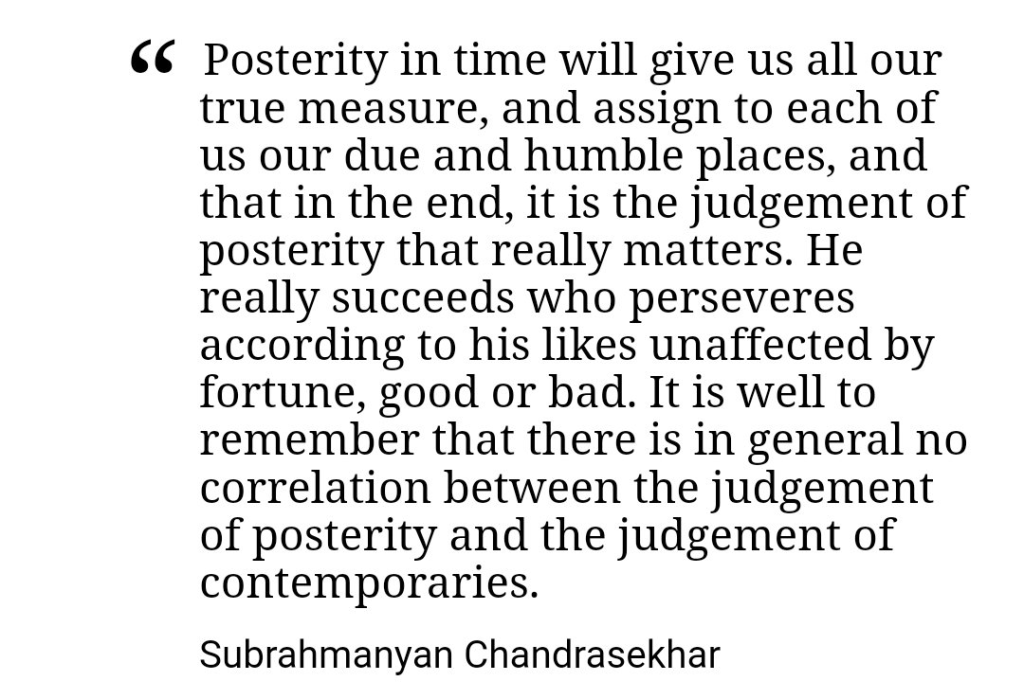
One of my all time fav. quotes. Chandra got it from Milne. Chandra had great temperament for scholarly work, & one can learn a lot from his style of working. His biographer, KC Wali, was a particle physicist, & his article linked is worth reading: https://jstor.org/stable/24100199
If interested, you can listen to a podcast I did on Chandra (one of the two of the similar name)…
On 23rd Aug 2023, ISRO made history by landing a spacecraft close to the south pole of the moon. For a long time in India, I have not seen such an enthusiasm for science and technology, and it was indeed heartening to experience this. In reference to the proceedings in recent times, below are some brief lessons I learnt :
For space programs, strong foundations in computation coupled with deep understanding of computer-assisted hardware is vital. Traditionally, India had good strength in computational aspect, but this mission showcased its capability in computer-assisted hardware and manipulation. As expected, ISRO is leading the way, and it is important to emulate this software-hardware coherence in other sectors.
Science and Technology need not be a zero-sum game. Collectively, they have a lot to offer to the Indian society. The mission shows how investing in scientific activities can positively influence a society. In an essence, collective scientific endeavors like Chandrayaan strengthens our democracy.
ISRO’s ability to learn from past failure is commendable. It showcased how scientific experiments should be approached, and how missions should be accomplished.
There was a significant proportion and contribution of women in Chandrayaan 3.
A reasonable and sustained research-budget given to a dedicated set of people can, sometimes, achieve remarkable things. That should not be a reason to limit funding towards research. This should encourage our society to further support scientific research.
Some parts of social media and online news portals played a better role in broadcasting and discussing the mission than Indian TV channels.
Some news papers (I read Indian Express (in print) and non-paywalled parts of Hindu online) did a good job of explaining many scientific concepts.
Global south has tremendous scientific potential. The Indian sub-continent must take up collective scientific endeavors to have a greater impact in the region. India can lead the way.
Classical physics and Engineering Science is alive and kicking. There is still a lot to explore and understand nature at ‘macro’ scale. It also highlights the importance of strong foundations in science and mathematics.
At the heart of all these things is human curiosity and rationality. Nurturing this curiosity and rationality is our collective responsibility. It not only offers transient joy, but also orients our collective action to make this world a better place. After all, it resonates with वसुधैव कुटुम्बकम (“The World Is One Family“).
In the exuberance of the #OppenheimerFilm, lest we forget the PhD advisor of Oppenheimer – Max Born and one of the fundamental principles of molecular quantum physics :



 VISMAYA - History & Philosophy of Physics