In the past 14 yrs of my research group, I have made a few policies for myself, which may be helpful to others:
1) Any group member is free to criticize my input with reason. This has been one of the most liberating experience. Importantly, it has helped me learn.
2) Physical and mental health of group members is of primary importance. Good health and good research is not a zero sum game.
3) Constancy of thought and work is vital. We overestimate work that can be done in short term and underestimate the long term. Constant effort, spread over months and years, can build intellectual and technical monuments.
4) Set internal standards. Let this standard be reasonable and focused towards oneself. The biggest stress in work comes from comparison with others. Instead, compare your past with present, & strive for a +ve difference. Be sceptical of external metrics.
5) Write regularly. Writing is not only about publication in a journal or a book. It is a way to reflect, learn, revise and communicate. Writing is the process. A publication is one of the outcomes, a temporary goal. Focus on the process, goals will follow.
6) Share your knowledge. If possible – TEACH. Teaching informally is very enjoyable. It is devoid of judgements. In the longer run, it is perhaps the most impactful thing you will do, and will be remembered for. Remember Feynman.
7) None of the above points matter if your work does not make you a better human being. Be compassionate to others. The biggest strength of scientific research, if done well is it elevates the individual & collective – both local & global.
8) Academia, in its good form, can feed your stomach, brain and heart. Nurturing and enabling all the three is the overarching goal of academics. And perhaps the goal of humanity.
To wonder is to be human. At the heart of wondering is questioning. As an individual and a collective, encouraging people to ask questions is one of the most important things we can do. Start with your children or young people around you. Encourage them to question you. Try to answer them honestly. If you do not know the answer, explore the answer with them. Emphasize that no answer is complete and is subject to revision upon new evidence and ideas. In my opinion, this process is the safest training you can give them as an adult and help them become informed citizens.
Along the way, teach them two things: 1) how to formulate a question and 2) pay attention to the tone of the question they ask.
Formulating a good question is a challenging task and requires iteration. Iterations mean patience. So, asking a good question is a training in patient thinking. Discourage rushing through. That does not mean the upper time bound is infinite. This means you shouldn’t settle for the default question. Question the question.
Next is the tone of the question. It is the tone which determines the intention of the question. If your intention is grounded in humility, curiosity and transparency, you will have a better chance of obtaining an answer. A question asked in a condescending tone generally discourages people from answering, even if their intention is not to conceal.
Of course, these are not general rules but guidelines that may be useful.
Conclusion: Pay attention not only to the substance of your question but also to the form of your question. A questioning mindset can be extrapolated to your everyday thinking. Gradually, it will become a way of life. Learning is more important than ego. When you realise this, questions become a great tool to explore the world.
Any physics buff would know Bose-Einstein condensation and the statistics named after them. An interesting fact is Satyendra Nath Bose (SN Bose) also served as a member of the Indian parliament.
SN Bose was a member of the Rajya Sabha. Notably, he participated in some debates on bills, mainly in the second term, circa 1955 onwards. He was part of the earliest formulation of THE UNIVERSITY GRANTS COMMISSION BILL, 1954. See this link for the bills in which he was involved.
Bose also participated in some debates in the Rajya Sabha, mainly regarding education/research.
Below is an excerpt of his speech related to UGC bill, and shows his interest in the then university/academic system of India (emphasis added) :
It has, of course, been suggested that this particular Commission would be able to solve the problem of education in this country. I may, however, point out that in this task we will ultimately have to depend upon the responsible people that are in charge of education inside the Universities. I also know, Sir, that every teacher in our country is alive to his responsibility, and the corporate bodies that we have set up in our land are also serious about their tasks. I do not feel, Sir, that the standard of our universities has gone down to a very ludicrous level. I do not feel so, because I remember the long list of persons that have been turned out by these universities who had served the national cause, and who have been and who still continue to be the leaders of thought in our country. We also remember. Sir, that in many of these universities, there are young people and workers who have achieved fame and distinction, who have contributed substantially to the cause of learning, and who have made the name of India respected in different lands. Therefore, Sir, you need not have any misgivings about the way in which, work is being done in our universities. All that is wanted is that you should be generous, and you should set up an efficient machinery which should be able to get in touch with the people who work at different centres, and should find out what they need. And you should be able to supply those needs in the form of grants, which may either be given out of the Consolidated Fund of the Government or out of the fund set apart for this purpose, which would be administered by the Commission.
As you can observe, SN Bose is making a case for increased funding to the Indian research community and is emphasizing the availability of excellent human resources in universities. As researchers in India, we must ask ourselves whether we have lived up to his confidence and effectively addressed these issues over the past several decades. I believe we have not. Bose’s optimism motivates us to relook at our system and self-reflect on pursuing scientific and technological research in India. A good starting point is to ask for ‘ease of doing research and teaching’.
A few Indian scientists of the past, including Meghnad Saha and MGK Menon, were also members of the Indian parliament. Still, this representation needs to be improved, as discussed by my colleague MS Santhanam. Scientists inclined to take politics to influence society must openly express their opinions on policies related to science and technology. If they do get elected to the office, it is their imperative to actively participate in parliamentary debates and ask and address relevant questions, especially about education and research.
After all, the foundation of democracy is based on ‘questions and answers’, and interestingly, that is also the foundation of scientific method.
How do you determine the refractive index of a material which is not transparent?
In 1895, J.C. Bose addressed this question experimentally using ‘electric rays’, which we currently know as microwave radiation!
The citation of the paper is
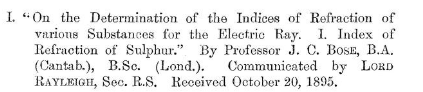
Bose, J. C.,I. On the determination of the indices of refraction of various substances for the electric ray. I. Index of refraction of sulphur. Proceedings of the Royal Society of London, 59(353–358), 160–167. https://doi.org/10.1098/rspl.1895.0069
Below is the title of the paper that was communicated to the Royal Society via Lord Rayleigh, who was an authority on optical concepts Bose was using.
His experiment used the microwaves’ total internal reflection and extracted the samples’ refractive index through Brewster’s angle.
Bose beautifully describes his method as follows :
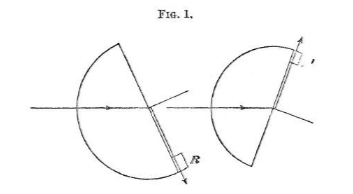
The angle of incidence is slowly decreased till the critical value is reached. At this point the ray is all at once refracted into the air, making an angle of 90° with the normal to the surface. If a receiver be fixed against the side of the semi-cylinder at II, it will now respond to the refracted radiation.
Below is the diagram depicting the same principle :
And the detailed description is as follows:
The refracting substance is cut out or cast in the form of a semi¬ cylinder, and mounted on the central table of a spectrometer; the electric ray is directed towards the centre of the spectrometer, and its direction is always kept fixed. It strikes the curved surface and passes into its mass without any deviation. It is then incident on the plane surface of the semi-cylinder, and is refracted into the air beyond.
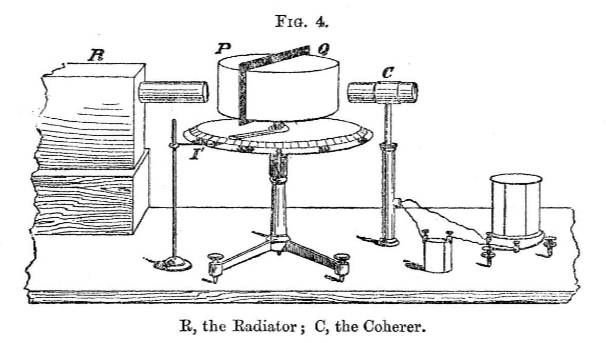
The apparatus design was also interesting, and the diagram below depicts what we nowadays call the microwave transmitter (indicated as radiator, R) and receiver (indicated as Coherer, C).
If you read the paper completely, the details of experiments are described meticulously, and the attention to detail is remarkable.
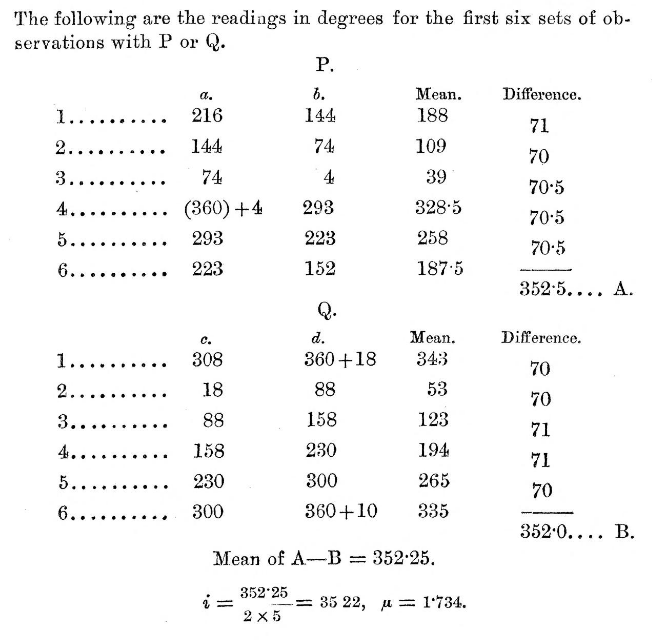
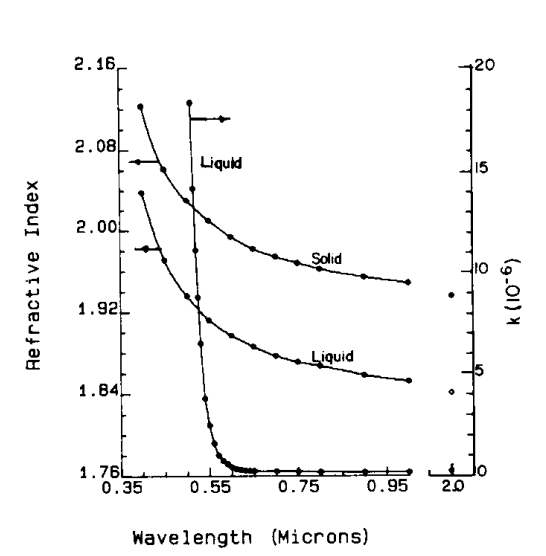
So, he determines the refractive index of sulfur using this method and ends up with a value of 1.734, which is quite accurate even by today’s standards (the value is upwards of 1.7 and depends on the wavelength of light). Notice that the measurement was made to the accuracy of three decimal places, which is impressive. Below is a set of data for which the value of the refractive index was determined.
Now compare this to the modern measurement (see below data from around 1985) of refractive index based on more sophisticated methods, and you will see the matching is reasonably good at higher wavelengths close to 1 micron. (Note that Bose’s measurements was at higher wavelength than shown below)
Since the 16th century CE, improving the limits of optical resolution has become an essential technical goal in optics research, and it continues to challenge us even today. When they were introduced, optical microscopes opened a new world for humans to observe, learn and eventually control matter at microscopic scales. A logical progression in this thought was to extend the resolution limit to the atomic scales unavailable to optical microscopes. Enter the ‘electron’ microscope. They changed the game entirely and paved the way to visualize matter at the atomic scale.
Electron microscopes were invented in the 1930s. When they were built in some laboratories, there was considerable public interest in understanding these “advanced” tools, as witnessed by a short but interesting article in the September 1940 edition of Popular Mechanics.
Sept 1940: Above is an image and description of one of the earliest electron microscopes published in Popular Mechanics
First applications of the electron microscope are expected to be in biological and industrial research.
This is interesting because electron microscopes were still in their infancy, and the working principles were explored for better quality images and sample durability.
The origins of the electron microscope have an interesting history and were inspired by optics (for an interesting commentary, see Freundlich, Martin M. 1963. “Origin of the Electron Microscope.” Science 142 (3589): 185–88. https://www.jstor.org/stable/1712183). The first demonstration of a working microscope was by Ruska and Knoll (Z. Tech. Phys., 12 (1931)), and the conceptual foundations date back to the late 1890s. Ruska was eventually awarded a Nobel prize for his work on electron optics and the invention of the electron microscope in 1986.
As with any development in science and technology, an idea becomes a seed to another idea. In the case of electron microscopy, it led to some early motivations behind the invention of optical holography by Dennis Gabor, which eventually fetched him a Nobel Prize in 1970.
Dennis Gabor was also inspired and interested by the invention of electron microscopes. He played a critical role in formulating the problem of resolution limit, which further led to the invention of holography. To quote his Nobel lecture :
Let us now jump a century and a half, to 1947. At that time I was very interested in electron microscopy. This wonderful instrument had at that time produced a hundredfold improvement on the resolving power of the best light microscopes, and yet it was disappointing, because it had stopped short of resolving atomic lattices. The de Broglie wavelength of fast electrons, about l/20 Ångström, was short enough, but the optics was imperfect. The best electron objective which one can make can be compared in optical perfection to a raindrop than to a microscope objective, and through the theoretical work of O. Scherzer it was known that it could never be perfected.
Interestingly, Gabor started his work in Germany but had to move out of the country due to the political situation. As he mentions in his biographical note :
In 1933, when Hitler came to power, I left Germany and after a short period in Hungary went to England. At that time, in 1934, England was still in the depths of the depression, and jobs for foreigners were very difficult. I obtained employment with the British Thomson-Houston Co., Rugby, on an inventor’s agreement. The invention was a gas discharge tube with a positive characteristic, which could be operated on the mains.
He stayed back in England and continued his work. The important aspect is that the development of electron microscopy eventually led to some fundamental experiments in optical holography. To quote Gabor’s biographical note :
The years after the war were the most fruitful. I wrote, among many others, my first papers on communication theory, I developed a system of stereoscopic cinematography, and in the last year, 1948 I carried out the basic experiments in holography, at that time called “wavefront reconstruction”. This again was an exercise in serendipity. The original objective was an improved electron microscope, capable of resolving atomic lattices and seeing single atoms. Three year’s work, 1950-53, carried out in collaboration with the AEI Research Laboratory in Aldermaston, led to some respectable results, but still far from the goal. We had started 20 years too early.
The general notion in optics is that experiments in the visible light frequencies led to developments in electron microscopy. In the case of optical holography, at least in the initial stages of its invention, electron microscopy played a critical role. Developments in electron optics led to some fundamental questions in optical wavefront reconstruction. This further led to optical holography.
An interesting way to look at Galileo's work. Has some interpretations from a modern capitalistic viewpoint.
From a history of science viewpoint, I am curious to know if such thought process was common in the medieval age or was particular to Galileo. https://t.co/JvXySKlk1q
November 1783, John Michell published a paper on ‘dark stars’.
This was kind of a preamble to the concept of black holes & interestingly, was based on Newton’s corpuscular theory of light and the slowing down of light due to gravity!
Part of the original paper (the beginning) is reproduced below :
The first few lines of Michell’s 24-page paper elaborate on his idea. As you may observe, he makes a remarkable connection between the velocity of light and the measures related to stars (distance, magnitude, etc.)




 VISMAYA - History & Philosophy of Physics