We have a new paper published in Journal of Physical Chemistry Letters on “Single Molecule Surface Enhanced Raman Scattering in a Single Gold Nanoparticle-Driven Thermoplasmonic Tweezer”
Thanks to the fantastic effort by Sunny Tiwari, and excellent support by Utkarsh Khandelwal (former IISER-P undergrad) and Vandana Sharma from my group, we have been able to combine single molecule Raman scattering with a specialized nanoscale optical tweezer.
The uniqueness of this tweezer platform is that the optical trapping process is driven by the thermo-plasmonic potential created by a SINGLE, 150nm GOLD NANOPARTICLE. Concomitantly, the same field can be used to perform single-molecule Raman spectroscopy. Kind of “ek teer mae do shikar” strategy
Using this system, not only we push the limits of optothermal trapping of a single nanoparticle (see video) at low laser powers, but also create a platform for deterministic transport of reversible colloidal assembly in a fluid.
We envisage that our nanometric plasmonic tweezer can be harnessed to trap and tweeze biological entities such as single virus and bacteria. Another possible application of our study is to create reconfigurable plasmonic metafluids in physiological and catalytic environments, and to be potentially adapted as an in vivo optothermal tweezer.
In short, we show, how by bending a nanowire we can narrowly beam the light scattered from molecules (see adjoining picture).
Optical emission from quantum objects such as atoms and molecules are very sensitive to their local surroundings. One of the current challenges in controlling optical emission from molecules at subwavelength scale is to narrow their scattering directivity. In the context of molecules, controlling light scattering at sub-wavelength scale has utility in optical trapping of molecules, molecular QED, cavity molecular mechanics, molecular quantum optics and many other areas of research.
Thanks to the great effort by Sunny Tiwari in my lab, who in the middle of the pandemic, tirelessly executed the idea of beaming elastic and Raman scattering emission from molecules in the vicinity of a bent plasmonic silver nanowire resting on a metallic mirror. He was ably supported by Adarsh (now at ETH), Dipta and Shailendra. Together, they experimentally confirmed the beaming characteristics from this geometry and corroborated with elaborate numerical simulations.
This work further motivates questions related to directivity control for single photon emitters and can be potentially harnessed for momentum-space engineering of nano-optical forces……
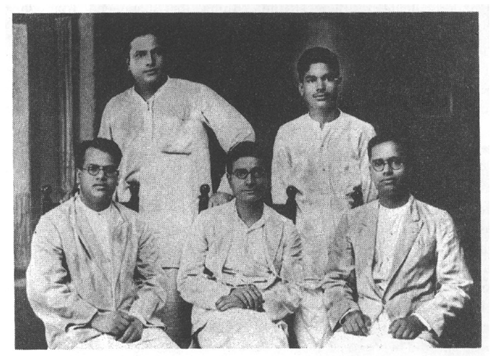
Above picture : A group of 5 students of Raman. Front row- Left to Right 1) S. Vekateswaran, whose observations on the polarized ‘weak fluorescence’ of glycerine in early 1928 started the last lap of investigations which led to the discovery of the Raman effect. 2) K. S. Krishnan, he was 31 when this photograph was taken. 3) A. S. Ganesan – spectroscopist, later editor Current Science, who worked with Raman. He compiled the first bibliography of the Raman effect which Rutherford submitted to the Nobel Committee when he proposed Raman for the Nobel Prize. Back row. 1) C. Mahadevan, who later became renowned geologist who did his post-graduate work with Raman on X-ray studies of minerals. He was present at the Indian Association for the Cultivation of Science in Calcutta during the momentous discovery of the Raman effect and he has left graphic accounts of what happened then. Right S. Bhagavantam, another renowned student of Raman, who worked with him after the discovery of the Raman effect and is well-known for his application of group theory to the Raman effect. Reproduced from Current Science, Vol 75, NO. 11, 10 DECEMBER 1998
Today is National Science Day in India. We celebrate this day in commemoration of the discovery of the Raman effect. I have previously written about the significance of this day.
One of the important aspects of the discovery of the Raman effect is the role played by the then student K.S. Krishnan, who went on to be become a distinguished scientist and the founding Director of National Physics Laboratory, Delhi. There were also a few others who played a part in this discovery too (see picture)
Raman Research Institute has an excellent repository of the collected works of Raman. It also has a lot of content about Raman.
“I (Ramaseshan) said there was a view that he (Krishnan) years discovered the Raman effect for Raman and this view had again surfaced. His reply was ‘It is a blatant misrepresentation. The best I can say is that I participated actively in the discovery”
Krishnan goes on to say how it all started with Raman taking the initiative. In fact, Krishan vividly describes the scene :
‘The story starts in the early Febrauary 1928 when Professor (Raman) came to my room and said “I want to pull out of the theoretical studies in which you have immersed yourself for the 2 or 3 years. I feel it is not quite healthy for a scientific man to be out of touch with actual experimentation and experimental facts for any length of time’
Interestingly, Raman and Krishan fell out of each other, and this interview has some snippets of this controversy. The article has some comments by S. Chandrasekhar on the credit of discovery behind Raman effect, in which he attributes Raman and Krishan’s collaborative approach towards the discovery, and mentions about the importance of exchanging ideas between two researchers working on a problem.
Overall, I must mention that the interview and the historical anecdotes in the document are riveting to say the least, and also showcases the complexity and sociology of a scientific discovery.
Science, per se, is objective. But pursuit of science has a human element, which makes it complex and interesting…
So always remember that as we commemorate the effect named after a person, but there are a few more people who have contributed to it. After all, science is a collective human endeavor.
There is no Frigate like a Book
To take us Lands away
Nor any Coursers like a Page
Of prancing Poetry –
This Traverse may the poorest take
Without oppress of Toll –
How frugal is the Chariot
That bears the Human Soul –
Generally speaking, scientists are natural philosophers: they observe nature, ask questions, hypothesize an answer, test them through experiments and extend this exploration by escaping into the universe of ideas in books and journals. New ideas emerge from this exploration and join the chorus, and the intellectual journey continues. In my own research on light scattering, I have been deeply influenced by ideas of various fellow-explorers. For me, journal papers and books encompass the “metaphorical oxygen” for creativity and knowledge. Below I introduce you to some classic books which keep my research alive.
Comments: There are two kinds of authors who write textbooks. One is the ‘boring kind’ and the other is the ‘Bohren kind’. If you want to fall in love with light scattering (and science in general), read books and articles by Craig Bohren. It will not only deeply influence your thinking, but also will show how a textbook can, and should, evolve a subject systematically. This particular classic has some of the most important ideas related to how light behaves when it interacts with matter comparable to the wavelength of light, and forms the bedrock on which a lot of contemporary research, including nanophotonics and plasmonics, is pursued. This book has wit, humour and a touch of poetry jumbled up together as flowing river of knowledge. To give you a spirit of their writings, let me reproduce the first paragraph of their introduction
Comments: The first edition of this book was published in 1957, by the author was a legendary astronomer. This book has a beautiful description of single and multiple-scattering phenomenon, and describes specific situations where they apply. Written with an astrophysical viewpoint, it elegantly combines depth and breadth in a lucid way. This book has perhaps served as inspiration to most of the books written on light scattering.
Comments: Some researchers have remarkable ability to choose problems that have far reaching consequences beyond the next research paper. Milton Kerker was one such legend. His research papers and this book has not only influenced the way physics of light scattering is studied, but has had deep impact on utilization of light scattering in various branches of science and technology. This 600 odd page book is indeed a masterpiece, and in a unique way caters to almost all kinds of researchers who are interested in light scattering.
Comments: A majority of the matter in biology and chemistry are suspended in a fluid. When an object in a medium undergoes Brownian motion, it influences the way a light beam scatters and traverses through that medium. This book explain the how and why of this fascinating topic. Written by experts in chemical physics, this classic serves as the foundation for light scattering in soft-condensed matter physics.
Comments: Historically, light scattering by molecules has been studied by legends such as Rayleigh, Raman and many more. Interestingly, all these legends emphasized the connection between polarization of scattered light and structure of matter. In this book, Barron puts together these ideas in a very elegant way, and motivates and develops the phenomenon of optical activity from a molecular physics viewpoint. Given that a majority of biomolecules are chiral in nature, the insight that one obtains by reading this book has direct implication in understanding the structure and dynamics of biomolecules such as amino acids, proteins and DNA.
Comments: Mischchenko is a scientist at NASA, and his books on light scattering have had great influence in aerosol science, radar technology and many more. The T-matrix codes based on this book forms a very important tool across the research community that works on weather prediction and pollution monitoring.
Comments: This classic from late 1970s was one of the elaborate attempts to put together wave propagation and scattering in a random media on a rigorous mathematical foundation. This 2 volume book has solutions to various mathematical problems that one encounters in light scattering physics, and makes an important connection to transport theory of light in a medium.
Comments: If you are interested in experimental aspect of light scattering, this is one of the best books. It is essentially a field guide, which tells you how to quantitatively make a light scattering measurement, and what aspects to look-out for. This is a very good book for students who want to get a hands-on experience in light scattering.
Comments: Chu’s book develops the topic of laser light scattering in terms of both experimental aspect and theoretical foundations. Importantly, it connects the topics of light scattering to optical spectroscopy, and shows how one can obtain meaningful information about light-matter interaction.
Comments: Quantum mechanical entities such as electrons and photons can be confined in space and time. Depending on the geometry of confinement, very interesting physics such as weak and strong localization can emerge. This book looks at the physics of confined electron and photon from a unified viewpoint. It highlights similarities and difference between the electrons (fermions) and photons (bosons).
Comments: Written by a pioneer in the field, this book till date remains the most rigorous treatment on Raman scattering of light from a theoretical viewpoint. Based on quantum mechanical arguments, this book relies on perturbation theory, and clearly shows the connection between structure of molecules and how they influence the scattered light.
Comments: The most definitive book written on surface enhanced Raman scattering by two physicists whom I greatly admire. This book gives unified treatment of plasmonics and surface enhanced inelastic light scattering, and is written in a style catering to physics audience. The book has a lot of details and explanations, and also serves as excellent introduction to plasmonics and vibrational spectroscopy. Given that the authors themselves are pioneers in single-molecule Raman scattering, their insight into single molecule optics in plasmonic field is fascinating. Unfortunately, Etchegoin succumbed to cancer, and I could never meet him. However his great ideas and thoughts stay on…
Comments: Random lasing is an emerging topic of research in nanophotonics. The fact that one can have random structures assembled in space and time, and yet achieve spatial and temporal coherence is quite remarkable. This book brings together insights from wave scattering and mesoscopic physics to show how light behaves when confined to small volumes compared to wavelength of light. The insights obtained from this book are heavily used in the literature on random lasers.
Author(s): Craig F. Bohren and Eugene E. Clothiaux
Comments: Bohren weaves his magic…..again. Although the title of this book indicates atmospheric radiation, the way the authors treat the topic of absorption, emission and scattering of light is fascinating. This book gives a broad viewpoint of interaction of light with matter, and shows one can and should treat the subject coherently. The references and problems are very relevant and interesting, and I have found some gems while reading through this text.


 VISMAYA - History & Philosophy of Physics