Here I discuss the paper that announced the Raman effect to the world…
Category: Raman Scattering
Raman in a marriage reception
C.V. Raman was obsessed with science, and he was actively thinking about research problems even on odd occasions when he was supposed to be socializing. Nagendra Nath, in 1971, recounts1:
In November 1969, he and Lady Lokasundari Raman were graciously pleased to attend the marriage reception of my daughter. Professor drew me aside outside the reception hall and told me for nearly half-an-hour that his latest problem was to give a proper theory of earthquakes. The present theories were based on models which were highly deficient as they did not properly take into account the shape of the earth and the wave nature of the disturbance.
Nearly half an hour !!
Imagine the condition of Nagendra Nath :-)
- Nath, N. S. Nagendra. ‘My Professor’. Current Science 40, no. 9 (1971): 234–35. https://www.jstor.org/stable/24074207.
↩︎
Raman essay and Open-Access
I see that the essay I wrote on CV Raman and made open access (thanks to Resonance, which published it) has been used by several educators on YouTube, including some in Indian languages. Also, the Google AI overview shows the published essay as the main reference for a search related to Raman’s science communication (see slideshow below).

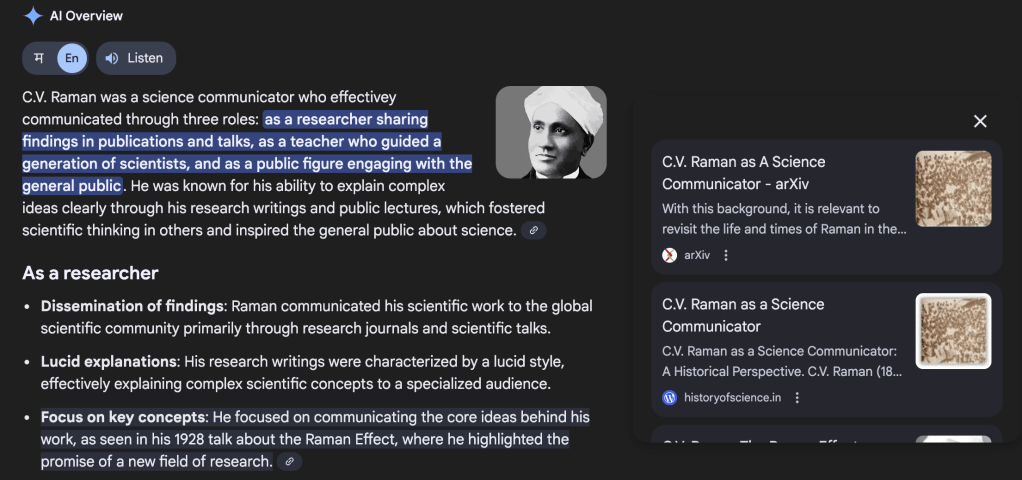
I am glad to see that making one’s writing open to all has positive effects. Open-access, not just for readers, but also for authors, is beneficial. Especially in India, paywalls for science are a detriment.
My worry is that open-access publishing has been mainly driven by commercial publishers that extract huge funds from the publishing authors. This defeats the purpose of open science, especially when the research of an author is publicly funded. Added to that, Indian researchers and writers cannot afford to pay huge sums for publishing articles and books.
The publication landscape (including journals and books) across the world needs an introspection. Open-access model is effective only when the readers and authors have access to that model. Otherwise, the model becomes a paywall for authors.
Floral colours, CV Raman and illustrations

In the 1960s, C. V. Raman wrote a series of papers on floral colors and the physiology of vision. In there, he was very interested in the origin of colors from various different flowers. This was also motivated by his fascination with optics and natural colors in vegetation. Specifically, during that era, he had a large garden at his institution and he was deeply immersed in understanding the origin of the colors from these wonderful living creatures.


By using his knowledge of spectroscopy and the chemistry of pigments, he was able to explore some of the spectral features of the floral colors. The diagrams that you are seeing are illustrations from his paper published in 1963.
As you can observe, these illustrations are beautifully created. I don’t know whether Raman himself drew these pictures, but one should really appreciate the artist who has created them.
In a broader sense, it also indicates two important aspects. The first is that Raman was deeply motivated by natural phenomena. His intuition of optics helped him to understand the origins of a variety of natural optical processes. Spectroscopy was a crucial element in all the things that he did. The second aspect is that, in a deeper sense, aesthetics is interwoven with the pursuit of science and Raman’s work, especially towards the later part of his life, showcased it.
There is a fascinating video conversation with Richard Feynman where he describes the appreciation of the beauty of flowers by a scientist. Raman’s appreciation of beauty is close to what Feynman is describing in the video.
C. V. Raman was a curious person. He had a deep inclination to explore natural phenomena, using the knowledge and tools he had accumulated over several decades. In that sense, he was a scientist driven by curiosity before and after his Nobel prize.
Next time when you see a flower, remember that it is a creature of beauty and science merged together.
ps: blogpost in audio-visual format
Essay on Raman – now on arXiv
Here is the link to my essay on #arXiv : https://arxiv.org/abs/2403.04773 and it has a digital address for further reference: arXiv:2403.04773

Preamble to the discovery of Raman Effect
Today is India’s National Science Day. It celebrates the discovery of Raman effect on 28th February, 1928.
For more details on the discovery of the effect, and various human aspects related to it : you can see my past blogs here, here, here and here.
In this blog, I will briefly discuss about some of the work that directly influenced Raman’s thinking that further led to a remarkable discovery that we know by his name.
All creative pursuits are motivated by ideas from the past. No one gets their ideas in vacuum. All of us are influenced by the information which we perceive and receive. This means consciously or subconsciously the world that we are creating, both in our minds and in reality, is fundamentally influenced by the information in the world.
The discovery behind the Raman effect is no exception to this particular principle. In his formative years, C V Raman was heavily influenced by the research of Rayleigh and Helmholtz, and some classical thinkers including Euclid. Raman was also closely following the development of quantum mechanics in the early 1920s, and he was keenly studying the theoretical and experimental developments in this field.
Two aspects which played a crucial role in motivating Raman’s (Nobel prize winning) work was Compton scattering and Kramers-Heisenberg formula.
Compton scattering was as outstanding experimental achievement that revealed two aspects of light-matter interaction. First, it demonstrated inelastic scattering of electromagnetic radiation interacting with a quantum object (in this case free electrons) in the laboratory frame. Second is that it laid a foundation to revisit the wave-particle duality of light from an experimental viewpoint. Raman and Krishnan’s main paper on light scattering starts by explicitly referring to Compton effect, and motivates observation for optical analogue of Compton scattering.
To quote from Raman’s Nobel lecture :
“In interpreting the observed phenomena, the analogy with the Compton effect was adopted as the guiding principle. The work of Compton had gained general acceptance for the idea that the scattering of radiation is a unitary process in which the conservation principles hold good.”
Next is the Kramers-Heisenberg formula. This mathematical description gives the scattering cross section of a photon interacting with a quantum object (in this case electron). This formula uses second-order perturbation theory, and evokes the famous ‘sum of all the intermediate states’ for non-resonant optical interaction. PAM Dirac played a vital role in deriving this formula from a quantum mechanical framework of radiation. An important and logical consequence of this formula is the emergence of stimulated emission of radiation, and this has had deep implications in understanding LASERs. Raman was keenly studying the formula and made a brilliant conceptual connection between laboratory observation and this formula that revealed the scattering cross-section.
Again to quote from Raman’s Nobel lecture:
“The work of Kramers and Heisenberg, and the newer developments in quantum mechanics which have their root in Bohr’s correspondence principle seem to offer a promising way of approach towards an understanding of the experimental results.”
The above two concepts were important ideas that motivated Raman scattering experiments. Importantly it highlights the jugalbandi between theoretical intuition with concrete experimental observations, which forms the bedrock of modern physics.
Newton famously mentioned about the discoveries he made by ‘standing on the shoulders of the giants’. Various people involved in creative pursuits including scientists acknowledge the fact that new ideas emerge from convergence/mutation of old ideas. The harder part of creativity in science, or for that matter any art form, is to choose the right ideas to combine so that the ’emergent’ new idea has greater value compared to the individual parts. In that sense, science is a great form of creative activity that not only combines old ideas to create new valuable ideas, but also transforms the perspective of the individual seed ideas. Thus ideas combine and evolve.
So let us combine good ideas and evolve. Happy Science Day !
FCS workshop – talk slides
I gave a tutorial talk on “Plasmons, SERS and more”: at National Workshop on Fluorescence and Raman Spectroscopy
Below is the embedded file of the presentation
Roadmap for optical tweezers is on arxiv
I am delighted to share the arxiv link to Roadmap For Optical Tweezers : https://arxiv.org/abs/2206.13789

This document brings together researchers from 52 different affiliations across the globe to look into the accomplishments and future directions of optical tweezers.
My contribution towards roadmap appears on page 136, topic number 31 on — Raman scattering in (thermo)plasmonic tweezers.
In there, I discuss how plasmonic platforms can be used to generate attractive optothermal forces to trap and interrogate molecules and nanoparticles, down to single copy limit. I also discuss the challenges and opportunities of such a process.
Optical tweezers is one of the most powerful optical tools that finds utility not only in fundamental physics, but also in diverse applications including biology and medicine.
Ever since the Nobel prize-winning work of Arthur Ashkin, optical tweezers have evolved and continues to evolve into various forms. This roadmap article aims to capture this evolution, and to discuss the emerging capabilities and challenges of optical tweezers.
A big thank you to
Giovanni Volpe
Onofrio M. Maragò
and Halina Rubinzstein-Dunlop
for their leadership in this field and for the herculean task of coordinating and editing this roadmap….
The roadmap has been submitted to Journal of Physics : Photonics (IOP)
Talks on C.V. Raman – YouTube links
Below are the YouTube links to the 2 talks I gave on C.V. Raman on the occasion of India’s Science Day
The first talk is about : C.V. Raman: A brief History
Organized by IISER Pune Science Activity Centre
Age group 6 to 100: Students, Teachers, Science Enthusiasts and all Members of the Public
The second talk is about : C. V. Raman : History of Ideas
Organized by Science Club IISER Pune
Target audience: Science students and researchers
Raman and Science Day
Raman was an extraordinary scientist, great communicator of science, and a very interesting human being with strong opinions and independent thought…. his scientific journey is an ‘audacity of hope’. His human endeavour.. from Bowbazar to Bengaluru..is what makes Raman what he is…and what he will be remembered for..
Raman’s work was deeply influenced by many great classical thinkers, and Euclid was one of them. To quote Raman
“Not until many years later did I appreciate the central position of geometry to all natural knowledge. I can give a thousand examples. Every mineral found in Nature, every crystal made by man, every leaf, flower or fruit that we see growing, every living thing from the smallest to the largest that walks on earth, flies in the air or swims in the waters or lives deep down on the ocean floor, speaks aloud of the fundamental role of geometry in Nature. The pages of Euclid are like the opening bars in the Grand Opera of Nature’s great drama. They lift the veil and show to our vision a glimpse of the vast world of natural knowledge awaiting study.”
To know more, you may want to attend the announced talks..
Happy Science Day !


 VISMAYA - History & Philosophy of Physics