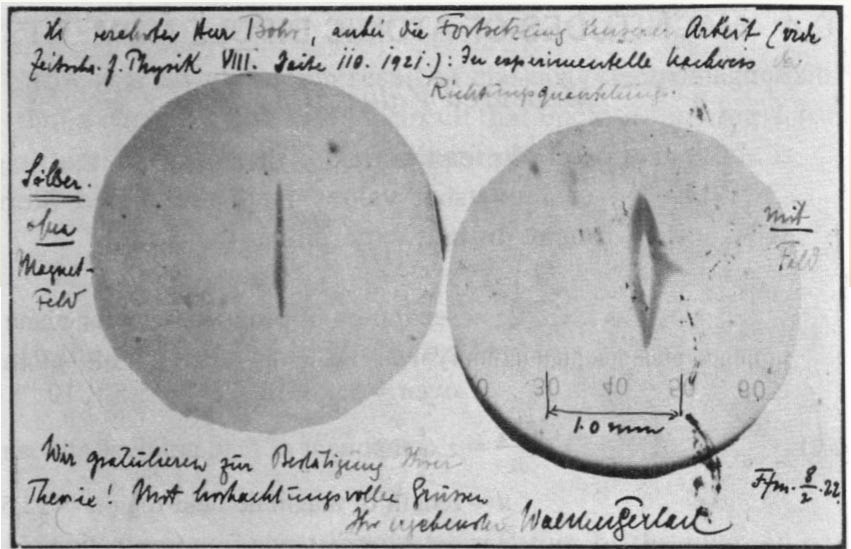
Stern-Gerlach experiment – the first picture

The above picture is from Friedrich, Bretislav, and Dudley Herschbach. “Stern and Gerlach: How a Bad Cigar Helped Reorient Atomic Physics.” Physics Today 56, no. 12 (December 1, 2003): 53–59. https://doi.org/10.1063/1.1650229.

During the formative years of quantum mechanics (early 1900s), the spin and orbital angular momentum of atoms were found to be quantized by theoretical arguments. Experimental proof was lacking.

Stern-Gerlach experiment provided the first experimental proof in 1922. They took a beam of neutral silver atoms and deflected them through an inhomogeneous magnetic field.

Silver atoms have an unpaired electron in their outermost orbit. If they were to obey quantum mechanics, they should exhibit a spin of +1/2 or -1/2. When subjected to an external magnetic field, the electrons with +1/2 or -1/2 should spatially split into two. That is exactly what Stern and Gerlach observed, and below is the first picture of the same.

To quote the authors:

Gerlach’s postcard, dated 8 February 1922, to Niels Bohr. It shows a photograph of the beam splitting, with the message, in translation: “Attached [is] the experimental proof of directional quantization. We congratulate [you] on the confirmation of your theory.” (Courtesy AIP Emilio Segrè Visual Archives.)

This experiment was one of the most important observations in quantum mechanics and further confirmed the quantization of spins, which is now common knowledge in physics.
Willow in comparison – Google quantum chip

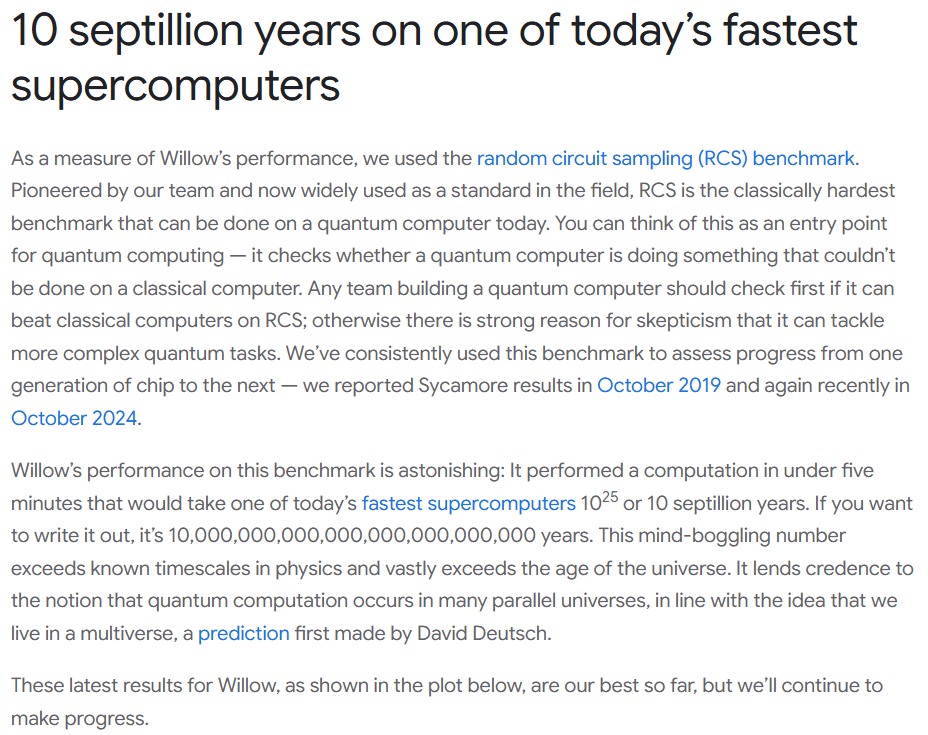
In scientific research, comparative analysis is an excellent way to objectively quantify two measurable entities. The recent Google quantum chip (named Willow) does that efficiently as it compares its capability with today’s fastest supercomputers. The comparison note on Google’s blog is worth reading.

In scientific analysis, such comparison teaches us three things:

a) how a scientific boundary is claimed to be pushed?

b) how a benchmark problem is used to achieve comparison?

c) what is the current state-of-the-art in that research area?

Some further observations on the work:

  • The theme of the Nature paper reporting this breakthrough is mainly on error correction. Technically, it shows how error tolerance is measured for a quantum device. This device is based on superconducting circuits, which were tested first on a 72-qubit processor and then on a 105-qubit processor.
  • Interestingly, as the authors mention in the paper, the origins of the errors are not understood well.
  • The paper is quite technical to read, and, to my limited understanding as an outsider, it makes a good case for the claim. The introduction and the outlook of the paper are written well, and give more technical information that can be appreciated by a general scientific audience.
  • There is more to come ! It looks like Google has further plans to expand on this work, and it will be interesting to see in which direction they will take the capability. The Google blog shows a roadmap and mentions their ambition as follows: “The next challenge for the field is to demonstrate a first “useful, beyond-classical” computation on today’s quantum chips that is relevant to a real-world application. We’re optimistic that the Willow generation of chips can help us achieve this goal.”
  • In the past 12 months or so, there has been a lot of buzz related to AI tools (thanks to GPTs, Nobels and perplexities :-), which are mainly in the realm of software theoretical development. This breakthrough in the realm of ‘hardware’ tells us how the physical world is still important!

More to learn and explore…interesting times ahead..

Planck replies to Sommerfeld

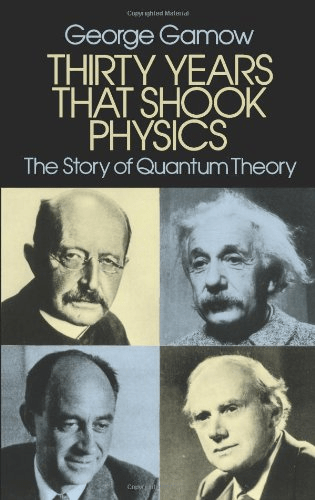
Gamow, George. 1966. Thirty Years That Shook Physics: The Story of Quantum Theory.

An excerpt from the book mentioned above:

“Planck was a typical German professor of his time, serious and probably pedantic, but not without a warm human feeling, which is evidenced in his correspondence with Arnold Sommerfeld who, following the work of Niels Bohr, was applying the Quantum Theory to the structure of the atom. Referring to the quantum as Planck’s notion, Sommerfeld in a letter to him wrote:

You cultivate the virgin soil,
Where picking flowers was my only toil.

and to this answered Planck:

You picked flowers—well, so have I.
Let them be, then, combined;
Let us exchange our flowers fair,
And in the brightest wreath them bind.”

Who thought these scientists were so poetic!