Today, I complete 15 years as a faculty member at IISER-Pune. I have attempted to put together a list of some lessons (based on my previous writings) that I have learnt so far. A disclaimer to note is that this list is by no means a comprehensive one, but a text of self-reflection from my viewpoint on Indian academia. Of course, I write this in my personal capacity. So here it is..
People First, Infrastructure Next As an experimental physicist, people and infrastructure in the workplace are of paramount importance. When I am forced to prioritize between them, I have chosen people over infrastructure. I am extremely fortunate to have worked with, and continue to work with, excellent students, faculty colleagues, and administrative staff members. A good workplace is mainly defined by the people who occupy it. I do not neglect the role of infrastructure in academia, especially in a country like India, but people have a greater impact on academic life.
Create Internal Standards In academia, there will always be evaluations and judgments on research, teaching, and beyond. Every academic ecosystem has its own standards, but they are generalized and not tailored to individuals. It was important for me to define what good work meant for myself. As long as internal standards are high and consistently met, external evaluation becomes secondary. This mindset frees the mind and allows for growth, without unnecessary comparisons.
Compare with Yourself, Not Others The biggest stress in academic life often arises from comparison with peers. I’ve found peace and motivation in comparing my past with my present. Set internal benchmarks. Be skeptical of external metrics. Strive for a positive difference over time.
Constancy and Moderation Intellectual work thrives not on intensity alone, but on constancy. Most research outcomes evolve over months and years. Constant effort with moderation keeps motivation high and the work enjoyable. Binge-working is tempting, but rarely effective for sustained intellectual output.
Long-Term Work We often overestimate what we can do in a day or a week, and underestimate what we can do in a year. Sustained thought and work over time can build intellectual and technical monuments. Constancy is underrated.
Self-Mentoring Much of the academic advice available is tailored for Western systems. Some of it is transferable to Indian contexts, but much of it is not. In such situations, I find it useful to mentor myself by learning from the lives and work of people who have done extraordinary science in India. I have been deeply inspired by many people, including M. Visvesvaraya, Ashoke Sen, R. Srinivasan, and Gagandeep Kang.
Write Regularly—Writing Is Thinking Writing is a tool to think. Not just formal academic writing, but any articulation of thought, journals, blogs, drafts, clarifies and sharpens the mind. Many of my ideas have taken shape only after I started writing about them. Writing is part of the research process, not just a means of communicating its outcomes.
Publication is an outcome, not a goal Publication is just one outcome of doing research. The act of doing the work itself is very important. It’s where the real intellectual engagement happens. Focus on the process, not just the destination.
Importance of History and Philosophy of Physics Ever since my undergraduate days, I have been interested in the history and philosophy of science, especially physics. Although I never took a formal course, over time I have developed a deep appreciation for how historical and philosophical perspectives shape scientific understanding. They have helped me answer the fundamental question, “Why do I do what I do?” Reflecting on the evolution of ideas in physics—how they emerged, changed, and endured—has profoundly influenced both my teaching and research.
Value of Curiosity-Driven Side Projects Some of the most fulfilling work I’ve done has emerged from side projects, not directly tied to funding deadlines or publication pressure, but driven by sheer curiosity. These projects, often small and exploratory, have helped me learn new tools, ask new questions, and sometimes even open up new directions in research. Curiosity, when protected from utilitarian pressures, can be deeply transformative.
Professor as a Post-doc A strategy I found useful is to treat myself as a post-doc in my own lab. In India, retaining long-term post-docs is difficult. Hence, many hands-on skills and subtle knowledge are hard to transfer. During the lockdown, I was the only person in the lab for six months, doing experiments, rebuilding setups, and regaining technical depth. That experience was invaluable.
Teaching as a Social Responsibility Scientific social responsibility is a buzzword, but for me, it finds its most meaningful expression in teaching. The impact of good teaching is often immeasurable and long-term. Watching students grow is among the most rewarding experiences in academia. Local, visible change matters.
Teaching Informally Matters Teaching need not always be formal. Informal teaching, through conversations, mentoring, and public outreach, can be more effective and memorable. It is free of rigid expectations and evaluations. If possible, teach. And teach with joy. As Feynman showed us, it is a great way to learn.
Foster Open Criticism In my group, anyone is free to critique my ideas, with reason. This open culture has been liberating and has helped me learn. It builds mutual respect and a more democratic intellectual space.
Share Your Knowledge If possible, teach. Sharing knowledge is a fundamental part of academic life and enriches both the teacher and the learner. The joy of passing on what you know is priceless.
Social Media: Effective If Used Properly Social media, if used responsibly, is a powerful tool, especially in India. It can bridge linguistic and geographical divides, connect scientists across the world, and communicate science to diverse audiences. For Indian scientists, it is a vital instrument of outreach and dialogue. My motivation to start the podcast was in this dialogue and self-reflection.
Emphasis on Mental and Physical Health In my group, our foundational principle is clear: good health first, good work next. Mental and physical well-being are not optional; they are necessary conditions for a sustainable, meaningful academic life. There is no glory in research achieved at the cost of one’s health.
Science, Sports, and Arts: A Trinity I enjoy outdoor sports like running, swimming, and cricket. Equally, I love music, poetry, and art from all cultures. This trinity of pursuits—science, sports, and the arts—makes us better human beings and enriches our intellectual and emotional lives. They complement and nourish each other.
Build Compassion into Science None of this matters if the journey doesn’t make you a better human being. Be kind to students, collaborators, peers, and especially yourself. Scientific research, when done well, elevates both the individual and the collective. It has motivated me to humanize science.
Academia Can Feed the Stomach, Brain, and Heart Academia, in its best form, can feed your stomach, brain and heart. Nurturing and enabling all three is the overarching goal of academics. And perhaps the goal of humanity.
My academic journey so far has given me plenty of reasons to love physics, India and humanity. Hopefully, it has made me a better human being.
I have been interested in the views of Einstein related to the history and philosophy of science (HPS). The more I read about his work, the more I find that his inclination is to combine science with its historical and philosophical evolution. I am in search of his correspondence with fellow scientists and intellectuals, and have been looking at clues towards this combinational approach to science.
The above image is the title of the Physics Today article.
Recently, I came across an article in Physics Today1 that reproduced a part of Einstein’s letter2. Here it is:
I fully agree with you about the significance and educational value of methodology as well as history and philosophy of science. So many people today—and even professional scientists—seem to me like someone who has seen thousands of trees but has never seen a forest. A knowledge of the historic and philosophical background gives that kind of independence from prejudices of his generation from which most scientists are suffering. This independence created by philosophical insight is—in my opinion—the mark of distinction between a mere artisan or specialist and a real seeker after truth
It is clear that Einstein liked this combination and thought that it should be part of one’s scientific education. There is a lot more on this topic in the Physics Today article, and it is an excellent read to understand the thoughts of Einstein on this topic. More on this in a future blog…
Howard, Don A. “Albert Einstein as a Philosopher of Science.” Physics Today 58, no. 12 (December 1, 2005): 34–40. https://doi.org/10.1063/1.2169442. ↩︎
A. Einstein to R. A. Thornton, unpublished letter dated 7 December 1944 (EA 6-574), Einstein Archive, Hebrew University, Jerusalem ↩︎
Sid Nagel has given an aura to an area of physics that was not considered fashionable even as late as the 2010s. Part of his elevation is because “Soft Matter Physics” has become so vital to understand our everyday world (including biological) that it is hard to ignore it anymore. Chemical Engineers, too, have played a major role in this elevation, and the James Frank Institute at Chicago has been an epicenter for this way of thinking.
A major shift in thinking, especially among physicists, is thanks to PW Anderson. His essay – ‘More is Different” did a great service to soft matter and complex systems by highlighting the importance of emergence (side note: the word emergence does not occur in his essay, even once !) It further got a major headway with a Nobel to de Gennes. Suddenly, condensed matter physicists had something to explore beyond electrons and their density functions. The French school had a major hand in this.
For me, soft matter physics, in a way, makes physics experiments democratic. One can still dare to do some ‘breakthrough science’ in a tiny kitchen 🙂
Even today, as a professor of physics, and importantly as a student of physics, I go back to his lecture series to learn AND derive inspiration from his thinking. He made physics more humane.
Many people across the globe have fallen in love with physics because of his books and the ‘way he did physics’
Feynman was a physics genius, but he had his flaws. It is important for us to note the limitations of human beings; celebrate what is good, and be aware and critical of what is not.
I have been amazed to explore the archives on Hideki Yukawa, which have been systematically categorized and meticulously maintained by Osaka University in Japan. My sincere thanks and acknowledgment to the Yukawa Memorial.
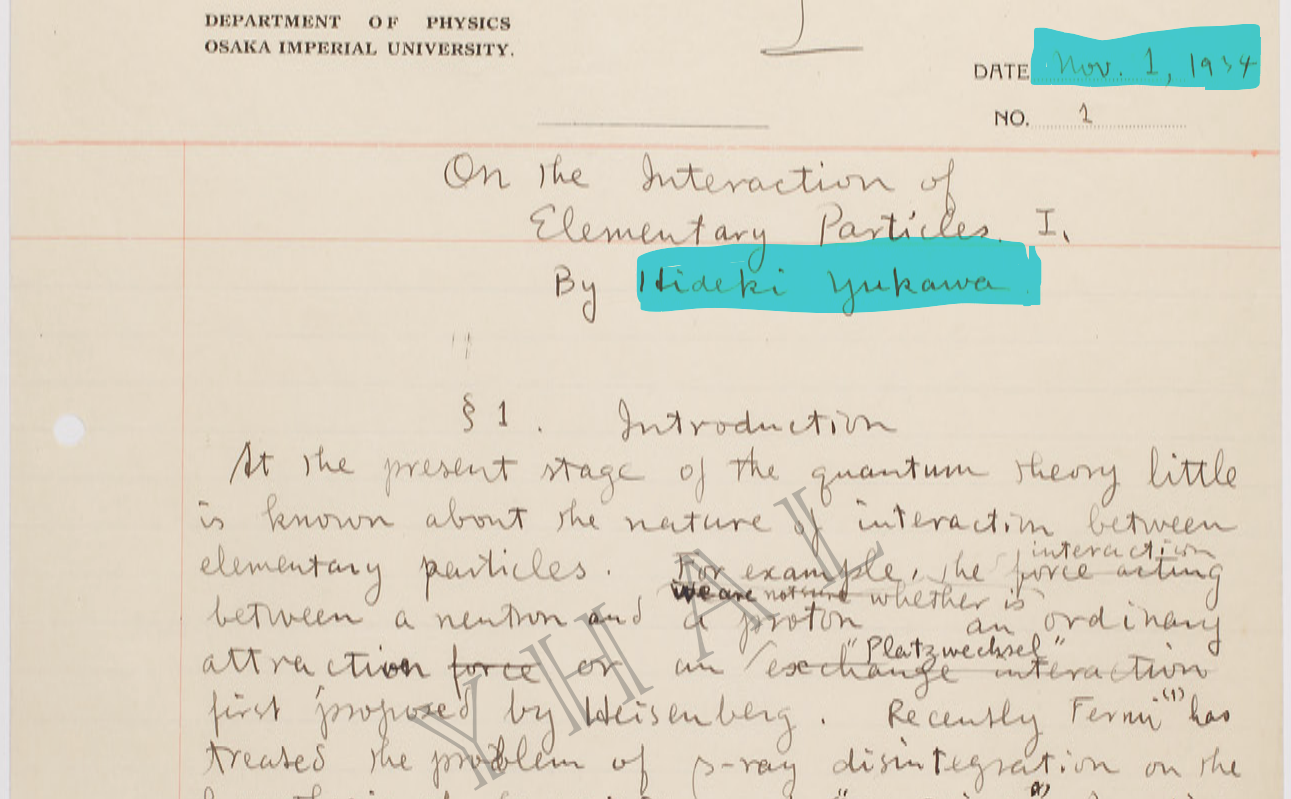
Below are a few gems from their public archives :
Draft of the paperwritten in 1934 – The making of the groundbreaking paper of Yukawa, which eventually led to his Nobel Prize in 1949.
The archive draft is accompanied by a note which reads:
Yukawa had not published any paper before then. In 1933, Yukawa began working at Osaka Imperial University and tackled the challenge of elucidating the mystery of nuclear forces while Seishi Kikuchi and other prominent researchers were producing achievements in nuclear physics and quantum physics. The idea of γ’ (gamma prime) that Yukawa came up with in early October led to the discovery of a new particle (meson) that mediates nuclear forces. The idea of introducing a new particle for the purpose of explaining the forces that act between particles was revolutionary at that time. Yukawa estimated the mass of the new particle and the degree of its force. No other physicists in the world had thought of this idea before.
2. Letters between Tomonaga and Yukawa
Sin-Itiro Tomonaga was a legendary theoretical physicist from Japan, who independently formulated the theory of quantum electrodynamics (apart from Feynman and Schwinger) and went on to win the Nobel Prize in physics in 1965.
Both these theoreticians were intensely working on interrelated problems and constantly exchanged ideas. The archival note related to the letter has to say the following:
During this period, Yukawa and Tomonaga concentrated on elucidating nuclear forces day in and day out, and communicated their thoughts to each other. In this letter, before starting the explanation, Tomonaga wrote “I am presently working on calculations and I believe that the ongoing process is not very interesting, so I omit details.” While analyzing the Heisenberg theory of interactions between neutrons and protons, Tomonaga attempted to explain the mass defects of deuterium by using the hypothesis that is now known as Yukawa potential. The determination of potential was arbitrary and the latest Pegrum’s experiment at that time was taken into consideration. Tomonaga also compared his results with Wigner’s theorem and Majorana’s theory.
3. Rejection letter from Physical Review
Which physicist can escape a rejection from the journal Physical Review?
Even Yukawa was not spared :-) Below is a snapshot of a rejection letter from 1936, and John Tate does the honours.
The influence of Yukawa and Tomonaga can be seen and felt at many of the physics departments across Japan. Specifically, their influence on nuclear and particle physics is deep and wide, and has inspired many in Japan to do physics. As the archive note says:
Yukawa and Tomonaga fostered the theory of elementary particles in Japan from each other’s standpoint. Younger researchers who were brought up by them, so to speak, must not forget that the establishment of Japan’s rich foundation for the research of the theory of elementary particles owes largely to Yukawa and Tomonaga.
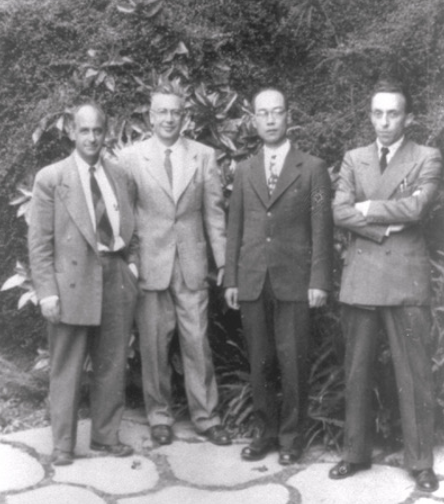
4. Lastly, below is a picture of the legends from the archive: Enrico Fermi, Emilio Segrè, Hideki Yukawa, and James Chadwick.
From the archive note on the picture from September 1948:
Yukawa met Prof. Fermi and other physicists of the University of Chicago who were staying in Berkeley for the summer lectures. From the left: Enrico Fermi, Emilio Segrè, Hideki Yukawa, and James Chadwick.
Tomorrow, I will conclude my third trip to Japan. I always take a lot of inspiration from this wonderful country. As usual, I have not only met and learnt a lot from contemporary Japanese researchers, but also have metaphorically visited the past masters who continue to inspire physicists like me across the world.
In the previous essay, we discussed engineering civilizations. Specifically, we discussed how philosophy and technology have played a critical role in the betterment of civilization. In addition, the fact that thoughts and tools have direct implications on how human beings live cannot be overstated.
Over the centuries, there have been many people who have played a critical role in advancing philosophical thoughts and engineering tools that have directly or indirectly influenced the development of physics. Before we really get into the specifics of the science of mechanics and its historical developments, we need to investigate some of the ideas that were part of the discussion in ancient civilizations. Given that mechanical tools date back to the prehistoric era, it is not surprising that human beings took an interest in understanding how the world works within their proximity.
In such a development, a human being is always curious to understand and harness nature. To do this effectively, one will have to systematically think about how nature works. According to the existing literature from a history of science viewpoint, the Greek philosophers occupy a very special position.
Part of the reason is that their thoughts were recorded in some form or another, and these thoughts date back to a period as early as 300 to 400 BCE or even before. This also coincides with the time at which writing became an important tool to propagate ideas, and therefore, one can see the emergence of historical evidence from this era. The Greek philosophers have a great reputation in Western philosophy and have influenced the development of scientific thinking for a very long period.
This does not mean that people from other civilizations did not think about tools and philosophical ideas. Just that the availability of written records, either direct or indirect, has been one of the hallmarks of Greek civilization. Thanks to the accumulation of these texts, either in the primary or in the secondary source form, it has played a critical role in identifying a specific point in Western civilization(1).
Physics, as we know it in the 21st century, has a very different avatar compared to its origin. Among the many Greek philosophers who seriously thought about natural philosophy was Aristotle(2). Aristotle has had a long legacy of being the student of some great thinkers from the Hellenistic era.
Aristotle was a student of Plato, and Plato was a student of Socrates. So, these three gentlemen have contributed to Western philosophy in such a great way that one cannot discuss anything about philosophical discourse without bringing them into the picture. The origins of physics, too, have some connection to these gentlemen, specifically to Aristotle(3), who was guided by some processes of thinking developed by Socrates and his direct guru, Plato.
The Plato school of thinking deeply influenced Aristotle, and yet he paved his own way in Western philosophy. He was also one of the first writers among these philosophers to seriously think about natural philosophy in the form and shape that resembles the current day science. His questions were related to natural phenomena, and it is by studying them that we realize Aristotle’s contribution. As I always keep saying, it is not just the answers that make great thoughts; it is also the questions that elevate the answers and make them profound. In that way, Aristotle’s questions were profound.
Therefore, I need to emphasize the quality of the questions that Aristotle asked instead of just emphasizing the answers he gave in the process of this questioning. It also indicates that current-day physics, as we now know it is not in the form Aristotle thought about, but we can see a glimpse of some interesting ideas in Aristotle, which turned out to be extremely important. It became so critical that for the next thousand years from the time of Aristotle, the Western philosophy and the science that emerged out of it kept Aristotle as an important benchmark and developed its thought either in agreement or in rejection of Aristotle’s idea.
So much so that this thinking process in reference to Aristotle’s idea not only influenced Western civilization but also had a very deep implication for Islamic civilizations. Although Aristotle’s ideas became critical in ancient Europe and the ancient Islamic world, its ideas and categorizations of knowledge found relevance across various civilizations.
So, let’s try to get a glimpse of the man himself – Aristotle. Let us look at the biographical details of this remarkable individual and learn about his work.
########
The Life of Aristotle
Aristotle was born in Stagira, Macedonia, which is in the northern part of Greece, in 384 BCE. His father was a physician to one of the kings in Macedon, and Aristotle was probably influenced by his father’s way of thinking about nature and natural phenomena. Of course, this is all conjecture because nobody knows the exact nature of the interaction between Aristotle and his father. However, this reconstruction is generally accepted based on historical texts(4).
When Aristotle was around 17 years old, in 367 BCE, he was sent to Athens to join the remarkable institution known as Plato’s Academy. During that period, Plato’s Academy was one of the leading intellectual centers in Europe, playing a critical role in shaping the thinking of various philosophers, including Aristotle.
It was at this place that Aristotle honed his skills in philosophical argumentation and the observation of nature and natural phenomena. This foundation played a crucial role in shaping his later works. For approximately 20 years, Aristotle remained at Plato’s Academy.
After Plato died in 348 BCE, Aristotle moved elsewhere. Historical texts suggest two possible reasons for his departure. One possibility is that he had intellectual differences with Plato’s nephew, who took over the Academy. The second possible reason is that the political atmosphere in Athens had become increasingly hostile toward people from Macedonia. These reasons, of course, remain speculative, although they are mentioned in historical literature.
In 343 BCE, King Philip II of Macedon invited Aristotle to tutor his son, Alexander. This is the same Alexander whom history remembers as Alexander the Great, though we will refer to him simply as Alexander. Aristotle played a crucial role in educating Alexander for more than five to seven years, deeply influencing the future conqueror’s thought process.
After about seven to eight years, Aristotle returned to Athens and established the Lyceum, a school of philosophy that had a profound impact on Western thought. This school had a unique feature—philosophers often lectured while taking long walks. As a result, the school came to be known as the Peripatetic School, recognized for its tradition of philosophical discourse while on the move.
During this period, around 330 BCE, Aristotle produced some of his most significant works, particularly in the context of physics. Even before leaving Athens, he had made substantial contributions to topics related to biology. However, in this second phase of his career, his focus broadened to natural philosophy, logic, ethics, aesthetics, rhetoric, and even music. This vast intellectual repertoire is one of Aristotle’s most remarkable features(4).
Around 323 BCE, Aristotle left Athens again following the untimely death of Alexander. During that period, anti-Macedonian sentiment was widespread in Athens, which likely motivated his departure. Within a year of leaving, around 322 BCE, Aristotle passed away at the age of 62. The probable cause of his death appears to have been natural.
All this information, of course, is based on historical sources that have been passed down through the centuries(4). One should always be cautious when interpreting ancient texts, as most of these sources survive only in translation rather than their original form. There is always a possibility of inaccuracies, and one must approach these accounts with care.
Aristotle’s intellectual journey covered a vast spectrum of human inquiry, from the heavens, as in astronomy, to logic within the framework of mathematics and, of course, physics. His interests also overlapped with observational phenomena and the life around him, which is evident from the questions he explored. Among his many areas of interest, we will focus primarily on Aristotle and his contributions to physics.
Aristotle’s writings on natural philosophy cover a vast range of topics, from celestial bodies to the nature of matter and motion. His works, though sometimes speculative by modern standards, laid the foundation for centuries of philosophical and scientific thought(5). Much of what we know about Aristotle comes from the preserved writings of later scholars, as very few primary sources from Aristotle himself remain.
Before I discuss Aristotle’s book, a few words on the origin of the word Physics. The word physics is derived from a Greek word called phusikḗ, which means natural science. This word has its origin in another word, and it is called phúsis, which means nature in Greek. The modern definition of physics is essentially derived from the Latin word physikā, which essentially means the study of nature.
This word was adapted by the old French, which was further adapted by English to be transformed into the word physics, as in natural philosophy.
In the context of Aristotle, it is the Greek word phúsis, meaning nature, is central to this discussion.
##########
The Eight Books of Physics
Aristotle’s Physics is divided into eight books(6), each exploring different aspects of nature and motion. Specifically, he was interested in the principles and causes of change and motion of objects. Let me give you an overview of his books.
Book One introduces Aristotle’s fundamental concepts of matter and form. A key discussion in this book is the doctrine of the four causes: the material cause, which explains what something is made of; the formal cause, which defines its shape or essence; the efficient cause, which refers to the force or agent that brings about change; and the final cause, which represents the purpose or end goal of an object or process. These causes provide a framework for understanding physical interactions and transformations.
In Book Two, Aristotle argues for teleology—the idea that nature has inherent purposes. He defends the study of nature as a legitimate form of scientific inquiry and lays out a methodological foundation for observing and interpreting natural phenomena.
Book Three explores the nature of change. Aristotle distinguishes between actuality, the realized state of an object brought about by an external force, and potentiality, the inherent capability of an object to become something else. This distinction is significant in understanding motion and transformation.
In Book Four, Aristotle explores the nature of voids, rejecting the concept of a vacuum. He also presents an interesting perspective on time, defining it as a measure of change.
Book Five classifies different kinds of motion, an important step in distinguishing natural movement from forced motion.
In Book Six, Aristotle discusses the nature of continuity and the concept of infinity. He argues against the existence of actual infinity, emphasizing the finiteness of physical reality.
Book Seven introduces the concept of the Prime Mover—an external force that initiates movement. This idea becomes central to Aristotle’s broader cosmology.
Book Eight expands on the idea of the Prime Mover as the ultimate cause of cosmic motion. This notion of an external force influencing the universe had a lasting impact on Western thought, intertwining scientific and theological perspectives for centuries.
Related to these books was Aristotle’s book titled On the Heavens. In there, Aristotle discussed his celestial theories. This four-part work, On the Heavens, explores the nature of celestial bodies and their motion.
He proposes that heavenly bodies are made of ether, a perfect and unchanging substance.
Aristotle also argues that the Earth is spherical and that celestial objects move in circular orbits—a belief that persisted until Kepler’s elliptical model. He discusses why celestial objects move in circular paths, distinguishing their motion from that of objects on Earth.
Expanding on his theory of the five fundamental elements—earth, water, air, fire, and ether—Aristotle’s ideas parallel similar concepts in other ancient civilizations, such as those in India and Mesopotamia.
Aristotle also studied natural phenomena through observations, and a related 4 book series was titledMeteorology. These books addressed:
Weather phenomena (clouds, wind, rain, lightning)
Natural bodies (lakes, rivers, seas, and geological formations)
Dynamic processes such as volcanoes and the transformation of matter
Another interesting book that Aristotle wrote about was based on his views on matter. The title of the work is unconventional and reads: On Generation and Corruption. This work, consisting of two books, discusses:
The four elements and their combinations in forming matter
The processes of transformation, mixing, and decomposition of substances
One may wonder how we know so much about Aristotle, even though he lived around 350 BCE. This is one of the remarkable features of human beings. They carry forward ideas from one generation to another.
Of course, this transmission across ages may cause errors in translation, but at least we get a gist of the idea through percolation. The records that we obtain through transmission will depend on the preservation of the sources of ideas. This is where the written text becomes so important because a physical text can be preserved, transported and reproduced with relative ease compared to oral records from the past.
#######
Most of the information about Aristotle comes from Corpus Aristotelisium(4). This is a multinational project about preserving Aristotle’s work. Around 200 texts are associated with Aristotle, out of which 31 have survived as the ancient textual evidence. These texts are from later eras across different countries, but one can make a connection to the original source through educated guesses and cross-connections.
So, I hope you have got a glimpse of and range of topics Aristotle was interested in from a physics viewpoint. Aristotle’s broad approach to physics covered motion, change, matter, and the cosmos. While many of his explanations were later refuted, his method of questioning and systematic exploration laid the groundwork for future scientific inquiry(5). His emphasis on philosophical reasoning remains an essential part of the intellectual history of physics.
In this essay, we discussed the origins of physics from Aristotle’s philosophical viewpoint. We learnt about his life and remarkable scholarly output. Going forward, we will explore other ideas and thinkers from the ancient age whose work you will generally find in physics textbooks. Can you guess what ideas they are and whom I am referring to? Think about it for a while…
References:
1. Adamson P. Classical Philosophy: A history of philosophy without any gaps, Volume 1. Oxford, New York: Oxford University Press; 2014. 368 p. (A History of Philosophy).
2. Shields C. Aristotle. In: Zalta EN, Nodelman U, editors. The Stanford Encyclopedia of Philosophy [Internet]. Winter 2023. Metaphysics Research Lab, Stanford University; 2023 [cited 2025 Mar 27]. Available from: https://plato.stanford.edu/archives/win2023/entries/aristotle/
3. Bodnar I. Aristotle’s Natural Philosophy. In: Zalta EN, Nodelman U, editors. The Stanford Encyclopedia of Philosophy [Internet]. Spring 2025. Metaphysics Research Lab, Stanford University; 2025 [cited 2025 Mar 27]. Available from: https://plato.stanford.edu/archives/spr2025/entries/aristotle-natphil/
4. Winzenrieth J. The Textual Transmission of the Aristotelian Corpus. In: Zalta EN, Nodelman U, editors. The Stanford Encyclopedia of Philosophy [Internet]. Spring 2025. Metaphysics Research Lab, Stanford University; 2025 [cited 2025 Apr 2]. Available from: https://plato.stanford.edu/archives/spr2025/entries/aristotle-text/
Many of the Nobel winners in science deserve the prize they get, but there are many deserving who do not make the list for various reasons, including sociology, geography & financial support. Using the Nobel prize as a benchmark of progress may lead to errors in the judgment of a country.
A better way to judge is to ask: how are science and technology in a country making lives better for the people of the country & the world? A better life includes both intellectual & material aspects. We, in India & the global south, can make progress if scientific thinking becomes prevalent in the everyday discourse of society, from family conversations to political debates. And prizes, by design, are exclusive. It is easier to exclude a country that is not scientific as no one cares in such a situation.
Scientific progress in a society is generally bottom-up. We have a large population of young people who should be more scientific in their worldview. If we have a large, scientifically oriented population, science and technological achievements become proportional.
If science-based intellectual & material progress is achieved, prizes will follow. But a Nobel should not be our primary goal. Better lives & better minds should be.
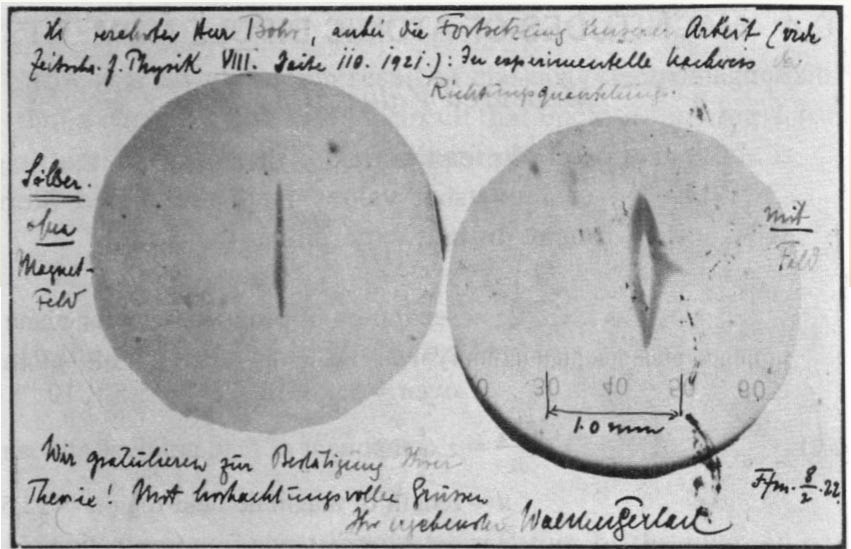
The above picture is from Friedrich, Bretislav, and Dudley Herschbach. “Stern and Gerlach: How a Bad Cigar Helped Reorient Atomic Physics.” Physics Today 56, no. 12 (December 1, 2003): 53–59. https://doi.org/10.1063/1.1650229.
During the formative years of quantum mechanics (early 1900s), the spin and orbital angular momentum of atoms were found to be quantized by theoretical arguments. Experimental proof was lacking.
Stern-Gerlach experiment provided the first experimental proof in 1922. They took a beam of neutral silver atoms and deflected them through an inhomogeneous magnetic field.
Silver atoms have an unpaired electron in their outermost orbit. If they were to obey quantum mechanics, they should exhibit a spin of +1/2 or -1/2. When subjected to an external magnetic field, the electrons with +1/2 or -1/2 should spatially split into two. That is exactly what Stern and Gerlach observed, and below is the first picture of the same.
To quote the authors:
Gerlach’s postcard, dated 8 February 1922, to Niels Bohr. It shows a photograph of the beam splitting, with the message, in translation: “Attached [is] the experimental proof of directional quantization. We congratulate [you] on the confirmation of your theory.” (Courtesy AIP Emilio Segrè Visual Archives.)
This experiment was one of the most important observations in quantum mechanics and further confirmed the quantization of spins, which is now common knowledge in physics.






 VISMAYA - History & Philosophy of Physics