The Italian painter Tomaso Barisini da Modena (1325-1379) was one of the first to depict a person wearing a spectacle. The above painting dates back to 1352.
There has been a bit of debate on the first painting to have a person wearing spectacle as discussed in the below reference. The history of spectacles itself is interesting, and their origins is also hotly debated among historians of science.
To give you a flavor of the debate, let me quote E. Rosen, “The Invention of Eyeglasses,” Journal of the History of Medicine and Allied Sciences 1 1 (1956), p.13. :
“Much has been written, ranging from the valuable to the worthless, about the invention of eyeglasses; but when it is all summed up, the fact remains that the world has found lenses on its nose without knowing whom to thank.”
Similarly, the origins of telescope are also under debate [1]:
“if victory has a thousand fathers, as it is commonly said, then the invention of spectacles and of its derivative, the telescope (another nominee listed among the top inventions of the last two millennia), must have just as many.”
Since the 16th century CE, improving the limits of optical resolution has become an essential technical goal in optics research, and it continues to challenge us even today. When they were introduced, optical microscopes opened a new world for humans to observe, learn and eventually control matter at microscopic scales. A logical progression in this thought was to extend the resolution limit to the atomic scales unavailable to optical microscopes. Enter the ‘electron’ microscope. They changed the game entirely and paved the way to visualize matter at the atomic scale.
Electron microscopes were invented in the 1930s. When they were built in some laboratories, there was considerable public interest in understanding these “advanced” tools, as witnessed by a short but interesting article in the September 1940 edition of Popular Mechanics.
Sept 1940: Above is an image and description of one of the earliest electron microscopes published in Popular Mechanics
First applications of the electron microscope are expected to be in biological and industrial research.
This is interesting because electron microscopes were still in their infancy, and the working principles were explored for better quality images and sample durability.
The origins of the electron microscope have an interesting history and were inspired by optics (for an interesting commentary, see Freundlich, Martin M. 1963. “Origin of the Electron Microscope.” Science 142 (3589): 185–88. https://www.jstor.org/stable/1712183). The first demonstration of a working microscope was by Ruska and Knoll (Z. Tech. Phys., 12 (1931)), and the conceptual foundations date back to the late 1890s. Ruska was eventually awarded a Nobel prize for his work on electron optics and the invention of the electron microscope in 1986.
As with any development in science and technology, an idea becomes a seed to another idea. In the case of electron microscopy, it led to some early motivations behind the invention of optical holography by Dennis Gabor, which eventually fetched him a Nobel Prize in 1970.
Dennis Gabor was also inspired and interested by the invention of electron microscopes. He played a critical role in formulating the problem of resolution limit, which further led to the invention of holography. To quote his Nobel lecture :
Let us now jump a century and a half, to 1947. At that time I was very interested in electron microscopy. This wonderful instrument had at that time produced a hundredfold improvement on the resolving power of the best light microscopes, and yet it was disappointing, because it had stopped short of resolving atomic lattices. The de Broglie wavelength of fast electrons, about l/20 Ångström, was short enough, but the optics was imperfect. The best electron objective which one can make can be compared in optical perfection to a raindrop than to a microscope objective, and through the theoretical work of O. Scherzer it was known that it could never be perfected.
Interestingly, Gabor started his work in Germany but had to move out of the country due to the political situation. As he mentions in his biographical note :
In 1933, when Hitler came to power, I left Germany and after a short period in Hungary went to England. At that time, in 1934, England was still in the depths of the depression, and jobs for foreigners were very difficult. I obtained employment with the British Thomson-Houston Co., Rugby, on an inventor’s agreement. The invention was a gas discharge tube with a positive characteristic, which could be operated on the mains.
He stayed back in England and continued his work. The important aspect is that the development of electron microscopy eventually led to some fundamental experiments in optical holography. To quote Gabor’s biographical note :
The years after the war were the most fruitful. I wrote, among many others, my first papers on communication theory, I developed a system of stereoscopic cinematography, and in the last year, 1948 I carried out the basic experiments in holography, at that time called “wavefront reconstruction”. This again was an exercise in serendipity. The original objective was an improved electron microscope, capable of resolving atomic lattices and seeing single atoms. Three year’s work, 1950-53, carried out in collaboration with the AEI Research Laboratory in Aldermaston, led to some respectable results, but still far from the goal. We had started 20 years too early.
The general notion in optics is that experiments in the visible light frequencies led to developments in electron microscopy. In the case of optical holography, at least in the initial stages of its invention, electron microscopy played a critical role. Developments in electron optics led to some fundamental questions in optical wavefront reconstruction. This further led to optical holography.
Today, I will be teaching the origins of LASERs in my optics class. Some of the content may interest science enthusiasts here. I present some snapshots from my notes. As expected, it starts with Einstein introducing his A and B coefficients and the stimulated emission.
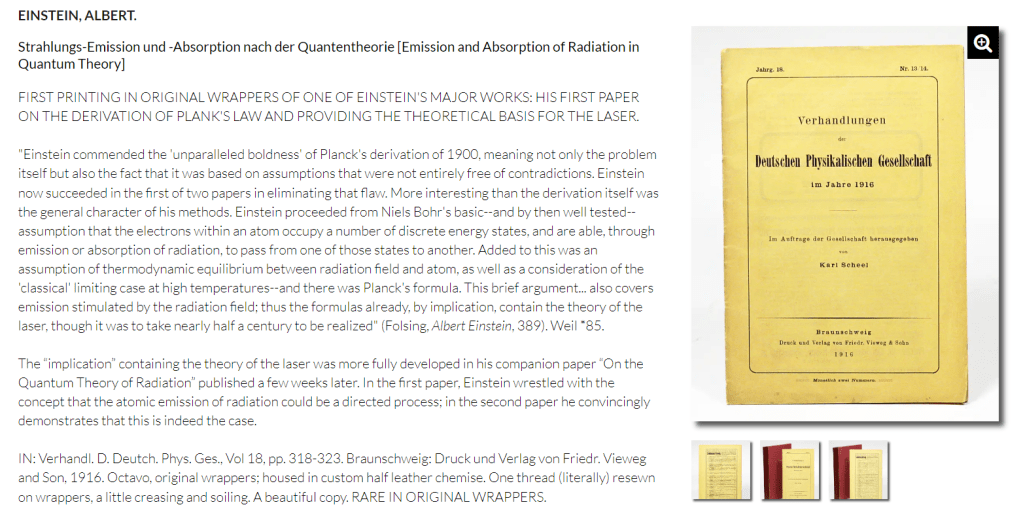
He introduced them in a paper written in German: Einstein, A. (1916). “Strahlungs-Emission und -Absorption nach der Quantentheorie”. Verhandlungen der Deutschen Physikalischen Gesellschaft. 18: 318–323.
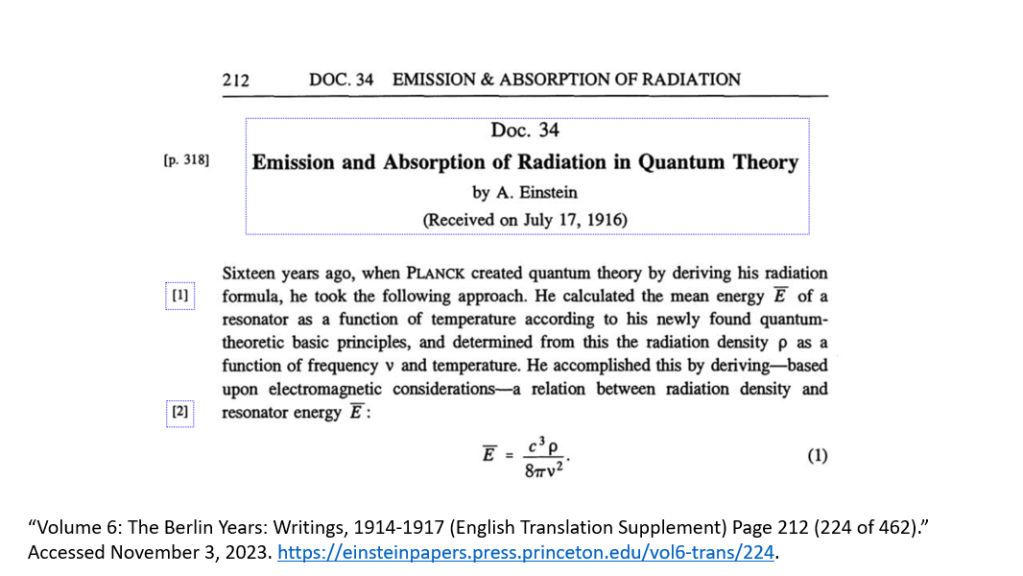
The English translation of the paper: “Volume 6: The Berlin Years: Writings, 1914-1917 (English Translation Supplement) Page 212 (224 of 462).” Accessed November 3, 2023. https://einsteinpapers.press.princeton.edu/vol6-trans/224.
Under thermodynamic equilibrium, the detailed balance gives us the connection between the coefficients…and amplification and stimulated emission of radiation become a measurable prospect.
The pic shows the leading characters behind the invention of the Light Amplification by Stimulated Emission of Radiation (LASER) Charles Townes was the intellectual pioneer behind microwave variety… and Maiman….the freak behind the optical version..
The history of the invention is fascinating and dramatic. I did a podcast on this a few months ago. Check it out..
One should not be surprised nowadays if a Nobel prize in physics goes to something related to light. As a person working in optics and light-matter interaction, I welcome any recognition of one of the most profound aspects of nature: light. This time, the prize has gone to some great experimental effort dating back to the late 1980s to early 2000s when amazing progress was made in three aspects related to the prize: a) higher harmonic generation of light in rare gases, b) production of a train of attosecond light pulses, and c) eventually production of single attosecond light pulses that can interact with matter, especially electrons in matter. Such an interaction can lead to the mapping of dynamics of quantum entities such as electrons and will have far-reaching consequences in probing the internal degrees of molecules and atoms. The scientific information published by the Nobel Committee has wonderful illustrations and is worth reading.
This time, the Nobel Prize website has published a fantastic set of illustrations to convey the relevance of the research. The above one shows the spectrum of temporal scales. It elegantly illustrates the breadth of the scale – attosecond to heartbeat:: Heartbeat to the age of the universe.. Oh, how beautiful science is!
Via Twitter, thanks to a student who was attending a lecture by Anne (one of the Nobel laureates), we got to see continuing her lecture even after a Nobel announcement. Now that is the spirit of academics!
This is the fundamental paper that triggered higher harmonic generation in gases and laid the foundation for attosecond pulse generation. of today, the impact factor of this journal is 1.6. The impact is not proportional to the impact factor of a journal




 VISMAYA - History & Philosophy of Physics