Raman essay and Open-Access

I see that the essay I wrote on CV Raman and made open access (thanks to Resonance, which published it) has been used by several educators on YouTube, including some in Indian languages. Also, the Google AI overview shows the published essay as the main reference for a search related to Raman’s science communication (see slideshow below).

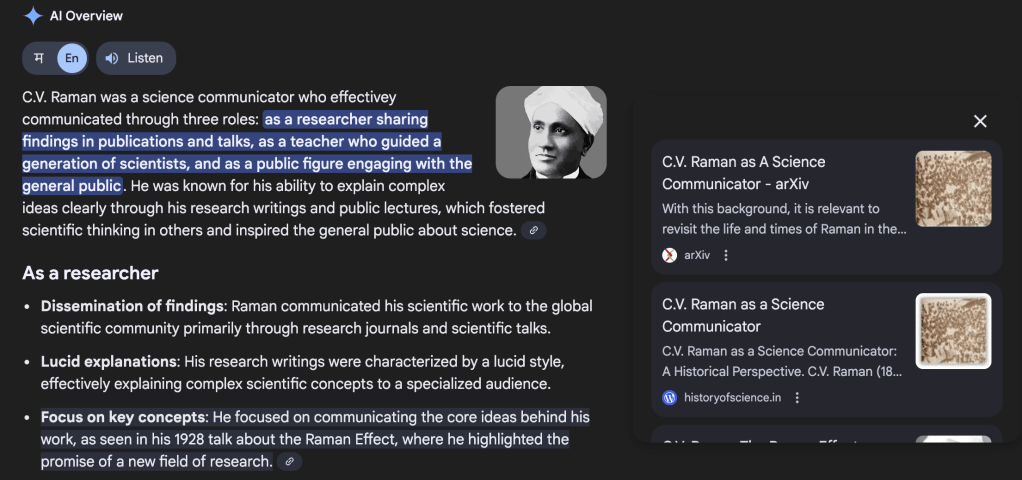
I am glad to see that making one’s writing open to all has positive effects. Open-access, not just for readers, but also for authors, is beneficial. Especially in India, paywalls for science are a detriment.

My worry is that open-access publishing has been mainly driven by commercial publishers that extract huge funds from the publishing authors. This defeats the purpose of open science, especially when the research of an author is publicly funded. Added to that, Indian researchers and writers cannot afford to pay huge sums for publishing articles and books.

The publication landscape (including journals and books) across the world needs an introspection. Open-access model is effective only when the readers and authors have access to that model. Otherwise, the model becomes a paywall for authors.

YouTube as an Archival Source

There are several models for using YouTube. One of them is to use it as a substitute for television and media outlets. This is where the number of views, subscriptions, and reach becomes important.

Another model is to harness YouTube as an archival source that is open to the public. This is one of the crucial elements of a platform that is easily accessible and, importantly, searchable. Such a platform becomes a repository for many informal academic discussions and interactions.

The archive model is an important category, especially if there is no need to generate revenue from the content deposited on the platform. A crucial aspect is that it can be accessed across the world and, in that sense, represents truly open-access content without paywalls, publication charges or subscriptions. Therefore, I am glad to see that many Indian academic programs, including NPTEL, ICTS, Science Activity Center/Media Center at IISER-Pune and many others are utilizing platforms such as YouTube to post their lectures and talks. Also, many individual academics in India are gradually using YouTube to discuss their work, in the context of research, teaching and entrepreneurship.

This development is slowly turning out to be an invaluable resource that can reach a large audience. Although YouTube is one of the most well-known platforms, many other platforms in the context of social media can also be tapped to spread knowledge. Given their reach and simplicity of use, both for creators and users, these tools become important in a vast country such as India.

As audio-visual public platforms join hands with artificial intelligence tools, they can positively (hopefully) affect how people, especially students, consume educational content. Going forward, I anticipate language translation through direct dubbing to be a game-changer. It could attract many new viewers who have been hesitant to watch technical content simply because it was in a foreign language. Of course, on these platforms, the noise is equally high compared to the signal, and therefore, curating good, targeted resources will be vital. Also, these platforms cannot be treated as a substitute for formal education, but as an extension or complementary source for research and education.

Interesting times ahead.

15 years at IISER Pune – Journey so far

Today, I complete 15 years as a faculty member at IISER-Pune. I have attempted to put together a list of some lessons (based on my previous writings) that I have learnt so far. A disclaimer to note is that this list is by no means a comprehensive one, but a text of self-reflection from my viewpoint on Indian academia. Of course, I write this in my personal capacity. So here it is..

  1. People First, Infrastructure Next
    As an experimental physicist, people and infrastructure in the workplace are of paramount importance. When I am forced to prioritize between them, I have chosen people over infrastructure. I am extremely fortunate to have worked with, and continue to work with, excellent students, faculty colleagues, and administrative staff members. A good workplace is mainly defined by the people who occupy it. I do not neglect the role of infrastructure in academia, especially in a country like India, but people have a greater impact on academic life.
  2. Create Internal Standards
    In academia, there will always be evaluations and judgments on research, teaching, and beyond. Every academic ecosystem has its own standards, but they are generalized and not tailored to individuals. It was important for me to define what good work meant for myself. As long as internal standards are high and consistently met, external evaluation becomes secondary. This mindset frees the mind and allows for growth, without unnecessary comparisons.
  3. Compare with Yourself, Not Others
    The biggest stress in academic life often arises from comparison with peers. I’ve found peace and motivation in comparing my past with my present. Set internal benchmarks. Be skeptical of external metrics. Strive for a positive difference over time.
  4. Constancy and Moderation
    Intellectual work thrives not on intensity alone, but on constancy. Most research outcomes evolve over months and years. Constant effort with moderation keeps motivation high and the work enjoyable. Binge-working is tempting, but rarely effective for sustained intellectual output.
  5. Long-Term Work
    We often overestimate what we can do in a day or a week, and underestimate what we can do in a year. Sustained thought and work over time can build intellectual and technical monuments. Constancy is underrated.
  6. Self-Mentoring
    Much of the academic advice available is tailored for Western systems. Some of it is transferable to Indian contexts, but much of it is not. In such situations, I find it useful to mentor myself by learning from the lives and work of people who have done extraordinary science in India. I have been deeply inspired by many people, including M. Visvesvaraya, Ashoke Sen, R. Srinivasan, and Gagandeep Kang.
  7. Write Regularly—Writing Is Thinking
    Writing is a tool to think. Not just formal academic writing, but any articulation of thought, journals, blogs, drafts, clarifies and sharpens the mind. Many of my ideas have taken shape only after I started writing about them. Writing is part of the research process, not just a means of communicating its outcomes.
  8. Publication is an outcome, not a goal Publication is just one outcome of doing research. The act of doing the work itself is very important. It’s where the real intellectual engagement happens. Focus on the process, not just the destination.
  9. Importance of History and Philosophy of Physics
    Ever since my undergraduate days, I have been interested in the history and philosophy of science, especially physics. Although I never took a formal course, over time I have developed a deep appreciation for how historical and philosophical perspectives shape scientific understanding. They have helped me answer the fundamental question, “Why do I do what I do?” Reflecting on the evolution of ideas in physics—how they emerged, changed, and endured—has profoundly influenced both my teaching and research.
  10. Value of Curiosity-Driven Side Projects
    Some of the most fulfilling work I’ve done has emerged from side projects, not directly tied to funding deadlines or publication pressure, but driven by sheer curiosity. These projects, often small and exploratory, have helped me learn new tools, ask new questions, and sometimes even open up new directions in research. Curiosity, when protected from utilitarian pressures, can be deeply transformative.
  11. Professor as a Post-doc
    A strategy I found useful is to treat myself as a post-doc in my own lab. In India, retaining long-term post-docs is difficult. Hence, many hands-on skills and subtle knowledge are hard to transfer. During the lockdown, I was the only person in the lab for six months, doing experiments, rebuilding setups, and regaining technical depth. That experience was invaluable.
  12. Teaching as a Social Responsibility
    Scientific social responsibility is a buzzword, but for me, it finds its most meaningful expression in teaching. The impact of good teaching is often immeasurable and long-term. Watching students grow is among the most rewarding experiences in academia. Local, visible change matters.
  13. Teaching Informally Matters
    Teaching need not always be formal. Informal teaching, through conversations, mentoring, and public outreach, can be more effective and memorable. It is free of rigid expectations and evaluations. If possible, teach. And teach with joy. As Feynman showed us, it is a great way to learn.
  14. Foster Open Criticism
    In my group, anyone is free to critique my ideas, with reason. This open culture has been liberating and has helped me learn. It builds mutual respect and a more democratic intellectual space.
  15. Share Your Knowledge
    If possible, teach. Sharing knowledge is a fundamental part of academic life and enriches both the teacher and the learner. The joy of passing on what you know is priceless.
  16. Social Media: Effective If Used Properly
    Social media, if used responsibly, is a powerful tool, especially in India. It can bridge linguistic and geographical divides, connect scientists across the world, and communicate science to diverse audiences. For Indian scientists, it is a vital instrument of outreach and dialogue. My motivation to start the podcast was in this dialogue and self-reflection.
  17. Emphasis on Mental and Physical Health
    In my group, our foundational principle is clear: good health first, good work next. Mental and physical well-being are not optional; they are necessary conditions for a sustainable, meaningful academic life. There is no glory in research achieved at the cost of one’s health.
  18. Science, Sports, and Arts: A Trinity
    I enjoy outdoor sports like running, swimming, and cricket. Equally, I love music, poetry, and art from all cultures. This trinity of pursuits—science, sports, and the arts—makes us better human beings and enriches our intellectual and emotional lives. They complement and nourish each other.
  19. Build Compassion into Science
    None of this matters if the journey doesn’t make you a better human being. Be kind to students, collaborators, peers, and especially yourself. Scientific research, when done well, elevates both the individual and the collective. It has motivated me to humanize science.
  20. Academia Can Feed the Stomach, Brain, and Heart
    Academia, in its best form, can feed your stomach, brain and heart. Nurturing and enabling all three is the overarching goal of academics. And perhaps the goal of humanity.

My academic journey so far has given me plenty of reasons to love physics, India and humanity. Hopefully, it has made me a better human being.

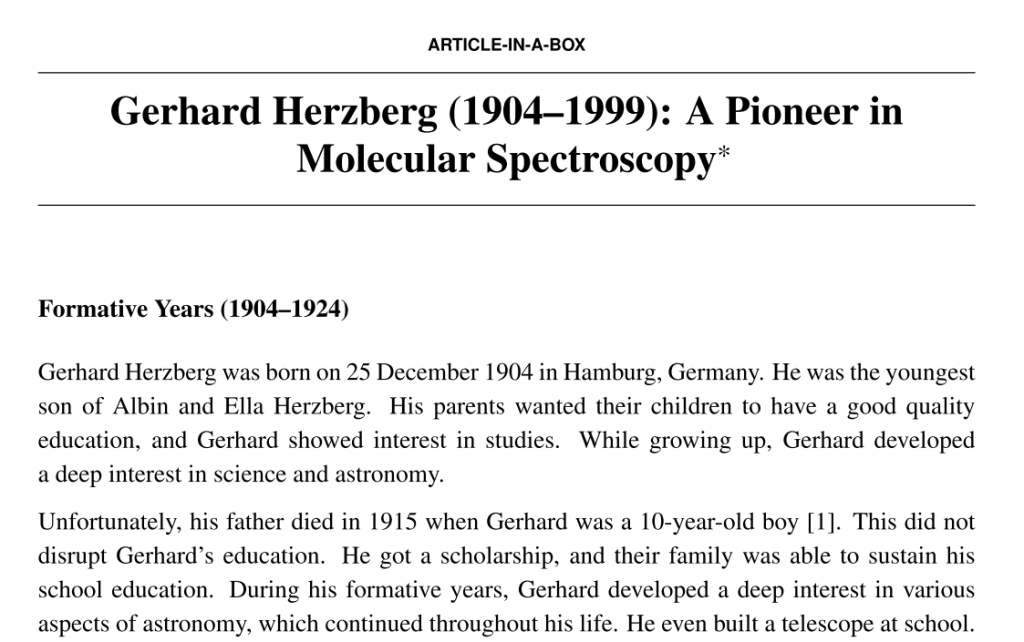
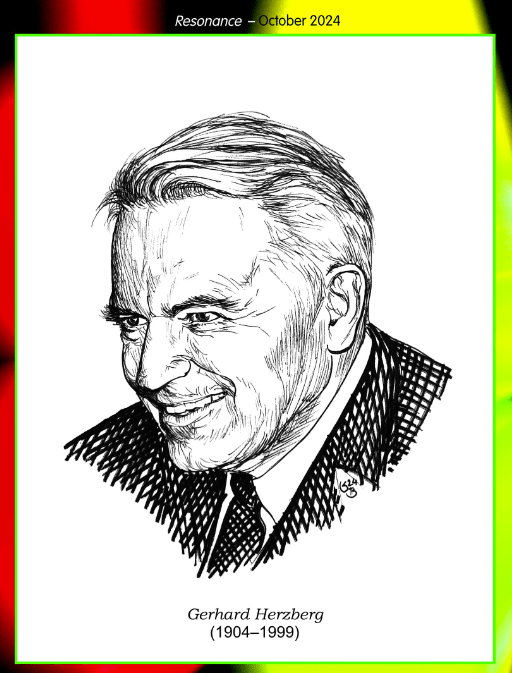
Article on Gerhard Herzberg

The October 2024 issue of Resonance, Journal of Science Education

highlights the life and science of Gerhard Herzberg.

He was one of the greatest molecular spectroscopists who laid the foundation of atomic and molecular quantum mechanics and deeply impacted molecular astrophysics and astrochemistry.

He lived an extraordinary life, first in Europe learning quantum mechanics and then escaping 1930s Germany as his wife was of Jewish origin. Then, he settled in Canada to build and lead his lab, which was considered the ‘mecca of spectroscopy’ at NRC, Ottowa.

I wrote a sci-biography article about him in this issue

Link to full edition: https://www.ias.ac.in/listing/articles/reso/029/10

If you don’t know – Resonance is a pedagogical journal published by the Indian Academy of Sciences. It is a true open-access journal. Free to read and does not charge the authors to publish.

Do explore the past editions. There are some absolute gems. https://www.ias.ac.in/listing/issues/reso

Open access : a few thoughts and books

I think that knowledge, especially academic knowledge, should be openly accessible to fellow researchers and the public. Given that most of the academic research in India is public-funded, it is imperative that our work is made available for anyone interested in reading and utilizing the knowledge. This makes a strong case for making our work open to access. Unfortunately, the open-access publication venture has been hijacked by some commercial publishers, who have misused the enthusiasm of academic researchers by converting it into a money-making opportunity via so-called ‘gold’ open-access models, where authors pay exorbitant article processing charges (APCs) to publish their work in the journals.

I have been searching literature to understand the philosophy and economics of open-access publishing models, and recently, by chance, I came across a couple of books by Peter Suber.

First is an open-access book on Open Access. Peter Suber has been a philosopher & open-access advocate for a long time. In this book, he explains what it really means to have open access to knowledge & the related philosophy, including its economics. Link to the book.

Second is a collection of writings on open-access publication (link), and as the online blurb says :

Influential writings make the case for open access to research, explore its implications, and document the early struggles and successes of the open access movement.

The green open-access model is very interesting and pertinent to countries such as India, and as per wiki it is defined as :

Green OA, is the practice of placing a version of an author’s manuscript into a repository, making it freely accessible for the scientific community.

The primary motivation of Open Access was
to provide Open Access to Knowledge to the READER of Publications and; to allow Open Access to AUTHORS Publication (unbiased publication of Knowledge)

Open access in the true sense, should neither have barriers to knowledge consumption nor to knowledge generation and dissemination. Therefore, APCs are a major hurdle to researchers and authors who do not have monetary support. This is most of the global south, and hence, a fair policy is needed to make it more democratic.