From my Substack conversation

From my Substack conversation
Recently, I was talking to a college student who had read some of my blogs. He was interested in knowing what it means to humanize science. I told him that there are at least three aspects to it.
First is to bring out the wonder and curiosity in a human being in the pursuit of science. The second was to emphasize human qualities such as compassion, effort, mistakes, wrong directions, greed, competition and humour in the pursuit of science. The third thing was to bring out the utilitarian perspective.
The student was able to understand the first two points but wondered why utility was important in the pursuit of humanizing science. I mentioned that the origins of curiosity and various human tendencies can also be intertwined with the ability to use ideas. Some of the great discoveries and inventions, including those in the so-called “pure science” categories, have happened in the process of addressing a question that had its origin in some form of an application.
Some of the remarkable ideas in science have emerged in the process of applying another idea. Two great examples came into my mind: the invention of LASERs, and pasteurization.
I mentioned that economics has had a major role in influencing human ideas – directly or indirectly. As we conversed, I told the student that there is sometimes a tendency among young people who are motivated to do science to look down upon ideas that may have application and utility. I said that this needs a change in the mindset, and one way to do so is to study the history, philosophy and economics of science. I said that there are umpteen examples in history where applications have led to great ideas, both experimental and theoretical in nature, including mathematics.
Further, the student asked me for a few references, and I suggested a few sources. Specifically, I quoted to him what Einstein had said:
“….So many people today—and even professional scientists—seem to me like someone who has seen thousands of trees but has never seen a forest. A knowledge of the historic and philosophical background gives that kind of independence from prejudices of his generation from which most scientists are suffering. This independence created by philosophical insight is—in my opinion—the mark of distinction between a mere artisan or specialist and a real seeker after truth..”
The student was pleasantly surprised and asked me how this is connected to economics. I mentioned that physicists like Marie Curie, Einstein and Feynman did think of applications and referred to the famous lecture by Feynman titled “There is Plenty of Room at the Bottom” (1959).
To give a gist of his thinking, I showed what Feynman had to say on miniaturization:
“There may even be an economic point to this business of making things very small. Let me remind you of some of the problems of computing machines. In computers we have to store an enormous amount of information. The kind of writing that I was mentioning before, in which I had everything down as a distribution of metal, is permanent. Much more interesting to a computer is a way of writing, erasing, and writing something else. (This is usually because we don’t want to waste the material on which we have just written. Yet if we could write it in a very small space, it wouldn’t make any difference; it could just be thrown away after it was read. It doesn’t cost very much for the material).”
I mentioned that this line of thinking on minaturization is now a major area of physics and has reached the quantum limit. The student was excited and left after noting the references.
On reflecting on the conversation, now I think that there is plenty of room to humanize science.
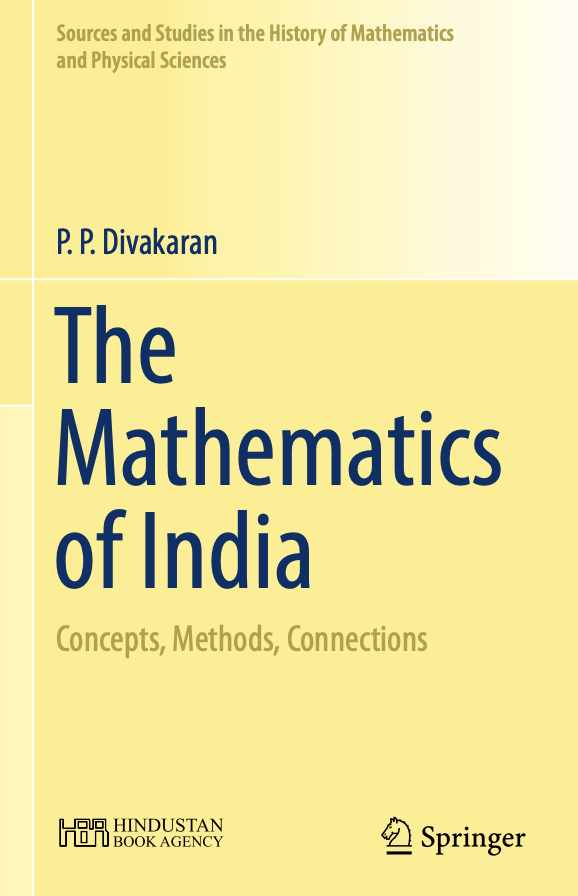
In recent years, this has been one of the best books on the history of mathematics in India. The late Prof. Divakaran was a theoretical physicist and a scholar.
This book is also an excellent example of how a scientist can present historical facts and analyse them with rigour and nuance. Particularly, it puts the Indian contribution in the global context and shows how ideas are exchanged across the geography. The writing is jargon-free and can be understood by anyone interested in mathematics.
Unfortunately, the cost of the book ranges from Rs 8800 to Rs 14,000 (depending on the version), which is a shame. Part of the reason why scholarly books, particularly in India, don’t get the traction is because of such high cost. This needs to change for the betterment and penetration of knowledge in a vast society such as India.
There is a nice video by numberphile on Prof. Divakaran and his book:
‘There is a story about two friends, who were classmates in high school,
talking about their jobs. One of them became a statistician and was working
on population trends. He showed a reprint to his former classmate, The
reprint started, as usual, with the Gaussian distribution and the statistician
explained to his former classmate the meaning of the symbols for the actual
population, for the average population, and so on. His classmate was a
bit incredulous and was not quite sure whether the statistician was pulling
his leg. “How can you know that?” was his query. “And what is this
symbol here?” “Oh,” said the statistician, “this is π.” “What is that?”
“The ratio of the circumference of the circle to its diameter.” “Well, now
you are pushing your joke too far,” said the classmate, “surely the population has nothing to do with the circumference of the circle.”’
These are the opening lines of Wigner’s famous essay titled: The Unreasonable Effectiveness of Mathematics in the Natural Sciences

This week in my optics class, I have been teaching Kramers-Kronig (KK) relations of electric susceptibility. It is fascinating to see the causality argument emerge from the relationship between the real and imaginary parts of the complex susceptibility. Whereas the time domain explanation is relatively easier to appreciate (that dissipation follows perturbation in time), for me, the frequency domain implication in KK relation is fascinating: the fact that information about the real part of the function at all frequencies can give you insight into the imaginary part at any given frequency (and vice versa) makes it such a powerful mathematical and physical tool. For example, by knowing the absorption spectrum of a medium, you can find out the refractive index of a medium at a particular frequency that is not easily accessible in experiments.
Two inferences I draw:
1) Complex analysis combined with differential calculus is one of the most beautiful and powerful mathematical tools invented, and exploring its application in experimental scenarios has made physics intriguing, useful, and profound.
2) The KK relationship shows how causality and the structure of matter are connected to each other, and by studying them, one will be able to extrapolate the idea beyond the problem at hand and apply it to a different context in physics. It just shows how ideas hop from one domain to another and how mathematics plays a critical role in intellectual arbitrage.
Real is imaginary and vice versa. Complex numbers zindabad!
Kaneenika Sinha is a mathematician and is as associate professor in department of mathematics at Indian Institute of Science Education and Research Pune. She is a number theorist, and her research interest is in analytic number theory and arithmetic statistics of modular forms. Kaneenika did her PhD from Queen’s University in Canada, and spent a few more years as post doc in Univ of Toronto, Univ of Alberta and Mathematical Sciences Research Institute, Berkeley. She started her independent career at IISER Kolkata before moving to IISER Pune.
“Kaneenika Sinha’s webpage.” Accessed August 26, 2023. http://sites.iiserpune.ac.in/~kaneenika/.
Twitter. “Kaneenika Sinha (@kaneenikasinha) / X,” June 15, 2023. https://twitter.com/kaneenikasinha.
Youtube (audio) :
Spotify :
google podcast :
apple podcast :
In this episode we discussed
References :
1. Link to her article on Prime numbers in the Bhavana Magazine: https://bhavana.org.in/primes-of-our-lives/
2. Link to a biographical article she wrote on Sarvadaman Chowla: https://bhavana.org.in/sarvadaman-chowla-the-perpetual-ambassador-for-number-theory/
3. Her TedX talk on Prime numbers:
4. Link to a blog post on Harivansh Rai Bachchan: https://academic-garden.blogspot.com/2022/12/harivansh-rai-bachchan-inspiring-phd.html
5. Link to two articles on C R Rao in Bhavana Magazine :
6. Link to Resonance: https://www.ias.ac.in/Journals/Resonance_%E2%80%93_Journal_of_Science_Education
7. Link to her book on the AMS webpage: https://bookstore.ams.org/STML/104
8. Link to preface of the book : https://www.ams.org/bookstore/pspdf/stml-104-pref.pdf
Steven Strogatz is a well know applied mathematician from Cornell University, and has done some fascinating research on nonlinear dynamics (NLD). His lecture series on NLD and chaos is one of the best I have come across. Apart from writing columns in New York Times, he has also published some fantastic books on explaining mathematics, its relevance and impact on our daily lives, society and ecology.
Steve Strogatz has also been hosting The Joy of x podcast on the Quanta Magazine. In there, he interviews many contemporary mathematicians and scientists, who are actively involved in research and teaching. I found these informal interactions and exchange of ideas very interesting.
In one of the podcasts, Steven interviews Tadashi Tokieda, a mathematician who is interested in toys, and specifically the intriguing mathematics and physics of toys. In this interview, Tadashi describes his journey as an artist, philologist and as a professor who works on mathematics of toys.
Towards the end of the podcast (around 49 min in this audio), Tadashi describes how people (especially adults) ask him about the practical applications of studying toys, and how it can be beneficial to them. To this, his answer is something on the following lines :
When I show these toys to children, and explain to them the science and mathematics related to the toys, they feel very happy about it. What can be a better practical application that this !
Listening this just made my day…
 VISMAYA - History & Philosophy of Physics