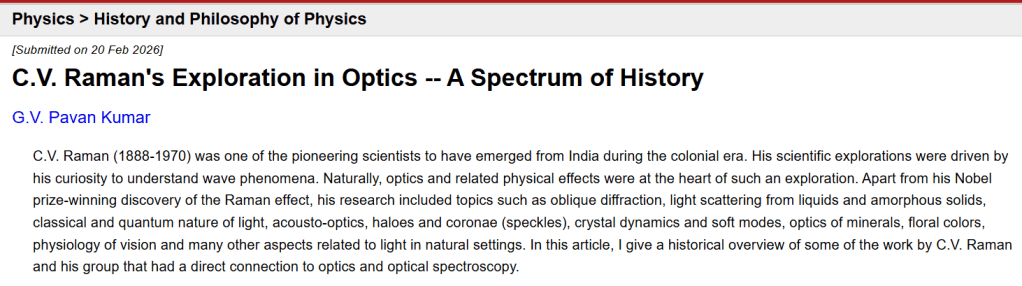
Journal of the Optical Society of America is coming up with a special issue on Optics in South Asia. I was invited to write a historical overview of Raman’s work on optics. Below is the snapshot of the pre-print. It should also appear in the axriv in the coming week. Meanwhile, you can access the preprint PDF below.
Also, look out for a research article from my group on multipolar optical binding submitted to the same issue. I will post a link when it appears as a pre-print.
Acknowledgements:
Professor Anurag Sharma, IIT, Delhi, for inviting me to write about Raman;
Other editors of this issue for taking the initiative.
Digital Archive Depository of Raman Research Institute
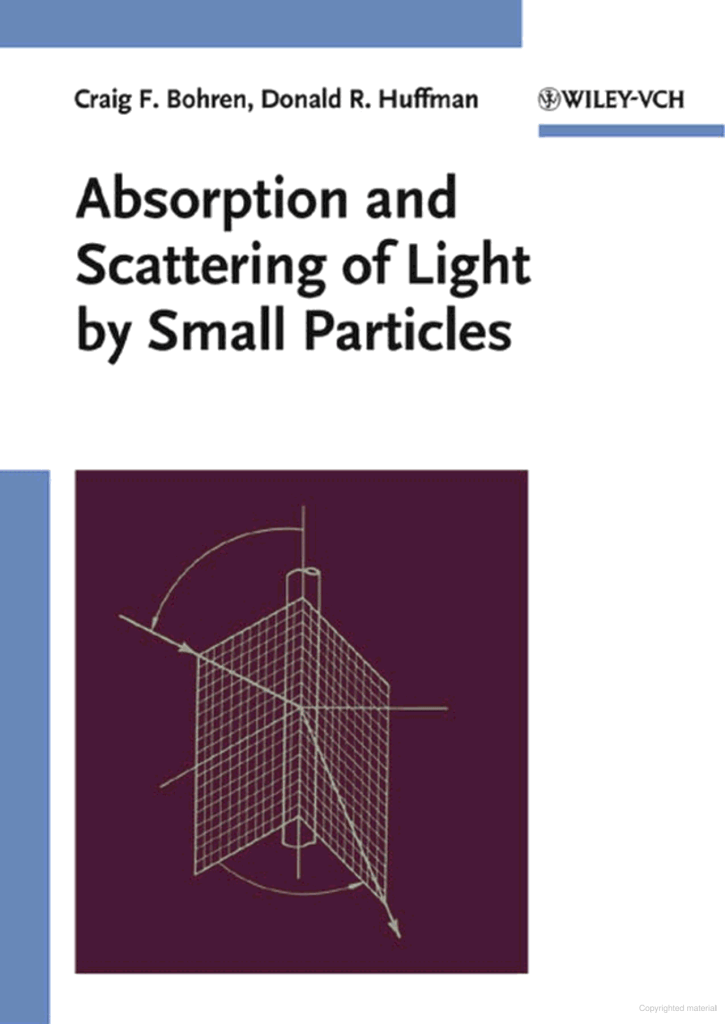
Cover of ‘Absorption and Scattering of Light by Small Particles’ by Craig F. Bohren and Donald R. Huffman.
It is important to read good books. Astrophysics, quantum mechanics, and gravity (including attempts to combine them with quantum mechanics) have been at the forefront in terms of popular physics imagination. These are wonderful subtopics of physics, but there are a few others that need equal emphasis. So, here is my attempt to fill this gap with some book recommendations.
The first one in the optics community is just called ‘Bohren and Huffman’ and is one of the best technical books I have read and continue to read. It is humorous and filled with wonderful insights that still engage researchers and students alike.
Craig Bohren, a theoretical physicist, is a wonderful writer, and you will see more of his books discussed here.
The book introduces the scattering matrix from a ‘light scattering’ viewpoint, and has a direct connection to laboratory measurements.
Humour is one of the key aspects of this book (as with others from Bohren), and the title of chapter 8 gives a nice glimpse: “A Potpourri of Particles”
There is a famous section in Chapter 11 with the heading – “Extinction = Absorption + Scattering” that wonderfully explains the physics behind it.
Overall, an outstanding book for understanding optics from an electromagnetics viewpoint and also to learn how electromagnetism is harnessed to understand interactions at the classical spatio-temporal scales.
Read this if you are interested in physics…It is a delight!
The paper makes interesting claim on observation of ‘chiral graviton modes’ in certain ultra-cooled semiconductors (Gallium Arsenide – famously called GaAs). The cooled temperature is quite low (~50 mK), which is impressive, and the chirality of the mode is unveiled using polarization-resolved Raman scattering. The observation of this so-called ‘Graviton modes’ is essentially a quasiparticle excitation, and has created some buzz. In my opinion, graviton-like behavior is a bit of an exaggeration.
Anyway, this paper has set an interesting discussion among my colleagues (condensed matter and high energy physics) in our department. To add to their discussion, I wrote on 2 points (and an inference) from optics perspective, which I am sharing below :
The measurement scheme used to unveil the chirality of the quasi-particles is a well-known trick in polarization optics. In fact, I teach it to our undergrads. Notice the use of quarter-wave plates (indicated by the arrow in the figure below). This is also the measurement at the heart of unveiling optical anisotropy. Experimentally, what is impressive is the ultra-low energy excitation captured via Raman scattering. This is again thanks to the excellent cooling of the sample (50 mK).
Figure from the Nature paper.
2. The last author of this paper, Aron Pinczuk, was a well-known expert in light scattering in solids. He was an Argentinian-American professor at Columbia University, and passed away in 2022.
The first edition (1976) of a great series : Light Scattering in Solids
My initial inference on the paper : This is an old Argentinan wine of quasiparticles in a new GaAs bottle at ultra-low temperature….and NATURE is selling it as champagne de graviton made in China !
What you see in this image (observed on 6th April 2023, 7.13am, Pune, India) is the emergence of sunlight from clouds in a peculiar expanding beam of rays. Such rays are called crepuscular rays.
The etymology of the word –
crepuscular (adj.)
figurative use, “dim, indistinct,” is attested from 1660s; literal use, “pertaining to or resembling twilight,” from 1755, from Latin crepusculum “twilight, dusk,” related to creper “obscure, uncertain,”
These rays are generally observed during the twilight and persist for a short time. The location of observation is close to the horizon, although I sighted it at a reasonable angle above the horizon (on Dr. Homi Bhabha road, in front of IISER-Pune Pashan gate).
There is a large class of optical phenomena including sunbeams and moonshines, which are exclusively observed at twilight. For more details read this article by Shields, Janet. “Sunbeams and Moonshine.” Optics and Photonics News 5, no. 7 (July 1, 1994): 57. https://doi.org/10.1364/OPN.5.7.000057.
One may think this phenomenon is related to some kind of diffraction, but it is not. It mainly arises due to the linear perspective of how we visualize this optical effect in an open sky. Of course light scattering has some interesting role in this observation. A very nice discussion on this can be found in an article by Bohren, Craig, and Mark L. Sowers. “Simple Experiments in Atmospheric Physics.” Weatherwise 45, no. 2 (May 1, 1992): 34–38. https://doi.org/10.1080/00431672.1992.9925919.
A Surprise in Western Ghats
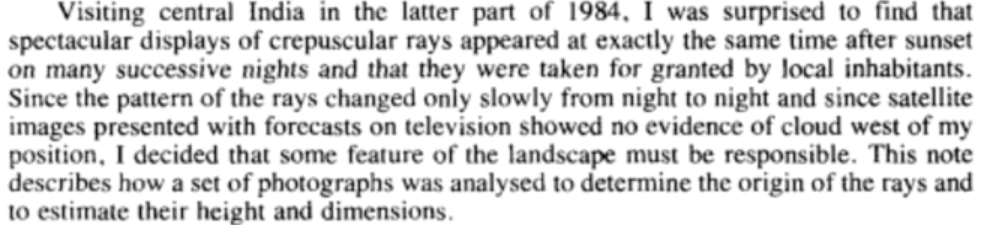
Western ghats are known to show this optical effect. In the year 1984, J. L. Monteith, a researcher who was visiting India from Goddard space center, USA (which is part of NASA) made an interesting and surprising observation. Below I reproduce his text –
For more details on this observation, read this paper by Monteith, J. L. “Crepuscular Rays Formed by the Western Ghats.” Weather 41, no. 9 (September 1986): 292–99. https://doi.org/10.1002/j.1477-8696.1986.tb03862.x.
Interestingly, such rays have also been periodically found in China and was reported as early as 1888 ! See this remarkable observation by Doberck, W. “Crepuscular Rays in China.” Nature 37, no. 959 (March 1888): 464–464. https://doi.org/10.1038/037464b0. Doberck also makes a connection to a historical text by Homer, in which Greek mariners describe the beautiful skies with peculiar rays.
Around 2011, the crepuscular rays were simulated in a laboratory and further corroborated using numerical simulations. In order to mimic the behavior of clouds, “artificial fogs and milk–water solutions” were used and interesting quantitative observations were made. For more details read : Gedzelman, Stanley David, and Michael Vollmer. “Crepuscular Rays: Laboratory Experiments and Simulations.” Applied Optics 50, no. 28 (October 1, 2011): F142–51. https://doi.org/10.1364/AO.50.00F142.
Atmospheric and meteorological optics are fascinating topics with some historical connections. For interested readers I highly recommend the following (fascinating and readable) books :
Bohren, Craig F. Clouds in a Glass of Beer: Simple Experiments in Atmospheric Physics. Courier Corporation, 2001.
What Light Through Yonder Window Breaks?: More Experiments in Atmospheric Physics. Courier Corporation, 2006.
Minnaert, M. The Nature of Light and Colour in the Open Air. Revised ed. edition. New York, N.Y: Dover Publications, 1954.
Minnaert, Marcel. Light and Color in the Outdoors. Translated by L. Seymour. Corrected edition. New York: Springer, 1993.
Today is India’s National Science Day. It celebrates the discovery of Raman effect on 28th February, 1928.
For more details on the discovery of the effect, and various human aspects related to it : you can see my past blogs here, here, here and here.
In this blog, I will briefly discuss about some of the work that directly influenced Raman’s thinking that further led to a remarkable discovery that we know by his name.
All creative pursuits are motivated by ideas from the past. No one gets their ideas in vacuum. All of us are influenced by the information which we perceive and receive. This means consciously or subconsciously the world that we are creating, both in our minds and in reality, is fundamentally influenced by the information in the world.
The discovery behind the Raman effect is no exception to this particular principle. In his formative years, C V Raman was heavily influenced by the research of Rayleigh and Helmholtz, and some classical thinkers including Euclid. Raman was also closely following the development of quantum mechanics in the early 1920s, and he was keenly studying the theoretical and experimental developments in this field.
Compton scattering was as outstanding experimental achievement that revealed two aspects of light-matter interaction. First, it demonstrated inelastic scattering of electromagnetic radiation interacting with a quantum object (in this case free electrons) in the laboratory frame. Second is that it laid a foundation to revisit the wave-particle duality of light from an experimental viewpoint. Raman and Krishnan’s main paper on light scattering starts by explicitly referring to Compton effect, and motivates observation for optical analogue of Compton scattering.
“In interpreting the observed phenomena, the analogy with the Compton effect was adopted as the guiding principle. The work of Compton had gained general acceptance for the idea that the scattering of radiation is a unitary process in which the conservation principles hold good.”
Next is the Kramers-Heisenberg formula. This mathematical description gives the scattering cross section of a photon interacting with a quantum object (in this case electron). This formula uses second-order perturbation theory, and evokes the famous ‘sum of all the intermediate states’ for non-resonant optical interaction. PAM Dirac played a vital role in deriving this formula from a quantum mechanical framework of radiation. An important and logical consequence of this formula is the emergence of stimulated emission of radiation, and this has had deep implications in understanding LASERs. Raman was keenly studying the formula and made a brilliant conceptual connection between laboratory observation and this formula that revealed the scattering cross-section.
Again to quote from Raman’s Nobel lecture:
“The work of Kramers and Heisenberg, and the newer developments in quantum mechanics which have their root in Bohr’s correspondence principle seem to offer a promising way of approach towards an understanding of the experimental results.”
The above two concepts were important ideas that motivated Raman scattering experiments. Importantly it highlights the jugalbandi between theoretical intuition with concrete experimental observations, which forms the bedrock of modern physics.
Newton famously mentioned about the discoveries he made by ‘standing on the shoulders of the giants’. Various people involved in creative pursuits including scientists acknowledge the fact that new ideas emerge from convergence/mutation of old ideas. The harder part of creativity in science, or for that matter any art form, is to choose the right ideas to combine so that the ’emergent’ new idea has greater value compared to the individual parts. In that sense, science is a great form of creative activity that not only combines old ideas to create new valuable ideas, but also transforms the perspective of the individual seed ideas. Thus ideas combine and evolve.
So let us combine good ideas and evolve. Happy Science Day !
I am always amazed to see fractal-like patterns….this one at a geographical scale…captured somewhere over south India..
I took the photo on my trip back to Pune from IIT Madras…
Thanks to IIT-M physics department for their invitation for colloquium…
Special thanks to Basudev Roy and Nirmala for hosting…. greatly enjoyed the discussion with many faculties and students..
In my talk, I mainly spoke on topics at the interface of statistical optics, Brownian motion and pattern formation.. Was delighted to see (and meet) Profs. Balki, Suresh Govindarajan Sunil Kumar Arnab Pal and many more in the audience.
The photo, retrospectively, captures the essence of the science discussed…
About 2 years ago (22nd May 2020), when all the academic activities were online, I gave a talk on “Soft-Matter Optics: A Cabinet of Curiosities” organized by American Chemical Society as part of India Science Talks. Below is the embedded video of the online talk.
In there, I give a broad overview of how interesting optical function can emerge from the complex world of soft matter. In addition to this, I have emphasized how optics can be harnessed to study structure and dynamics of soft-matter systems including colloids, liquid crystal and some biological matter. The target audience are new PhD students and anyone who is entering the field of light-soft matter interaction.
I mainly spoke about emergent Brownian dynamics of laser-heated colloids under optical confinement. Below is the link to the talk.
I concluded my talk quoting P W Anderson’s essay “More is Different“
“The constructionist hypothesis breaks down when confronted with the twin difficulties of scale and complexity. The behavior of large and complex aggregates of elementary particles, it turns out, is not to be understood in terms of a simple extrapolation of the properties of a few particles.
Instead, at each level of complexity entirely new properties appear, and the understanding of the new behaviors requires research which I think is as fundamental in its nature as any other.”
P.W. Anderson ‘More is Different’ Science, 177, 4047 (1972)



 VISMAYA - History & Philosophy of Physics