I gave a tutorial talk on “Plasmons, SERS and more”: at National Workshop on Fluorescence and Raman Spectroscopy
Below is the embedded file of the presentation
I gave a tutorial talk on “Plasmons, SERS and more”: at National Workshop on Fluorescence and Raman Spectroscopy
Below is the embedded file of the presentation
On 1st Dec 2022, I gave a talk on “Structured-Light Scattering : Implications in Momentum Space” as part of a discussion meeting on STRUCTURED LIGHT AND SPIN-ORBIT PHOTONICS held at International Center of Theoretical Sciences, Bangalore.
I mainly spoke about topological light scattering in the frame work of angular momentum of light and absorptive effects in optothermal tweezers created by structured light.
Below is the embedded video link to my talk. The playlist also has many other interesting talks related to the topic.
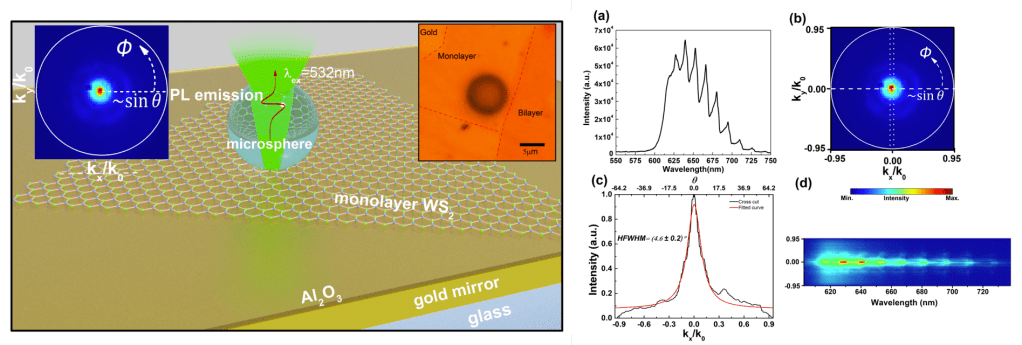
We have new paper appearing in Applied Physics Letters on how a dielectric microsphere placed on a 2D material deposited on a mirror can act as an optical antenna (see left panel for the schematic of the geometry and an optical image of the realized antenna).
The experimental and simulation efforts were mainly driven by our dynamic PhD student Shailendra Kumar Chaubey, who is very passionate about nanophotonics of 2D materials. He along with Sunny Tiwari and Diptabrata Paul explicitly show how experimental parameters such as sphere size and location of focusing can influence the photoluminescence emission from a WS2 monolayers. The experiments were mainly possible thanks to our collaboration with my colleague Atikur Rahman and his student Gokul, who continue to produce fantastic 2D materials for our nanophotonics study.
Interestingly, the emission from the WS2 monlayers can be as narrow as 4.6 degrees (see right side panel of the figure) which is one of the narrowest angular spread at room temperature. We also capture the energy-momentum photoluminescence spectra from WS2 monolayers, which is convoluted with the beautiful whispering gallery modes of the microsphere (see parts (a) and (d) of the figure).
We envisage such ’emission engineering’ using a simple microsphere can be further harnessed to control emission from quantum and nonlinear photonic 2D materials. Also, it raises new questions on how local photonic density of states can be tailored by altering the local environment around quantum emitters in solid state materials.
Arxiv version of the paper : https://arxiv.org/abs/2110.10387
Electromagnetic momentum is a topic with rich history dating back to Maxwell, Poynting, Minkowski, Abraham, Einstein, and many more1.
It has also led to new questions, and an intriguing controversy in electromagnetism2.
An interesting and contemporary question to ask is: what is the behavior of optical momentum in artificial materials ?
One class of artificial materials is the near zero-refractive index (NZI) materials.
What are NZI materials ? The general definition of refractive index from a material view point is that it is proportional to square root of a product: dielectric permittivity (ε) and magnetic permeability (μ) of the given material.
n = (εμ)½
If either of these material values go to zero at a given wavelength of light, then the refractive index goes to zero or close to zero. Such a situation creates new opportunity for enhanced or supressed light-matter interaction. See this popular review on NZI materials3
A recent theoretical paper4 addresses the consequence of evolution of optical momentum in NZI media.
This analysis has thrown a few fundamental surprises that are fascinating such as : absence of interference in Young’s double slit experiments, and some new opportunities in optical cloaking thanks to quantum nature of light. To quote the authors4 :
being inside an NZI materials would lead to an infinite uncertainty on position and zero uncertainty on momentum. Conceptually, this implies that since the resolution is poor and no correct image can be formed, an object of any shape and material can be “hidden” in a NZI material.
There are a few more interesting prospects, and of course, all of them are yet to be verified with experiments.
If you are interested in this topic, I strongly recommend this recent, popular level article5
1. M. Buchanan, “Minkowski, Abraham and the photon momentum,” 2, Nature Phys 3(2), 73–73, Nature Publishing Group (2007) [doi:10.1038/nphys519].
2. S. M. Barnett and R. Loudon, “The enigma of optical momentum in a medium,” Philosophical Transactions of the Royal Society A: Mathematical, Physical and Engineering Sciences 368(1914), 927–939, Royal Society (2010) [doi:10.1098/rsta.2009.0207].
3. “Optics & Photonics News – Zero-Index Platforms: Where Light Defies Geometry,” <https://www.optica-opn.org/home/articles/volume_27/july_august_2016/features/zero-index_platforms_where_light_defies_geometry/> (accessed 5 May 2022).
4. M. Lobet et al., “Momentum considerations inside near-zero index materials,” 1, Light Sci Appl 11(1), 110, Nature Publishing Group (2022) [doi:10.1038/s41377-022-00790-z].
5. “Exotic Materials Through Momentum’s Looking-Glass,” <https://www.optica-opn.org/home/newsroom/2022/may/exotic_materials_through_momentum_s_looking-glass/> (accessed 5 May 2022).
We have a new paper published in Journal of Physical Chemistry Letters on “Single Molecule Surface Enhanced Raman Scattering in a Single Gold Nanoparticle-Driven Thermoplasmonic Tweezer”
Thanks to the fantastic effort by Sunny Tiwari, and excellent support by Utkarsh Khandelwal (former IISER-P undergrad) and Vandana Sharma from my group, we have been able to combine single molecule Raman scattering with a specialized nanoscale optical tweezer.
The uniqueness of this tweezer platform is that the optical trapping process is driven by the thermo-plasmonic potential created by a SINGLE, 150nm GOLD NANOPARTICLE. Concomitantly, the same field can be used to perform single-molecule Raman spectroscopy. Kind of “ek teer mae do shikar” strategy 
Using this system, not only we push the limits of optothermal trapping of a single nanoparticle (see video) at low laser powers, but also create a platform for deterministic transport of reversible colloidal assembly in a fluid.
We envisage that our nanometric plasmonic tweezer can be harnessed to trap and tweeze biological entities such as single virus and bacteria. Another possible application of our study is to create reconfigurable plasmonic metafluids in physiological and catalytic environments, and to be potentially adapted as an in vivo optothermal tweezer.
All the videos related to this study can be found on our lab’s Youtube channel : https://www.youtube.com/playlist?list=PLVIRTkGrtbrvs7BaNsaH6tjPpzLUizyMI
DoI of the published paper : https://doi.org/10.1021/acs.jpclett.1c03450
preprint version on arxiv : https://arxiv.org/abs/2109.04281
We have a new paper published in the journal ‘Soft Matter’ titled : Optothermal pulling, trapping, and assembly of colloids using nanowire plasmons
When a silver nanowire is optically illuminated under certain conditions, they propagate surface plasmons. These surface electromagnetic waves not only propagate light at subwavelength scale, but also generate heat along the nanowire.
A question of interest to us: can we use the quasi one-dimensional optothermal potential of a nanowire-plasmon to trap and assemble soft, microscale matter ?
Motivated by this question – Vandana, Sunny and Dipta from my research group, performed optical trapping based experiments to show an interesting pulling and trapping effect on dielectric colloids (see video). Furthermore, by increasing the concentration of the colloids, an emerging two dimensional crystal was observed. Interestingly, the formation of this two dimensional assembly was found to be sensitive to the optical polarization at the excitation point on the nanowire.
Thanks are also due to other co-authors: my colleague Vijayakumar Chikkadi and his student Rathi for helping us to implement the particle tracking code on python.
Optical trapping and tweezing is a fascinating area of research. By adding plasmons to the mix of things, these optical effects become intriguing. Importantly, they facilitate a platform to explore questions in non equilibrium statistical mechanics including optically driven active matter…
Afterall, more is different…
DOI of article : https://doi.org/10.1039/D1SM01365C
Link to arxiv preprint: https://arxiv.org/abs/2109.09557
All videos here :
We have a new publication in Journal of Physical Chemistry Letters on the “Beaming Elastic and SERS Emission from Bent-Plasmonic Nanowire on a Mirror Cavity”
In short, we show, how by bending a nanowire we can narrowly beam the light scattered from molecules (see adjoining picture).

Optical emission from quantum objects such as atoms and molecules are very sensitive to their local surroundings. One of the current challenges in controlling optical emission from molecules at subwavelength scale is to narrow their scattering directivity. In the context of molecules, controlling light scattering at sub-wavelength scale has utility in optical trapping of molecules, molecular QED, cavity molecular mechanics, molecular quantum optics and many other areas of research.
Thanks to the great effort by Sunny Tiwari in my lab, who in the middle of the pandemic, tirelessly executed the idea of beaming elastic and Raman scattering emission from molecules in the vicinity of a bent plasmonic silver nanowire resting on a metallic mirror. He was ably supported by Adarsh (now at ETH), Dipta and Shailendra. Together, they experimentally confirmed the beaming characteristics from this geometry and corroborated with elaborate numerical simulations.
This work further motivates questions related to directivity control for single photon emitters and can be potentially harnessed for momentum-space engineering of nano-optical forces……
we say bend the light like a nanowire…
DOI of JPCL article : https://doi.org/10.1021/acs.jpclett.1c01923
arxiv version : https://arxiv.org/abs/2106.09347v1
A small thing to cheer during these gloomy times…
A new collaborative paper in Optics Express on modal and wavelength conversions in plasmonic nanowires
Work done by Adrian, Deepak K Sharma et al,
as part of Ifcpar Cefipra grant
We show that plasmonic nanowire-nanoparticle systems can perform nonlinear wavelength and modal conversions and potentially serve as building blocks for signal multiplexing and novel trafficking modalities. When a surface plasmon excited by a pulsed laser beam propagates in a nanowire, it generates a localized broadband nonlinear continuum at the nanowire surface as well as at active locations defined by sites where nanoparticles are absorbed (enhancement sites). The local response may couple to new sets of propagating modes enabling a complex routing of optical signals through modal and spectral conversions. Different aspects influencing the optical signal conversions are presented, including the parameters defining the local formation of the continuum and the subsequent modal routing in the nanowire.
Link to the paper: https://doi.org/10.1364/OE.421183
Dosa (dosae in Kannada) is one of the most relished dishes in India. An important prerequisite to prepare a good dosa is a hot pan, usually called as tawa.
Usually, just before the dosa batter is spread on the tawa, a few drops of water is sprinkled on this heated surface.
The video shows the dynamics of water droplets on a heated tawa at around 800 frames per second. Notice how the droplet expands, oscillates and evaporate….all at a very fast pace
Interestingly such fluid dynamics and oscillations can also be realized by heating a metal surface with a laser beam, which we do do in my lab. Of course, in such a situation, the laser heating is more localised and dynamics of the fluid is more complex, and importantly one can trap and optically manipulate colloids, nanoparticles and molecules, in such environments. More on this in a future blog..
 VISMAYA - History & Philosophy of Physics