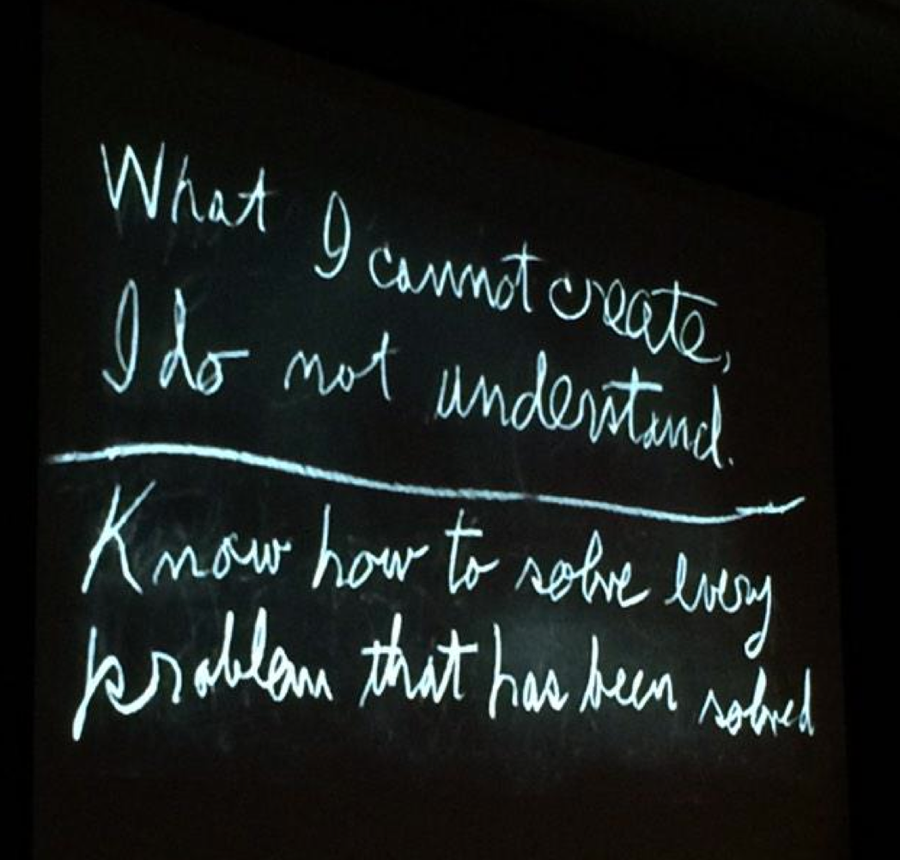
Below are two quotes on the blackboard of Feynman’s office in Caltech which were found just after his death.
Category: learning
Blog highlighted by SciRio
A nice article by @RutujaUgale in @Sci_Rio that discusses public engagement by scientists as influencers of scientific thought.
Thanks, Rutuja, for profiling my blog, ‘Vismaya’.
Here is my quote from the article:
“For me, there are two implications of doing science. One is that science is extremely useful to society, and the second is that it is a good, thoughtful way of living one’s life. Communicating the second implication is important to me, and I do this by researching, writing, and podcasting about the history and philosophy of science (physics in particular). This path helps people understand the human element of doing science and reveals a context. Some of my blogs (filtered here) discuss why I do science and how I do it. More than ‘influencing’ the audience, I am interested in inviting them to explore science by themselves via their own curiosity. That is one reason why my blog is called VISMAYA.”
Link to the full article.
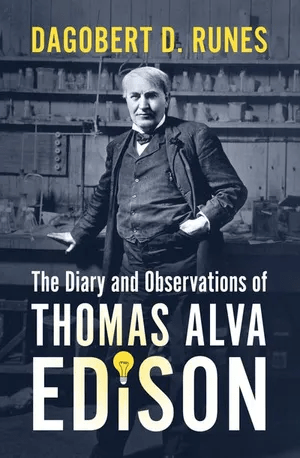
THE DIARY AND OBSERVATIONS OF THOMAS ALVA EDISON

Thomas Alva Edison was one of the greatest inventors we know about. Sometime ago, I stumbled upon a book titled THE DIARY AND OBSERVATIONS OF THOMAS ALVA EDISON, and it was an interesting read. In there, we obtain an insight into Edison’s view on many different subjects, including education, work, religion, etc. Edison was a person with strong views. His working methods were unconventional. Here are a few interesting facts I learnt from this book:
1) Edison had to recruit many executives to his labs; he always emphasized on a memory test and gave them a questionnaire to answer. He insisted that memory is very important for decision making, and he usually employed those people who had very good memory. Edison wrote “…Certainly the brain should have the facts. If a brain possesses an enormous number of facts, those facts, through action of the subconscious mind, will automatically keep themselves available when needed and will automatically keep themselves out of the way, not interfering when not required.”
2) Edison’s view on education was interesting and bold for his times, and he believed that learning through movies would be vital for future education. As early as the 1890s, he said that the best way to teach geography is either by taking the student on a tour or by showing them a movie. Edison wrote
“…motion pictures can be applied to a scientific, systematic course of memory training in the schools, taking the children at an early age when the mind is plastic enough to adapt itself most readily to new habit of thought.
Most of our text books fail on two big counts. They are not sufficiently human, and their application is not sufficiently practical”
3) In the following lines, Edison gives an insight into how he worked: “When I want to discover something, I begin by reading up everything that has been done along that line in the past-that’s what all these books in the library are for. I see what has been accomplished at great labor and expense in the past. I gather the data of many thousands of experiments as a starting point, and then I make thousands more.”
“ …..The motive that I have for inventing is, I guess, like the motive of the billiard player, who always wants to do a little better-to add to his record. Under present conditions I use the reasonable profit which I derive from one invention to make experiments looking towards another invention…..”
4) Edison rates the phonograph as his greatest discovery. He writes, “Which do I consider my greatest invention ? Well, my reply to that would be that I like the phonograph best. Doubtless this is because I love music. And then it has brought so much joy into millions of homes all over this country, and , indeed, all over the world.”
5) The following quotation by Joshua Reynolds was hung in every room of Edison’s laboratory “ There is no expedient to which a man will not resort to avoid the real labor of thinking”
There are many more fascinating thoughts of Edison, many agreeable and a few disagreeable ones, in the above-mentioned book, and if you happen to find it, read it through…it’s a classic and insightful read.
The above text is from a 2011 post on my old blog.
15 years at IISER Pune – Journey so far
Today, I complete 15 years as a faculty member at IISER-Pune. I have attempted to put together a list of some lessons (based on my previous writings) that I have learnt so far. A disclaimer to note is that this list is by no means a comprehensive one, but a text of self-reflection from my viewpoint on Indian academia. Of course, I write this in my personal capacity. So here it is..
- People First, Infrastructure Next
As an experimental physicist, people and infrastructure in the workplace are of paramount importance. When I am forced to prioritize between them, I have chosen people over infrastructure. I am extremely fortunate to have worked with, and continue to work with, excellent students, faculty colleagues, and administrative staff members. A good workplace is mainly defined by the people who occupy it. I do not neglect the role of infrastructure in academia, especially in a country like India, but people have a greater impact on academic life. - Create Internal Standards
In academia, there will always be evaluations and judgments on research, teaching, and beyond. Every academic ecosystem has its own standards, but they are generalized and not tailored to individuals. It was important for me to define what good work meant for myself. As long as internal standards are high and consistently met, external evaluation becomes secondary. This mindset frees the mind and allows for growth, without unnecessary comparisons. - Compare with Yourself, Not Others
The biggest stress in academic life often arises from comparison with peers. I’ve found peace and motivation in comparing my past with my present. Set internal benchmarks. Be skeptical of external metrics. Strive for a positive difference over time. - Constancy and Moderation
Intellectual work thrives not on intensity alone, but on constancy. Most research outcomes evolve over months and years. Constant effort with moderation keeps motivation high and the work enjoyable. Binge-working is tempting, but rarely effective for sustained intellectual output. - Long-Term Work
We often overestimate what we can do in a day or a week, and underestimate what we can do in a year. Sustained thought and work over time can build intellectual and technical monuments. Constancy is underrated. - Self-Mentoring
Much of the academic advice available is tailored for Western systems. Some of it is transferable to Indian contexts, but much of it is not. In such situations, I find it useful to mentor myself by learning from the lives and work of people who have done extraordinary science in India. I have been deeply inspired by many people, including M. Visvesvaraya, Ashoke Sen, R. Srinivasan, and Gagandeep Kang. - Write Regularly—Writing Is Thinking
Writing is a tool to think. Not just formal academic writing, but any articulation of thought, journals, blogs, drafts, clarifies and sharpens the mind. Many of my ideas have taken shape only after I started writing about them. Writing is part of the research process, not just a means of communicating its outcomes. - Publication is an outcome, not a goal Publication is just one outcome of doing research. The act of doing the work itself is very important. It’s where the real intellectual engagement happens. Focus on the process, not just the destination.
- Importance of History and Philosophy of Physics
Ever since my undergraduate days, I have been interested in the history and philosophy of science, especially physics. Although I never took a formal course, over time I have developed a deep appreciation for how historical and philosophical perspectives shape scientific understanding. They have helped me answer the fundamental question, “Why do I do what I do?” Reflecting on the evolution of ideas in physics—how they emerged, changed, and endured—has profoundly influenced both my teaching and research. - Value of Curiosity-Driven Side Projects
Some of the most fulfilling work I’ve done has emerged from side projects, not directly tied to funding deadlines or publication pressure, but driven by sheer curiosity. These projects, often small and exploratory, have helped me learn new tools, ask new questions, and sometimes even open up new directions in research. Curiosity, when protected from utilitarian pressures, can be deeply transformative. - Professor as a Post-doc
A strategy I found useful is to treat myself as a post-doc in my own lab. In India, retaining long-term post-docs is difficult. Hence, many hands-on skills and subtle knowledge are hard to transfer. During the lockdown, I was the only person in the lab for six months, doing experiments, rebuilding setups, and regaining technical depth. That experience was invaluable. - Teaching as a Social Responsibility
Scientific social responsibility is a buzzword, but for me, it finds its most meaningful expression in teaching. The impact of good teaching is often immeasurable and long-term. Watching students grow is among the most rewarding experiences in academia. Local, visible change matters. - Teaching Informally Matters
Teaching need not always be formal. Informal teaching, through conversations, mentoring, and public outreach, can be more effective and memorable. It is free of rigid expectations and evaluations. If possible, teach. And teach with joy. As Feynman showed us, it is a great way to learn. - Foster Open Criticism
In my group, anyone is free to critique my ideas, with reason. This open culture has been liberating and has helped me learn. It builds mutual respect and a more democratic intellectual space. - Share Your Knowledge
If possible, teach. Sharing knowledge is a fundamental part of academic life and enriches both the teacher and the learner. The joy of passing on what you know is priceless. - Social Media: Effective If Used Properly
Social media, if used responsibly, is a powerful tool, especially in India. It can bridge linguistic and geographical divides, connect scientists across the world, and communicate science to diverse audiences. For Indian scientists, it is a vital instrument of outreach and dialogue. My motivation to start the podcast was in this dialogue and self-reflection. - Emphasis on Mental and Physical Health
In my group, our foundational principle is clear: good health first, good work next. Mental and physical well-being are not optional; they are necessary conditions for a sustainable, meaningful academic life. There is no glory in research achieved at the cost of one’s health. - Science, Sports, and Arts: A Trinity
I enjoy outdoor sports like running, swimming, and cricket. Equally, I love music, poetry, and art from all cultures. This trinity of pursuits—science, sports, and the arts—makes us better human beings and enriches our intellectual and emotional lives. They complement and nourish each other. - Build Compassion into Science
None of this matters if the journey doesn’t make you a better human being. Be kind to students, collaborators, peers, and especially yourself. Scientific research, when done well, elevates both the individual and the collective. It has motivated me to humanize science. - Academia Can Feed the Stomach, Brain, and Heart
Academia, in its best form, can feed your stomach, brain and heart. Nurturing and enabling all three is the overarching goal of academics. And perhaps the goal of humanity.
My academic journey so far has given me plenty of reasons to love physics, India and humanity. Hopefully, it has made me a better human being.
Why Read Books in the age of internet ?
Learning & Happiness
Writing in the age of AI
A contemporary question of interest: How can artificial intelligence (AI) influence writing?
Writing has two consequences – 1) a writer processing information and communicating it to an audience; 2) a reader processing the author’s information.
The first part has an element of personal touch, just like any art or craft (for example, pottery). One does write (or create a pot) partly because it gives some pleasure and helps one to understand something in the process. There is a gain of knowledge in writing. This pleasure and wisdom through writing cannot be replaced by an external agency like AI. This is because external tools like AI are assistants of thought, not internal replacements of thought. In that sense, no external tool can replace any amateur activity because something is done for the sake of the process. Writing as a tool of self-reflection cannot be replaced by something external.
So, where is the threat? Actually, it is professional writing which is under partial threat from AI. Wherever the end product is more important than the process of writing, AI can gain prominence, provided it is accurate. It is still a partial threat because a professional writer can create questions and combinations that may arise out of individual experiences. Those lived experiences are derived from “life“, and AI cannot be a substitute for such an internal experience.
Writing, like many human endeavors, is both internal and external. The former makes us human, and that is hard to replace. After all, the A in AI stands for artificial.
The net forward..
Scientific progress is 2 steps forward and 1 step backward.
The public perceives only the net forward step. But it is that backward step that makes science authentic.
The origins of scientific temper is in that 3rd step. Science is incomplete without that step.
Some policies of my research
In the past 14 yrs of my research group, I have made a few policies for myself, which may be helpful to others:
1) Any group member is free to criticize my input with reason. This has been one of the most liberating experience. Importantly, it has helped me learn.
2) Physical and mental health of group members is of primary importance. Good health and good research is not a zero sum game.
3) Constancy of thought and work is vital. We overestimate work that can be done in short term and underestimate the long term. Constant effort, spread over months and years, can build intellectual and technical monuments.
4) Set internal standards. Let this standard be reasonable and focused towards oneself. The biggest stress in work comes from comparison with others. Instead, compare your past with present, & strive for a +ve difference. Be sceptical of external metrics.
5) Write regularly. Writing is not only about publication in a journal or a book. It is a way to reflect, learn, revise and communicate. Writing is the process. A publication is one of the outcomes, a temporary goal. Focus on the process, goals will follow.
6) Share your knowledge. If possible – TEACH. Teaching informally is very enjoyable. It is devoid of judgements. In the longer run, it is perhaps the most impactful thing you will do, and will be remembered for. Remember Feynman.
7) None of the above points matter if your work does not make you a better human being. Be compassionate to others. The biggest strength of scientific research, if done well is it elevates the individual & collective – both local & global.
8) Academia, in its good form, can feed your stomach, brain and heart. Nurturing and enabling all the three is the overarching goal of academics. And perhaps the goal of humanity.
Questions: Substance and Form

To wonder is to be human. At the heart of wondering is questioning. As an individual and a collective, encouraging people to ask questions is one of the most important things we can do. Start with your children or young people around you. Encourage them to question you. Try to answer them honestly. If you do not know the answer, explore the answer with them. Emphasize that no answer is complete and is subject to revision upon new evidence and ideas.
In my opinion, this process is the safest training you can give them as an adult and help them become informed citizens.
Along the way, teach them two things: 1) how to formulate a question and 2) pay attention to the tone of the question they ask.
Formulating a good question is a challenging task and requires iteration. Iterations mean patience. So, asking a good question is a training in patient thinking. Discourage rushing through. That does not mean the upper time bound is infinite. This means you shouldn’t settle for the default question. Question the question.
Next is the tone of the question. It is the tone which determines the intention of the question. If your intention is grounded in humility, curiosity and transparency, you will have a better chance of obtaining an answer. A question asked in a condescending tone generally discourages people from answering, even if their intention is not to conceal.
Of course, these are not general rules but guidelines that may be useful.
Conclusion:
Pay attention not only to the substance of your question but also to the form of your question. A questioning mindset can be extrapolated to your everyday thinking. Gradually, it will become a way of life.
Learning is more important than ego. When you realise this, questions become a great tool to explore the world.