The recent image of the black hole at the center of the milky way has been spectacular. When I teach a course, I generally emphasize analogies across the sub-disciplines of physics. In the below video I draw some analogies between black hole image and an optical vortex.
Light can carry orbital angular momentum (OAM) and spin angular momentum (SAM). This momentum can be transferred to an object that is interacting with the light. What we show is the experimental proof of concomitant detection of OAM and SAM in the coherent light scattering signatures from a single, silver nanowire. Essentially, the nanowire acts like a slit, and scatters the light. During this scattering process, the distribution of light in momentum space gets altered according to the spin (polarization) and orbital (topological charge) state illuminating the nanowire.
A notable point is that unlike other (metamaterials) methods, this unambiguous detection scheme does not require sophisticated nanofabrication methods and is mainly founded on fundamental principles of vectorial light scattering in the momentum space.
This experimental work (with a good dose of theoretical optics) was mainly due to the sustained efforts of an outstanding PhD student in my lab : Diptabrata Paul (about to finish PhD !)
He had excellent support and inputs from our PhD alumni Deepak K Sharma (now a postdoc/research scientist at ASTAR, Singapore).
Going further, this study motivates some interesting questions, of which we are interested in exploring the direct transfer of OAM and SAM at sub-wavelength scale to nanoscale objects including (macro)molecules. This will have some interesting manifestation on optical forces and torques at sub-wavelength scale, and we intend to study them in detail. This can be studied in a unique set-up that we have built in our lab that combines nano-optical tweezers with momentum-space imaging microscope. Look out for some studies in this direction from our lab.
It was late summer/early monsoon season of 2003, in Bangalore. The BTS bus travel from Rajajinagar to Koramangala via Majestic used to take 90 min or more. This commute, which I did for about 2 to 3 months, as summer student at Indian Institute Astrophysics (IIA) is still etched in my memory. I had just finished my first year MSc (Physics), and was seriously hooked on to physics in general, and astrophysics in particular. My summer project was on second solar spectrum guided by Prof. K. N. Nagendra (KNN) at IIA. It was he who introduced me to the fabulous world of polarization optics in the context of solar physics. This opened my eyes to the spectacular world of photon transport through an inhomogeneous medium, and hence multiple scattering of light. It was KNN who also introduced me to the classic : Radiative Transfer by Subrahmanyan Chandrasekhar. My first task as a summer student was to read the first chapter of this book and understand the representation of polarized light using Stokes parameters. The summer of 2003, was also the first time I encountered the power of computational methods to solve scientific problems, and ever since then I have deeply appreciated the role of computers in solving scientific problems. This introduction to computational physics and polarization optics (in the form of Jones, Stokes and Muller matrices) has turned out to be an important concept which I still use in my research. I thank KNN for this.
Recently, I was shocked to know that Prof. KNN passed away. His death was untimely, and a very sad news to me and many of the people who knew him. My condolences to his family, friends and students.
Weinberg inspires…
Recently, I also came to know about the sad demise of Steven Weinberg. Thanks to a special paper on Introduction to Quantum Electrodynamics in the final semester of my MSc, I learnt a bit about Weinberg as we were introduced to some aspects of unification of weak and electromagnetic forces. Also, with great enthusiasm, I learnt a lot from his fascinating book : The First Three Minutes: A Modern View of the Origin of the Universe. Undoubtedly, the scientific world has lost a great thinker.
The greatest impact of Weinberg on me was in a different context. In summer of 2004, I was selected for a PhD position at JNCASR. Prof. Chandrabhas had agreed to take me in as a PhD student, and I was elated and excited to join his group. I still remember the first time I visited his lab (after the selection) sometime in late May or early June 2004. As I entered the lab and opened that famous sliding door, there was a print-out of an article which was pasted right beside the door. This article was the Four Golden Lessons by Steven Weinberg, which was then recently published in 2003. This was literally, the first article I read as a PhD student in the lab, and has deeply impacted my work.
I still revisit the four golden lessons, time and again, and has been extremely useful throughout my career. As a tribute to him, below I reproduce the third lesson, which I think is worth contemplating :
My third piece of advice is probably the hardest to take. It is to forgive yourself for wasting time. Students are only asked to solve problems that their professors (unless unusually cruel) know to be solvable. In addition, it doesn’t matter if the problems are scientifically important — they have to be solved to pass the course. But in the real world, it’s very hard to know which problems are important, and you never know whether at a given moment in history a problem is solvable. At the beginning of the twentieth century, several leading physicists, including Lorentz and Abraham, were trying to work out a theory of the electron. This was partly in order to understand why all attempts to detect effects of Earth’s motion through the ether had failed. We now know that they were working on the wrong problem. At that time, no one could have developed a successful theory of the electron, because quantum mechanics had not yet been discovered. It took the genius of Albert Einstein in 1905 to realize that the right problem on which to work was the effect of motion on measurements of space and time. This led him to the special theory of relativity. As you will never be sure which are the right problems to work on, most of the time that you spend in the laboratory or at your desk will be wasted.If you want to be creative, then you will have to get used to spending most of your time not being creative, to being becalmed on the ocean of scientific knowledge. (emphasis is mine)
Thank you, KNN and Weinberg…for some golden lessons…
In short, we show, how by bending a nanowire we can narrowly beam the light scattered from molecules (see adjoining picture).
Optical emission from quantum objects such as atoms and molecules are very sensitive to their local surroundings. One of the current challenges in controlling optical emission from molecules at subwavelength scale is to narrow their scattering directivity. In the context of molecules, controlling light scattering at sub-wavelength scale has utility in optical trapping of molecules, molecular QED, cavity molecular mechanics, molecular quantum optics and many other areas of research.
Thanks to the great effort by Sunny Tiwari in my lab, who in the middle of the pandemic, tirelessly executed the idea of beaming elastic and Raman scattering emission from molecules in the vicinity of a bent plasmonic silver nanowire resting on a metallic mirror. He was ably supported by Adarsh (now at ETH), Dipta and Shailendra. Together, they experimentally confirmed the beaming characteristics from this geometry and corroborated with elaborate numerical simulations.
This work further motivates questions related to directivity control for single photon emitters and can be potentially harnessed for momentum-space engineering of nano-optical forces……
This semester I was teaching an advanced physics lab course (4th year BS-MS). Below is an email I sent to them. You may find it interesting :
Image of a plasma discharge experiment in the UG physics lab at IISER-Pune
Dear Students of PHY430,
I hope all of you are doing fine and staying safe where ever you are. Given that we are part of an advanced lab course, compensating for the lost time via internet is not feasible. To fill in the gap, I am writing to you about something you may find interesting and useful. So here it is:
Ventilators : By now you may be very familiar with this terminology. Essentially, it is a medical device that helps you to mechanically breathe, and has turned out be a vital component in fighting the extreme medical cases of COVID epidemic. In this regard, I want to inform about the efforts of my colleagues Sunil Nair and Umakant Rapol, who are actively involved in design and development of low-cost ventilators. As you may recognize, both of them are experimental physicists, and their knowledge and intuition has been put to excellent use during the pandemic. In an essence, their involvement in this venture shows how a strong foundation in physics can not only solve deep queries in fundamental aspects of science, but also can cater to an emergency situation. This is one of the important lesson of this course : the skills and knowledge that you gain as part of experimentation in a lab can be transferred and implemented to solve problems outside a lab.
A Book recommendation: Talking about experimental skills, I thought of recommending an excellent book by Matthew Crawford titled “Shop Class as Soulcraft: An Inquiry Into the Value of Work”. This is a kind of an autobiographical exposition by the author, who majored in Physics, obtained a Ph.D. in political philosophy, and worked in policy circles of Washington D.C. for a brief period, and quit this job to become a motorcycle mechanic and an academic author. This book dives deep into the philosophy of why working with hands (and brains) is a deeply satisfying venture as a career and life-style. If you are not able to read the book, here is an excellent excerpt by the author himself.
Lab reports: Do send me the report of the experiments that are due to be evaluated. I know some of you may or may not have good access to internet, so timelines can be flexible (2 weeks from today). Also, you may not have access to research material. In that case, do co-ordinate with your lab partners, and let me know if I can be of some help in this regard.
Finally, keep your experimental spirits high. After all, everything at home is a kind of lab equipment to explore
First of all, my condolences to all people who have lost someone directly or indirectly due to pandemic. Second, my salutations to all the health and essential workers who are striving hard to keep the world breathing. Third, my sympathies to all the free-willing minds who have been locked down. This outbreak has indeed changed our lives and life-style, and has confined most of the humankind spatially, and has metaphorically frozen us in time. Also, it has given us some time for self-introspection on what it is to be an individual in a society, and how actions of individuals and local community can affect the globe. In an essence, what we may be witnessing is a classic case of butterfly effect.
So, what am I up to in the past month or so ?
Research work: Now that all my research-group members are away from the institute, it has had an effect on our research. Although online platforms have kept us connected, and we are making slow progress in writing some papers and performing some computer simulations, it can never substitute two important things: experimental work in a lab, and the in-person interaction during research. On personal research front, I have been studying some interesting concepts on liquid crystals, and their related meso-photonics effects. That will be a topic of another blog in future.
COVID-related research: For the past year of so, I have been informally interacting with some researchers at Bharat Electronics Limited, Pune on topics related to nanphotonics and optofluidics. Thanks to the recent developments, we have initiated collaboration on research related to COVID. We will be exploring some on-chip optical microscopy and plasmonic methods to detect and interrogate pathogens in our local environment (including virus and virus-like particles). I will update you as we make some progress.
An interesting book: Over the past fortnight or so, I have been reading an interesting book titled : Fizzics – The Science of Bubbles, Droplets and Foams. It is a semi-technical/popular science book written by F. Roland Young, who has done considerable research on bubble cavitation and sonoluminescence. This book has some fascinating discussion on questions such as:
What is the origin of the sound when we crack our knuckles ?
Why and how do bubbles rise in a bottle of champagne ?
How to compute a math puzzle using a soap film ?
and many more…
My posts going further – Henceforth, I wish to post short blogs more frequently. Once in a while, I will post longer essays.
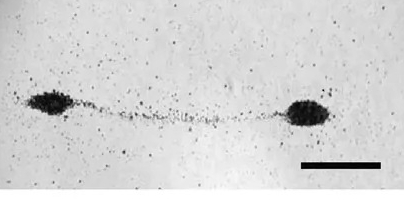
Optical microscopy image (scale bar 100 microns) of a metal colloidal chain assembled in a plasmofluidic potential in our lab at IISER-Pune (see https://www.nature.com/articles/ncomms5357 for more details)
Malleshwaram is one of the oldest parts of Bangalore. I studied BSc (Physics, Maths, Electronics) in MES College which is at the 15th cross of Malleshwaram. Apart from the college day memories of eating Dosae at CTR, other memorable aspects of my student life were playing cricket at Malleshwaram ground, and regularly visiting IISc and Raman Research Institute (RRI), which were not far from Malleshwaram. Particularly, the library at RRI was the place I spent most of my time during BSc and MSc. Two Professors at RRI with whom I interacted a lot were Prof. G.S. Ranganath and Prof. G. Srinivasan (both are retired now). I owe a lot of my interest in science to these two gentlemen. I was always interested in optical physics, and thanks to the interaction with Prof. G Srinivasan, I really got interested in optical phenomena in astronomy and astrophysics (I even did a rotation curve experiment using the radio telescope at RRI).
Thanks to this excitement, during my MSc Physics at Bangalore University, I did my summer research project at Indian Institute of Astrophysics, Bangalore with Prof. K.N. Nagendra, who introduced me to solar astrophysics. In fact, my project was on second solar spectrum and polarization of light in stars such as sun. Gradually, as I learnt more about optics in stellar environment, I increasingly became interested in optics of everyday life, and started exploring optics of rainbow, soap bubbles and other common objects.
Concomitantly, during BSc and MSc days, I and some of my classmates used to visit RRI and interact with Prof. G.S. Ranganath. He was the one who introduced us to soft-matter physics. Importantly, he impressed upon me the fascinating world at the interface of soft-matter physics and optics. I strongly recommend one of his books, which discusses some of these topics.
This introduction to soft-matter physics and interactions with Prof. Ranganath has had a profound impact on my research career. So much so, that I joined Prof. Chandrabhas’s lab at JNCASR for my Ph.D. to work on a (then) newly emerging topic of surface enhanced Raman scattering, which had a unique blend of colloids (a prototypical soft-matter) and light scattering, and it perfectly suited my research interest. During my Ph.D., I had a fantastic and thrilling experience of working on topics related to interaction of metal colloids with biological macromolecules using Raman scattering microscope as a tool. Thanks to the deep knowledge of Prof. Chandrabhas on optics and optical spectroscopy, and a variety of research at JNCASR, I got introduced to the fascinating field of optical microscopy, Raman scattering and soft-matter physics. Then during my post doc, first at ICFO-Barcelona, I got introduced to near-field optics and single-molecule imaging, and then at Purdue University, I learnt a bit of cell biology and used plasmonic light scattering to study some questions in bio-imaging.
Ever since I started my own research group in 2010 at IISER-Pune, my research interest evolved in topics such as nanowire plasmonics, spin and orbital angular momentum of light, whispering gallery modes in microspheres, single-molecule Raman scattering, and Fourier-plane optical microscopy and spectroscopy. As of Feb 2020, 6 Ph.D. students and around 9 MS students have graduated working on the abovementioned topics. The main focus, for about 10 years, has been on nanophotonics, and on some topics related to soft-matter physics, especially on colloids.
Starting Jan 2020, our emphasis and research orientation will be mainly towards ‘soft-photonics’. The motivation of this research is to explore some emerging questions at the interface of soft matter physics and micro- and nano-photonics. There are two important objectives to this research:
To study structure and dynamics of mesoscale soft-matter including colloids, liquid crystals, and complex fluids using a variety of techniques that we have developed for the past 10 years in the area of nanophotonics and single-nanoparticle optics.
To explore new opportunities in meso- and nano-photonics using soft-matter systems such as colloids, liquid crystals, droplets and bubbles, as a platform.
In a way, for the past 5 years or so, we have been implicitly working on these objectives. But from 2020 onwards, we will be mainly focusing on these objectives, and will be orienting all our efforts towards this direction.
This explicit reorientation is for the following reasons:
The interface of soft-matter physics and photonics provides some new opportunities to study some interesting questions in fundamental physics (such as topology, pattern formation, emergence and single-macromolecule dynamics) and applications (optofluidics, optical antennas, aerosol optics and gastronomy)
Light scattering and “quantitative” optical microscopy have emerged as powerful tools to study structure and dynamics of soft-matter. Given that our lab has laid a strong foundation in these tools for 10 years or so, it is an obvious extrapolation of our capabilities.
Thanks to the interaction with my soft-matter colleagues at IISER-Pune and many friends/researchers across India and outside, I have been “re-hooked” to soft matter physics. Given that the Indian research community on soft-matter is growing in number and has a good mix of experiments and theory, further motivates me to pursue this direction.
Perhaps the most important reason is that it renews my interest in science and reminds me of the fundamental reason of why I became a researcher: to enjoy what I do!
As a consequence of this renewed interest, I intend to write blogs oriented towards soft matter physics + photonics and wish to use this platform to educate myself and communicate my excitement with all of you.
Let me conclude by quoting “a poem from an experiment of soft matter” by Boudin, which is also the concluding part of the Nobel lecture of Pierre de Gennes:


 VISMAYA - History & Philosophy of Physics