J.C. Bose and the measurement of refractive index

Image : Wikicommons

How do you determine the refractive index of a material which is not transparent?

In 1895, J.C. Bose addressed this question experimentally using ‘electric rays’, which we currently know as microwave radiation!

The citation of the paper is

Bose, J. C., I. On the determination of the indices of refraction of various substances for the electric ray. I. Index of refraction of sulphur. Proceedings of the Royal Society of London, 59(353–358), 160–167. https://doi.org/10.1098/rspl.1895.0069

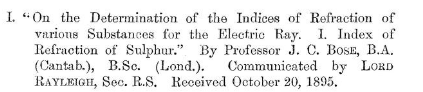
Below is the title of the paper that was communicated to the Royal Society via Lord Rayleigh, who was an authority on optical concepts Bose was using.
His experiment used the microwaves’ total internal reflection and extracted the samples’ refractive index through Brewster’s angle.

Bose beautifully describes his method as follows :

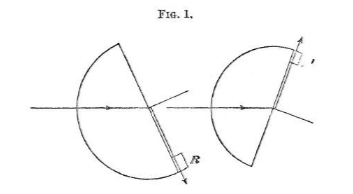
The angle of incidence is slowly decreased till the critical value is reached. At this point the ray is all at once refracted into the air, making an angle of 90° with the normal to the surface. If a receiver be fixed against the side of the semi-cylinder at II, it will now respond to the refracted radiation.

Below is the diagram depicting the same principle :
And the detailed description is as follows:

The refracting substance is cut out or cast in the form of a semi¬ cylinder, and mounted on the central table of a spectrometer; the electric ray is directed towards the centre of the spectrometer, and its direction is always kept fixed. It strikes the curved surface and passes into its mass without any deviation. It is then incident on the plane surface of the semi-cylinder, and is refracted into the air beyond.

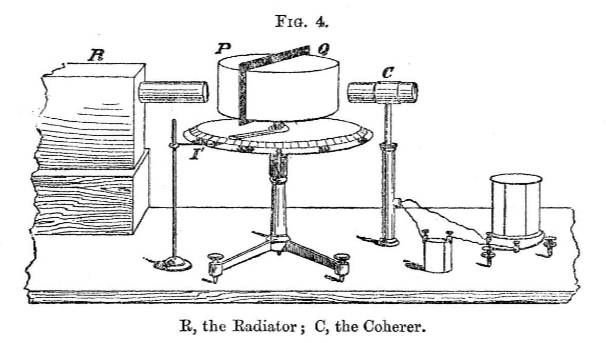
The apparatus design was also interesting, and the diagram below depicts what we nowadays call the microwave transmitter (indicated as radiator, R) and receiver (indicated as Coherer, C).
If you read the paper completely, the details of experiments are described meticulously, and the attention to detail is remarkable.

So, he determines the refractive index of sulfur using this method and ends up with a value of 1.734, which is quite accurate even by today’s standards (the value is upwards of 1.7 and depends on the wavelength of light). Notice that the measurement was made to the accuracy of three decimal places, which is impressive. Below is a set of data for which the value of the refractive index was determined.
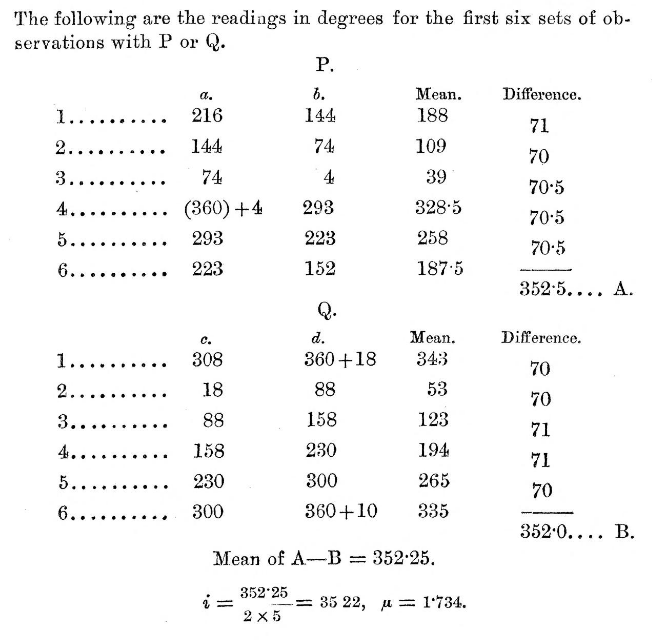
Now compare this to the modern measurement (see below data from around 1985) of refractive index based on more sophisticated methods, and you will see the matching is reasonably good at higher wavelengths close to 1 micron. (Note that Bose’s measurements was at higher wavelength than shown below)
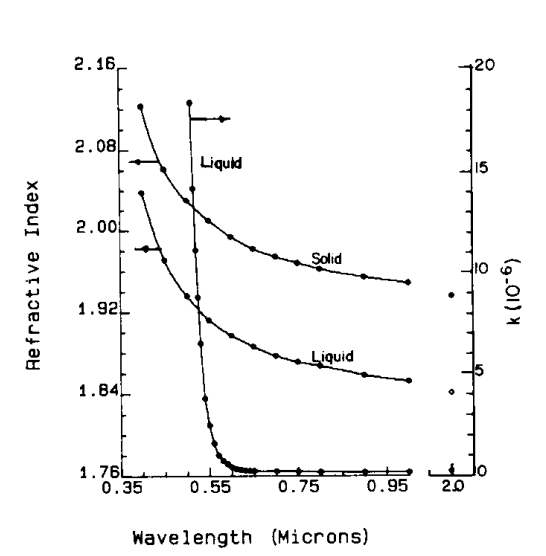
Data from: Icarus. Volume 64, Issue 3, December 1985, Pages 368-374; https://www.sciencedirect.com/science/article/abs/pii/0019103585900612

J.C. Bose was a creative scientist; the above example is just a small illustration of his capabilities as an experimentalist.

Now, with this inspiration, let me head back to my lab to do some experiments :-)

ps: A video to go with this blog (updated on 17th Apr 2025)

2023 Nobel in Sciences – A few observations and questions

One of the interesting aspects of the Nobel Prize in Sciences this time is that all the 8 laureates are experimentalists. This is not to underplay the contribution of theoreticians but to emphasize the point that experimental observations are central to the progress of sciences and follow-up technology. Also note that many of these laureates were equally well-versed in theoretical ideas, and hence were able to connect the abstract to the real. An effective way to do science.

Another aspect is that all the experimentalists are strongly anchored in the West. They have performed all their work in an ecosystem that has supported their efforts, even when their ideas were not well known. A case in point is Katalin Karikó (one of the medicine/physiology laureates). Although U Penn treated her badly, she was still able to sustain her research thanks to the research-driven business ecosystem in the West, including the USA and Germany, where she could establish herself in the biotech research industry. This means the Western research ecosystem, including its businesses, was open enough to allow someone who was almost discarded by the US academic system. Karikó’s is a great story, but we must not forget that eventually, the system in which she worked recognized her contribution.

Now, some things to ponder – what if Karikó had moved to a place such as India? Could she have survived and thrived in our research ecosystem? If she had moved, was our academic and market ecosystem open to welcome her, take her expertise, and utilize it effectively? Answers to these questions are not straightforward but may indicate where we are as a research ecosystem. 

अहिंसा, सत्याग्रह

अहिंसा, सत्याग्रह

Gandhi lived a life in pursuit of non-violence and truth (the meaning of the above two words in Devanagari script).

The beauty of Gandhi’s life is his astonishing honesty. You can still disagree with him on certain aspects of his politics, including economics, and yet engage with his ideas and learn something deep. If you observe his writings, he was always engaging in disagreement and yet never dismissive of an opposing idea. He subjected himself to scrutiny of his character and yet emerged with a deeper meaning of flaws and self-introspection. Talk about confidence!

This is perhaps the hallmark of his education. A lesson he took not only as a teacher but also as a student of life.

Probably Gandhi’s most innovative idea was to recognize the deep philosophical and human aspects of life and incorporate them into his work. He practiced what he preached, which is a rarity. Einstein realized this very early (see the quote).

The two ideas mentioned at the beginning have stood the test of time, and I think they will continue to serve as benchmarks of human intellectual life. That is the lesson I take away from his life.

Long live अहिंसा and सत्याग्रह…

Sanskrit quote on learning..

आचार्यात् पादमादत्ते पादं शिष्यः स्वमेधया ।
सब्रह्मचारिभ्यः पादं पादं कालक्रमेण च ॥

One fourth from the teacher, one fourth from own intelligence,
One fourth from classmates, and one fourth only with time.

Happy Teacher’s Day.. learning is eternal..

10 things I learnt from Chandrayan 3

On 23rd Aug 2023, ISRO made history by landing a spacecraft close to the south pole of the moon. For a long time in India, I have not seen such an enthusiasm for science and technology, and it was indeed heartening to experience this. In reference to the proceedings in recent times, below are some brief lessons I learnt :

  1. For space programs, strong foundations in computation coupled with deep understanding of computer-assisted hardware is vital. Traditionally, India had good strength in computational aspect, but this mission showcased its capability in computer-assisted hardware and manipulation. As expected, ISRO is leading the way, and it is important to emulate this software-hardware coherence in other sectors.
  2. Science and Technology need not be a zero-sum game. Collectively, they have a lot to offer to the Indian society. The mission shows how investing in scientific activities can positively influence a society. In an essence, collective scientific endeavors like Chandrayaan strengthens our democracy.
  3. ISRO’s ability to learn from past failure is commendable. It showcased how scientific experiments should be approached, and how missions should be accomplished.
  4. There was a significant proportion and contribution of women in Chandrayaan 3.
  5. A reasonable and sustained research-budget given to a dedicated set of people can, sometimes, achieve remarkable things. That should not be a reason to limit funding towards research. This should encourage our society to further support scientific research.
  6. Some parts of social media and online news portals played a better role in broadcasting and discussing the mission than Indian TV channels.
  7. Some news papers (I read Indian Express (in print) and non-paywalled parts of Hindu online) did a good job of explaining many scientific concepts.
  8. Global south has tremendous scientific potential. The Indian sub-continent must take up collective scientific endeavors to have a greater impact in the region. India can lead the way.
  9. Classical physics and Engineering Science is alive and kicking. There is still a lot to explore and understand nature at ‘macro’ scale. It also highlights the importance of strong foundations in science and mathematics.
  10. At the heart of all these things is human curiosity and rationality. Nurturing this curiosity and rationality is our collective responsibility. It not only offers transient joy, but also orients our collective action to make this world a better place. After all, it resonates with वसुधैव कुटुम्बकम (“The World Is One Family“).

A case for compassionate rationality

Nowadays, it is very common to see various advertisements and social media posts where blatantly unscientific and irrational suggestions are explicitly presented, and even celebrated.

Perhaps this is one of the best ways to avoid probabilistic thinking, which is not natural to human beings. Irrationality attracts a lot of people, and those who understand this utilize it for their benefit. It is the fastest way to group people into a stream as you don’t need to explain. The burden of explanation is always on the rational and not on the irrational. Essentially, it is an asymmetric game.

Generally, any explanation leads to more questions. These questions can further lead to enquiry and that has a cognitive cost. Irrationality does not have to pay that cost.

This has been happening for ages, just that their forms keep changing. It is important to emphasize that cultures across the world, including India, have elements of spirituality and rationality.

Most of the time, the spiritual element is over-emphasized, whereas the philosophical and rational aspect is not given the same prominence. If you dig deeper into any culture, it is the philosophical and rational that has elevated the thought process by asking probing questions, but it is the spiritual which captures the attention.

One way to overcome this problem is to emphasize the rational aspect of the culture. If people start appreciating the fact that there were many people from their own cultural roots who did think deeply and questioned everything, then there is a historical connection. Importantly it leads to a realization that rationality is not something foreign but a cultivated human behavior indigenous to ones own culture.

This is where I make a case for compassionate rationality. It is important that we take the path of patience and explain the gravitas of rationality and its cultural roots without being condescending in our tone and in our thoughts. We need to emphasize its benefits compared to blind faith. We need to make a strong case that rationality has a historical past in our own culture, and importantly it has utility in the present and in the future.

After all, being an atheist/rationalist is not incompatible with being an empathetic and compassionate person. One can still not believe in god and appreciate the cultural roots. One can still go to a temple/mosque/church/any place of worship and be in awe of the architectural beauty and creativity. One can still have a friend who is deeply religious, and have a meaningful argument.

One can still be rational and human.

References for further exploration:

Watson, Peter. “Ideas: A History from Fire to Freud.” Accessed May 26, 2023. https://peterwatsonauthor.com/books/ideas-a-history-from-fire-to-freud/.

Sen, Amartya. The Argumentative Indian: Writings on Indian History, Culture and Identity. Penguin UK, 2006. https://www.google.co.in/books/edition/The_Argumentative_Indian/gcGiwyBS3YwC?hl=en&gbpv=0

Pinker, Steven. “Rationality.” Accessed May 26, 2023. https://www.google.co.in/books/edition/Rationality/HT0NEAAAQBAJ?hl=en&gbpv=1&printsec=frontcover.

Episode 4. Science, Rationality and Compassion, 2023. https://www.youtube.com/watch?v=ewZIue55Zl0.