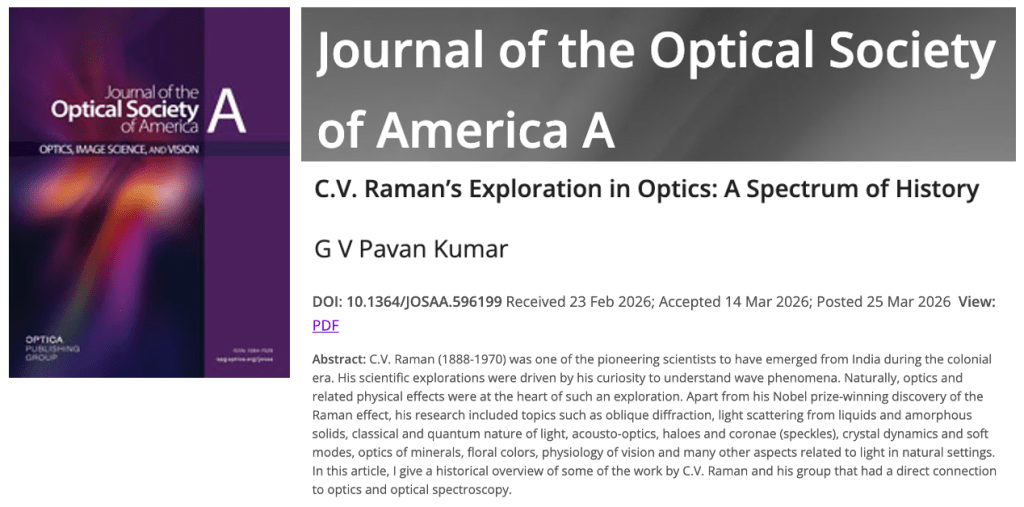
The accepted paper is online now. Thanks to the anonymous reviewer(s) for the encouraging feedback. It made my day :-)
The paper will be published as part of a special issue on optics in South Asia
Link to the online version here.
The accepted paper is online now. Thanks to the anonymous reviewer(s) for the encouraging feedback. It made my day :-)
The paper will be published as part of a special issue on optics in South Asia
Link to the online version here.
One of the important issues to be addressed in recent (AI-driven) times is: how can research scholars acquire knowledge and simultaneously contribute to and communicate with society? Related to this question is: What is the role of scholarship in contemporary times?
Below are three thoughts that I wrote mainly with young researchers in mind. I am hoping that it may find use even among others.
1) Pursuit and utility of knowledge is the primary task of a scholar, and managing the perception of that knowledge is secondary. This means a scholar should use a majority of their time, resources and energy in enhancing scholarly knowledge, and in cases where there is utility, applying that knowledge in the outside ‘noisy’ world. This is your personal knowledge based on your efforts and experiences, and cannot be replaced instantaneously. This also brings uniqueness. Once you have this, you can venture into creating a realistic perception of your knowledge. Remember that learning and researching, to a large extent, are under your control; whereas how the outside world perceives your knowledge is not. Therefore, it would be prudent to pay more attention to learning and doing rather than creating a perception. Note that I am not saying that perception is unimportant. All I am saying is that perception is secondary in importance.
2) One of the key learnings in research and education is that the world is always open to good knowledge and ideas, be it in academia or industry. People are always interested in interacting with and hiring people with a sound knowledge base. It may take a while for somebody to discover your knowledge, but if you have a strong foundation and then go out to the world and interact with it, it is very difficult for the world to ignore you. This means that, having done good work, you should be able to share that work with the outside world. This can be a research paper or an engineering prototype, or any form of science, art or talent that you have. The crucial point here is to first do the hard work and then venture into the sharing of that work.
3) In your work, do not compromise on rigor. If you are a researcher, your first commitment should be towards addressing your scholarly peers or the specialized industry and then broadening your communication. Within scholarly communication, you will have to address questions within the research community. This means you will be basing your work on a large body of knowledge and subjecting yourself to internal and external criticism. This is where rigor comes in handy. Here, rigor does not mean unclear communication. It means to have thought through the questions, nuances and complications of a problem and have a broad and balanced view of the research problem. The general audience sometimes perceives rigorous scholarly communication as filled with jargon and complications. Therefore, it is always better to create two versions of your work: one for your peers and one for the general audience. In the age of AI, the second version is easier to create. Remember that your expertise will be vital in creating the second version for the general audience. That is where you can bring your authenticity and creativity. This can also broaden the scope of your knowledge without compromising your scholarship.
These are a few fleeting thoughts. You can criticize, edit, expand and adapt it to make your own version of it. After all, that is how knowledge moves forward 😊
There is a story going around on Facebook related to C.V. Raman and Nehru, and it makes a reference to Raman’s biography. It describes Raman and Nehru’s interaction in a darkened room at Raman Research Institute. Intrigued by the story, I went back and checked some of the biographies of C.V. Raman, and I could not find that story. If someone could find the exact reference, please let me know. (update on 4th March 2026: I dug up the sources further and found this anecdote in chapter 21 of C.V. Raman: A Biography, by Uma Parameswaran, Penguin Books India (2011). Unfortunately, there is no primary or secondary reference associated with the anecdote.)
Among the biographies, Venkatraman’s ‘Journey into the Light’ is comprehensive and mentions Nehru at least 70 times. It does discuss quite a bit about the interaction between these two powerful people and their differences of opinion. It also highlights their common commitment to science and technology. Raman publicly expressed his opinion on the state of science in India. His pronouncements did not go unnoticed, and the press highlighted them. Raman’s biographer, Venkatraman, addresses the issue of Raman’s criticism: “It should not be assumed that Raman was merely making a series of arbitrary and disconnected pronouncements. On the contrary, they were symptoms of a deep concern he had begun to feel about the way science was being promoted. It seemed to him that in the rush for development, scientific excellence and the objectives of science had begun to take a back seat. Sycophancy was on the rise, and ill-equipped people were being propelled into seats they were not ready to occupy. Everyone paid lip sympathy to the universities, but when it came to funding them, they were generally forgotten. What was worse, mediocrity was slowly allowed to become institutionalized. In retrospect, Raman’s utterances, though harsh, implicitly carried a warning that was unfortunately not heeded. And despite all the pious hopes of that period, the linkages between science and technology in India continue to be quite tenuous.” ([Venkataraman, 1989, p. 488])
Having said that, I should mention that almost all of his biographers mention Raman’s confrontation with a variety of people, starting from his Calcutta days till the end of his life. Subsequent scholarship in social sciences has also highlighted Raman’s issue with gender and caste. In contrast to people like Babha, Saha, and Dhawan, Raman was not an institution builder. He had his limitations, but his commitment to science and its role in society is unquestionable.
As I have written before, Raman was not an easy character to study and understand. He contained multitudes. For sure, he was an outstanding experimental physicist. His knowledge of mathematical physics, especially the classical aspect, was very good, and he utilized it extensively in his work. His scientific biographers, both Venkatraman and Ramaseshan, mention that although he had the aptitude to analyze theoretical frameworks, he was more driven by intuition and generally skimmed over the mathematical aspect of his work. This was also observed by Max Born. He also mentored some excellent scientists, such as K.S. Krishnan, Nagendra Nath, Bhagavatham, Pancharatnam, and G.N. Ramachandran, Anna Mani (one of the few women in his lab), to name a few. Probably the most important feature of Raman as an individual was his can-do spirit and his lifelong drive to do science irrespective of the situation.
My broad lesson from all this is to take the positives from the science and the scientific pursuit of a scientist, and yet, remain aware of the flaws in the character of the human being. After all, course correction is from the benefit of hindsight, and its application is in the present and the future.
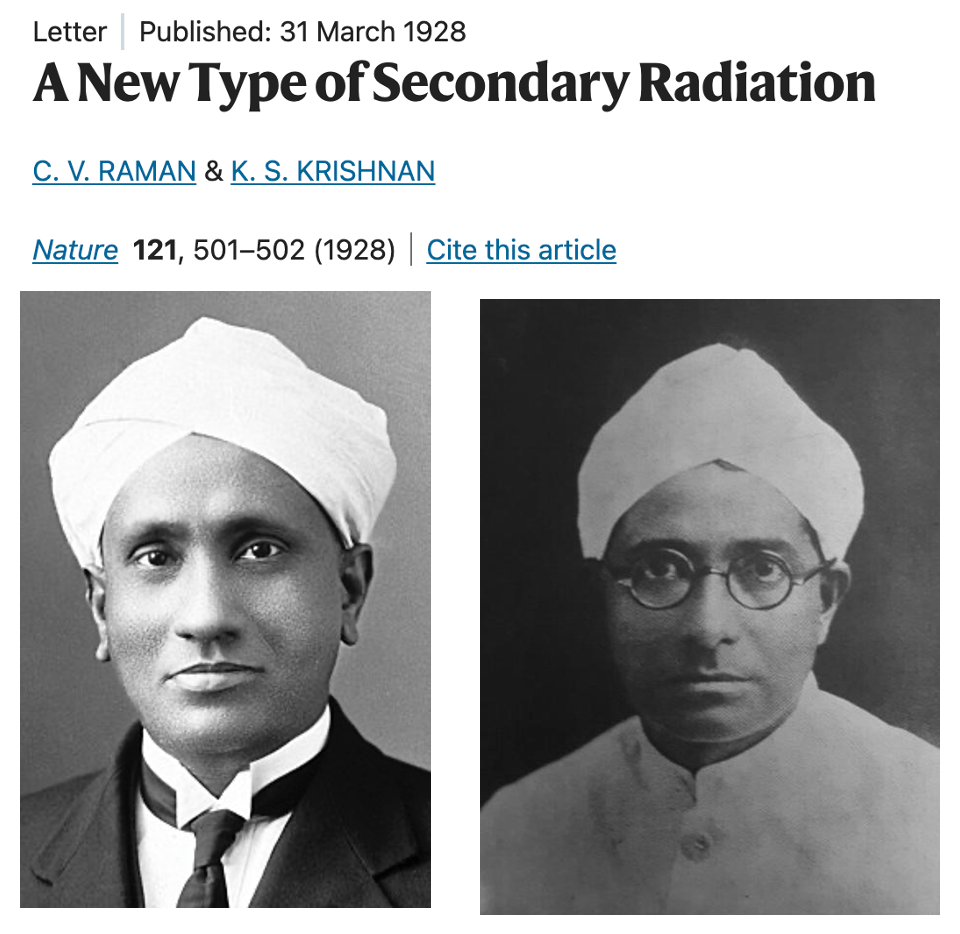
On 28th February, we commemorate the first confirmed observation of the Raman effect, dating back to 1928. Raman’s student, K. S. Krishnan (imaged on the right), had an important role in this observation, and the scientific paper associated with Raman scattering has both Raman and Krishnan as the authors (see picture above). Scientific discoveries and inventions happen with constant effort spread over a long duration. It also happens on a strong foundation of knowledge that has already been established.
Raman recognised this and, as he mentions in his talk on scientific outlook, “The happy discoverer in science is invariably a seeker after knowledge and truth working in a chosen field of his own and inspired in his labours by the hope of finding at least a little grain of something new. The commentators who like to consider discoveries as accidents forget that the most important part of a scientific discovery is the recognition of its true nature by the observer, and this is scarcely possible if he does not possess the requisite capacity or knowledge of the subject. Rarely indeed are any scientific discoveries made except as the result of a carefully thought-out programme of work. They come, if they do come, as the reward of months or years of systematic study and research in a particular branch of knowledge.” (Raman, 1951, p. 243)
This, I think, is generally good advice for researchers, especially the younger ones. One cannot over-emphasize the importance of systematic study.
On this commemorative day, it will be good for us, Indians, to commit ourselves to sincere, honest, hard work motivated by a scientific outlook. As Raman mentions, we need to be seekers of knowledge and truth. Not everything may lead to spectacular results, but it will give us a reason for having done something correct and hopefully useful to humanity. In doing so, we may live a meaningful and purposeful life. Science and scientific thinking can have a central role in realizing such a life.
Happy National Science Day to India…and to the world. After all, science is global.
Reference:
Raman, C. V. ‘The Scientific Outlook’. The New Physics – Talks on Aspects of Science by C V Raman, Philosophical Library, New York, 1951. https://doi.org/10.1007/BF02835148.
One of the last letters written by Rutherford. This was to Raman dated 3rd Aug 1937.
Here, he is consoling Raman after he quit the Directorship of IISc. Rutherford is also discussing his possible travel plans to India.
Unfortunately, Rutherford died on 19th Oct 1937..
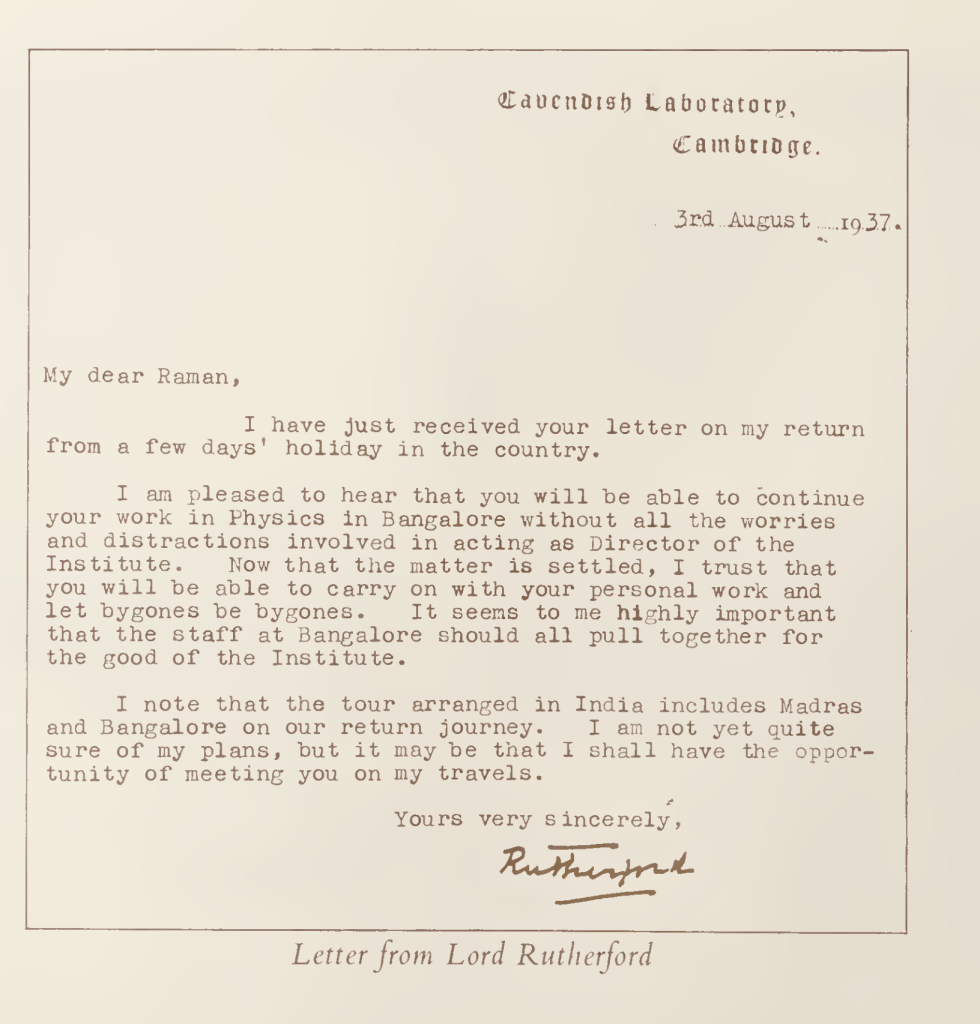
ref: S. Ramaseshan and C. Ramachandra Rao. C.V. Raman : A Pictorial Biography, p 108 (1988)
A gentle reminder: Digital infrastructure is not equal to physical infrastructure.
The former is a smaller set of the four-dimensional space-time world we live in.
AI-based tech is fantastic for an upgrade in digital infrastructure and has already made tremendous progress. But the real deal is in the physical domain.
This also indicates where the future action is, and will be influenced by our understanding of physical sciences, including engineering domains beyond computer science.
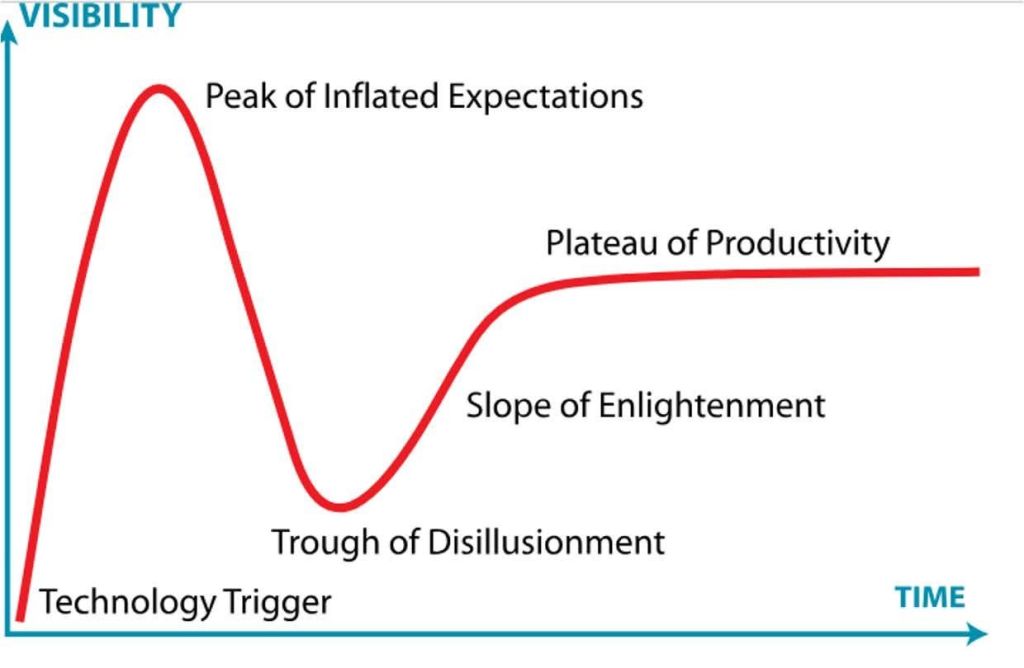
What we are witnessing in AI is probably the peak of Gartner’s hype cycle.
Here I discuss the paper that announced the Raman effect to the world…
Happy Republic Day to all my fellow Indians !
26th Jan is also an important day in the history of physics/engineering –
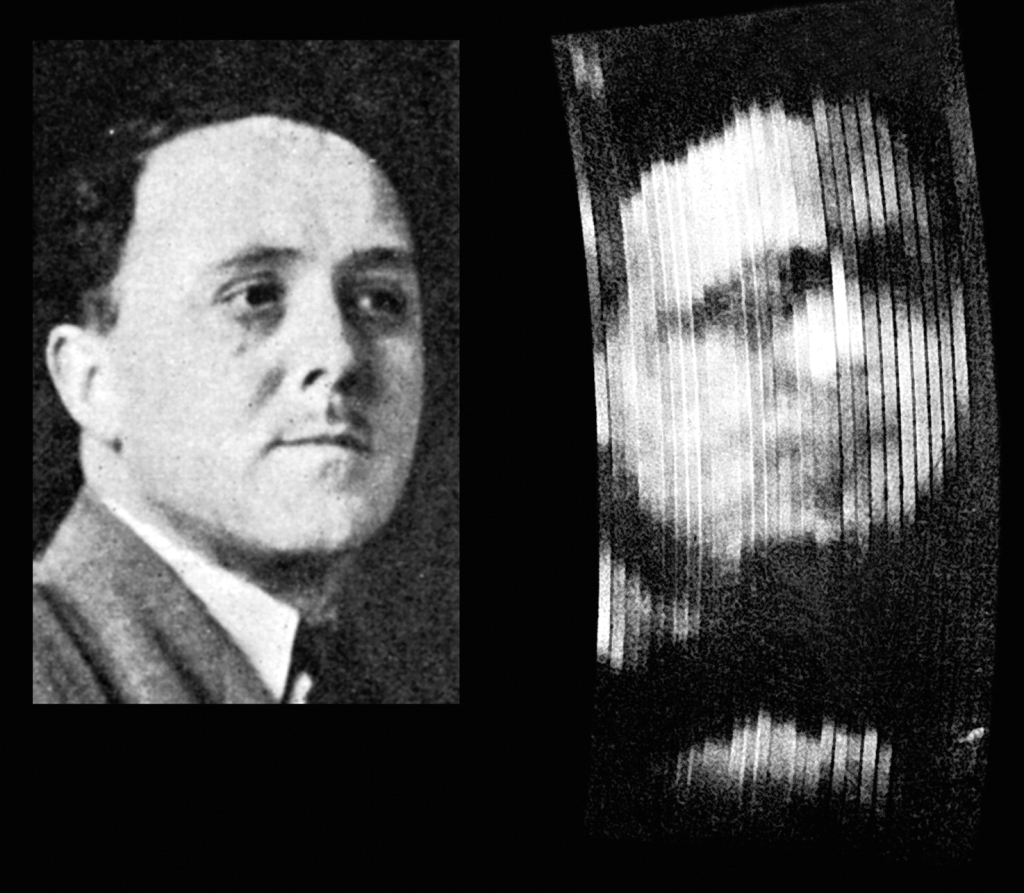
26th Jan 1926 – J.L. Baird “demonstrated television at his premises in Frith Street, London, to about forty people including members of the Royal Institution…..The Times was the only newspaper invited, and its reporter published the story on 28 January”. This exactly a 100 years today !
26th Jan 1939 – Niels Bohr publicly announced nuclear fission, specifically the splitting of the uranium atom.
26th Jan 1954 – Morris Tanenbaum et al. at Bell Laboratories showed a working silicon transistor.
McLean, Donald F. 2014. “The Achievement of Television: The Quality and Features of John Logie Baird’s System in 1926.” The International Journal for the History of Engineering & Technology 84 (2): 227–47. https://doi.org/10.1179/1758120614Z.00000000048.
“Niels Bohr Announces the Discovery of Fission – Nuclear Museum.” n.d. Https://Ahf.Nuclearmuseum.Org/. Accessed January 26, 2026. https://ahf.nuclearmuseum.org/niels-bohr-announces-discovery-fission/.
“The Lost History of the Transistor.” 2004. IEEE Spectrum 41 (5): 44–49. https://doi.org/10.1109/MSPEC.2004.1296014.
Wikipedia. 2025. “History of the transistor.” December 22. https://en.wikipedia.org/w/index.php?title=History_of_the_transistor&oldid=1328866801.

In reference to a recent article on higher education in the Economic Times, a well-known tech entrepreneur and philanthropist wrote the following on X/Twitter: “75% of Indian higher education institutions still not industry-ready. Lot of work left to transform. But the 21st century requires education, research, innovation, and startups as four pillars of a university.”
This is a thought I do support, but I think there is one more important meta-pillar, perhaps a ‘foundation’ on which all these pillars are standing, and that is called ethics. Below are five aspects of ethics that I think need further attention.
There is an inherent connection between cooperation and trust, and that is founded on an ethical principle. The world requires an ethical recap, and it should be part of individuals, institutions, and governments. There is a rich history of ethics in all the cultures across the world, and it is worth revisiting them in a new light. Perhaps it is high time that we “Make Ethics Great Again.”
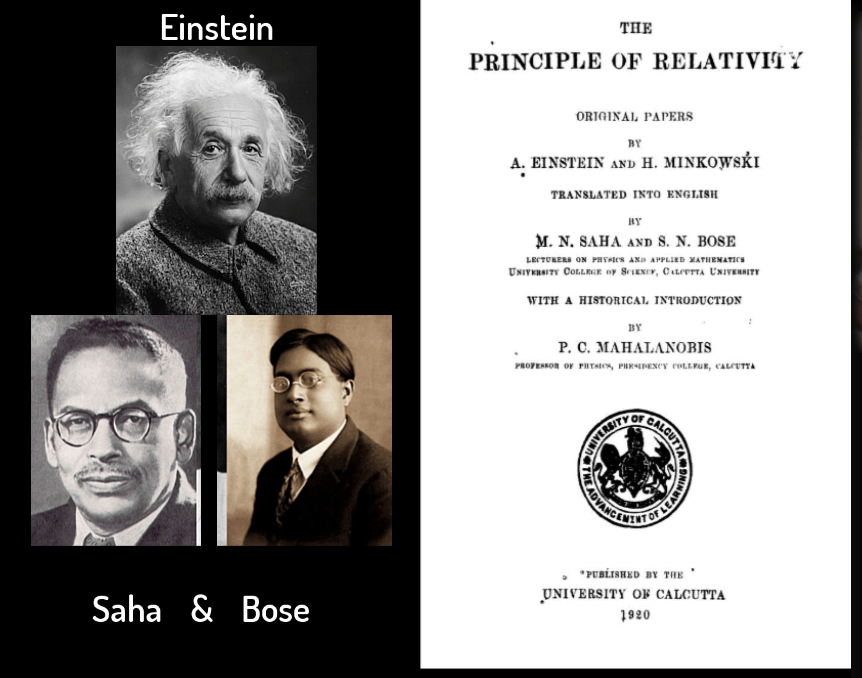
In physics, the general theory of relativity is one of the most remarkable achievements. It has turned out to be one of the most profound theories in the history of physics. In 1916, Albert Einstein proposed this theory, and it was confirmed in 1919.
Right after this confirmation, around 1920, two Indian gentlemen named Satyendranath Bose and Meghnad Saha translated Einstein’s German work into English. What you are seeing as an image is the remarkable book Principles of Relativity, containing the original papers by Einstein and Minkowski. This translation was done by M.N. Saha and S. N. Bose, who were then at the University College of Science, Calcutta University. It was published in 1920 by the University of Calcutta.
The book also contains a historical introduction by Mahalanobis, the celebrated statistician, although he was originally trained as a physicist himself. This historical introduction is itself quite remarkable.
If you look at the table of contents of this book, you will find the following:
The historical introduction discusses the evolution of ideas that led to the fruition of the general theory of relativity. This turned out to be one of the most important expositions of the general theory of relativity, soon after the emergence of the theory and its subsequent confirmation by Eddington through his famous solar eclipse expedition. This is a remarkable document, and it is available on the Internet Archive.
 VISMAYA - History & Philosophy of Physics