ShuX in IISER Pune

Yesterday evening (10th Jan 2026), Shubhanshu Shukla, the recent Indian astronaut, was at IISER Pune as part of the ‘India Science Festival’. There was a huge crowd gathered to see and listen to him. Within IISER, it is rare to see such a massive gathering for a science event, and it was heartening to witness this on a Saturday evening. Thanks to schools and colleges in Pune, science and science-related activities get traction from the people of Pune (especially younger people). They enthusiastically participate in many events related to science.

 Such a gathering is very important for at least three reasons:

  1. It connects a scientifically oriented person to the public and thereby connects them to science.
  2. It showcases that there is some science-related activity happening within the Indian scene.
  3. It sends out a message to people that icons can be created out of people who do science funded by the public.

I would want to emphasize four other points:

  1. Scientific icons are as good as the science they represent. A major part of the credit should go to the organizations that supported and trained him, and this includes ISRO, NASA and the Indian Air Force.
  2. To put an astronaut in space, it takes a lot of effort at various levels of society. Public support is vital for such an effort. Public icons such as Shubhanshu Shukla are a good representation of what investment in science can do to the morale of the public, especially for young people.
  3. The created momentum should not be lost, given that recognizable people, such as astronaut Shubhanshu Shukla, have made an imprint on young people. This should be followed up with measures to recruit them for science and technology.
  4. Space science and technology, astronomy and astrophysics have always been among the most fascinating domains to attract people into science. Many Indian scientists and a past astronaut, Rakesh Sharma, have played an important role in this pursuit. One should not forget them.

Let me conclude with a word of appreciation for Pune city. It is not a capital city, but its enthusiasm for intellectual pursuits is high, and it attracts a lot of enterprising people (recently, there was a public policy conference that had some amazing people). If it can get a lift in its public infrastructure, it can create its own path in the landscape of science and technology.

Quantum Optics course – thoughts and notes

Jan 2026 – Apr 2026 – I am teaching a course on Quantum Optics. Below you will find some random thoughts and notes related to my reading. I will be updating the list as I go along the semester. You can add your comments below.

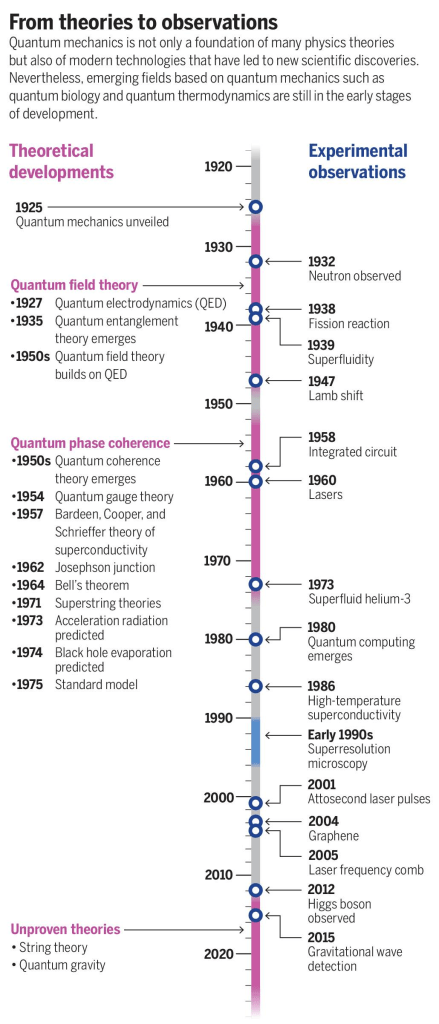
  1. Anyone interested in physics should know a bit about renormalized QED and the efforts that went behind it… It still remains a benchmark of how experiments and theory work in elevating each other…
    • Hari Dass (erstwhile, IMSc) on FB made an interesting observation:it’s unfortunate that after all those and subsequent developments, a mystery is being built out of renormalisation..it was the price to pay for assuming, without any justification, that the microscopic description held to arbitrarily small distances..wilson,schwinger and even feynman have clarified that the right way to do physics is to start with an effective description with a cutoff, which can be fully quantum in nature, and keep extending it to higher and higher scales with the help of further data, as well as with better theoretical understanding..
  2. “The photon is the only particle that was known as a field before it was detected as a particle.” 
    • This is how Weinberg introduces the birth of quantum field theory. He further adds:  “Thus it is natural that the formalism of quantum field theory should have been developed in the first instance in connection with radiation and only later applied to other particles and fields.”Ref: S. Weinberg (in Quantum Theory of Fields, p.15,  1995)
      • Sudipta Sarkar (IIT G) made an interesting observation in facebook:
        • In some sense, it did right! Dirac started QFT with the effort to quantise radiation! But formally, it is not easy to write down the quantum version of electrodynamics owing to gauge symmetry. It took quite a bit of time to understand how to manage a quantum theory with massless states!
        • My reply: “indeed..the reconciliation of symmetry was a bottleneck. I am also amazed by the progress of thought, especially by Dirac, who took the harmonic oscillator problem and treated it the way he did. Historically, the question of quantization of particles was already an established programme, but to quantize the field was indeed a major challenge, and hence ‘second quantization’.
        • The concept of creation and annihilation operators is an intriguing one because it brings in the thoughts from the commutation relationship that existed in classical physics and transfers that into quantum mechanics. This intellectual connection is mainly attributed to Dirac, and historically, this has been one of the most important connections to be made. The question of field quantization already existed in 1920s, but it is thanks to Dirac who really made this connection in a systematic and mathematically consistent way.
  3. In the context of the quantum harmonic oscillator model of electromagnetic radiation, the shift from canonical variables such as position and momentum to creation and annihilation operators is a fascinating one. Interestingly, this progression further leads to the so-called number operator. It is also a progression from Hermitian to non-Hermitian and again back to a Hermitian operator. In the process of understanding the number operators, one realizes that the ground-state results in the so-called zero-point energy. Taken further, the commutation of the number operator with the electric field of the electromagnetic radiation results in the number-amplitude uncertainty. This further gives an insight into why the field amplitude has a non-zero spread, even for the n = 0 state, and therefore results in the so-called vacuum fluctuations.
    • It can’t get more quantum than this…
  4. An essay on Quantum States in Argand Diagrams: https://historyofscience.in/2026/02/03/quantum-states-in-argand-diagrams-vacuum-coherent-and-squeezed/

Raman in a marriage reception

C.V. Raman was obsessed with science, and he was actively thinking about research problems even on odd occasions when he was supposed to be socializing. Nagendra Nath, in 1971, recounts1:

In November 1969, he and Lady Lokasundari Raman were graciously pleased to attend the marriage reception of my daughter. Professor drew me aside outside the reception hall and told me for nearly half-an-hour that his latest problem was to give a proper theory of earthquakes. The present theories were based on models which were highly deficient as they did not properly take into account the shape of the earth and the wave nature of the disturbance.

Nearly half an hour !!
Imagine the condition of Nagendra Nath :-)

  1. Nath, N. S. Nagendra. ‘My Professor’. Current Science 40, no. 9 (1971): 234–35. https://www.jstor.org/stable/24074207.
    ↩︎

Hedi Born’s picture

This is Hedi Born (wife of Max Born) sending a picture with a note to Lokasundari Ammal (CV Raman’s wife) in 1937.

Max Born and his family spent some time at IISc, Bangalore, in 1935-36.

Amazing to see how communication channels have changed, but the human urge to communicate remains the same..

picture source: (Venkataraman, G.; Journey into Light: Life and Science of C.V. Raman. Indian Academy of Sciences, 1989. p. 364)

Create to Understand

Below are two quotes on the blackboard of Feynman’s office in Caltech which were found just after his death.

 
The first of these quotes by Feynman is a guiding principle for anyone who wants to learn. The second quote is an idealistic one, but a good approach to becoming a ‘problem-solving’ researcher. Feynman was a master of this approach.
 
From a philosophy of science perspective, researchers can be both ‘problem creators’ and ‘problem solvers’. The latter ones are usually famous.
 
Michael Nielsen, a pioneer of quantum computing and champion of open science movement, has an essay titled: Principles of Effective Research, in which he explicitly identifies these two categories of researchers, and mentions that “they’re not really disjoint or exclusive styles of working, but rather idealizations which are useful ways of thinking about how people go about creative work.”.
 
He defines problem solvers as those “who works intensively on well-posed technical problems, often problems known (and sometimes well-known) to the entire research community in which they work.” Interesting, he connects this to sociology of researchers, and mentions that they “often attach great social cache to the level of difficulty of the problem they solve.”
 
On the other hand, problem creators, as Nielsen indicates, “ask an interesting new question, or pose an old problem in a new way, or demonstrate a simple but fruitful connection that no-one previously realized existed.”
 
He acknowledges that such bifurcation of researchers is an idealization, but a good model to “clarify our thinking about the creative process.”
 
Central to both of these processes is the problem itself, and what is a good research problem depends both on the taste of an individual and the consensus of a research community. This is one of the main reasons why researchers emphasize defining a problem so much. A counterintuitive aspect of the definition of the problem is that one does not know how good the ‘question’ is until one tries to answer and communicate it to others. This means feedback plays an important role in pursuing the problem further, and this aptly circles back to Feynman’s quote: “What I cannot create, I do not understand”.


Physics Ideas for Entrepreneurs

Starting a new (ad)venture

A YouTube channel dedicated to discussing physics ideas for entrepreneurs

I bring ideas from an ocean of physics and present them to anyone interested in using them for business and entrepreneurship. These are not physics lectures, but discussions on ideas with a perspective of economic utility.

As with all my ventures, it is open source.

Join me in this journey, and please share and subscribe

The first video is out:

Raman essay and Open-Access

I see that the essay I wrote on CV Raman and made open access (thanks to Resonance, which published it) has been used by several educators on YouTube, including some in Indian languages. Also, the Google AI overview shows the published essay as the main reference for a search related to Raman’s science communication (see slideshow below).

I am glad to see that making one’s writing open to all has positive effects. Open-access, not just for readers, but also for authors, is beneficial. Especially in India, paywalls for science are a detriment.

My worry is that open-access publishing has been mainly driven by commercial publishers that extract huge funds from the publishing authors. This defeats the purpose of open science, especially when the research of an author is publicly funded. Added to that, Indian researchers and writers cannot afford to pay huge sums for publishing articles and books.

The publication landscape (including journals and books) across the world needs an introspection. Open-access model is effective only when the readers and authors have access to that model. Otherwise, the model becomes a paywall for authors.

Quantum Optics – teaching in Jan 2026

More than 22 years ago, I started my journey as a research student in theoretical physics – Quantum Electrodynamics (QED) + Radiative Transfer (MSc summer project at the Indian Institute of Astrophysics), and my special paper in the MSc final semester was QED. Later in my PhD, I branched into experiments on light scattering (Raman, Mie & Rayleigh).

Over the years, QED and quantum optics have always been at the back of my mind while studying, researching and teaching.

Come January, I will be teaching a course on Quantum Optics to MS(Quantum Tech), MS-PhDs, and 4th-year physics UGs

I designed the first course on this topic at IISER Pune about a decade ago with the able inputs from Prof. Rajaram Nityananda, and I have taught the course a few times. Now, after a few years, I will teach it again.

With the emergence of quantum sci & tech, there is a new impetus and excitement on this topic.

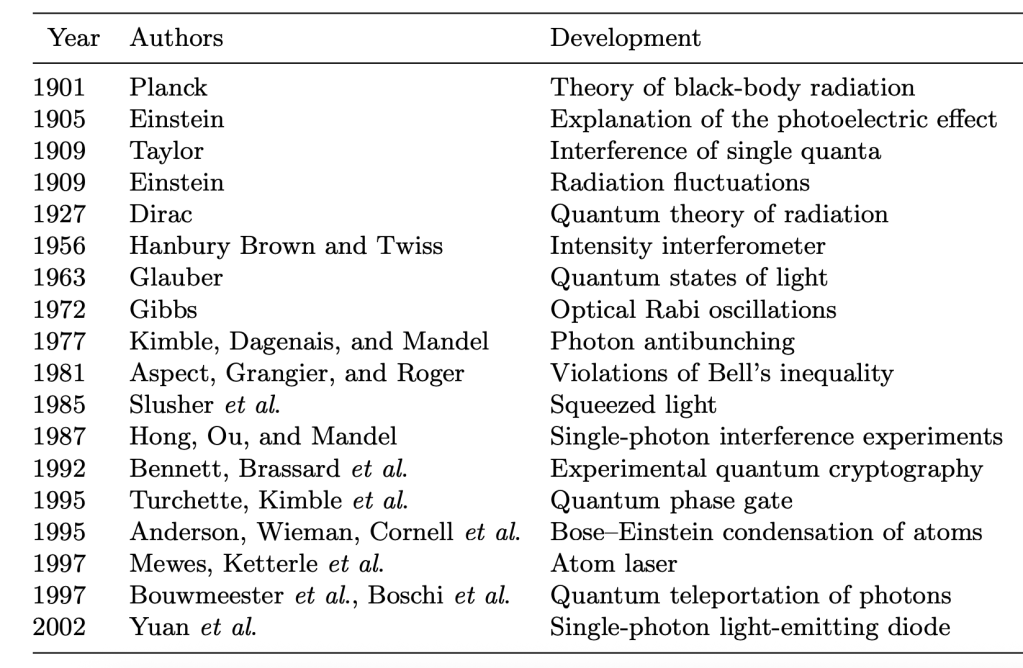
Having said that, the foundations of the topic remain the same, and Quantum Optics has a wonderful history and philosophy associated with it…and where better to start than Dirac’s classic (see below).

Look out for ‘quantum blogs’ in 2026…

Betty Archdale – 1939 cricket picture – Kannada magazine

This may be a rare pic:

In 1939, a Kannada magazine – Swadeshabhimani – reported on growing interest in women’s cricket.

Pictured is a shot by Betty Archdale, the then women’s cricket captain in England (according to the caption in the picture).

A copy of the magazine can be found here:

https://archive.org/details/karnataka-state-archives-RGVlcGFrMTA0MjYz-RGVlcGFrMQ/page/n23/mode/2up