J.C. Bose and the measurement of refractive index

Image : Wikicommons

How do you determine the refractive index of a material which is not transparent?

In 1895, J.C. Bose addressed this question experimentally using ‘electric rays’, which we currently know as microwave radiation!

The citation of the paper is

Bose, J. C., I. On the determination of the indices of refraction of various substances for the electric ray. I. Index of refraction of sulphur. Proceedings of the Royal Society of London, 59(353–358), 160–167. https://doi.org/10.1098/rspl.1895.0069

Below is the title of the paper that was communicated to the Royal Society via Lord Rayleigh, who was an authority on optical concepts Bose was using.
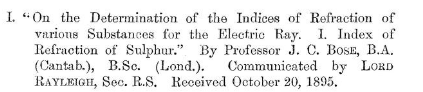
His experiment used the microwaves’ total internal reflection and extracted the samples’ refractive index through Brewster’s angle.

Bose beautifully describes his method as follows :

The angle of incidence is slowly decreased till the critical value is reached. At this point the ray is all at once refracted into the air, making an angle of 90° with the normal to the surface. If a receiver be fixed against the side of the semi-cylinder at II, it will now respond to the refracted radiation.

Below is the diagram depicting the same principle :
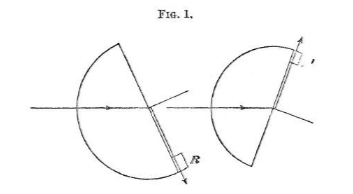
And the detailed description is as follows:

The refracting substance is cut out or cast in the form of a semi¬ cylinder, and mounted on the central table of a spectrometer; the electric ray is directed towards the centre of the spectrometer, and its direction is always kept fixed. It strikes the curved surface and passes into its mass without any deviation. It is then incident on the plane surface of the semi-cylinder, and is refracted into the air beyond.

The apparatus design was also interesting, and the diagram below depicts what we nowadays call the microwave transmitter (indicated as radiator, R) and receiver (indicated as Coherer, C).
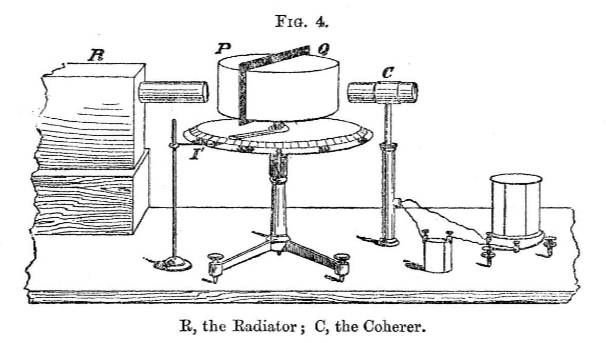
If you read the paper completely, the details of experiments are described meticulously, and the attention to detail is remarkable.

So, he determines the refractive index of sulfur using this method and ends up with a value of 1.734, which is quite accurate even by today’s standards (the value is upwards of 1.7 and depends on the wavelength of light). Notice that the measurement was made to the accuracy of three decimal places, which is impressive. Below is a set of data for which the value of the refractive index was determined.
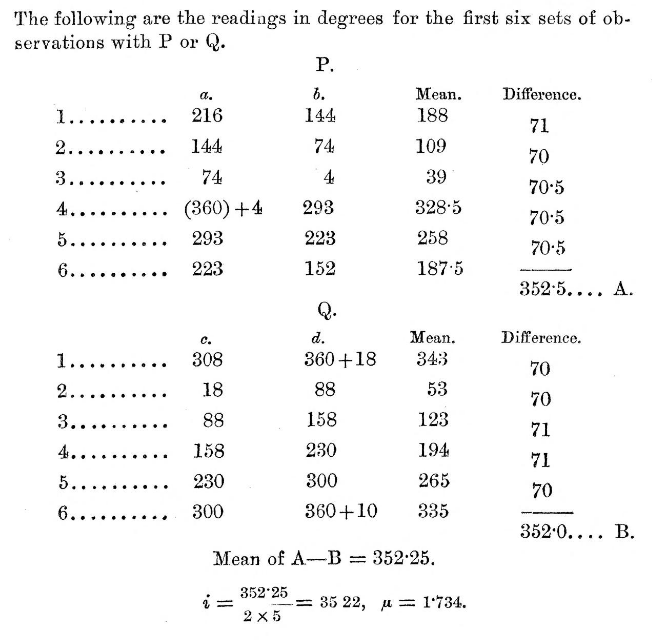
Now compare this to the modern measurement (see below data from around 1985) of refractive index based on more sophisticated methods, and you will see the matching is reasonably good at higher wavelengths close to 1 micron. (Note that Bose’s measurements was at higher wavelength than shown below)
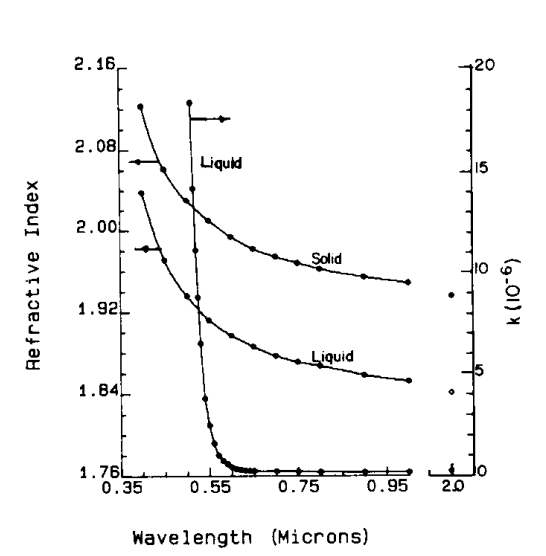
Data from: Icarus. Volume 64, Issue 3, December 1985, Pages 368-374; https://www.sciencedirect.com/science/article/abs/pii/0019103585900612

J.C. Bose was a creative scientist; the above example is just a small illustration of his capabilities as an experimentalist.

Now, with this inspiration, let me head back to my lab to do some experiments :-)

ps: A video to go with this blog (updated on 17th Apr 2025)

Electron Microscopy and Optical Holography: some notes from history

Since the 16th century CE, improving the limits of optical resolution has become an essential technical goal in optics research, and it continues to challenge us even today. When they were introduced, optical microscopes opened a new world for humans to observe, learn and eventually control matter at microscopic scales. A logical progression in this thought was to extend the resolution limit to the atomic scales unavailable to optical microscopes. Enter the ‘electron’ microscope. They changed the game entirely and paved the way to visualize matter at the atomic scale.

Electron microscopes were invented in the 1930s. When they were built in some laboratories, there was considerable public interest in understanding these “advanced” tools, as witnessed by a short but interesting article in the September 1940 edition of Popular Mechanics.

Sept 1940: Above is an image and description of one of the earliest electron microscopes published in Popular Mechanics

Reference: Popular Mechanics ~ 1940. n.d. Accessed January 7, 2024. http://archive.org/details/PopularMechanics1940.

The article speculates

First applications of the electron microscope are expected to be in biological and industrial research.

This is interesting because electron microscopes were still in their infancy, and the working principles were explored for better quality images and sample durability.

The origins of the electron microscope have an interesting history and were inspired by optics (for an interesting commentary, see Freundlich, Martin M. 1963. “Origin of the Electron Microscope.” Science 142 (3589): 185–88. https://www.jstor.org/stable/1712183). The first demonstration of a working microscope was by Ruska and Knoll (Z. Tech. Phys., 12 (1931)), and the conceptual foundations date back to the late 1890s. Ruska was eventually awarded a Nobel prize for his work on electron optics and the invention of the electron microscope in 1986.

As with any development in science and technology, an idea becomes a seed to another idea. In the case of electron microscopy, it led to some early motivations behind the invention of optical holography by Dennis Gabor, which eventually fetched him a Nobel Prize in 1970.

Dennis Gabor was also inspired and interested by the invention of electron microscopes. He played a critical role in formulating the problem of resolution limit, which further led to the invention of holography. To quote his Nobel lecture :

Let us now jump a century and a half, to 1947. At that time I was very
interested in electron microscopy. This wonderful instrument had at that time
produced a hundredfold improvement on the resolving power of the best light
microscopes, and yet it was disappointing, because it had stopped short of resolving atomic lattices. The de Broglie wavelength of fast electrons, about
l/20 Ångström, was short enough, but the optics was imperfect. The best
electron objective which one can make can be compared in optical perfection
to a raindrop than to a microscope objective, and through the theoretical
work of O. Scherzer it was known that it could never be perfected.

Interestingly, Gabor started his work in Germany but had to move out of the country due to the political situation. As he mentions in his biographical note :

In 1933, when Hitler came to power, I left Germany and after a short period in Hungary went to England. At that time, in 1934, England was still in the depths of the depression, and jobs for foreigners were very difficult. I obtained employment with the British Thomson-Houston Co., Rugby, on an inventor’s agreement. The invention was a gas discharge tube with a positive characteristic, which could be operated on the mains.

He stayed back in England and continued his work. The important aspect is that the development of electron microscopy eventually led to some fundamental experiments in optical holography. To quote Gabor’s biographical note :

The years after the war were the most fruitful. I wrote, among many others, my first papers on communication theory, I developed a system of stereoscopic cinematography, and in the last year, 1948 I carried out the basic experiments in holography, at that time called “wavefront reconstruction”. This again was an exercise in serendipity. The original objective was an improved electron microscope, capable of resolving atomic lattices and seeing single atoms. Three year’s work, 1950-53, carried out in collaboration with the AEI Research Laboratory in Aldermaston, led to some respectable results, but still far from the goal. We had started 20 years too early. 

The general notion in optics is that experiments in the visible light frequencies led to developments in electron microscopy. In the case of optical holography, at least in the initial stages of its invention, electron microscopy played a critical role. Developments in electron optics led to some fundamental questions in optical wavefront reconstruction. This further led to optical holography.

This reminds me of a quote attributed to Buckminster :

How often I found where I should be going only by setting out for somewhere else.

A capitalistic Galileo ?

Some books on the history of thermodynamics

Müller, Ingo. 2007. A History of Thermodynamics: The Doctrine of Energy and Entropy. Springer Science & Business Media. https://www.google.co.in/books/edition/A_History_of_Thermodynamics/u13KiGlz2zcC?hl=en&gbpv=1&printsec=frontcover.

Truesdell, C. 2013. The Tragicomical History of Thermodynamics, 1822–1854. Springer Science & Business Media. https://www.google.co.in/books/edition/The_Tragicomical_History_of_Thermodynami/3EjaBwAAQBAJ?hl=en&gbpv=1&printsec=frontcover.

Planck replies to Sommerfeld

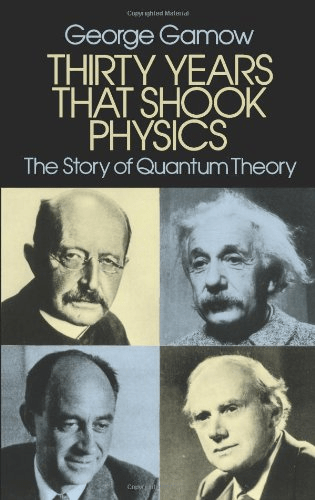
Gamow, George. 1966. Thirty Years That Shook Physics: The Story of Quantum Theory.

An excerpt from the book mentioned above:

“Planck was a typical German professor of his time, serious and probably pedantic, but not without a warm human feeling, which is evidenced in his correspondence with Arnold Sommerfeld who, following the work of Niels Bohr, was applying the Quantum Theory to the structure of the atom. Referring to the quantum as Planck’s notion, Sommerfeld in a letter to him wrote:

You cultivate the virgin soil,
Where picking flowers was my only toil.

and to this answered Planck:

You picked flowers—well, so have I.
Let them be, then, combined;
Let us exchange our flowers fair,
And in the brightest wreath them bind.”

Who thought these scientists were so poetic!

John Michell and ‘dark stars’

November 1783,
John Michell published a paper on ‘dark stars’.

This was kind of a preamble to the concept of black holes & interestingly, was based on Newton’s corpuscular theory of light and the slowing down of light due to gravity!

See this article for details:

https://aps.org/publications/apsnews/200911/physicshistory.cfm?fbclid=IwAR18kT6v-zMtqT5B3udIHxb0gjDYkv5AyFqHDLd2lEZ41-QecKhVG-llrhY

Part of the original paper (the beginning) is reproduced below :

The first few lines of Michell’s 24-page paper elaborate on his idea. As you may observe, he makes a remarkable connection between the velocity of light and the measures related to stars (distance, magnitude, etc.)

Kumar Patel and CO2 laser- Baramati-Pune to Bell Labs

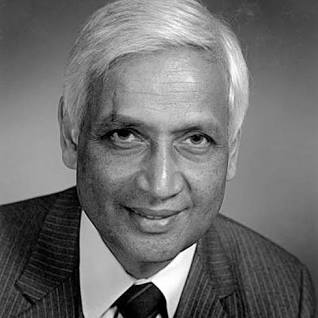
Happy Deepavali: let’s celebrate (laser) light! Did you know there is a connection b/w Baramati, Pune city & the first-ever CO2 lasers? Kumar Patel, the inventor of one of the most powerful lasers, was born in Baramati & did his BE at the College of Engineering, Pune!

Chandra Kumar Naranbhai Patel had an illustrious career. From Pune, he moved to Stanford University for his PhD and then worked at Bell Labs, where he created his CO2 laser. See him describe the invention:

In Nov 1964 (around the time of the Diwali festival :)), he published his invention: https://journals.aps.org/pr/abstract/10.1103/PhysRev.136.A1187

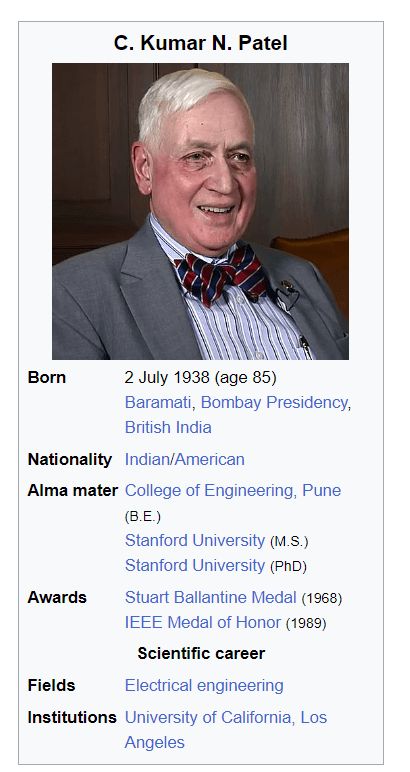
Wikipedia has a good profile of his work, including a video :

https://en.wikipedia.org/wiki/C._Kumar_N._Patel

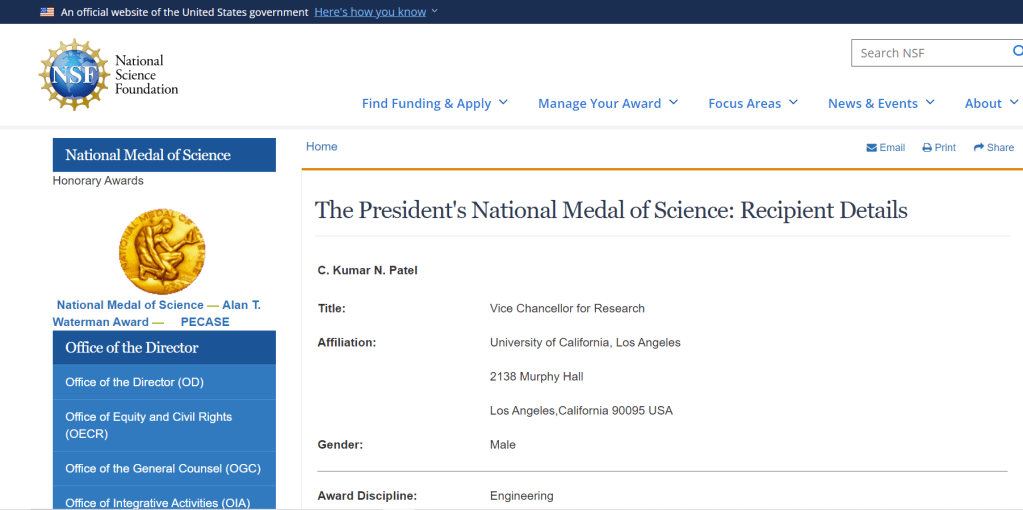
Kumar Patel went on to win many laurels, including US President’s National Medal of Science. https://www.nsf.gov/od/nms/recip_details.jsp?recip_id=270

Kumar was a rare engineering scientist who also served as the president of the American Physical Society in 1995.

https://www.aps.org/about/governance/presidents.cfm

One of the reasons to celebrate Diwali is the move from darkness(ignorance) to light(knowledge). I hope humanity moves toward peace, knowledge and harmony with nature guided by compassion and science. Baramati-born Kumar Patel has shown us one of the ways.

Kannada – ನಿಮಗೆಲ್ಲರಿಗೂ ದೀಪಾವಳಿಯ ಶುಭಾಶಯಗಳು

Marathi – तुम्हा सर्वांना दीपावलीच्या हार्दिक शुभेच्छा

Sanskrit – सर्वेभ्यः दीपावली शुभकामना

Hindi – आप सभी को दीपावली की शुभकामनाएँ

I wish you all a happy Deepavali.