Article on Gerhard Herzberg

The October 2024 issue of Resonance, Journal of Science Education

highlights the life and science of Gerhard Herzberg.

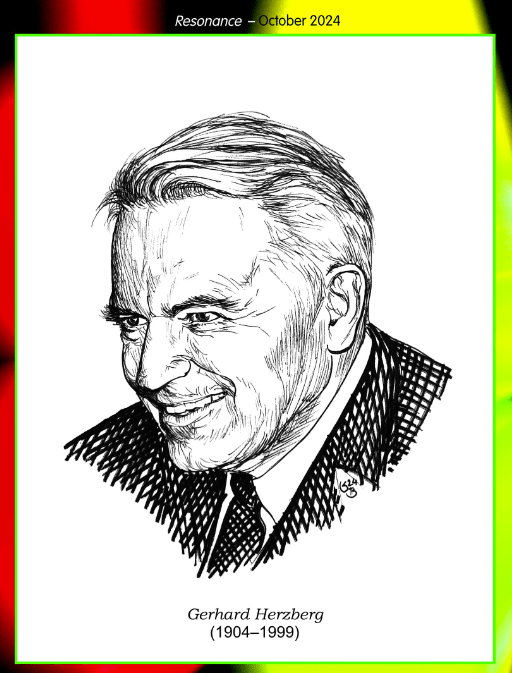
He was one of the greatest molecular spectroscopists who laid the foundation of atomic and molecular quantum mechanics and deeply impacted molecular astrophysics and astrochemistry.

He lived an extraordinary life, first in Europe learning quantum mechanics and then escaping 1930s Germany as his wife was of Jewish origin. Then, he settled in Canada to build and lead his lab, which was considered the ‘mecca of spectroscopy’ at NRC, Ottowa.

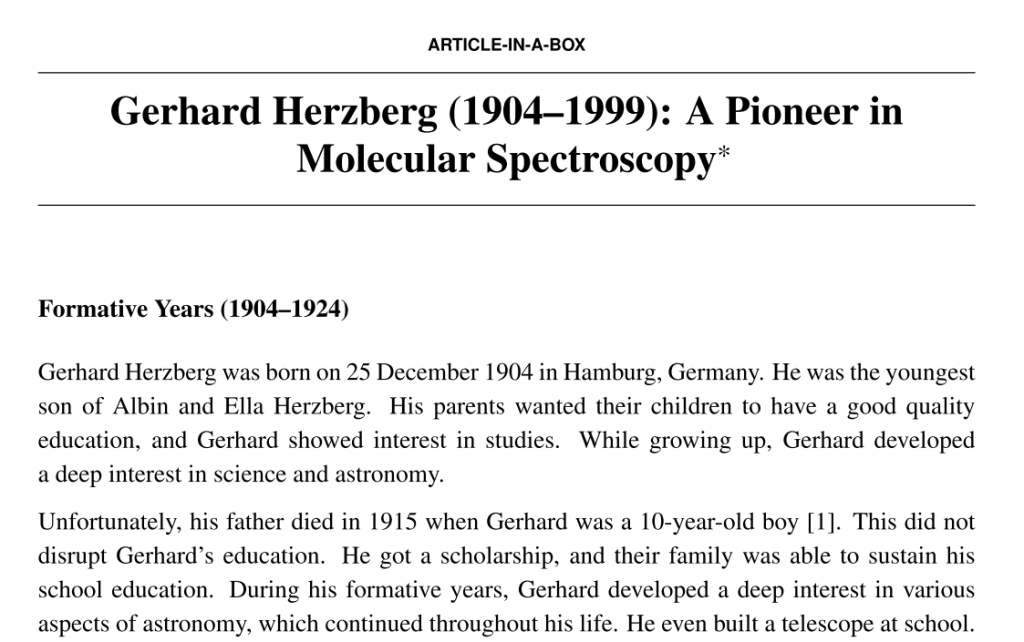
I wrote a sci-biography article about him in this issue

Link to full edition: https://www.ias.ac.in/listing/articles/reso/029/10

If you don’t know – Resonance is a pedagogical journal published by the Indian Academy of Sciences. It is a true open-access journal. Free to read and does not charge the authors to publish.

Do explore the past editions. There are some absolute gems. https://www.ias.ac.in/listing/issues/reso

Conversation with Chinmay Tumbe

Chinmay is an author, historian and associate professor at IIM Ahmedabad: https://sites.google.com/site/chinmaytumbe/home.

We explored his intellectual landscape of becoming a writer and a historian. We discuss his writing process and his experience of researching and teaching business history in a scientific & engaging way.

Many related strands…

Listen as we humanize science with history…

References:

  1. “Chinmay Tumbe.” Accessed October 15, 2024. https://sites.google.com/site/chinmaytumbe/home.
  2. “Chinmay Tumbe | IIMA.” Accessed October 15, 2024. https://www.iima.ac.in/faculty-research/faculty-directory/Chinmay-Tumbe.
  3. “‪Chinmay Tumbe – ‪Google Scholar.” Accessed October 15, 2024. https://scholar.google.com/citations?hl=en&btnA=1&user=MyvxhAUAAAAJ.
  4. “Chinmay Tumbe – History.” Accessed October 16, 2024. https://sites.google.com/site/chinmaytumbe/home/history.
  5. Diamond, Jared, and James A. Robinson. Natural Experiments of History. Reprint edition. Cambridge, Mass: Harvard University Press, 2011.
  6. Jha, Prabhat, Yashwant Deshmukh, Chinmay Tumbe, Wilson Suraweera, Aditi Bhowmick, Sankalp Sharma, Paul Novosad, et al. “COVID Mortality in India: National Survey Data and Health Facility Deaths.” Science 375, no. 6581 (February 11, 2022): 667–71. https://doi.org/10.1126/science.abm5154.
  7. “Literature Festivals: India’s Vibrant History Scene.” Accessed October 15, 2024. https://historylitfest.com/.
  8. Tumbe, Chinmay. Age Of Pandemics (1817-1920): How They Shaped India and the World, 2020.
  9. ———. India Moving: A History of Migration. Vintage Books, 2018.
  10. X (formerly Twitter). “(1) Chinmay Tumbe (@ChinmayTumbe) / X,” June 9, 2024. https://x.com/chinmaytumbe.
  11. X (formerly Twitter). “HITCH (@BizEconHist) / X,” September 15, 2022. https://x.com/bizeconhist.

Physics Nobel 2024 – anywhere to everywhere

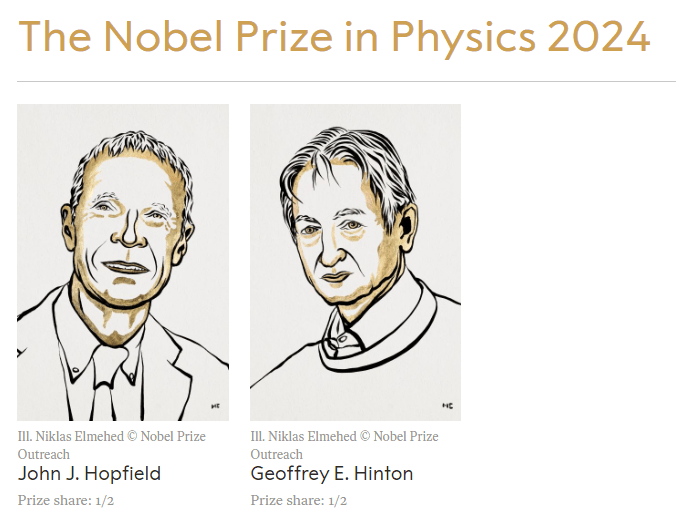
The Nobel Prize in Physics 2024 was awarded to John J. Hopfield and Geoffrey E. Hinton “for foundational discoveries and inventions that enable machine learning with artificial neural networks“. There has been much buzz surrounding this prize, especially in the context of whether these discoveries are indeed in the realm of mainstream physics. Many science commentators have questioned the choice and have provocatively dismissed it as ‘not part of mainstream physics’.

This has also brought into focus an important question: What is physics?

This question does not have a simple answer, given the rich history of the subject and its applicability over centuries. What we now call engineering is essentially an extrapolation of thinking in physics. New avenues have branched out from physics that cannot be readily identified as mainstream physics; a case in point is artificial intelligence and machine learning.

One of the aspects of mainstream physics is that the intellectual investment in the contemporary scenario is mainly driven by discoveries happening in the realm of quantum mechanics and general relativity. One of the mainstream problems in physics is to combine quantum mechanics and gravitation, which remains an unresolved task. Therefore, significant attention is paid to understanding these theories and verifying them through experimentation. Other areas and sub-disciplines in physics have become loosely connected to these two important theories.

There is another dimension to physics that is equally important and has vast applications: statistical physics. In statistical physics, the motivation comes from multi-particle systems and their applicability as models to understand our world, including biological systems. One utilizes knowledge from mathematics and statistics, combining them with physical laws to predict, invent and understand new forms and assemblies of matter. This thinking has been extrapolated to abstract assemblies and hence applied to a variety of situations. This approach has led to a revolution in how we can understand the realistic world because a statistical viewpoint is very useful for studying complex systems, such as many-body quantum mechanical aggregates (such as groups of electrons), dynamics of molecules inside a cell and the evolution of the stock market. Statistical physics plays a dominant role in all these situations. It has become a ubiquitous tool, making it difficult to directly connect it to basic principles of physics as taught in college textbooks and classrooms. It reminds me of a saying: if you are everywhere, then you are from nowhere.

This situation leads us back to the question: What is physics? John Hopfield himself offers an interesting definition related to this question, emphasizing that viewpoint is a crucial element. This perspective allows for greater freedom in using physics beyond conventional definitions. Among scientific disciplines, physics is always associated with its depth of understanding. This is a good opportunity to emphasize the breadth of physics, which is equally noteworthy.

In that light, the 2024 Nobel Prize in Physics should be welcomed as an expansion of the horizon of what constitutes physics. In a day and age where basic science has been questioned regarding its applicability to modern-day life and technology, this prize serves as a welcome change to showcase that basic science has played a fundamental role in establishing a contemporary tool of primary importance to society.

This point is particularly important because policymakers and politicians tend to focus on immediate issues and ask how they can influence them by using modern-day technology. Utility is central to this form of thinking. Given that basic sciences are often viewed as ‘not immediately useful’, this viewpoint diminishes the prominence of foundational disciplines: physics, chemistry, biology, and mathematics. In contrast, this prize reinforces the idea that building cutting-edge technology, which holds contemporary relevance and societal impact, has its roots in these foundational disciplines. In that sense, this prize is an important message because, like it or not, the Nobel Prize captures the attention not only of the scientific world but also of the public and, hence, of interest to politicians and policymakers.

Issac Asimov is attributed to have said: “There is a single light of science, and to brighten it anywhere is to brighten it everywhere.” The Nobel Prize in Physics 2024 fits that bill.

Physics is a point of view about the world

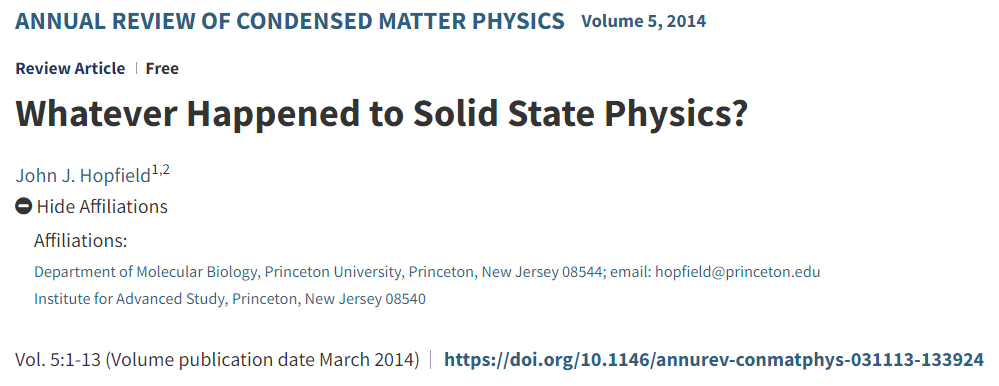
picture from : Hopfield, John J. “Whatever Happened to Solid State Physics?” Annual Review of Condensed Matter Physics 5, no. Volume 5, 2014 (March 10, 2014): 1–13. https://doi.org/10.1146/annurev-conmatphys-031113-133924.

The title of this blog is the closing line of an autobiographical essay written by John Hopfield (pictured above), one of the physics Nobel laureates today: “for foundational discoveries and inventions that enable machine learning with artificial neural networks.”

In this essay, he retraces his trajectory across various sub-disciplines of physics and how he eventually used his knowledge of physics to work on a problem in neurobiology that further connects to machine learning.

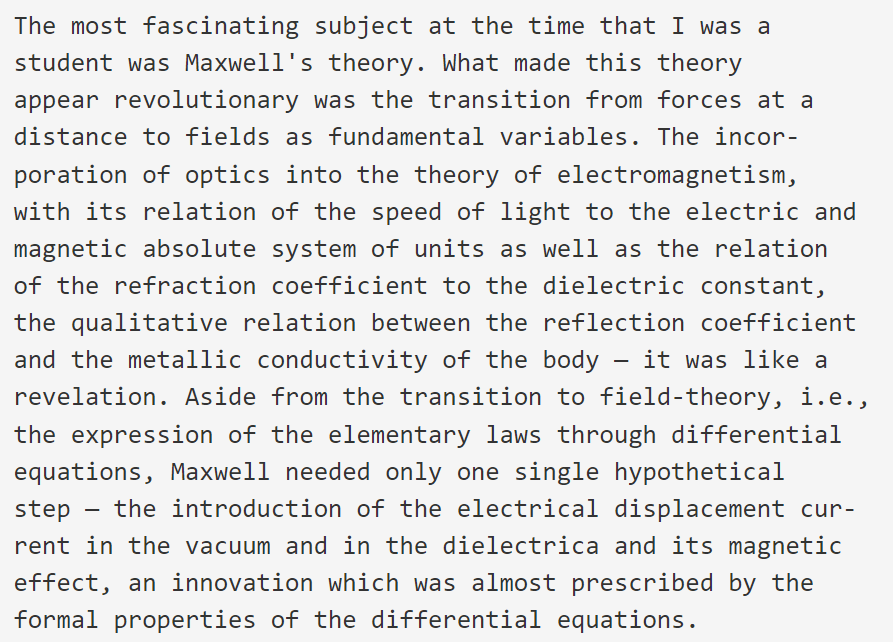
The title of the essay is provocative(see below) but worth reading to understand how physics has evolved over the years and its profound impact on various disciplines.

Reference: Hopfield, John J. “Whatever Happened to Solid State Physics?” Annual Review of Condensed Matter Physics 5, no. Volume 5, 2014 (March 10, 2014): 1–13. https://doi.org/10.1146/annurev-conmatphys-031113-133924.

Thanks to Gautam Menon for bringing the essay to my notice.

By the way, Hopfield and Deepak Dhar shared the 2022 Boltzmann medal, and after the award, he gave a wonderful online talk at IMSc, Chennai. Thanks to Arnab Pal of IMSc for bringing this to my notice on X.

Let me end this post quoting Hopfield from the mentioned essay:

What is physics? To me—growing up with a father and mother who were both physicists—physics was not subject matter. The atom, the troposphere, the nucleus, a piece of glass, the washing machine, my bicycle, the phonograph, a magnet—these were all incidentally the subject matter. The central idea was that the world is understandable, that you should be able to take anything apart, understand the relationships between its constituents, do experiments, and on that basis be able to develop a quantitative understanding of its behavior. Physics was a point of view that the world around us is, with effort, ingenuity, and adequate resources, understandable in a predictive and reasonably quantitative fashion. Being a physicist is a dedication to the quest for this kind of understanding.

Let that quest never die!

Academic Scientific Writing: A Case for Two Versions

Whenever one comes across an interesting debate in science communication, one will always find criticism about academic writing. Generally, it is considered opaque, jargon-filled and many times incomprehensible. So, when a person without a deep scientific background reads an academic paper or an academic book, they blame the writing and the writer for making it complicated.

I am the first person to admit that academic writing needs drastic improvement. But there is another point which I want to make in this essay. Being an academic: as a student, as a teacher, as a researcher and as an editor, I have read, heard, seen and discussed with so many academics who are very creative and have great clarity of thought. Over the past many years, I have seen outstanding science communicators who can express their thoughts and opinions in a comprehensible way, and this is always inspiring.

So, there is a disconnect between what people read, hear and see about academic scientific content and what academicians do to make themselves clear. So, this motivates two questions:  a) what academics can do to make sure that their writing and exposition are more comprehensible and cater to the public? b) how the public can consume academic scientific information? In this essay, I discuss these issues.

The Two Versions

One solution is to have two versions of their work at their disposal. The first version is for a specialized, scientific audience with whom they correspond as part of their research papers and academic books. In here, one uses rigorous analysis and sometimes unavoidable jargon to express precise thoughts and extract in-depth analysis. This is essential because if one is working at the forefront of knowledge, one must get to that point with minimum resistance and maximum efficiency. In the first version, the assumption is that the person reading the text has some basic scientific background and, with some effort, will be able to retrace all the assumptions made in the text. Again, I am not proposing the text to be complicated. But making a case for better communication at the forefront of knowledge. Writing a comprehensive yet academically rigorous argument is not easy. All of us, the academics, should strive to create a good text that can be understood with an in-depth reading.

Opening to Public

The second version is an explanation of the first version in plain language without the usage of jargon, acronyms and complicated equations. This also makes a strong case for bringing analogies where one can take the concepts that are abstract and convert them into everyday objects or relationships so that the public can comprehend the thought behind the abstraction.

The second version is not a very easy version to create because it needs a kind of translation of thought that is not straightforward and requires one to have a deeper understanding of the relationships within the abstraction. The advantageous fallout of the second version is that it forces an expert to think in such a way that they must really go into the core principles of their work and extract meaning. This means that the second version is helping the expert to understand things better, which is vital for their own sake.

Many times, when I have forced myself to create a second version of my primary work, I have ended up gaining more information and insight into my own abstract work, which I would have not obtained but for the initiation of the second version. Given that people are more interested in knowing what is happening in academic work and how it can be related to the public, there will always be interest among a large audience. So, this process of creating two versions is necessary nowadays. It also means that academics have a very nice way to make their work connected to a larger audience.

Public Consumption of Scientific Information

So, now I want to discuss about what the public can do when they come across academic work. First and the foremost aspect I want to emphasize is that research papers and academic books are not like reading novels. It needs engagement with the text, and generally, one will not come across a page-turner.  This means the general reader must spend more time on the assumptions and the questions discussed in the text. These texts are difficult to read in a single sitting. One will have to consult multiple sources and build the information which is presented in the text. This is how generally an academic text is written, and most of the time it is not compiled in one sitting. Therefore, one cannot expect a person to read academic text, especially if it is discussing some complex concepts in a single sitting. So, what I would suggest is whenever one comes across an academic work, please explore the work through a summary, if available. A summary of the abstract academic text is now becoming popular even among academic journals, and many of them publish a descriptive summary in a narrative style which is generally comprehensible to a broader audience. If the public finds the summary also to be complicated, the next best thing is to talk to a knowledgeable person who can explain things better. (Note: sometimes knowledgeable people may not explain things well. So be choosy)

The other important aspect is if you are interested in a scientific concept and you want to learn more, explore it in a gradual way – from a broader source to a specialized source. So, for example, if you want to learn something about climate change, do a cursory reading on Wikipedia about that concept and note down the primary references furnished. Listen to some podcasts and watch some YouTube videos related to that concept.

Thereafter, what is important is that you should extract good primary references from these platforms such as Wikipedia, podcasts and YouTube videos. This identification of primary sources and perhaps even a good book on this particular topic will help you to identify authentic information. This way of exploration gives you an advantage of first getting the big picture of the concept and then moving towards the specialized aspect that you are interested in. Therefore, this combination of the big picture and the narrow specialization will enrich your thoughts on that particular concept. So, what I would suggest you do is to explore tertiary and secondary sources such as Wikipedia articles, videos and podcasts to begin with, then extract good primary sources and secondary sources from that exploration, and then go deeper. All this depends on how deep you want to go into that topic.

Always remember that a Wikipedia article, a podcast or a video is a kind of a tertiary or a secondary source at its best. Most of the time, they are not the primary sources and therefore, it is always important to keep this in your mind when you are citing your sources in your discussion. To be more authentic, you will always have to go to the primary source and know the nuances of a particular concept from the original work.

Academic Thoughts with the Public in Mind

In conclusion, academic writing surely needs drastic change, especially in the way things are expressed in a journal or an academic book. Academics will also have to think about how to generate information that is not only applicable to a specialized audience but also to the public. Such information would be of very high value not only to the public but also to people in the peripheral research areas, and importantly it will add greater understanding to the expert who is generating this kind of information.

The public should also be a bit more patient to engage with the academic text and should explore the relevant information. This is getting easier, given that information is not at a premium nowadays. The availability of tertiary and secondary sources is abundant. How one makes use of that resource and how we connect those resources to primary data is both a craft and an art. It needs immersion with the sources.

At the end of the day, we need better communication between the specialized experts and the public. After all, academic thoughts should have a direct implication on thoughts of the society. We academics should also be cognisant about the vice versa.