Every year the Science club at IISER-Pune organizes “Nobel evening – an event that has been a part of IISER since its inception and has thus become tradition”. This is essentially a gathering of IISER community where public lectures are delivered on the latest Nobel prizes.
On 22nd Oct 2018, we had this year’s Nobel evening, and in there I gave a talk on 2018 Nobel Prize in Physics. It was indeed an honour to talk about the work which has created such a deep impact on both science and technology.
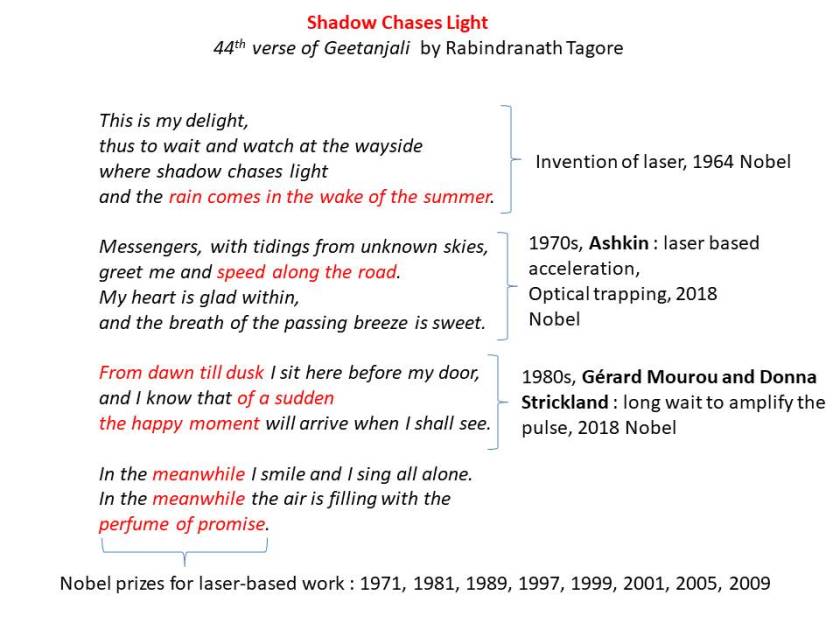
While I was preparing for the talk over the weekend (talk was on a monday), I took a break and casually looked into my collection of books. I happened to skim through Tagore’s Geetanjali. As I went through the beautiful verses of this epic poem, what immediately struck me was its 44th verse. I could see an interesting analogy between the 44th verse, and the 2018 Nobel prize in physics. So I decide to use this analogy in closing of my talk. The whole talk had 25 slide. Below I show the 3 slides from my talk : the first one being the opening slide and last two are my closing slides that contain the analogy I mentioned about….
Diffusion is a simple yet fascinating physical phenomenon. By merely observing how an object moves around in a medium as a function of time, there is a lot of stuff one can learn about the environment, about the diffuser and about the interaction between diffuser and its environment. Over the last few days, I have been studying some papers related to trajectory of individual nanostructures in liquid environment, and have learnt some interesting aspects such as sub-diffusion and super-diffusion.
Concomitantly, I came across one of the better poems I have read in recent times on travelling: Childe Harold’s Pilgrimage by Lord Byron George. This is a long poem, but a couple of stanzas are worth a read:
There is a pleasure in the pathless woods, There is a rapture on the lonely shore, There is society where none intrudes, By the deep Sea, and music in its roar: I love not Man the less, but Nature more, From these our interviews, in which I steal From all I may be, or have been before, To mingle with the Universe, and feel What I can ne’er express, yet cannot all conceal.
Roll on, thou deep and dark blue Ocean—roll! Ten thousand fleets sweep over thee in vain; Man marks the earth with ruin—his control Stops with the shore;—upon the watery plain The wrecks are all thy deed, nor doth remain A shadow of man’s ravage, save his own, When for a moment, like a drop of rain, He sinks into thy depths with bubbling groan, Without a grave, unknelled, uncoffined, and unknown
These two readings (of the paper and the poem) were on the same day, and I felt a connection between diffusion and travelling. It kept lingering on my mind for the next few days, and I felt going deeper and exploring it further. So, I went back to my archived files on my laptop and started exploring some photographs I have taken over the years of travel. During this exploration, I found some of my travelogue related to Scotland when I visited that beautiful country in June 2013. During that trip, I and some of my colleagues were mainly visiting Glasgow University. During the last leg of the trip, we visited the University of Edinburgh and Edinburgh city for a day.
It was a bright, sunny day on 21 June 2013 (generally 21 June is the longest day of the year). We took an early morning train from Glasgow to Edinburgh. Around 9am in the morning, we were at University of Edinburgh, and we visited the departments of physics and chemistry. This was followed by talks by us and a few researchers at the university. After our interaction and lunch, we had about 5 to 6 hours to spend in the city of Edinburgh before we could take our train back to Glasgow. So, we went to the city centre, and I decided to visit the travel information desk. I wanted to know if I could see around the city within 5 hours or so, and what places could I visit on feet. One of my favourite activities, especially when I am travelling alone, is to take a random walk around the city (of course with a map), and explore the places on feet. I have found these “on-feet” explorations can closely connect you to the place, and importantly slows one down so that one can pause, observe and grasp the local environment in its details. In an essence, this “confined Brownian motion” can lead to some interesting insight and thoughts.
Coming back to Edinburgh, I gathered all the information of possible sites I could visit on feet within 4 to 5 hours, and here are a few things I explored during the walk:
Statue of Sherlock Holmes:
Although a fiction-character, Sherlock Holmes has a real statue in Edinburgh! Anybody who has read Sherlock Holmes also knows its author Aurthur Conan Doyle cannot miss this place. Close by to the Holmes’ statue is a pub named The Conan Doyle (see below)
Bronze statue of Adam Smith:
A 10 feet long monument of Adam Smith cannot be ignored. The celebrated economist, philosopher and author of “The Wealth of Nation”, is one of jewels in the crown of Scotland.
Statue of James Clerk Maxwell:
Interestingly, this was the hardest thing to find in the city. It was at a remote corner of the town, and very few people knew that there is indeed a statue of Maxwell in Edinburgh city. It took me almost 45 to 60 minutes to explore the statue. I was almost about to give up, but somehow I did not want to….so I went ahead, and found this statue of the celebrated physicist. It was a happy moment!
The famous Scotch Wishky trail:
How could one miss this! This was one of the easiest things to find on my path, and what I found inside this trail was nothing short of breath-taking variety of Scotch.
The cliff edge:
This was strictly-speaking not during the walk in the city, but just before that, and is perhaps the picture that has stuck in my mind all the while when I think about Scotland. Unconsciously, when I think of diffusion in space and time, this is the same picture that comes back to my mind. There is something unique about a person at cliff edge, all by himself exploring his universe…I find it kind of philosophical and fascinating…..and also goes well with abovementioned poem.
Brain is a strange thing. It forces us to connect the unconnected, and the above content is just an example. Towards the end of the trip, I sat on the train back to Glasgow. I started listening to the music on my headphone, and the song on my playlist was Hotel California. As I relaxed back in the seat, I was struck by these lyrics :
Last thing I remember, I was
Running for the door
I had to find the passage back to the place I was before
‘Relax’ said the night man,
‘We are programmed to receive.
You can check out any time you like,
But you can never leave!’
I had checked out of Edinburgh, but my mind has never left that random walk…..
Every morning, I have an interesting task at home. I prepare filtered-coffee and boil milk as soon as I wake up in the morning. Both these processes are supposed to be mundane task, but over the years I have found it to be one of the most intriguing things one can do in kitchen. To make the task engaging, I have been measuring the rate at which half a liter of milk boils and when does it reach the point where it is about to spill over from the container (of course, I do not spill it over, else I will be devoid of my morning coffee…no way). Over many years of this task, I have found that the parameters of milk boiling vary as a function of temperature, humidity, shape of the container, the pressure of the gas supplied in the stove, the content and age of the milk. I have also found some interesting methods to stop the milk spill over even while it is still under boil. In an essence, I start my day with a curious-experiment in the kitchen, and I look forward to it every day.
Radial patterns in a tomato slice on my kitchen slab
Curiosity as life – Tasks like boiling milk, preparing coffee, playing with tooth-paste, running in rain, watching clouds, creating soap bubbles, watching water flow, slicing vegetables (see image), dusting the house, cleaning a window pane, washing shoes and drying an umbrella are common to all of us. If you look at these tasks closely, one can connect them to a lot of interesting science. I have found great joy in doing so, and have turned out be an integral part of my life. An important off-shoot of this way of looking at things is that I hardly get bored. Every trivial thing that I observe has something intriguing, and this has had a profound influence on how I approach my life. Invariably, while exploring my curiosities, I find myself losing the feel for time, and one goes into the state of flow. That is a happy place to park your mind.
Scientists’ dilemma – ‘Impact on society’ is touted as the modern mantra for doing research. A scientist is strongly encouraged, especially by funding agencies, to work on research problems that have relevance to a large community. Even among scientific communities, novel solutions to research problems are often encouraged and are highly valued and rewarded. So, a scientist is always looking for problems that can have greater impact, either conceptually or technically. Influenced by this external push, the priority of what one has to do is always under question. Critically, this puts a scientist in a dilemma: should I work on problems that are curiosity-driven or should I work on problems that have largest impact to the society? This conundrum is especially sharp if one is a scientist whose research requires large infrastructure and financial assistance. Related to this dilemma is the debate of basic vs applied research, and has inspired concepts such as Pasteur’s quadrant. I do research for my living and most of time is spent on it. I and my research group think on the “why and how” of our research, and it is important for us to resolve this dilemma.
Resolving the dilemma, personally – Given that we do laboratory-based experimental research, I have to ensure that we secure research funds to keep it up and running. Concomitantly, I have to cater to my curiosity, without which I will not be able to sustain my interest in the work I do. Over the years, balancing these concerns has influenced the work I do. An important aspect of resolving the above-mentioned dilemma has been to spend long hours on identifying and choosing a research problem that caters to my curiosity and has relevance to the research community. The process of choosing a research problem is not a simple one, but in my opinion, is perhaps the most important step in doing research. After all, the question one defines will eventually guide the answer we can find; hence every minute we spend on it is priceless.
Light and light scattering has been central to all the stuff I do in my research. I am also intrigued by science in everyday life. So, the best possible thing to do was to study light-matter interaction. This inspired me to look for problems that can cater to my interest and a large research community, and may potentially have applications that can impact the society -all of this without having to sacrifice my curiosity. Over the years, this intention has guided me to pursue research at the interface of optical physics and biochemistry; nano-plasmonics, advanced optical instrumentation, and in recent times on plasmon-soft matter interactions. All these areas that I have been working-on are strongly rooted in my curiosities. I have deliberately picked these fields such that I never have to sacrifice on what I like to do.
Parting thoughts – Generally, among research students, there is a concern about their future, and how they can retain their curiosity and pursue their career. Invariably, they are sandwiched between what they like and what the external-world tells them to like. If these two things do not overlap, there is always frustration. For such situations, I have a suggestion: follow your curiosity and be cognizant of the fact that curiosity-driven life not only feeds your brain, but also your stomach. Just by following curiosity, a lot of people including myself, have been able to build a career out of it. What is further encouraging is that there is enough room in the society for our curiosities to develop and flourish, provided we take the effort to connect our curiosity to a relevant research problem out there. This exploration will take time, and we must remain patient until it yields. The onus of connecting our curiosity to external relevance is ours, and we must take the initiative. As the saying goes:
There is no Frigate like a Book
To take us Lands away
Nor any Coursers like a Page
Of prancing Poetry –
This Traverse may the poorest take
Without oppress of Toll –
How frugal is the Chariot
That bears the Human Soul –
Generally speaking, scientists are natural philosophers: they observe nature, ask questions, hypothesize an answer, test them through experiments and extend this exploration by escaping into the universe of ideas in books and journals. New ideas emerge from this exploration and join the chorus, and the intellectual journey continues. In my own research on light scattering, I have been deeply influenced by ideas of various fellow-explorers. For me, journal papers and books encompass the “metaphorical oxygen” for creativity and knowledge. Below I introduce you to some classic books which keep my research alive.
Comments: There are two kinds of authors who write textbooks. One is the ‘boring kind’ and the other is the ‘Bohren kind’. If you want to fall in love with light scattering (and science in general), read books and articles by Craig Bohren. It will not only deeply influence your thinking, but also will show how a textbook can, and should, evolve a subject systematically. This particular classic has some of the most important ideas related to how light behaves when it interacts with matter comparable to the wavelength of light, and forms the bedrock on which a lot of contemporary research, including nanophotonics and plasmonics, is pursued. This book has wit, humour and a touch of poetry jumbled up together as flowing river of knowledge. To give you a spirit of their writings, let me reproduce the first paragraph of their introduction
Comments: The first edition of this book was published in 1957, by the author was a legendary astronomer. This book has a beautiful description of single and multiple-scattering phenomenon, and describes specific situations where they apply. Written with an astrophysical viewpoint, it elegantly combines depth and breadth in a lucid way. This book has perhaps served as inspiration to most of the books written on light scattering.
Comments: Some researchers have remarkable ability to choose problems that have far reaching consequences beyond the next research paper. Milton Kerker was one such legend. His research papers and this book has not only influenced the way physics of light scattering is studied, but has had deep impact on utilization of light scattering in various branches of science and technology. This 600 odd page book is indeed a masterpiece, and in a unique way caters to almost all kinds of researchers who are interested in light scattering.
Comments: A majority of the matter in biology and chemistry are suspended in a fluid. When an object in a medium undergoes Brownian motion, it influences the way a light beam scatters and traverses through that medium. This book explain the how and why of this fascinating topic. Written by experts in chemical physics, this classic serves as the foundation for light scattering in soft-condensed matter physics.
Comments: Historically, light scattering by molecules has been studied by legends such as Rayleigh, Raman and many more. Interestingly, all these legends emphasized the connection between polarization of scattered light and structure of matter. In this book, Barron puts together these ideas in a very elegant way, and motivates and develops the phenomenon of optical activity from a molecular physics viewpoint. Given that a majority of biomolecules are chiral in nature, the insight that one obtains by reading this book has direct implication in understanding the structure and dynamics of biomolecules such as amino acids, proteins and DNA.
Comments: Mischchenko is a scientist at NASA, and his books on light scattering have had great influence in aerosol science, radar technology and many more. The T-matrix codes based on this book forms a very important tool across the research community that works on weather prediction and pollution monitoring.
Comments: This classic from late 1970s was one of the elaborate attempts to put together wave propagation and scattering in a random media on a rigorous mathematical foundation. This 2 volume book has solutions to various mathematical problems that one encounters in light scattering physics, and makes an important connection to transport theory of light in a medium.
Comments: If you are interested in experimental aspect of light scattering, this is one of the best books. It is essentially a field guide, which tells you how to quantitatively make a light scattering measurement, and what aspects to look-out for. This is a very good book for students who want to get a hands-on experience in light scattering.
Comments: Chu’s book develops the topic of laser light scattering in terms of both experimental aspect and theoretical foundations. Importantly, it connects the topics of light scattering to optical spectroscopy, and shows how one can obtain meaningful information about light-matter interaction.
Comments: Quantum mechanical entities such as electrons and photons can be confined in space and time. Depending on the geometry of confinement, very interesting physics such as weak and strong localization can emerge. This book looks at the physics of confined electron and photon from a unified viewpoint. It highlights similarities and difference between the electrons (fermions) and photons (bosons).
Comments: Written by a pioneer in the field, this book till date remains the most rigorous treatment on Raman scattering of light from a theoretical viewpoint. Based on quantum mechanical arguments, this book relies on perturbation theory, and clearly shows the connection between structure of molecules and how they influence the scattered light.
Comments: The most definitive book written on surface enhanced Raman scattering by two physicists whom I greatly admire. This book gives unified treatment of plasmonics and surface enhanced inelastic light scattering, and is written in a style catering to physics audience. The book has a lot of details and explanations, and also serves as excellent introduction to plasmonics and vibrational spectroscopy. Given that the authors themselves are pioneers in single-molecule Raman scattering, their insight into single molecule optics in plasmonic field is fascinating. Unfortunately, Etchegoin succumbed to cancer, and I could never meet him. However his great ideas and thoughts stay on…
Comments: Random lasing is an emerging topic of research in nanophotonics. The fact that one can have random structures assembled in space and time, and yet achieve spatial and temporal coherence is quite remarkable. This book brings together insights from wave scattering and mesoscopic physics to show how light behaves when confined to small volumes compared to wavelength of light. The insights obtained from this book are heavily used in the literature on random lasers.
Author(s): Craig F. Bohren and Eugene E. Clothiaux
Comments: Bohren weaves his magic…..again. Although the title of this book indicates atmospheric radiation, the way the authors treat the topic of absorption, emission and scattering of light is fascinating. This book gives a broad viewpoint of interaction of light with matter, and shows one can and should treat the subject coherently. The references and problems are very relevant and interesting, and I have found some gems while reading through this text.
December is a month when you meet a lot of people, especially if you are an academic on a semester break. Invariably one is traveling on conference, or is on an outing with family during this month. Many a times, you meet new people, especially if you are traveling to new places. A general question people ask is: what do you do for a living? This is easy to answer (I am a scientist/professor working at IISER….blah..blah..), but once in a while somebody (generally a child) enquires : why do you do science? As always, the ‘why’ questions are not trivial, and needs a bit of thinking.
When I was asked about this why question recently, my ‘short answer’ was: because I like asking questions. Later, I thought about this question, and below is my ‘not-so-short’ answer:
A playground to wonder – The main driving factor of why I chose science is that I love asking questions and wonder about it. I found that, science and scientific research gives me a metaphorical playground to wonder about questions I have in my mind. In fact, I earn my living doing this! For me this is of fundamental importance to my living: the freedom to ask questions. In an essence, doing research is all about asking questions and trying to find out an answer. The answer you may find need not be complete (or correct), so you will have to again ask another question to verify that answer, and this process continues over many iterations, until you have viewed the answer from various different perspectives, and have come to a satisfactory answer. Remember that there is always room to ask more questions, so the process never ends. But you are allowed to pause or switch to a new question, after you have asked many questions. As you may observe, what drives you forward is the question, and this process of “Q & A” is perpetual in research, and I absolutely love it.
Mind + Hands – Being an experimentalist, I get a great intellectual kick by asking questions and creating new things in the lab. I can see how ideas in our minds can (or cannot) be realized by working with our hands, and this is a tremendously exhilarating, enabling and humbling process. Whenever you build a new instrument (an optical instrument in our case), it is no more just an equipment, but it is a piece of art built with labor of love. In a strange way, one also forms a bond with the instrument you build. That feeling is unique to the creator, and many of my students have tasted this high.
Visiting the past – I love history, especially history of science. It gives me an opportunity to intellectually explore the past in detail. In order to formulate a question, I need to understand the history behind the question. I need to know what other people have thought about the question, and how they have approached and addressed it. Science, after all, is built on ideas from the past and present, so knowing the history is vital. In a fast-paced world, this ability to explore the past is rare, but in research it is prevalent.
Science as human expression – Human being is a social animal. They interact, talk, exchange ideas and learn. To me science is a form of human expression. It adds two important dimensions to society. The obvious one is the utilitarian aspect. Science benefits mankind through its application. In fact everything around our materialistic world is thanks to science and its off-shoot – technology. The non-obvious dimension that science inculcates is the way of thinking and looking at the world. Science facilitates a metaphorical spectacle to view the universe. As Feynman describes beautifully in this video, science helps you to appreciate the world you live in, just as art does.
Test of the self – A scientist needs all the ability that any top professional needs: endurance, concentration, time- and people-management skills, and deeper understanding of ethics, rights and duties. Doing scientific research, especially as a profession, needs coordinating and interfacing with people. And wherever there are people, there are infinite parameters to deal with. Doing science is not just about being in the lab or at your desk/board; it is an activity which generally happens in sync with a community. Interacting with such a community, interestingly, will bring the individual in you. It will help you identify yourself and differentiate from others, in a positive way. I have realized and understood myself more and better by interacting with others than by keeping thoughts to myself. This process of self-realization by communicating with the outside world has been a great learning experience. You expose yourself not only to new science, but also to new ways of living and thinking, especially when you travel and meet new people from different cultures. This exposure to the unknown has added a new dimension to my views and has enriched my life. After all, diversity has its use.
So, these are the main reasons why I do science. Doing what we do as profession is an extremely personal thing. Not everybody gets an opportunity to do what they want, but if you get it, you better nurture it with love and passion. As the English poet Alexander Pope said “On life’s vast ocean diversely we sail. Reasons the card, but passion the gale.”
So add more gale to your life….and have a WONDERFUL year ahead !
BORN AGAIN: Today I opened the google webpage and to my surprise found the doodle (picture above) celebrating birthday of Max Born. He was not only a great physicist who contributed immensely to quantum mechanics and other branches of physics (including optics), but also a mentor to many great physicists including Fermi, Heisenberg, Pauli, Wigner, Teller, Emil Wolf and many more.
Every student who has studied physics, is aware of quantum mechanical wavefunction (ψ). Given a quantum system and its environment (electron in an atom, for example), wavefunction is a fundamental quantity that one can compute, and forms the basis to understand the system in greater detail. When quantum mechanics was evolving in early 1900s, the question of how to physically interpret the meaning of wavefunction was at the forefront. It was Max Born who gave the statistical interpretation for the wavefunction, which later fetched him a Nobel prize in 1954.
Born identified the importance of interpretation of the wavefunction, and its connect to the realistic, observable parameter. To quote Born from his Nobel lecture :
“The problem was this: an harmonic oscillation not only has a frequency,
but also an intensity. For each transition in the array there must be
a corresponding intensity. The question is how to find this through the
considerations of correspondence? “
This quest set forth an intense programme in physics and motivated people like Heisenberg, Schrodinger, Bohr, and Einstein to find an answer. Interestingly, Born’s work was heavily inspired by Einstein’s work. To quote Born from his Nobel lecture:
“But the decisive step was again taken by Einstein who, by a fresh
derivation of Planck’s radiation formula, made it transparently clear that the
classical concept of intensity of radiation must be replaced by the statistical
concept of transition probability.”
Further, he adds
“Again an idea of Einstein’s gave me the lead. He had tried to make the duality of particles light quanta or photons – and waves comprehensible by interpreting the square of the optical wave amplitudes as probability density for the occurrence of photons. This concept could at once be carried over to the ψ-function: |ψ|^2 ought to represent the probability density for electrons (or other particles).”
Reading Born’s Nobel lecture, two things struck me : first was that science is never done in isolation. Every single idea is inspired by another idea. Second, physical optics has a major influence on interpretation of quantum mechanics. Max Born was no stranger to optics. In fact, he was one of the pioneers of classical optics, and I am not surprised that he could make some vital connections between physical optics and quantum mechanics.
My personal copy…..standing tall and heavy :)
THE BOOK: This brings me to the most famous book written in optics(see picture above) by none other than Max Born and Emil Wolf (Emil Wolf was the last research assistant of Max Born, and a well know optical physicist) The book is titled “Principles of Optics”, but in optics community we call it “Born and Wolf”. The first edition of this book appeared in 1959, and has never gone out of print. Currently, it is in its 7th edition and is 951 pages thick !
As described in the preface (first edition of Born and Wolf), several people urged Born to translate his 1933 book: “Optik” from german to english. By 1950s, optics had evolved and had made inroads into atomic physics, molecular spectroscopy, solid-state physics and various other branches of science and technology. So, they had to write the book from scratch taking new ideas into consideration.
“Born and Wolf” explains optical phenomenon through the eyes of Maxwell’s theory, and has become the foundation on which various aspects of classical optics can be studied in a mathematically rigorous fashion. In fact, it also lays foundation to various quantum optical phenomenon including coherence and correlation functions, on which Emil Wolf’s contribution has been immense.
For me, chapter 13 on “Scattering from homogeneous media” is the highlight of this book. It starts with elements of scalar theory of scattering by expaining the first-order Born approximation followed by discussion on scattering from periodic potential. The best part is the discussion on multiple scattering, which in a sense lays the foundation to study various important optical phenomenon including diffraction tomography and optical cross-section theorem (or more famously known as Optical theorem). Also, the 13th chapter has a very interesting discussion on concept of far-field and its connection to scattering of electromagnetic waves.
Actually, the book is very well known for its treatment on diffraction theory and image formation. It gives a very strong footing to attack problems in imaging, aberration and inteferometry using Maxwell’s equation and related boundary condition. It also, highlights optics of metals, which has now transformed and evolved into a sub-field of optics and photonics – plasmonics.
Origins of the book: The writing of this book has a historical context. Emil Wolf was a research assistant (post-doc) of Max Born and joined him after his Ph.D. He recollects his experiences with Born and about writing this book in an interesting article. Below is an interesting quote:
“Through Gabor I learned in 1950 that Born was thinking of preparing a
new book on optics, somewhat along the lines of his earlier German book
Optik, published in 1933, but modernized to include accounts of the more
important developments that had taken place in the nearly 20 years that
had gone by since then. At that time Born was the Tait Professor of Natural
Philosophy at the University of Edinburgh, a post he had held since 1936,
and in 1950 he was 67 years old, close to his retirement. He wanted to find
some scientists who specialized in modern optics and who would be willing
to collaborate with him in this project. Born approached Gabor for advice,
and at first it was planned that the book would be written jointly by him,
Gabor, and H. H. Hopkins. The book was to include a few contributed
sections on some specialized topics, and Gabor invited me to write a section
on diffraction theory of aberrations, a topic I was particularly interested in
at that time. Later it turned out that Hopkins felt he could not devote
adequate time to the project, and in October of 1950, Gabor, with Born’s
agreement, wrote to Linfoot and me asking if either of us, or both, would
be willing to take Hopkins’ place. After some lengthy negotiations it was
agreed that Born, Gabor, and I would co-author the book.”
Wolf writes about Born and his working style:
“In spite of his advanced age Born was very active and, as throughout all
his adult life, a prolific writer. He had a definite work routine. After coming
to his office he would dictate to his secretary answers to the letters that
arrived in large numbers almost daily. Afterward he would go to the adjacent
room where all his collaborators were seated around a large U-shaped
table. He would start at one end of it, stop opposite each person in turn,
and ask the same question: “What have you done since yesterday?” After
listening to the answer he would discuss the particular research activity and
make suggestions. Not everyone, however, was happy with this procedure.
I remember a physicist in this group who became visibly nervous each day
as Born approached to ask his usual question, and one day he told me that
he found the strain too much and that he would leave as soon as he could
find another position. He indeed did 80 a few months later. At first I too
was not entirely comfortable with Born’s question, since obviously when one
is doing research and writing there are sometimes periods of low productivity.
One day when Born stood opposite me at the U-shaped table and asked,
“Wolf, what have you done since yesterday?” I said simply, “Nothing!” Born
seemed a bit startled, but he did not complain and just moved on to the next
person, asking the same kind of question again.”
Wolf also gives an account of why Gabor pulled-out, and how Wolf had to play an unexpected, but vital role in writing this book:
“…..Gabor soon found it difficult to devote the necessary time to the project, and it was mutually agreed that he would not be a co-author after all, but would just
contribute a section on electron optics. So in the end it became my task to
do most of the actual writing. Fortunately I was rather young then, and so
I had the energy needed for what turned out to be a very large project. I
was in fact 40 years younger than Born. This large age gap is undoubtedIy
responsible for a question I am sometimes asked, whether I am a son of the
Emil Wolf who co-authored Principles of Optics with Max Born!”
Wolf also praises Born’s open-mindness to various branch of physics:
“Optics in those days-remember we are talking about optics in pre-laser
days-was not a subject that most physicists would consider exciting; in fact,
relatively little advanced optics was taught at universities in those days. The fashion then was nuclear physics, particle physics, high energy physics, and
solid state physics. Born was quite different in this respect from most of his
colleagues. To him all physics was important, and rather than distinguish
between “fashionable” and “unfashionable” physics he would only distinguish
between good and bad physics research.”
Emil Wolf is now 95 years old, and is still a very active researcher. His recent paper was in 2016 on partially coherent sources and their scattering from a crystal. Wolf’s books are classics in optics, and continues to raise probing questions and important connections in sub-branches of optics.
In an essence, great science books are written with love and passion to communicate the excitement of science. Born and Wolf certainly does that, and continues to inspire us to learn optics from the masters themselves.
“The work for which the Nobel Prize has been awarded to me is of a kind which has no immediate effect on human life and activity, but rather on human thinking. But indirectly it had a considerable influence not only in physics but in other fields of human endeavour.
This transformation of thinking in which I have taken part is however a real child of science, not of philosophy: it was not the result of speculation, but forced upon us by the observed properties of Nature.”
Max Born and Emil Wolf, your work and your books have transformed our thinking, and the way we see light and matter. Thank You !
Well, I have been pondering for sometime to write about my research on light scattering. One of the main motivations of why I became a student of science was to understand scattering of light. Be it the blue of the sky, the flying comets in space or a glowing molecule in a biological cell, light scattering has something to say on everything in this universe. This ubiquity of a physical process is worth exploring, and has lead me to take this intellectual journey. In an essence, I was, and continue to be fascinated by the beautiful concept of how light scatters off matter of various scales, be it the size of galaxy or be it a tiny little atom. Over the past 15 years or so, light scattering has been integral to everything I have been working on, and I think it is high time that I share the beauty of this subject through the posts in this blog. I intend to do this by exploring various aspects of light scattering – from fundamental theory to mind boggling applications.
History has a role – The field of light scattering itself has a very rich history, dating back to observations of Leonardo Da Vinci, spectacular opti’k’s by Newton, marvelous explanations by Rayleigh, creative experiments by Raman, connections by Tyndall, conditions by Kerker and so on….in fact the list is endless, and the story is compelling, which has to be said. As we take this journey, we will visit the masters, pick their brains, ask questions, and pester them for answers. This process, I promise, will be rewarding, and will hopefully keep you interested…
Lab stories – Another reason for starting this blog is to emphasize the experimental techniques in area of light-scattering research. Most of the times, the hard-fought battles of experimental laboratory researchers in unveiling the truth and beauties of nature goes unrecognized and under-represented, especially among general audience of science. Although, Einsteins and Maxwells of the world, deservingly get a lot of attention and applause for their theories, people like Bloembergen and Askins don’t get their share for the spectacular experiments they have performed. This blog, in way, is to compensate for such discrepancies.
Unity in diversity – An ulterior motive behind this venture is also to explore new aspects of light scattering in physics, which is evolving and taking new shape as I write. In this discussion about new physical concepts of light and matter, I wish to highlight its relevance and connection to various branches of science and technology. We will evidence how sub-branches of sciences progressed due to ideas and applications from light scattering. In this context, let me give you two examples: soft-matter physics and radiative transfer in astrophysics. A tremendous amount of information about nature of soft-matter and interstellar matter has been derived from light-scattering theories and experiments. As you may notice, the scales of these problems are tremendously different, but the underlying physics is essentially the same. In this blog I intend to showcase this unity of concepts in a diversity of problems in science and technology, how light scattering takes a center stage in this play.
Ultimately, what excites me to share this story is that I get to be a student all over again. This is a happy place to be for a professor: it keeps you grounded and engaged. After all, in the process of every learning and expression their is a concomitant enlightenment and scattering of thought. This is my intellectual kick to scatter forward…..



 VISMAYA - History & Philosophy of Physics