Panoramic view in cameras is a trick in stitching angle of images. To reveal the bending angle, you can take a panoramic shot with a known curvature in the foreground, as done in this case with the stairs of the cricket ground. Thereafter, you can compare the bending angles with a normal image of the same foreground. Folks from IISER Pune can easily guess that the panoramic angle in this image is around 180 degrees (actually slightly less than 180 degrees..)
Michael V. Berry is a distinguished theoretical physicist. He has made outstanding contribution towards classical and quantum physics, including optics (Pancharatnam-Berry phase, caustics, etc.). Berry is also a prolific writer and commentator on science and its pursuit. Recently, I came across a foreword published on his webpage, that I think is provocative but worth reading..here is a part of it :
“At a meeting in Bangalore in 1988, marking the birth centenary of the Nobel Laureate C V Raman, I was asked to give several additional lectures in place of overseas speakers who had cancelled. During one of those talks, I suddenly realised that underlying each of them was one or more contributions by Sir George Gabriel Stokes. Understanding divergent series, phenomena involving polarized light, fluid motion, refraction and diffraction by sound and of sound, Stokes theorem (I didn’t know then that he learned it from Kelvin)…the list seemed endless.
My enthusiasm thus ignited, I acquired Stokes’s collected works and explored the vast range and originality of his physics and mathematics (separately and in combination). Paul Dirac was certainly wrong in his uncharacteristically ungenerous assessment (reported by John Polkinghorne), dismissing Stokes as “… a second-rate Lucasian Professor”. On the contrary, in every subject he touched his contributions were definitive, and influenced all who followed. Perhaps Dirac failed to understand, as we do now, that discovering new laws of nature is not the only fundamental science: equally fundamental is discovering and understanding phenomena hidden in the laws we already know…………..”
An important takeaway is that fundamental science can also evolve as a consequence of existing laws applied to new boundary conditions or systems. In an essence, Berry’s comment also resonates with PW Anderson’s argument on emergence, which laid a philosophical foundation and integrated science of condensed matter. Undoubtedly, Stokes made some profound discoveries in physics, and a recent book illustrates his science and life (Berry’s foreword is from the same book).
post script: in the year 2000, Berry shared the IgNobel prize, with Andre Geim, for magnetic levitation of frogs. As you may know, Geim went on to win the Nobel prize in Physics (2010) for his groundbreaking work on graphene.
Will Berry get a Nobel prize in 2020 ? He is certainly a deserving candidate…we will see on 6th Oct…
When I come across any book, I do two things : first, I take a glimpse at table of contents, and second, I read the preface/foreword to the book. The second part is generally revealing in its own way, as I get to learn not only about the content of the book, but also about the human side of the topic under study. Recently, I was reading a technical book. In there, I came across a foreword written by Jacques Friedel, in which he quotes his grandfather Georges Friedel, and a part of the quoted text is reproduced below :
…none of the three approaches – the naturalist, the physicist, and the mathematician – should be neglected and that a healthy balance must be preserved amongst them !……
The text in bold is my emphasis. This quote resonates with what I think is a good way of doing science. Let me elaborate a bit on this “trinocular” view of science.
Naturalist: In this approach, one can cater to the curiosity of the self by absorbing and observing nature. In a way, this approach helps you to connect with a phenomenon at a personal level with a touch of imagination of ones own. The feeling of wonder is what plays a critical role to be a naturalist, and a naturalist approach is to take this grasp seriously, and wonder about why nature behaves the way it does. In a way, most of the children are naturalist. Also, this approach, in my view, is one of the fundamental aspect of what makes us human : the ability to wonder and question.
Physicist (scientist to be more general) : Once you observe a phenomenon or intrigued by a fact, the questions to ask are: why and how such a thing happens? To answer these questions, you need to bring in the existing knowledge of science and look into the problem at hand through this metaphorical lens. You will have to ask to what framework of concepts does your observation belong to, and try to cast your naturalist observation in this light. This helps you to identify the scientific parameters of the problem, i.e., the dependent and independent variables. With this knowledge about parameters, you can not only probe the system under study, but also control it in a systematic way (first step to engineering). Such a control gives us an intellectual platform to construct hierarchical structures, which can further serve as foundation to new phenomena and structures.
Mathematician : This viewpoint brings in the analytical framework to the observations at hand. From the scientific thought – via hypothesis, experiments and models, we would have obtained some insight into a problem. These building blocks can be further refined and articulated in a precise language, such that we can generalize the problem to a larger set of questions which can go beyond the system under study. This transfer of real to abstract picture is what make mathematics so powerful. It catches the essentials of the problem, and facilitates a framework for generalization, which can be further applied to a new problem.
What I have discussed above is a way (not the only way) to approach research in natural science. Interestingly, the above 3 approaches need not be considered in chronological order. The inspiration to study a natural phenomenon or anything for that matter can be initiated from any of the 3 approaches. A question or an observation in any one framework can be cast as a query in any other framework, and that is what makes pursuit of science so wonderful.
Perhaps, the most important lesson from the Friedel’s quote is to keep a healthy balance of all the three approaches while studying a natural process. Importantly, this triangulation and extrapolation of approaches is how you build knowledge : be it engineering, medicine, public policy or any facet of epistemology. At the heart of all these approaches is to look at a problem from multiple viewpoints and be open to adaptation, criticism, and revision.
After all, depth in view needs more than one cue !
Recently, I read an article titled The Quantum Poet. It is about Amy Catanzano, an academic poet amalgamating poetry with quantum physics. What is impressive is that she is trying to create a platform to communicate emerging trends in quantum world through poetry. She thinks poetry can bring something unique in terms of presentation which may help us understand science in a better way. In her own words she describes the power of poetic presentation :
“Poetry is a nuanced and complex form of language that goes beyond simple dictionary definitions of individual words. Poems use rhythm, visual structure, line breaks, word order, and other devices to explore invisible worlds, alter the flow of time, and depict the otherwise unimaginable”
Attempts to bring science and poetry together is an active effort now, as evidenced by projects such as “The Universe in Verse”, which is an emerging platform where scientist and poets not only exchange ideas but also get together to create something new. An early proponent of this philosophy is the poet Ursula K. Le Guin, who describes beautifully why science and poetry are necessary to understand the world that is overloaded with information :
“Science describes accurately from outside, poetry describes accurately from inside. Science explicates, poetry implicates. Both celebrate what they describe. We need the languages of both science and poetry to save us from merely stockpiling endless “information” that fails to inform our ignorance or our irresponsibility.”
Whereas the above examples show how poets are embracing science, I should mention that scientist too have been active in this endeavor. Roald Hoffmann, the Nobel prize winning chemist is one of the great examples of this.
The combination of science and poetry has interesting connection in ancient Indian tradition too. Specifically, many of the Sanskrit surtras essentially do this as evidenced in some old Indian texts. If you want to know more, I suggest you readthis article by Roddam Narasimha. His work, in my opinion, is a reliable source on topics related to science in ancient India. Interestingly, many languages in India do combine poetry with puzzles. One example that immediately comes to my mind is a lyrical puzzle in Kannada by Purandara Dasa called Mullu koneya mele.
A famous essay by C.P. Snow titled “Two Cultures” observed that arts and science, which are two endeavors of human activities, have to come together for a richer intellectual human experience. A lot has been debated on this topic. Perhaps, the above examples show that the two cultures indeed can inspire each other to create something neither of them can create individually. Of course, there is still a lot to achieve in this direction.
Science, arts and sports are three pursuits of human beings which are integral parts of our lives. Personally, I cannot imagine a world devoid of them. Let me conclude with a small poem I wrote sometime ago (this is a modified version that I had posted on facebook) :
Cycles of thought set question into motion,
it pours meaning into life as a cerebral conception.
Fathering an idea: a borrowed perception;
no endeavor is original, everything an inception.
Science, Arts and Sports are facets of inspiration;
after all, what is life without their juxtaposition.
ps : Disheartening to know the passing away of Indian actors Irrfan Khan and Rishi Kapoor. A lot of people are sad… reinforces the importance of art and artists in human society.
Endless it were to sing the powers of all, Their names, their numbers; how they rise and fall: Like baneful herbs the gazer’s eye they seize, Rush to the head, and poison where they please: Like idle flies, a busy, buzzing train, They drop their maggots in the trifler’s brain: That genial soil receives the fruitful store, And there they grow, and breed a thousand more.
Social media, such as Facebook, twitter, WhatsApp, Instagram, e-news platforms, blogs etc., are great tools to share information. It has been harnessed by humanity to not only “spread the word”, but also to share opinions, experiences, expressions and new ideas at an amazing pace across the globe.
On the social media, we generally consume information by three different means: read an article, listen to an audio clip or watch a photograph or a video. They have indeed elevated our experiences and are now an important part of our daily lives. As with all technological tools, social media too has its advantages and disadvantages. One of the main disadvantages of the social media is the authentication of an information. The problem of authentication becomes increasingly important when the news that we are consuming is related a vital situation (example: information on coronavirus epidemic). Therefore, it is critical that we identify the source of information that we are consuming.
In this blog let me give a brief outline on the kinds of source any information is based on.
I will be directly quoting from an excellent book titled – The Craft of Research (now in 4th edition)
There are 3 kinds of sources from which we consume our information:
Primary sources are “original” materials that provide you with the “raw data”
or evidence you will use to develop, test, and ultimately justify your
hypothesis or claim. What kinds of materials count as primary sources vary
significantly by field. In history, primary sources are artifacts or documents
that come directly from the period or event you are studying: letters, diaries,
objects, maps, even clothing. In literature or philosophy, your main primary
source is usually the text you are analyzing, and your data are the words on
the page. In arts criticism, your primary source would be the work of art you
are interpreting. In social sciences, such as sociology or political science,
census or survey data would also count as primary sources. In the natural
sciences, reports of original research are sometimes characterized as primary
sources (although scientists themselves rarely use that term).
2. Secondary sources
“Secondary sources are books, articles, or reports that are based on primary
sources and are intended for scholarly or professional audiences. The body of
secondary sources in a field is sometimes called that field’s “literature.” The
best secondary sources are books from reputable university presses and
articles or reports that have been “peer-reviewed,” meaning that they were
vetted by experts in the field before they were published. Researchers read
secondary sources to keep up with developments in their fields and, in this
way, to stimulate their own thinking…….”
3.Tertiary source
These are books and articles that synthesize and report on secondary sources
for general readers, such as textbooks, articles in encyclopedias (including
Wikipedia), and articles in mass-circulation publications like Psychology
Today. In the early stages of research, you can use tertiary sources to get a
feel for a topic. But if you are making a scholarly argument, you should rely
on secondary sources, because these make up the “conversation” in which
you are seeking to participate. If you cite tertiary sources in a scholarly
argument, you will mark yourself as either a novice or an outsider, and many
readers won’t take you—or your argument—seriously.
This response may seem unfair, but it’s not. Tertiary sources aren’t
necessarily wrong—many are in fact written by distinguished scholars—but
they are limited. Because they are intended for broad audiences who are
unfamiliar with the topics that they address, they can sometimes oversimplify
the research on which they are based, and they are susceptible to becoming
outdated. But if you keep these limitations in mind, tertiary sources can be
valuable resources: they can inform you about topics that are new to you, and
if they have bibliographies, they can sometimes lead you to valuable
secondary sources.
A majority of the information that we consume in social media is a tertiary source. When we consume information, we need to always ask questions such as:
On what kind of source is the information based on ?
Does this information cite appropriate source (primary, secondary or tertiary) ?
These are vital questions because it helps the reader to make a judgement on the information that they are consuming. For example, if you are reading an opinion piece or watching a video on e-news platform, the authors or the speakers will be making an argument as part of their opinion. Generally, this argument will be based on the three kinds of sources that I have quoted above. An important task of a serious reader/watcher is to seek the reference behind these sources, and identify the category of the source on which the opinion is based upon.
In the above quoted text on tertiary source, I have boldened the sentence related to bibliography to emphasize the importance of referencing. Given that hyperlinking is easy on social media, we should expect the author or the speaker to furnish their sources as part of their write-up or presentation.
Doing research should not be seen as an esoteric endeavor of human species. In fact, in this time and age of social media, it is not only our responsibility but also a necessity to do research on what we consume. So how should we do research ? To answer this, let me conclude by quoting the preface of the book again (page 13, 4th edition):
“…..Most current guides acknowledge that researchers rarely move in a straight line
from finding a topic to stating a thesis to filling in note cards to drafting and
revision. Experienced researchers loop back and forth, move forward a step
or two before going back in order to move ahead again, change directions, all
the while anticipating stages not yet begun. But so far as we know, no other
guide tries to explain how each part of the process influences all the others—
how developing a project prepares the researcher for drafting, how drafting
can reveal problems in an argument, how writing an introduction can prompt
you to do more research.”
To know more about how to do research, I strongly recommend you to read “The Craft of Research”. It is a rare combination of primary, secondary and tertiary source for this age.
28th Feb of every year is celebrated as National Science Day in India. I have previously written about the science behind the National Science Day. This day is associated with the discovery of Raman effect. Raman had a great legacy and influence on Indian science. In addition to being a great scientist, CV Raman encouraged the pursuit of science (with exceptions).
One of his legacies was the impression and influence he had on some close members of his family. Below is a small list of his illustrious nephews who made significant contributions in science.
Raman’s younger sister, Sitalakshmi, had 5 sons.
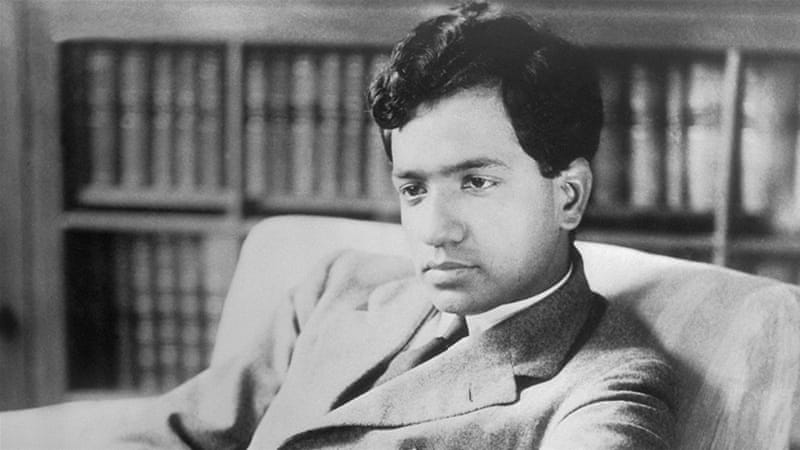
3 brothers : Pancharatnam, Ramseshan, Chandrasekhar. Image courtesy : Indian Academy of Sciences
S. Chandrasekhar was an astrophysicist who went to win the Nobel Prize in Physics
The real impact of science and technology, is not only in the materialistic gains of a society but also in the way it elevates the thought process of a society. Science as a pursuit of human knowledge influences thinking of human beings, and hence plays a vital role in shaping the character and culture of any individual, family, community, country and the world.
We should also remind ourselves that “impact of a scientist” cannot be judged merely by counting the number of papers/patents they publish nor by the high-office they hold in corridors of (scientific and political) power. If anything, such a judgment of impact should be left to the posterity.
On a related note, Kameshwar Wali, physicist and biographer of Subrahmanyan Chandrasekhar writes :
Chandra often quoted from a letter of his friend Edward A Milne during his Cambridge years:
“Posterity, in time will give us our true measure and assign to each of us our due measure and humble place; and in the end it is the judgement of posterity that really matters. He really succeeds who preserves accordingly to his lights, unaffected by fortune, good or bad. And it is well to remember there is no correlation between posterity and the judgement of contemporaries.”
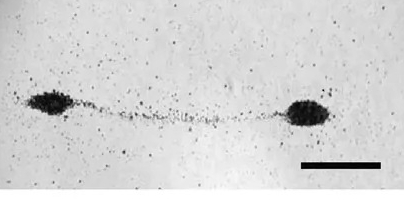
Optical microscopy image (scale bar 100 microns) of a metal colloidal chain assembled in a plasmofluidic potential in our lab at IISER-Pune (see https://www.nature.com/articles/ncomms5357 for more details)
Malleshwaram is one of the oldest parts of Bangalore. I studied BSc (Physics, Maths, Electronics) in MES College which is at the 15th cross of Malleshwaram. Apart from the college day memories of eating Dosae at CTR, other memorable aspects of my student life were playing cricket at Malleshwaram ground, and regularly visiting IISc and Raman Research Institute (RRI), which were not far from Malleshwaram. Particularly, the library at RRI was the place I spent most of my time during BSc and MSc. Two Professors at RRI with whom I interacted a lot were Prof. G.S. Ranganath and Prof. G. Srinivasan (both are retired now). I owe a lot of my interest in science to these two gentlemen. I was always interested in optical physics, and thanks to the interaction with Prof. G Srinivasan, I really got interested in optical phenomena in astronomy and astrophysics (I even did a rotation curve experiment using the radio telescope at RRI).
Thanks to this excitement, during my MSc Physics at Bangalore University, I did my summer research project at Indian Institute of Astrophysics, Bangalore with Prof. K.N. Nagendra, who introduced me to solar astrophysics. In fact, my project was on second solar spectrum and polarization of light in stars such as sun. Gradually, as I learnt more about optics in stellar environment, I increasingly became interested in optics of everyday life, and started exploring optics of rainbow, soap bubbles and other common objects.
Concomitantly, during BSc and MSc days, I and some of my classmates used to visit RRI and interact with Prof. G.S. Ranganath. He was the one who introduced us to soft-matter physics. Importantly, he impressed upon me the fascinating world at the interface of soft-matter physics and optics. I strongly recommend one of his books, which discusses some of these topics.
This introduction to soft-matter physics and interactions with Prof. Ranganath has had a profound impact on my research career. So much so, that I joined Prof. Chandrabhas’s lab at JNCASR for my Ph.D. to work on a (then) newly emerging topic of surface enhanced Raman scattering, which had a unique blend of colloids (a prototypical soft-matter) and light scattering, and it perfectly suited my research interest. During my Ph.D., I had a fantastic and thrilling experience of working on topics related to interaction of metal colloids with biological macromolecules using Raman scattering microscope as a tool. Thanks to the deep knowledge of Prof. Chandrabhas on optics and optical spectroscopy, and a variety of research at JNCASR, I got introduced to the fascinating field of optical microscopy, Raman scattering and soft-matter physics. Then during my post doc, first at ICFO-Barcelona, I got introduced to near-field optics and single-molecule imaging, and then at Purdue University, I learnt a bit of cell biology and used plasmonic light scattering to study some questions in bio-imaging.
Ever since I started my own research group in 2010 at IISER-Pune, my research interest evolved in topics such as nanowire plasmonics, spin and orbital angular momentum of light, whispering gallery modes in microspheres, single-molecule Raman scattering, and Fourier-plane optical microscopy and spectroscopy. As of Feb 2020, 6 Ph.D. students and around 9 MS students have graduated working on the abovementioned topics. The main focus, for about 10 years, has been on nanophotonics, and on some topics related to soft-matter physics, especially on colloids.
Starting Jan 2020, our emphasis and research orientation will be mainly towards ‘soft-photonics’. The motivation of this research is to explore some emerging questions at the interface of soft matter physics and micro- and nano-photonics. There are two important objectives to this research:
To study structure and dynamics of mesoscale soft-matter including colloids, liquid crystals, and complex fluids using a variety of techniques that we have developed for the past 10 years in the area of nanophotonics and single-nanoparticle optics.
To explore new opportunities in meso- and nano-photonics using soft-matter systems such as colloids, liquid crystals, droplets and bubbles, as a platform.
In a way, for the past 5 years or so, we have been implicitly working on these objectives. But from 2020 onwards, we will be mainly focusing on these objectives, and will be orienting all our efforts towards this direction.
This explicit reorientation is for the following reasons:
The interface of soft-matter physics and photonics provides some new opportunities to study some interesting questions in fundamental physics (such as topology, pattern formation, emergence and single-macromolecule dynamics) and applications (optofluidics, optical antennas, aerosol optics and gastronomy)
Light scattering and “quantitative” optical microscopy have emerged as powerful tools to study structure and dynamics of soft-matter. Given that our lab has laid a strong foundation in these tools for 10 years or so, it is an obvious extrapolation of our capabilities.
Thanks to the interaction with my soft-matter colleagues at IISER-Pune and many friends/researchers across India and outside, I have been “re-hooked” to soft matter physics. Given that the Indian research community on soft-matter is growing in number and has a good mix of experiments and theory, further motivates me to pursue this direction.
Perhaps the most important reason is that it renews my interest in science and reminds me of the fundamental reason of why I became a researcher: to enjoy what I do!
As a consequence of this renewed interest, I intend to write blogs oriented towards soft matter physics + photonics and wish to use this platform to educate myself and communicate my excitement with all of you.
Let me conclude by quoting “a poem from an experiment of soft matter” by Boudin, which is also the concluding part of the Nobel lecture of Pierre de Gennes:
India’s recent mission to reach the moon, Chandrayaan 2, has spurred a lot of interest, and I am glad that it is getting the attention it deserves. As we know, the space vehicle was supposed to land on the south pole of the moon but lost communication with earth just before the touchdown. The initial goal of landing the spacecraft was not achieved as per the expectation. The efforts of the people involved in this mission are indeed laudable. Given the drive, commitment and financial support that ISRO has, I am sure they will achieve greater things in the future.
This event is also a good occasion to talk about the importance of failed experiments in science, and below is my take:
This semester I have been teaching an advanced physics lab course to the 4th year BS-MS students. There are about 23 students, and we have been performing some experiments on concepts such as Thermionic emission, statistics in radioactive decay, electron spin resonance, Zeeman Effect, etc. As you may guess, all these experiments have deep connection to quantum mechanics, and its manifestation is evidenced in the lab. These experiments are designed such that we can test some hypothesis by formulating them as a question, and the experiments aim to reveal an answer to the posed question. As part of the process, the students explore the basic theory behind the experiment, understand the rationale behind the instrumentation utilized, and perform measurement and analyse the error in them. They are expected to record their observations, and finally submit a report in the form of a small research paper.
Many a times, the experiment that the students perform do not work according to the plan. So they need to troubleshoot the problem, and understand why things are failing. This stage of troubleshooting is where one LEARNS about how to do an experiment. After a careful analysis, they figure out where the problem was, and rectify it to proceed further. This whole process requires attention to details, better understanding of the instruments under use, and importantly a lot of patience. In a way, a lab course, if done in the right spirit, is one of the most fulfilling aspects of science education because it interfaces the abstract knowledge with the real world. So our understanding of the physical world is not only enriched but also we gain some degree of control over it, which is kind of empowering, so to speak.
Now what about experiments in a research lab? Well, the story is even more interesting in this situation. A majority of the times, the experiments that we design in a research lab DOES NOT work. In fact, we will not even know whether the direction we are taking is indeed the most accurate and appropriate one. Therefore, a careful design of experiments guided by hypothesis, and an educated “guesstimation” plays a vital role. Even with all precautions, we may fail to perform the experiments according to the plan. So the question is: how does one react during such a situation?
This is where the training we get in the laboratory courses is very vital. We need to fine tune our thinking to know what it is to do an experiment. Given the high probability of failure, we need to consider every experiment as a path to learn something new. This means that the negative result what we get should be considered as a feedback to our thought process.
With this new information from the failed experiment, there are at least two important prospects: First is that it will improve our understanding about the current situation, and throw some light on corrections that we need incorporate in our experiments. The second and more interesting aspect is that it can lead to a completely new direction of research which we may have otherwise ignored. This emergence of new direction is what makes experimentation very interesting. The new, uncharted path that a failed experiment can take us may result in some major discovery or inventions. History of science has a few examples of experiment with negative results that have led to major breakthroughs (for example Michelson-Morley experiment). A caveat to add is that not all negative experiment may result in a breakthrough. Generally speaking, paying attention to the failure is imperative to learn something new, and the same goes with experimentation. In an essence, true progress in experiments (and science in general) can be achieved only by revising it further. Let me conclude by quoting Peter Medawar (Advice to a Young Scientist (1979), 94):
“All experimentation is criticism. If an experiment does not hold out the possibility of causing one to revise one’s views, it is hard to see why it should be done at all.”
This semester I am teaching a course on interdisciplinary optics to about 200+ sophomore undergraduate students. The class encompasses diverse audience with varied interest, and I have been exploring some topics at the interface of optics and other disciplines. After we finish a class, I invariably have a conversation with a few students who have specific questions not only on the topics I have been teaching, but also on general optical phenomena. Since these questions arise totally out of interest of the students, I strongly encourage them and spend as much time as possible to address them. What I have found during these conversations is that the quality of questions is very good. I have found that I can answer only a few of them, but invariably it makes me think about it in greater detail, and further motivates me to consult relevant literature so that I can address the question in depth. This process of informal conversation is one of the enriching experiences of teaching. This has made me think about the role of conversation in science, especially in an informal way, and how it has influenced my thinking as a researcher.
During my undergraduate and postgraduate years, I frequently visited Raman Research Institute (RRI) in Bangalore. I did spend a lot of time in the RRI library, which I think is one of best in the country, especially for science literature. Thanks to great conversations and encouragement of Prof. G. Srinivasan and Prof. G.S. Ranganath, who were scientists at RRI (now retired), I was able to learn very interesting aspects of astronomy, astrophysics, optics, thermodynamics and soft-matter physics. Over informal conversations with them, I learnt interesting questions as diverse as: how stars form? What is the role of surface tension in formation of a soap bubble? Can an electron move faster than light in a specific medium? How diamonds shine light? How to measure colour? And many more…
Questions like these were per se not part of any curricula, but what I realized that the process of answering them took me on a mini intellectual-journey so to speak, and this process has had a tremendous influence on me and my work. What was fundamental to this process was the informal conversation that I had not only with the above-mentioned gentlemen, but also with my friends.
When I started my Ph.D. at JNCASR, I had a great set of batchmates with diverse interest in atomic, molecular and optical physics, high energy physics, condensed matter physics, all sub-disciplines of chemistry, molecular biology, ecology and fluid mechanics. Invariably, our informal conversations during coffee-break, lunch and dinner used to revolve around explaining some everyday phenomena from various viewpoints. These conversations were never meant to be serious. In fact most of the time it was a joke that we were trying to explain, but invariably, the humour was built on the relevant research an individual was doing, and this added great flavour to discussion, and ended up as a joyful learning experience. Surprisingly, the memories of certain moments that we spent during these informal conversations have still remained intact in my mind, and I cherish them.
After finishing my Ph.D., I moved to Barcelona, and then to the US. The informal conversations still played a critical role in my everyday research. Being in labs with great scientific, cultural, linguistic and artistic diversity, what I learnt was that the same science that I had learnt was viewed with different spectacles. It means analogies to explain a specific scientific concept depended on the person’s personal history. This added tremendous variety and richness to informal conversations on science. It also helped me appreciate diversity in viewpoints, and a bit of understanding on different cultures of doing science.
In my own research group, informal conversations on science and research play a very important role in our everyday research. Majority of the time we spend asking questions that help clarify our research, and further add new insights to the work we are doing. This process is generally through a conversation. Research students also learn from each other by talking on science in an informal way, and this percolation of knowledge is as important as reading research papers, and attending talks. Note that other form of scientific communication such as journals, research talks, posters are still the bedrocks of research, but the informal conversations on work plays a significant role in how we perform our research.
This human interaction through conversation is the reason why attending conferences and meetings is still a very important part of scientific life. Even when we have read research papers of an author, we obtain new insight on the same work when we converse with the author, in person. This valuable interaction adds a new dimension to our thoughts, and gives us an opportunity to express ideas which sometimes may get lost in formal communication channels.
Another intriguing but equally interesting aspect of doing science is to have an informal conversation with oneself on concepts and questions we are trying to address. Invariably, I end up understanding something when I try to explain it, first to myself and then to others. This process of “self-talk” is a very useful way to clarify ideas and identify a loophole in my own arguments. What is also interesting is that what we call as “our own thoughts”, are essentially words and images that we have borrowed from an external source. A quote attributed to Alan Watts nicely summarizes this point:
We seldom realize, for example, that our most private thoughts and emotions are not actually our own. For we think in terms of languages and images which we did not invent, but which were given to us by our society.
Verbal conversations are important part of human interaction. We learn, unlearn and relearn many things by talking to each other in an informal setting. Not only we exchange ideas during conversations, but also create new ones. Let me end by quoting the Oxford scholar Theodore Zeldin:
Conversation is a meeting of minds with different memories and habits. When minds meet, they don’t just exchange facts: they transform them, reshape them, draw different implications from them, and engage in new trains of thought. Conversation doesn’t just reshuffle the cards: it creates new cards.
“How often I found where I should be going only by setting out for somewhere else.”
R. Buckminster Fuller
About a month ago, I had an opportunity to interact with school students who were on the verge of transitioning from 10th and 11th grade. This event was part of a tech-fest organized by College of Engineering, Pune. The topic of discussion was “what scientist does in everyday life?” The students were very communicative (surprise!) and asked many questions (another surprise!), which was heartening. During the interaction, one of the issues we discussed was the importance of note-taking, as part of any serious observation in science, art or any other creative pursuit.
One of the curious questions asked by a student was the following: “If there are so many technological tools that are available to us today, why should we at all write by hand? Why don’t we directly learn typing on a computer instead of handwriting?”
This was an important question, and I did mention that writing by hand has not only the benefit of processing thoughts more effectively, but also provides a sense of creation that may be lost while typing a text. Furthermore, symbolic representation, manipulation and thought processing – as done in mathematical thinking or calligraphy – is more conducive and convenient in the hand written form.
I also pointed out that there is some scientific evidence which indicates that handwritten notes have greater impact on processing the information in our brain, than when the same notes are typed on a device. I told that there is a form of elegance and individuality that a handwritten displays, which may not be represented in a text that is typed. I mentioned that writing in general and handwriting in particular, was not only a form expression but also as form of exploration. I indicated that just like music, writing has a psychological benefit of its own. It helps you to explore your thoughts and creates a sense of connection with oneself. Interestingly, it will also take you on a journey which you may not anticipate. The quote at the beginning of this blog sums it up nicely. Writing is a form of exploration, and by merely writing, we are taken to new worlds which we had not envisaged or planned to go.
In this blog I give 2 examples of a scientist and a writer, who have effectively used handwritten text in their work and have deeply impacted their respective fields. The choice is purely personal, as they are inspirational to me. Here we go….
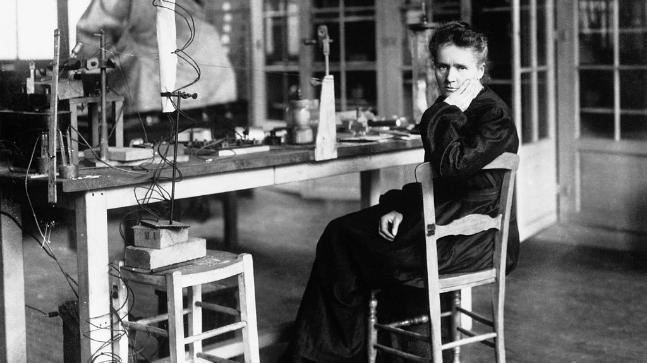
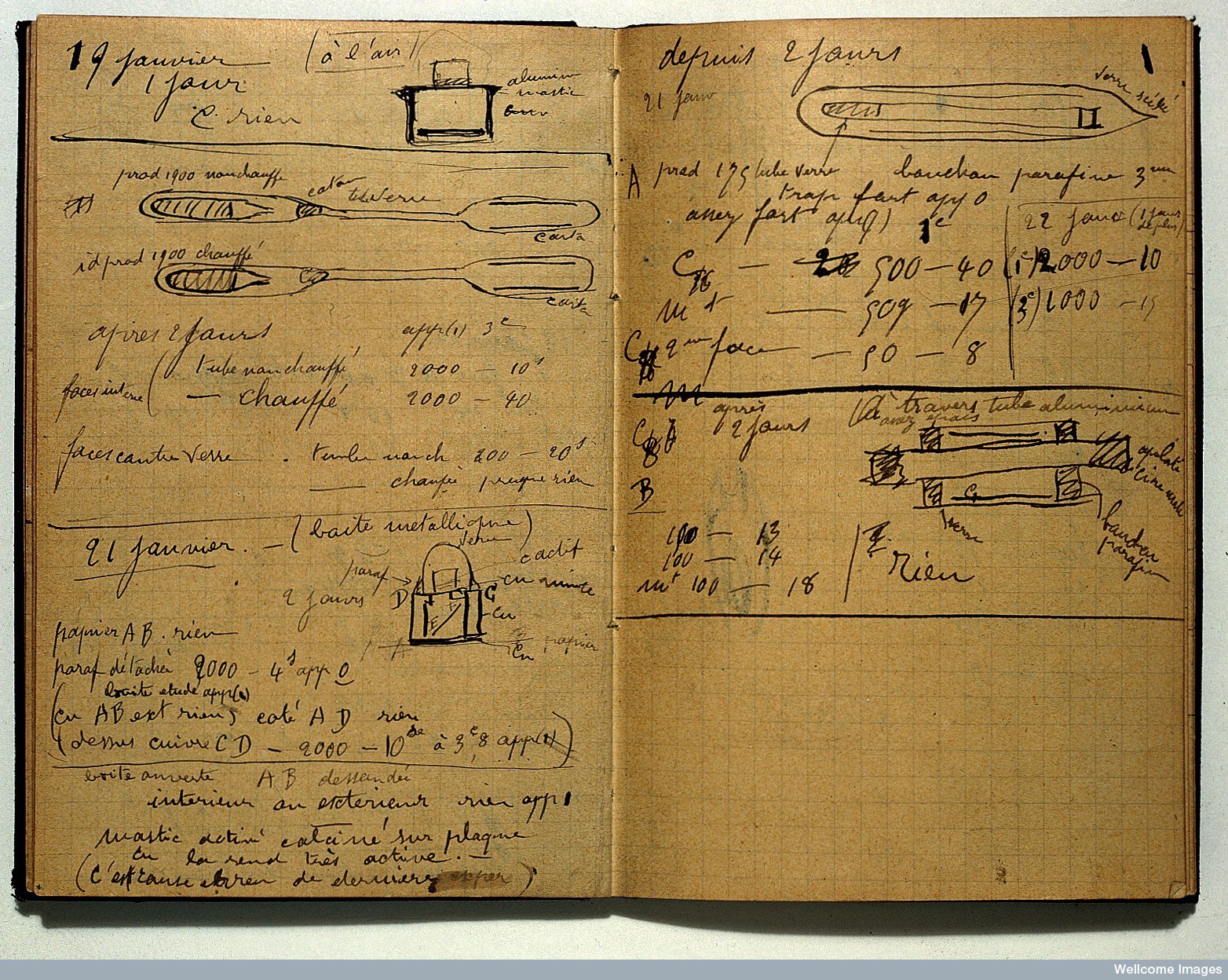
Cutting-edge science in early 1900s, especially in experimental physics and chemistry has had a great impact on modern society. Among the many who thought deeply about the nature of matter, Marie Curie’s contribution stood out. As a dedicated researcher, she not only developed elaborate experimental methods by herself to unveil the secrets of radioactivity, but also silently built a school of thought where dodgy, experimental exploration motivated new questions and directions in natural science. Below text is a snapshot from Marie Curie’s notes which describes the sample preparation in her lab. Interestingly, the mentioned texts of Marie Curie are still radioactive (and kept under isolation), and will remain radioactive for another 1500 year!
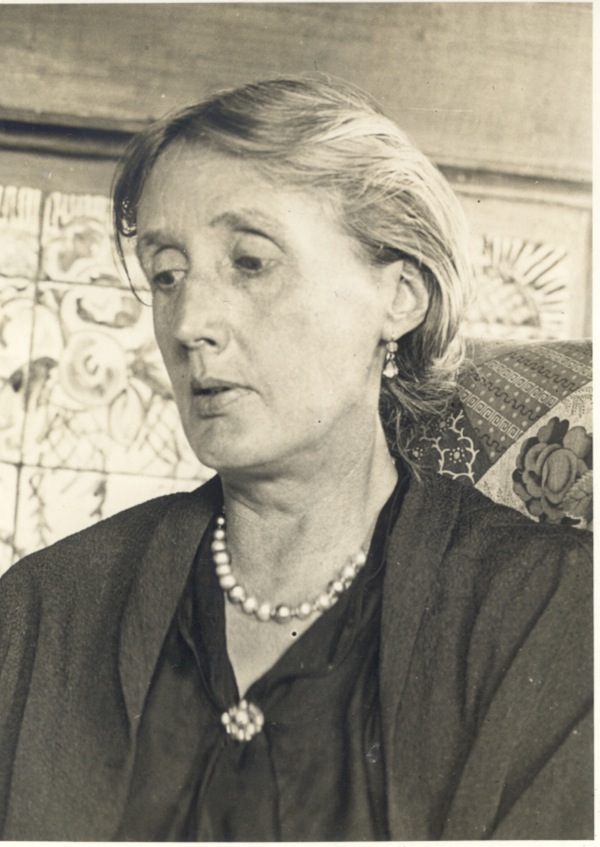
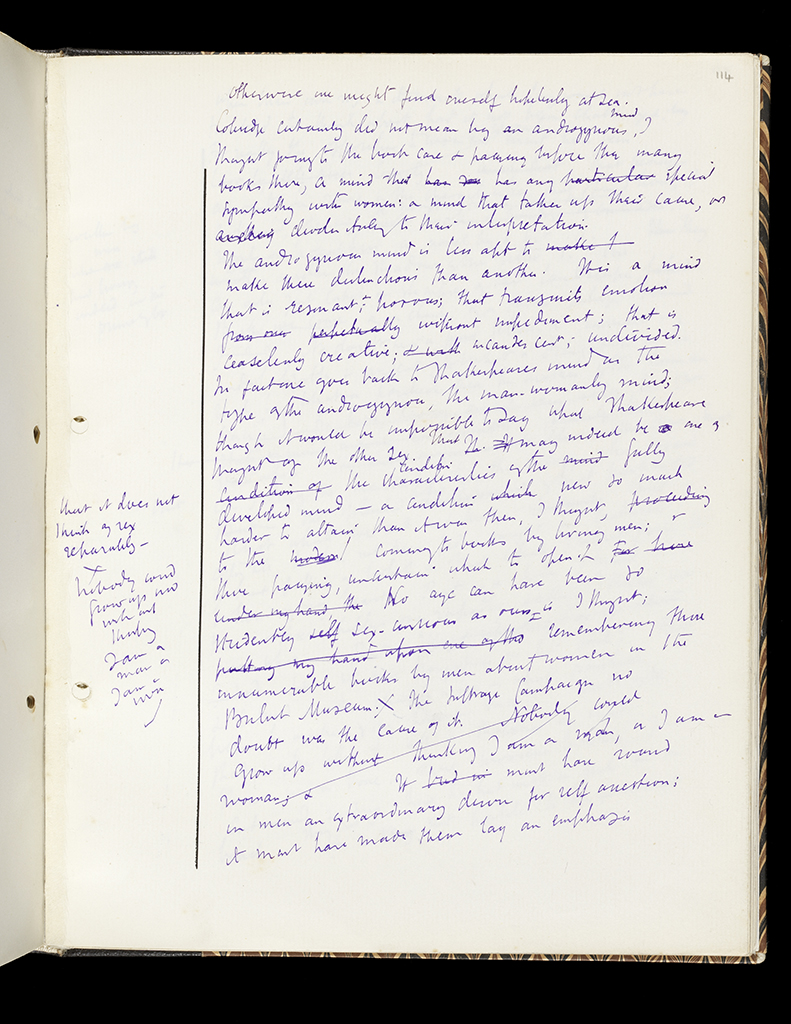
A literary giant who is surely one of the pioneers of modernist thought process, kept a diary for herself all throughout her life. In my opinion she was a great humanist who redefined the art of narrative from a modern perspective. What’s more, her texts are so quotable that anybody who reads them will get a new viewpoint of the world which we had never seen. Below I reproduce a copy of her handwritten page of her famous book “A room of one’s own”. In this text, the story is still in the making, but you can see how a cluttered text at that time has evolved into a masterpiece now.
Image Credit : Cambridge University
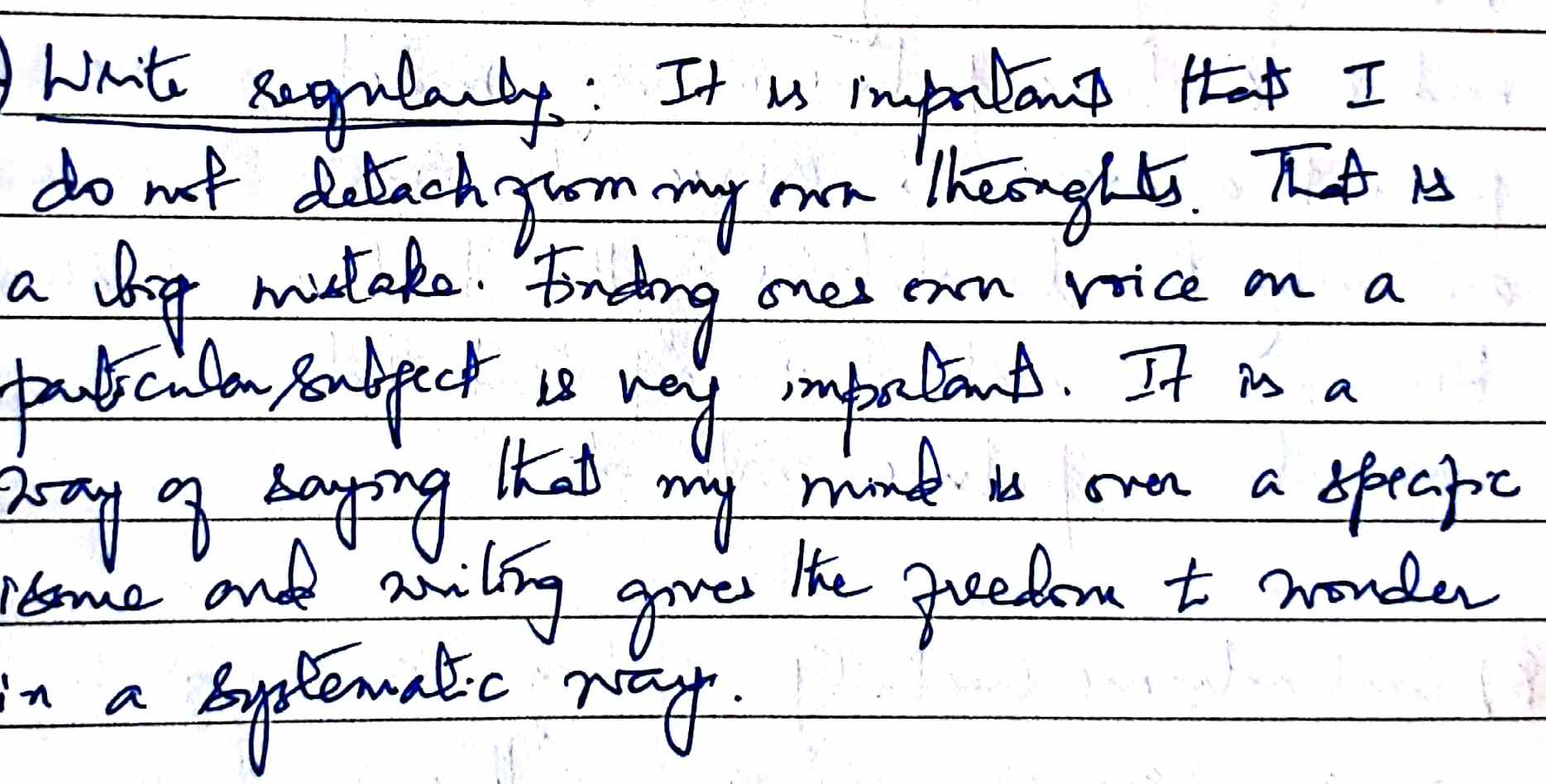
Well….preaching without practice is always hollow. When I was interacting with the students regarding handwritten text, they asked me whether I do write by hand. And my answer was yes, and below is a small handwritten note from my own notebook:
Snapshot of text from my notebook
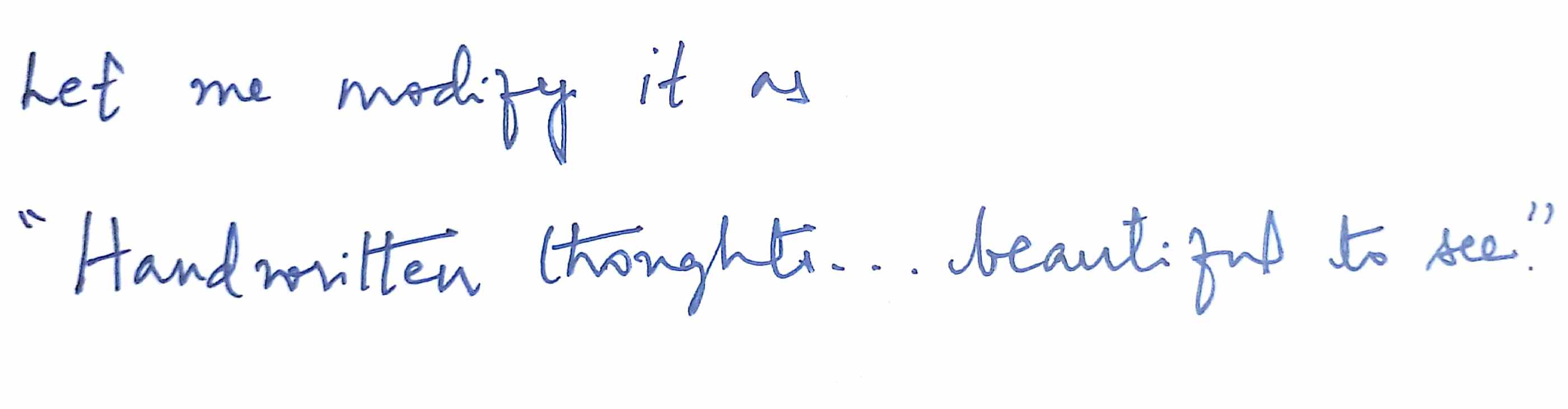
Handwritten text has its own aesthetic value, and I believe it should be retained as long as human expression exists.





 VISMAYA - History & Philosophy of Physics