To wonder is to be human. At the heart of wondering is questioning. As an individual and a collective, encouraging people to ask questions is one of the most important things we can do. Start with your children or young people around you. Encourage them to question you. Try to answer them honestly. If you do not know the answer, explore the answer with them. Emphasize that no answer is complete and is subject to revision upon new evidence and ideas. In my opinion, this process is the safest training you can give them as an adult and help them become informed citizens.
Along the way, teach them two things: 1) how to formulate a question and 2) pay attention to the tone of the question they ask.
Formulating a good question is a challenging task and requires iteration. Iterations mean patience. So, asking a good question is a training in patient thinking. Discourage rushing through. That does not mean the upper time bound is infinite. This means you shouldn’t settle for the default question. Question the question.
Next is the tone of the question. It is the tone which determines the intention of the question. If your intention is grounded in humility, curiosity and transparency, you will have a better chance of obtaining an answer. A question asked in a condescending tone generally discourages people from answering, even if their intention is not to conceal.
Of course, these are not general rules but guidelines that may be useful.
Conclusion: Pay attention not only to the substance of your question but also to the form of your question. A questioning mindset can be extrapolated to your everyday thinking. Gradually, it will become a way of life. Learning is more important than ego. When you realise this, questions become a great tool to explore the world.
In 1980s, every Friday morning, Akaashvani Bengaluru (a local radio channel of the state; language Kannada) woke me up with Bhimsen Joshi’s famous rendition – Bhaagyada laxmi baaramma. This song has stayed with me and somehow makes me nostalgic for the times we lived – a simple, lower-middle-class life. More than the devotional undertone of this song, what captured my attention was how it was beautifully adapted in a movie by Shankar Nag without compromising its authenticity. It showed me how art can be inclusive yet distinct.
I went to a local private English school. Those were the times when school education was affordable even for a lower-income family like ours, and now, if I look back, I did get a relatively decent primary education. Some of the teachers I remember had names: Firdoos, Christy and Geeta.
An interesting aspect of my upbringing was my exposure to various sports. It included cricket (of course), cycling, eye-spies, lagori, buguri,goli and bachha. The last three sports are unique. Buguri is playing with a top, where you spin the top with a tied rope. By releasing the rope skillfully, one can make the top rotate at a location of interest, be it on the floor or in the palm of your hand.
Goli is playing with marbles, where you compete with an opponent by hitting a marble with another. There were several games within the umbrella of this fascinating meta-game, and it was one of the most competitive sports I have played.
Bachha will be the most unfamiliar sport to many of you reading. It was typically played by children who grew up in lower-middle income surroundings, and the game was to use well-polished granite slabs that can fit your hand. This was made to sail over a tar road. The sailing of the stone had to be smooth, and the target of this throw was to dislodge a pile of old cigarette carrying paper boxes (without cigarettes) that had been collected over a long period of time. The whole point of the game was to hit the piled-up packs of these folded boxes and win them as a collection. Different boxes of cigarette brands had different values. Talk about capitalism !
Through the 1990s, the teenage years were memorable. Riding a two-wheeled motor vehicle made you feel you had evolved into an adult. It gave you the freedom to go to a petrol bunk and fill up the tank full of fuel (with tinge of kerosene) on a gear(care)less TVS 50. The picture that has stayed with me is the skilful handling of a bunch of currency notes by the guys who filled the petrol. They used to double up as cashiers (as they do even now), but then everything was to be dealt in cash, and the human processing speeds had to be good. Similar skills were evident with BTS bus conductors. A fascinating thing about them was that they had a whistle. This made their presence felt, and they were the representatives of the unique city culture of Bangalore. Their images are so iconic that many Kannada movies then had bus conductors as characters of their movies. Rajnikanth was one of the early ones to play this role. And yes, he started in Kannada movies, as did a few other Tamil superstars.
Deccan Herald was and is a newspaper that most of the Bengalurians are aware of. It had some wonderful commentaries on history and geography. Thanks to some of these articles by well-known writers, I was interested in these subjects. I was so motivated and encouraged by them that, as a school kid, I wrote them a letter. They published it. I remember it was a Saturday, and I spent my whole weekend staring at my article on paper. It was also a time when I learned about the great H. Narasimiaha distributing puffed rice to local people during a solar eclipse. His writings and thoughts sowed the seeds of rationality in me. Gradually, I transformed into an atheist, and over the years, I have adapted compassionate rationality as a way of living and thinking. This way has allowed me to appreciate my culture’s deep roots without compromising on rational thinking. It has given me a balance.
What was out of balance in my life was the pressure of education. The worst part of the late 90s was my pre-university education. Then, 11 and 12-grade education was part of pre-university college, and this exposed one to a life of partial independence. Unlike a bachelor’s degree, this time in college is boring, and everything is done to crack some silly exams that have ‘not so silly’ consequences on one’s career. With great fortune, I escaped a turbulent time and found myself doing BSc (Physics, Maths, Electronics), with a healthy amount of languages, including Sanskrit and English. Throughout this period, the wonderful libraries across the city were central to my education. There were many old public libraries in Bangalore, and one did not need any membership to read a book. I saw so many people preparing for civil service exams in such libraries.
In 2000s, I fell in love with physics. Astrophysics gripped my life and took me through an intellectual journey that has not stopped ever since. Intellectual pursuits are that way. One can vaguely remember their origins, but one will realize the effect on one’s life only after a while. Interestingly, it changes the character of a person. That is the power of education.
I went to Bangalore University to do my Masters in physics. This state-funded university’s semester fees were less than present-day woodland shoes. For the first time, I saw how education can be aspirational, inspirational, political, liberating, suffocating and fun. All at once. This was also the time I discovered that economics and politics have far-reaching consequences in scientific research.
This was also the era of my PhD at JNCASR. I started as a serious student of physics and ended my PhD as a serious student of science. This was transformative not only because I was exposed to new knowledge but also because I could contribute to knowledge. At the end of the first year of my PhD, I got an excellent opportunity to travel to the US. I attended a summer school at University of California, Santa Barbara.
Interestingly, this journey was the first time I took a flight on an aeroplane, and the trajectory was long and interesting as I flew around the globe (Bangalore to Bangkok to Osaka to Los Angeles) thanks to the limited funding. The biggest realization of my arrival in LA was a massive billboard of an iconic iPod silhouette advertisement. It is etched in my inner eye. My first travel within the US was a road trip from LA to Santa Barbara. What a ride!
After I finished my PhD, I moved to Barcelona and lived in Castelldefels. I shared my apartment with an Uruguayan (Spanish: uruguayos) couple and a cute dog. It was interesting that we were all immigrants. They spoke Spanish, but I did not, which impacted how we assimilated into the society. Although we did not speak similar languages, we could communicate very well with each other. That was an interesting lesson for me.
Then I moved to the US, and this was a time when Obama had just been elected into office. I have never seen a country undergoing economic recession and yet was so enthusiastic politically as the US. The ‘Yes We Can’ was an iconic campaign; I could see how it touched so many lives in the US. It was also a time when I was exposed to American professionalism and their excellent work culture. This has deeply impacted my thinking and how I look at work. It also made me realize the (positive and negative) powers of a free market economy. Again, it was an education.
In 2010, I got married, and started looking at life from a slightly long-term perspective. At the cusp of the decade, I moved back to India, and this time to Pune. Culturally, this is one of the wealthiest places in India. The flux of thought is high, and the people you get exposed to is often fascinating. It was also a time when I was building my lab, and I found how essential teamwork is. You always realize this when you are doing your PhD, but when you set up your group, you get a different grasp of how highly educated humans behave and coordinate for the greater good with a common goal.
Interestingly, these common goals can also align with personal career goals and growth. From a close quarter, I see how five years of focused work can transform people’s lives and thoughts. We need to pay more attention to the long-term work.
One of my life moments was to see my wife delivering my daughter. It made me feel human. I was there in that ward beside my wife, and those few minutes has transformed me forever. It also made me realize the power of human bonds. The day’s images are etched in my memory, and I thank biology for all that!
Now, we are in 2020s, and the pandemic has eaten away a few years. The early years also led to an explosion of information, and understanding the world is a continued challenge. An astonishing aspect has been that we, as humans, are still fighting wars. It indicates that we still do not understand each other, and cooperation is still a major goal to achieve. More work to do.
All through this journey, what has remained with me is reading, writing and talking to people. All people from all walks of life. Writing and talking has also encouraged me to use them as tools to look at the world. A lesson that I derive from all this: human cultures should use knowledge from the past and present and move towards the future. A forward-looking culture distills the best from every cultural exposure and adapts them to move forward. This is also a lesson from evolutionary biology, and perhaps a lesson for a beautiful country like India, that is Bharat, and many other magnificent things.
We are the people, and the wheel – the chakra, represents us on the move. This is the life I want to travel on : riding on a chakra of a forward-looking culture.
Chomsky et al., have some very interesting linguistic and philosophical points on chatGPT/AI and their variants (see NYT link).
To quote
“The human mind is not, like ChatGPT and its ilk, a lumbering statistical engine for pattern matching, gorging on hundreds of terabytes of data and extrapolating the most likely conversational response or most probable answer to a scientific question. On the contrary, the human mind is a surprisingly efficient and even elegant system that operates with small amounts of information; it seeks not to infer brute correlations among data points but to create explanations.”
The philosophical and ethical viewpoints expressed in this article are indeed noteworthy. What probably is even more important is the linguistic viewpoint which amalgamates language with human thought process, and that is what makes this article more interesting and unique.
My own take on Chatgpt has been ambivalent because I do see tremendous potential, but also some obvious faults in it. About a couple of months ago, I did try to play around with it, especially in the context of some obvious questions I had on optical forces, and the answers I got were far from satisfactory. At that time, I assumed that the algorithm had some work to do, and it was probably in the process of learning and getting better. The situation has not changed for better, and I do see some major flaws even now. Chomsky’s article highlighted the linguistic aspects which I had not come across in any other arguments against artificial intelligence-based answer generators, and there is some more food for thought here.
This is indeed an exciting time for machine learning-based approaches to train artificial thought process, but the question remains whether that process of thought can somehow emulate the capabilities of a human mind.
As humans, a part of us want to see this achievement, and a part of us do not want this to happen. Can an artificial intelligence system have such a dilemma?
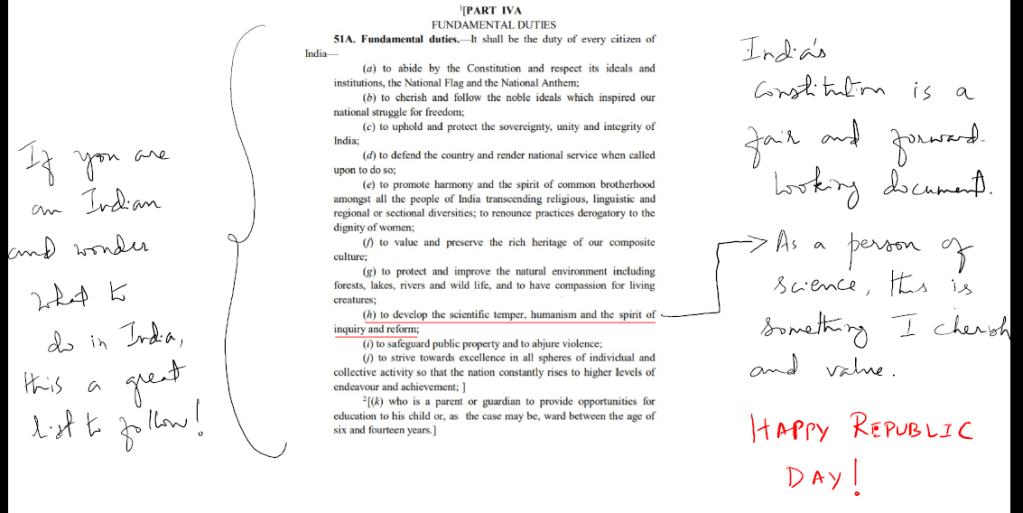
Today we mark the 75th anniversary of Indian independence from the British colonial rule. For a country of our population and size, it is indeed a great achievement that we have sustained to be a democratic nation. We continue to be a work in progress and there is a lot to learn and look forward to.
India today is awash in the tri-colour flag, which marks a symbol of our identity.
This symbol has a deeper philosophical meaning, and it has been wonderfully described by one of the great Indian philosopher Sarvepalli Radhakrishnan (also first vice-president of India, and subsequently President of India) as follows :
“Bhagwa or the saffron colour denotes renunciation of disinterestedness. Our leaders must be indifferent to material gains and dedicate themselves to their work. The white in the centre is light, the path of truth to guide our conduct. The green shows our relation to soil, our relation to the plant life here on which all other life depends. The Ashoka Wheel in the center of the white is the wheel of the law of dharma. Truth or satya, dharma or virtue ought to be the controlling principles of those who work under this flag. Again, the wheel denotes motion. There is death in stagnation. There is life in movement. India should no more resist change, it must move and go forward. The wheel represents the dynamism of a peaceful change.”
Dr. S. Radhakrishnan, Constituent Assembly of Independent India
The metaphor of wheel to go forward is noteworthy. It essentially states that we as a society should be forward-looking and evolve our thoughts as we make progress. Such a call for evolution of thought and progress is not alien to our civilization.
Lest we forget – Indian philosophy is not just a spiritual literature, it has immense depth and discussion on rationality and logic, and places emphasis on debates and arguments. So much so, that even our great, ancients poets such as Kalidasa uphold this rational spirit in their writings. To quote from his famous Malavikaagnimitram :
पुराणमित्येव न साधु सर्वंन चाऽपि काव्यं नवमित्यवद्यम्।
All poems are not good only because they are old. All poems are not bad because they are new. Good and wise people examine both and decide whether a poem is good or bad. Only a fool will be blindly led by what others say.
-Malavikaagnimitram (Great Poet Kaalidaas)
My hope is that we as a society get inspired by these calls for rationality, and adapt empathy, humility, logical and scientific thinking as some of the core principles our lives. This is not only for a better India, but also for a better world.
Today I complete 12 years as a faculty member at IISER-Pune. I have attempted to put together a list of some lessons that I have learnt so far. A disclaimer to note is that this list is by no means a comprehensive one, but a text of self-reflection from my viewpoint on Indian academia. Of course, I write this in my personal capacity. So here is it..
People first, infrastructure next – As an experimental physicist, people and infrastructure at working place are of paramount importance. When I am forced to prioritize between them, I have chosen people over infrastructure. I am extremely fortunate to have worked with and continue to work with excellent students, faculty colleagues, and admin staff members. I think a good work place is mainly defined by the people who occupy it. I am no way neglecting the role of infrastructure in academia, especially in a country like India, but people have a greater impact in academic life than infrastructure.
Create internal standards – In academia, whether you like it or not, there will be evaluations and judgments on your research and teaching. Generally, every academic ecosystem has its own standards for evaluating people. These standards are generalized principles and are not customized to an individual. Therefore, it was important for me to realize what good work meant and how to judge myself. As long as internal standards are high, and are properly met with consistency, the external evaluation becomes secondary. This attitude totally frees up the mind, and helps me to get better compared to my previous self. This also means I can appreciate others work without having to compare myself to them.
Constancy and Moderation – When it comes to any work, it is important to be consistent over a long period of time. An equally important aspect is to moderate the amount of work done for a period. Most of the important work in research happens in units of months if not years. Therefore, constant effort with moderation keeps the motivation high, and makes the work enjoyable. Binge-working is attractive, but for intellectual work it is ineffective.
Writing is a great tool to think – One of the most underestimated tools of thinking is writing. Not just formal writing, but the process of external articulation of thought on paper does wonders. Countless times, I have obtained, clarified and developed my thoughts only after I started writing about it. Writing is integral part of research and not just a communication tool.
Importance of philosophy – Ever since I was an undergrad, I have been interested in philosophy of science. I had never taken a formal course on philosophy, but I have gradually started appreciating the role of philosophy of science. Specifically, it has catered to my question on ‘why I do what I do?’
Teaching as social responsibility – In the Indian academia, scientific social responsibility is a buzz word. For me, the greatest social responsibility as an academic comes in the form of teaching. In larger scheme of things, some how we tend to neglect the impact of conventional teaching on students. Also, this impact is not easily measured. But the joy one obtains seeing a student do well is priceless. This local impact is what I value more because the feedback is there to see, right in front of you.
Science, sports and arts : a trinity – I love outdoor sports including running, swimming, cricket etc. Equally, I enjoy listening to music, reading poetry and appreciating any form of art from any culture. I have found that it has not only made me a better person, but also has positively impacted my work. Taken as a trinity, these human endeavours continue to enrich our lives.
Emphasis on mental and physical health – The most important policy that I have set in my research group is this: To do effective and enjoyable work, your mental and physical health should be good. There is no point in doing good work at the expense of your health. Therefore the priority will always be good health followed by good work.
Social media : effective if used properly – Social media has a unique reach. If you are in India, and you want to connect to the scientific world, social media is an excellent platform. Given the size and diversity of India, social media can also reach people from various backgrounds and languages. If used responsibly, social media can have great impact on how science is communicated within India and how India connects to the scientific world.
Renewed interest in applied mathematics and coding – During my BSc (Maths, Physics, Electronics) and MSc (Physics), I had excellent training and exposure in mathematics. During the lock-down period, I rejuvenated my interest in applied mathematics (especially nonlinear dynamics) and have started coding too. This has added a new impetus to my research and should reflect in the coming years.
Professor as a post-doc – A research strategy I found useful in my work is to treat myself as a post-doc in the lab. Given that, in India retaining a long-term post-doc is difficult, many of the skills and thought processes cannot be effectively transferred in lab. A long term research problem needs sustained effort in the lab. As an experimental faculty it is easy to get caught up in activities outside the lab and lose touch with the (optical) bench work. Thanks to the lock-down period, I was the only one in the lab for almost 6 months,and I restarted my experimental work. I value that time and I see great benefit in this approach.
Self-mentoring – A lot of academic advice is written by people working in the west. A few of them are general and applicable to Indian academia, but many of them are not. In such a situation, as an academic I try to derive inspiration by reading, especially about people who have done great work in India. I have been deeply influenced by people such as M. Visvesvaraya and Ashoke Sen.
Raman was an extraordinary scientist, great communicator of science, and a very interesting human being with strong opinions and independent thought…. his scientific journey is an ‘audacity of hope’. His human endeavour.. from Bowbazar to Bengaluru..is what makes Raman what he is…and what he will be remembered for..
Raman’s work was deeply influenced by many great classical thinkers, and Euclid was one of them. To quote Raman
“Not until many years later did I appreciate the central position of geometry to all natural knowledge. I can give a thousand examples. Every mineral found in Nature, every crystal made by man, every leaf, flower or fruit that we see growing, every living thing from the smallest to the largest that walks on earth, flies in the air or swims in the waters or lives deep down on the ocean floor, speaks aloud of the fundamental role of geometry in Nature. The pages of Euclid are like the opening bars in the Grand Opera of Nature’s great drama. They lift the veil and show to our vision a glimpse of the vast world of natural knowledge awaiting study.”
To know more, you may want to attend the announced talks..



 VISMAYA - History & Philosophy of Physics