Blog highlighted by SciRio

A nice article by @RutujaUgale in @Sci_Rio that discusses public engagement by scientists as influencers of scientific thought.

Thanks, Rutuja, for profiling my blog, ‘Vismaya’.

Here is my quote from the article:

For me, there are two implications of doing science. One is that science is extremely useful to society, and the second is that it is a good, thoughtful way of living one’s life. Communicating the second implication is important to me, and I do this by researching, writing, and podcasting about the history and philosophy of science (physics in particular). This path helps people understand the human element of doing science and reveals a context. Some of my blogs (filtered here) discuss why I do science and how I do it. More than ‘influencing’ the audience, I am interested in inviting them to explore science by themselves via their own curiosity. That is one reason why my blog is called VISMAYA.”

Link to the full article.

Gardner’s Synthesis

Once in a while, during my research, I come across writing by scholars from other disciplines that gives me a perspective that not only helps me to grasp the complexity of learning across disciplines, but also resonates with some thoughts on education.

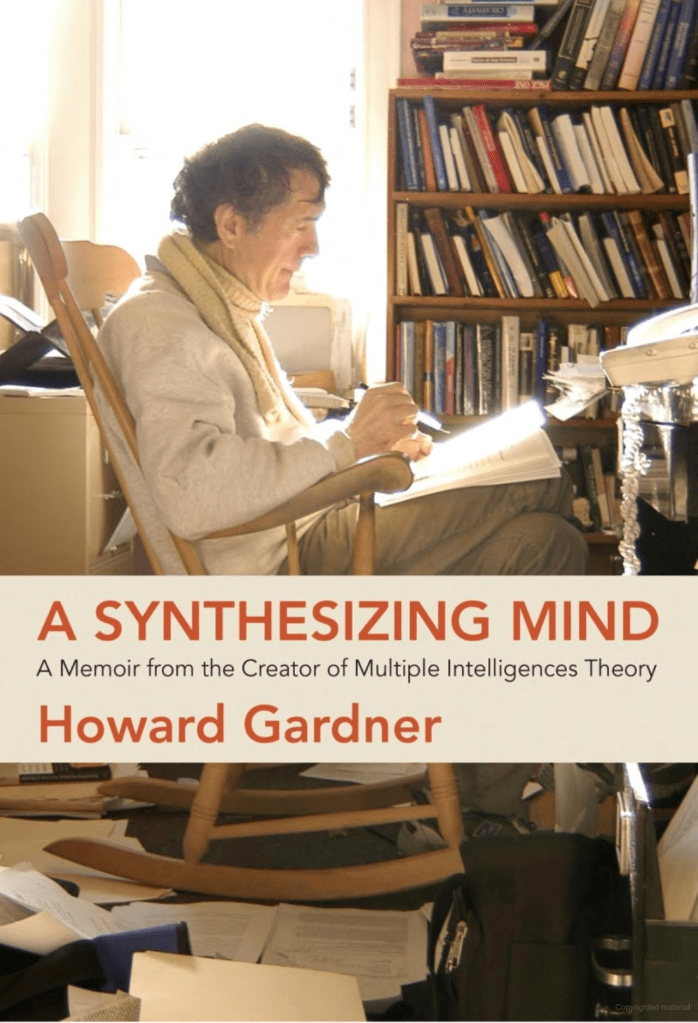
Howard Gardner is one such academic who works on developmental psychology and has researched extensively on cognition and education. He has written ~30 books and ~1000 articles, and blogs regularly, even at the age of 82 or so. His recent book is titled A Synthesizing Mind.

Howard Gardner is a renowned Harvard academic and, as his book describes him as follows:

“Throughout his career, Gardner has focused on human minds in general, or on the minds of particular creators and leaders. Reflecting now on his own mind, he concludes that his is a ‘synthesizing mind’—with the ability to survey experiences and data across a wide range of disciplines and perspectives. The thinkers he most admires—including historian Richard Hofstadter, biologist Charles Darwin, and literary critic Edmund Wilson—are exemplary synthesizers. Gardner contends that the synthesizing mind is particularly valuable at this time and proposes ways to cultivate a possibly unique human capacity.”

While exploring the book and the related material, I came across an interview with Howard Gardner. In there, he is conversing about the theme of the book and discusses the synthesis of thought across disciplines. One of the pertinent aspects of learning is to know how innovation can be fostered by cross-disciplinary exploration without diluting disciplinary rigour. As Gardner says:

“I am not opposed to disciplinary learning—indeed I am an enthusiastic advocate. Any person would be a fool to try to create physics or psychology or political science from the start. But if we want to have scholars or professionals who are innovative, creative—and innovation is not something that we can afford to marginalize—then they cannot and should not be slaves of any single discipline or methodology.”

As a physicist, I can relate to this thinking within my discipline, and how innovative ideas, over the ages, have emerged by bringing ideas from mathematics, engineering and biology into physics. Particularly, the combination of biology, physics and mathematics is one of the most exciting frontiers of human exploration today, and Gardner’s words apply well in this scenario.

Going beyond science, I am always intrigued and amazed by artists (especially musicians) who can create art that simultaneously draws the attention of specialists and generalists. This is not a trivial achievement, and as a scientist, I am always trying to understand how artists resonate so well with the public. Gardner, in the abovementioned interview, frames this problem by looking at the goals of science and arts, and draws a contrast that is worth noting:

“Most scholars and observers like to emphasize the similarities between the arts and the sciences, and that is fine. But the goals of the two enterprises are different. Science seeks an accurate and well supported description of the world. The arts seek to capture and convey various aspects of experience; and they have no obligation other than to capture the interest and attention of those who participate in them.

Of course, there are some individuals who excel in both science and art (Leonardo is everyone’s favorite example). But most artists—great or not—would not know their way around a scientific laboratory. And most scientists—even if they like to play the violin or to draw caricatures or to dance the tango—would not make works of art or performances that would interest others.”

I partially agree with this assessment, as I know a few scientists who are deeply involved in various forms of art (including music) and do it very well, even at the professional level. In a way, Gardner is re-emphasizing the “two cultures” debate of C.P. Snow. My own thoughts on this viewpoint are ambivalent, as I see science, arts and sports as important pursuits that cater to different facets of the human mind. Of course, when it comes to expertise, the division may matter. There is a lot more to learn about the interface of art and science, at least for me.

Anyway, Gardner is a fabulous writer, and his blogs and books are worth reading (and studying) if one is seriously interested in understanding how to synthesize thought across disciplines.

Since we are discussing synthesis of thought, which is a kind of harmony, and coming together, let me end the blog with a line from Mankuthimmana Kagga by the Kannada poet-philosopher D.V. Gundappa:

ಎಲ್ಲರೊಳಗೊಂದಾಗು ಮಂಕುತಿಮ್ಮ” (Eladaralongodhagu manku thimma)

which loosely translates to: oh fool…be one among all (blend into world, living in harmony).

Harmony of disciplines and minds – how badly the world needs it today?

YouTube as an Archival Source

There are several models for using YouTube. One of them is to use it as a substitute for television and media outlets. This is where the number of views, subscriptions, and reach becomes important.

Another model is to harness YouTube as an archival source that is open to the public. This is one of the crucial elements of a platform that is easily accessible and, importantly, searchable. Such a platform becomes a repository for many informal academic discussions and interactions.

The archive model is an important category, especially if there is no need to generate revenue from the content deposited on the platform. A crucial aspect is that it can be accessed across the world and, in that sense, represents truly open-access content without paywalls, publication charges or subscriptions. Therefore, I am glad to see that many Indian academic programs, including NPTEL, ICTS, Science Activity Center/Media Center at IISER-Pune and many others are utilizing platforms such as YouTube to post their lectures and talks. Also, many individual academics in India are gradually using YouTube to discuss their work, in the context of research, teaching and entrepreneurship.

This development is slowly turning out to be an invaluable resource that can reach a large audience. Although YouTube is one of the most well-known platforms, many other platforms in the context of social media can also be tapped to spread knowledge. Given their reach and simplicity of use, both for creators and users, these tools become important in a vast country such as India.

As audio-visual public platforms join hands with artificial intelligence tools, they can positively (hopefully) affect how people, especially students, consume educational content. Going forward, I anticipate language translation through direct dubbing to be a game-changer. It could attract many new viewers who have been hesitant to watch technical content simply because it was in a foreign language. Of course, on these platforms, the noise is equally high compared to the signal, and therefore, curating good, targeted resources will be vital. Also, these platforms cannot be treated as a substitute for formal education, but as an extension or complementary source for research and education.

Interesting times ahead.

Academic Scientific Writing: A Case for Two Versions

Whenever one comes across an interesting debate in science communication, one will always find criticism about academic writing. Generally, it is considered opaque, jargon-filled and many times incomprehensible. So, when a person without a deep scientific background reads an academic paper or an academic book, they blame the writing and the writer for making it complicated.

I am the first person to admit that academic writing needs drastic improvement. But there is another point which I want to make in this essay. Being an academic: as a student, as a teacher, as a researcher and as an editor, I have read, heard, seen and discussed with so many academics who are very creative and have great clarity of thought. Over the past many years, I have seen outstanding science communicators who can express their thoughts and opinions in a comprehensible way, and this is always inspiring.

So, there is a disconnect between what people read, hear and see about academic scientific content and what academicians do to make themselves clear. So, this motivates two questions:  a) what academics can do to make sure that their writing and exposition are more comprehensible and cater to the public? b) how the public can consume academic scientific information? In this essay, I discuss these issues.

The Two Versions

One solution is to have two versions of their work at their disposal. The first version is for a specialized, scientific audience with whom they correspond as part of their research papers and academic books. In here, one uses rigorous analysis and sometimes unavoidable jargon to express precise thoughts and extract in-depth analysis. This is essential because if one is working at the forefront of knowledge, one must get to that point with minimum resistance and maximum efficiency. In the first version, the assumption is that the person reading the text has some basic scientific background and, with some effort, will be able to retrace all the assumptions made in the text. Again, I am not proposing the text to be complicated. But making a case for better communication at the forefront of knowledge. Writing a comprehensive yet academically rigorous argument is not easy. All of us, the academics, should strive to create a good text that can be understood with an in-depth reading.

Opening to Public

The second version is an explanation of the first version in plain language without the usage of jargon, acronyms and complicated equations. This also makes a strong case for bringing analogies where one can take the concepts that are abstract and convert them into everyday objects or relationships so that the public can comprehend the thought behind the abstraction.

The second version is not a very easy version to create because it needs a kind of translation of thought that is not straightforward and requires one to have a deeper understanding of the relationships within the abstraction. The advantageous fallout of the second version is that it forces an expert to think in such a way that they must really go into the core principles of their work and extract meaning. This means that the second version is helping the expert to understand things better, which is vital for their own sake.

Many times, when I have forced myself to create a second version of my primary work, I have ended up gaining more information and insight into my own abstract work, which I would have not obtained but for the initiation of the second version. Given that people are more interested in knowing what is happening in academic work and how it can be related to the public, there will always be interest among a large audience. So, this process of creating two versions is necessary nowadays. It also means that academics have a very nice way to make their work connected to a larger audience.

Public Consumption of Scientific Information

So, now I want to discuss about what the public can do when they come across academic work. First and the foremost aspect I want to emphasize is that research papers and academic books are not like reading novels. It needs engagement with the text, and generally, one will not come across a page-turner.  This means the general reader must spend more time on the assumptions and the questions discussed in the text. These texts are difficult to read in a single sitting. One will have to consult multiple sources and build the information which is presented in the text. This is how generally an academic text is written, and most of the time it is not compiled in one sitting. Therefore, one cannot expect a person to read academic text, especially if it is discussing some complex concepts in a single sitting. So, what I would suggest is whenever one comes across an academic work, please explore the work through a summary, if available. A summary of the abstract academic text is now becoming popular even among academic journals, and many of them publish a descriptive summary in a narrative style which is generally comprehensible to a broader audience. If the public finds the summary also to be complicated, the next best thing is to talk to a knowledgeable person who can explain things better. (Note: sometimes knowledgeable people may not explain things well. So be choosy)

The other important aspect is if you are interested in a scientific concept and you want to learn more, explore it in a gradual way – from a broader source to a specialized source. So, for example, if you want to learn something about climate change, do a cursory reading on Wikipedia about that concept and note down the primary references furnished. Listen to some podcasts and watch some YouTube videos related to that concept.

Thereafter, what is important is that you should extract good primary references from these platforms such as Wikipedia, podcasts and YouTube videos. This identification of primary sources and perhaps even a good book on this particular topic will help you to identify authentic information. This way of exploration gives you an advantage of first getting the big picture of the concept and then moving towards the specialized aspect that you are interested in. Therefore, this combination of the big picture and the narrow specialization will enrich your thoughts on that particular concept. So, what I would suggest you do is to explore tertiary and secondary sources such as Wikipedia articles, videos and podcasts to begin with, then extract good primary sources and secondary sources from that exploration, and then go deeper. All this depends on how deep you want to go into that topic.

Always remember that a Wikipedia article, a podcast or a video is a kind of a tertiary or a secondary source at its best. Most of the time, they are not the primary sources and therefore, it is always important to keep this in your mind when you are citing your sources in your discussion. To be more authentic, you will always have to go to the primary source and know the nuances of a particular concept from the original work.

Academic Thoughts with the Public in Mind

In conclusion, academic writing surely needs drastic change, especially in the way things are expressed in a journal or an academic book. Academics will also have to think about how to generate information that is not only applicable to a specialized audience but also to the public. Such information would be of very high value not only to the public but also to people in the peripheral research areas, and importantly it will add greater understanding to the expert who is generating this kind of information.

The public should also be a bit more patient to engage with the academic text and should explore the relevant information. This is getting easier, given that information is not at a premium nowadays. The availability of tertiary and secondary sources is abundant. How one makes use of that resource and how we connect those resources to primary data is both a craft and an art. It needs immersion with the sources.

At the end of the day, we need better communication between the specialized experts and the public. After all, academic thoughts should have a direct implication on thoughts of the society. We academics should also be cognisant about the vice versa.
50 deg C – here to stay..

India and many parts of the world are facing severe heat waves. Routinely, we are observing recorded temperatures much above 40 degrees Celsius.

Where is the problem? How to overcome this?

We need an ecological reset, perhaps a new social contract with nature. We may have to ask what human development means to us in the short and long term. Using technologies, quick-fix solutions can wash the eyes, not the dust inside them. Despite being an experimental physicist who likes to tinker with nature and is fascinated by machines, I am saying this.

Many proposed solutions to alleviate the problem of climate change are not sustainable. It is no longer just a question of science or technology deployment. We need a change in human behaviour on a large scale, and this includes governments, industries, and common people. Collective incoherence is the crux of the problem, and until we address it, we will see 50 deg C more often and in many places.

Questions: Substance and Form

To wonder is to be human. At the heart of wondering is questioning. As an individual and a collective, encouraging people to ask questions is one of the most important things we can do. Start with your children or young people around you. Encourage them to question you. Try to answer them honestly. If you do not know the answer, explore the answer with them. Emphasize that no answer is complete and is subject to revision upon new evidence and ideas.
In my opinion, this process is the safest training you can give them as an adult and help them become informed citizens.

Along the way, teach them two things: 1) how to formulate a question and 2) pay attention to the tone of the question they ask.

Formulating a good question is a challenging task and requires iteration. Iterations mean patience. So, asking a good question is a training in patient thinking. Discourage rushing through. That does not mean the upper time bound is infinite. This means you shouldn’t settle for the default question. Question the question.

Next is the tone of the question. It is the tone which determines the intention of the question. If your intention is grounded in humility, curiosity and transparency, you will have a better chance of obtaining an answer. A question asked in a condescending tone generally discourages people from answering, even if their intention is not to conceal.

Of course, these are not general rules but guidelines that may be useful.

Conclusion:
Pay attention not only to the substance of your question but also to the form of your question. A questioning mindset can be extrapolated to your everyday thinking. Gradually, it will become a way of life.
Learning is more important than ego. When you realise this, questions become a great tool to explore the world.