Satish Dhawan – truly a man for all seasons

Image credit: Current Science 119, no. 9 (2020): 1427–32

Today is the birth anniversary of Satish Dhawan (25 September 1920 – 3 January 2002). He was probably India’s best scientist-administrator who headed institutions such as the Indian Institute of Science and the Indian Space Research Organization. With a PhD from Caltech, he came back to India and set up a marvellous research enterprise on fluid mechanics, including aerospace science and engineering. He mentored some of the outstanding scientists of India and led scientific institutions with vision, openness and informality, which is still a great benchmark to emulate1.

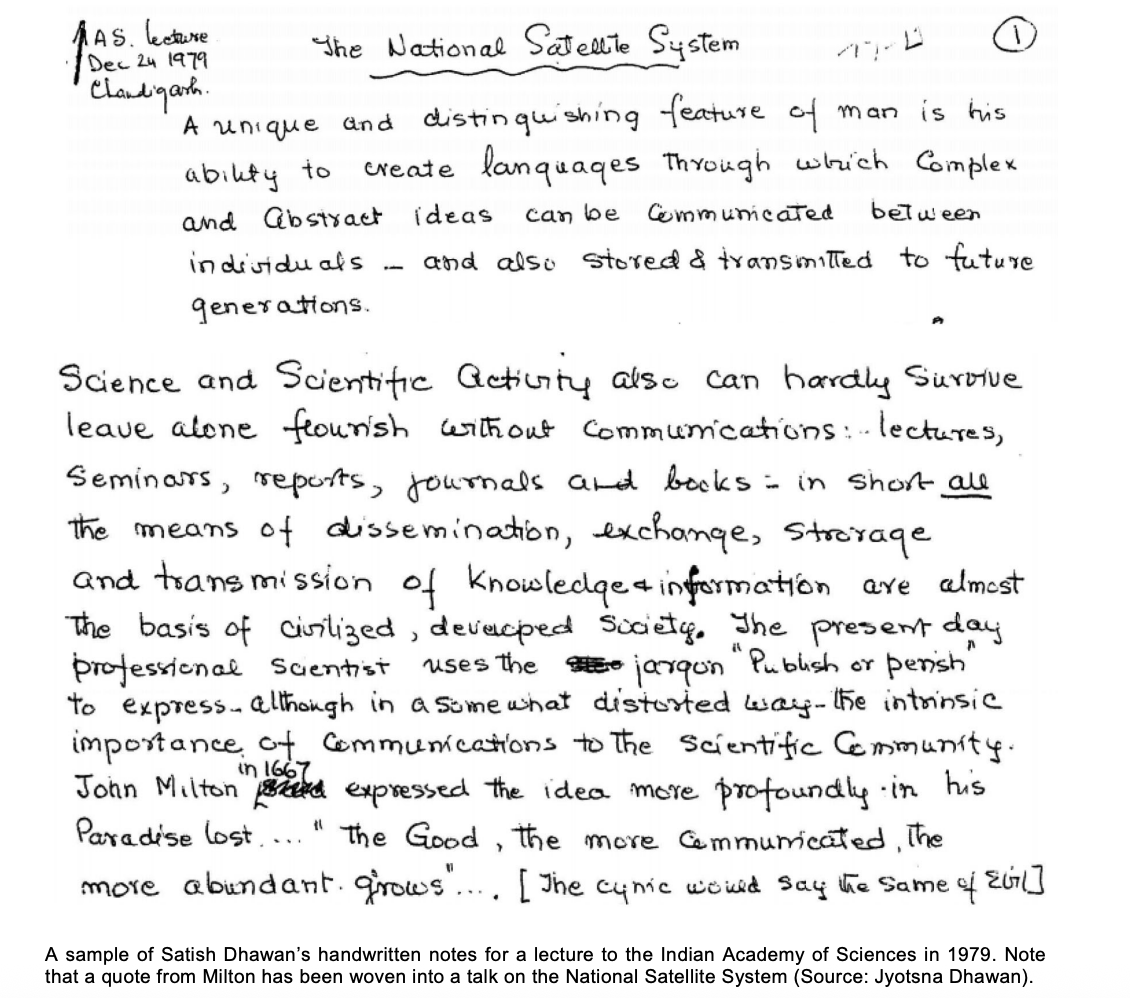
Below are a couple of historical documents related to Dhawan:

The first one is a lecture note from 1979, on making a case for a national satellite system and how it influences science and scientific activity (a copy of this note has been reproduced in a wonderful tribute to Satish Dhawan written by P. Balaram on his birth centenary2).
The next one is a beautiful perspective article written by Dhawan on ‘Bird Flight’ from an aerodynamics perspective3. It is a detailed overview of the dynamics of bird flight and shows Dhawan’s interest and ability to bridge two facets of science. It is a prototypical example of interdisciplinary research.

Finally, let me end the blog with a quote from P. Balaram on Satish Dhawan4:

“Dhawan mentored some remarkable students and built the discipline of aeronautical engineering at the Institute. He influenced aeronautical research and industry in India in a major way. He shepherded the Indian space programme following Vikram Sarabhai’s untimely death. He served the Indian scientific community in many ways. His stewardship transformed IISc. How then do we describe such a man? Dhawan studied English literature obtaining a Master’s degree in his youth. It may therefore be appropriate for me to borrow a 16th century description of Sir Thomas More:


‘[Sir Thomas] More is a man of an angel’s wit and
singular learning. I know not his fellow. For where is
the man of that gentleness, lowliness and affability?
And, as time requireth, a man of marvelous mirth and
pastimes, and sometime of as sad gravity. A man for
all seasons.’

Satish Dhawan was truly a man for all seasons.”

Happy Birthday to Prof. Satish Dhawan!

References:

  1. Current Science, in 2020, had a section of a volume dedicated to the birth centenary of Satish Dhawan, and has a foreword by his daughter and articles by many of his students and co-workers. https://www.jstor.org/stable/e27139029 ↩︎
  2. P. Balaram, “Satish Dhawan: The Transformation of the Indian Institute of Science, Bangalore,” Current Science 119, no. 9 (2020): 1427–32. This reference has many interesting references, including a handwritten obituary of CV Raman written by Dhawan https://www.jstor.org/stable/27139041. ↩︎
  3. S. Dhawan, “Bird Flight,” Sadhana 16, no. 4 (1991): 275–352, https://doi.org/10.1007/BF02745345. ↩︎
  4. P. Balaram, Current Science 119, no. 9 (2020), page 1432. https://www.jstor.org/stable/27139041. ↩︎

Talk at Kyoto University

Whereas Sunday was bright, sunny, and clear for outdoor activities, Monday started cloudy with a forecast of rain. I started from my living place to Kyoto University around 10 in the morning. I took the city bus, which shuttles people from the city centre to the university. Within half an hour, I was in a serene, green, and beautiful campus, typical of a Japanese university. Kyoto University has a rich blend of modern and ancient architecture, and I was not surprised to see a large maroon-coloured ark at the entrance of the university.

With Prof. Tetsuro, who hosted me at the Graduate School of Informatics at Kyoto University.

I met Tesuji Tetsuro upon arrival (our previous in-person meeting was in the 2023 Optics & Photonics Congress on optical manipulation at Yokohama). He had just arrived from his run (he is a regular marathon runner), and we had a brief chat. He had arranged an office for me to occupy for the day. We had a short discussion and thereafter went for lunch. Prof. Kazuo Aoki (Tetsuro’s erstwhile advisor at Kyoto University) accompanied us, and I was delighted to meet him. We had a delicious lunch at a small Italian restaurant.

Around 3 pm, we met at the seminar hall where I gave my talk titled Hot Brownian Dynamics Driven by Structured Light. One of the key points I emphasized in my talk was the relevance of structured light in driving Brownian dynamics of colloids. I spoke about various parts of the stochastic differential equation (see equation 1 below) that represent the dynamics of a colloidal system interacting with an external force.

A key element of my discussion was the generalized driving force on the right-hand side of the equation, where the conventional restoring force in an optical trap can be generalized to an external driving force due to structured light. This versatile force is a result of a large set of linear and angular momentum states of structured light. These states can drive soft matter, further resulting in unconventional assembly and dynamics. Furthermore, the generalized driving force can include not only the optical force but also the thermal and hydrodynamic effects initiated by optical illumination. The combination of these forces culminates in a resultant force, offering an unconventional driving mechanism to drive the structure, assembly, and dynamics of colloids and other kinds of soft matter systems, including droplets and fluids. I showed some of our experimental results related to the above-mentioned concepts with emphasis on rotational and orbital degrees of freedom. I also presented our recent results on synchronization in an optothermal trap.

We had a long discussion on how to measure fluid dynamic properties around such colloids, especially when there is an external perturbation force, such as a laser beam, which can itself influence the colloidal dynamics. Tetsuro also mentioned his protocols and certain simulation strategies utilized to study thermo-osmotic flows in such situations. I learned about interesting methods they have been developing to numerically simulate the interactions using differential temperatures. The strategy is interesting and deserves further attention by the community. He also showed his experimental setup and gave a tour of his laboratory facilities.

Overall, it was a long, thoughtful day with wonderful discussions on topics of common scientific interest. We ended with a delicious dinner at a Japanese izakaya, and I thank Tetsuro for his invitation and hospitality. Kyoto University has a wonderful atmosphere for research, and I hope to visit again.

Why write interesting papers ?

A lesson I keep learning from Daan Frenkel: write interesting research papers. Thanks to Arghya Dutta (on X), who brought the paper below to my notice. https://arxiv.org/abs/1211.4440

Sometimes, interesting, well-written papers can have a deeper impact. Even otherwise, it would add clarity.

Scholarship + interesting writing >>>> prestige of the journal.

Don’t worship journals.

A common question when I say so is: what about academic assessment for jobs and promotion?

My answer is that academia (still) values consistent, scholarly output in reasonable journals.

It is very hard to reject scholarship. Aim for this as it is under your control.

Why liquid state is amazing ?

One of the research questions I am interested in is how light interacts with the liquid state of matter?

A related question is how is it different from the interaction of light with a solid state?

Specifically, I am interested in understanding how optical forces can influence the structure of liquid matter and if one can control such interaction.

The liquid state of matter is ubiquitous but not as well understood as the solid or gaseous state of matter. This is because the nature of interaction in liquid is intermediate between the other two states, and the way molecules and atoms interact depends on parameters that include interaction in classical and quantum physics.

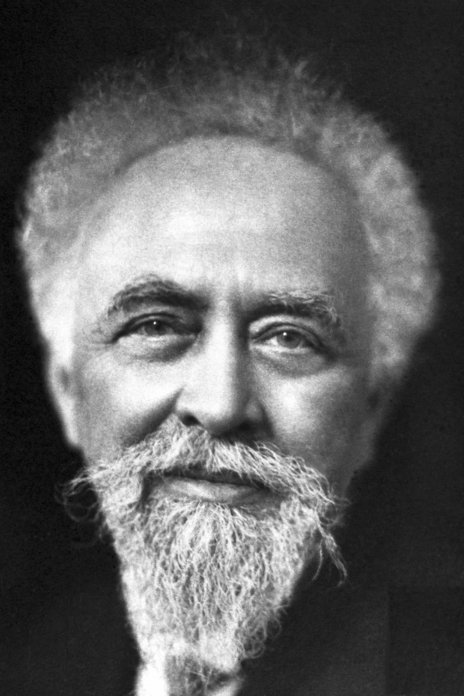
Jean Perrin – Image courtesy: Nobel Foundation archive.

A connected question to this problem is how liquid behaves under and out of equilibrium. This classification is again non-trivial as it depends on the spatio-temporal scales under which one is making an observation. An important aspect of the liquid state is the local and global fluctuations, which complicate the problem. Jean Perrin, in his 1926 Nobel lecture, alludes to this problem very succinctly.

There is still much to learn about the liquid state, and enormous progress has been made from experimental and theoretical viewpoints. But there are some fascinating ‘landscapes’ yet to be fully explored in this domain.

Sometime in the future, I will write more about how this is done and what the historical context is, especially from an optical force viewpoint.

On a related note :

Here is an illustration of the Brownian motion of gold nanoparticles..imaged using a dark field optical trapping microscope..this is a custom-built system in my lab. We study the effect of laser traps on Brownian dynamics..more on this later.

Leidenfrost effect in my kitchen

Jerel Walker of the fame of Halliday, Resnick ,Walker textbook fame has a superb article on this: https://www.reed.edu/physics/332/pdf/Leidenfrost.pdf

Wikipedia has a reasonable explanation: https://en.m.wikipedia.org/wiki/Leidenfrost_effect#:~:text=The%20Leidenfrost%20effect%20is%20a,the%20liquid%20from%20boiling%20rapidly.

Ocean, Okinawa and OIST…

I had a memorable visit to Okinawa Institute of Science and Technology – OIST (27th and 28th April 2023). Prof. Mahesh Bandi was my host, I had a fabulous time interacting with him and a few other groups. Below are some (of many) highlights.

First, the geography : located in the midst of the ocean(s), away from the mainland Japan, Okinawa is the southern most part of Japan. I took a 2.5 hrs. flight from Tokyo and reached the destination when it was dark.

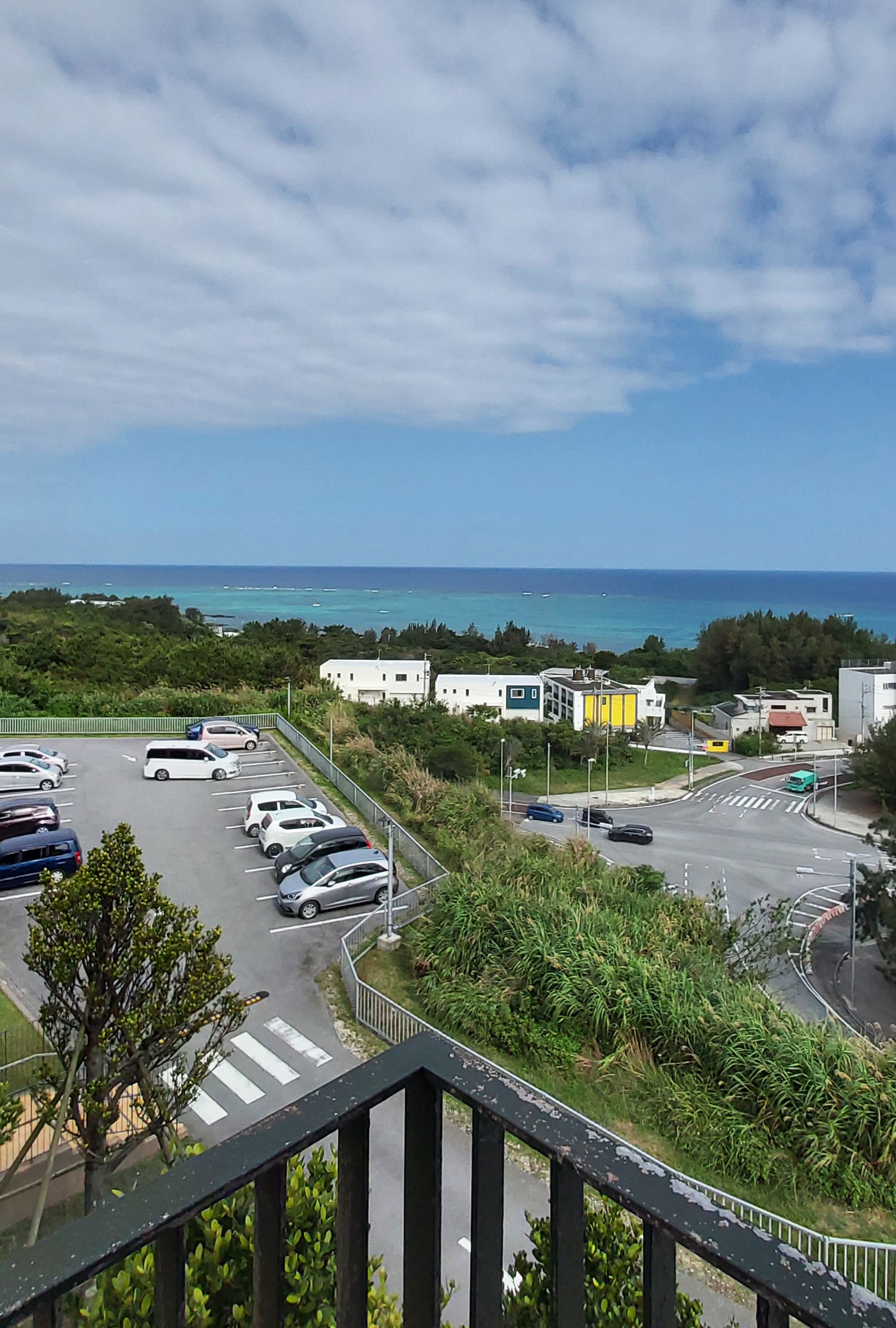
In the morning, I woke up and opened the window to be pleasantly surprised to see the beautiful ocean in my field of view. Below is a photo I took from the balcony of the room.

At the outset, I had a fabulous discussion. Mahesh and I had a excellent free-wheeling discussion on various topics including science, arts and history. Also, I visited his lab to see very creative experiments on non-equilibrium physics including some fascinating experimental designs to probe dynamics at liquid-air interface. He has a fabulous set of students working on interesting problems. It was both refreshing and stimulating.

with Mahesh Bandi

In the afternoon, I gave my seminar and below is an interesting announcement (because it spells out my full name :-)). I discussed about some non-equilibrium aspects of our work, and towards the end emphasized some interesting prospects of statistical optics in an optothermal-assembly.

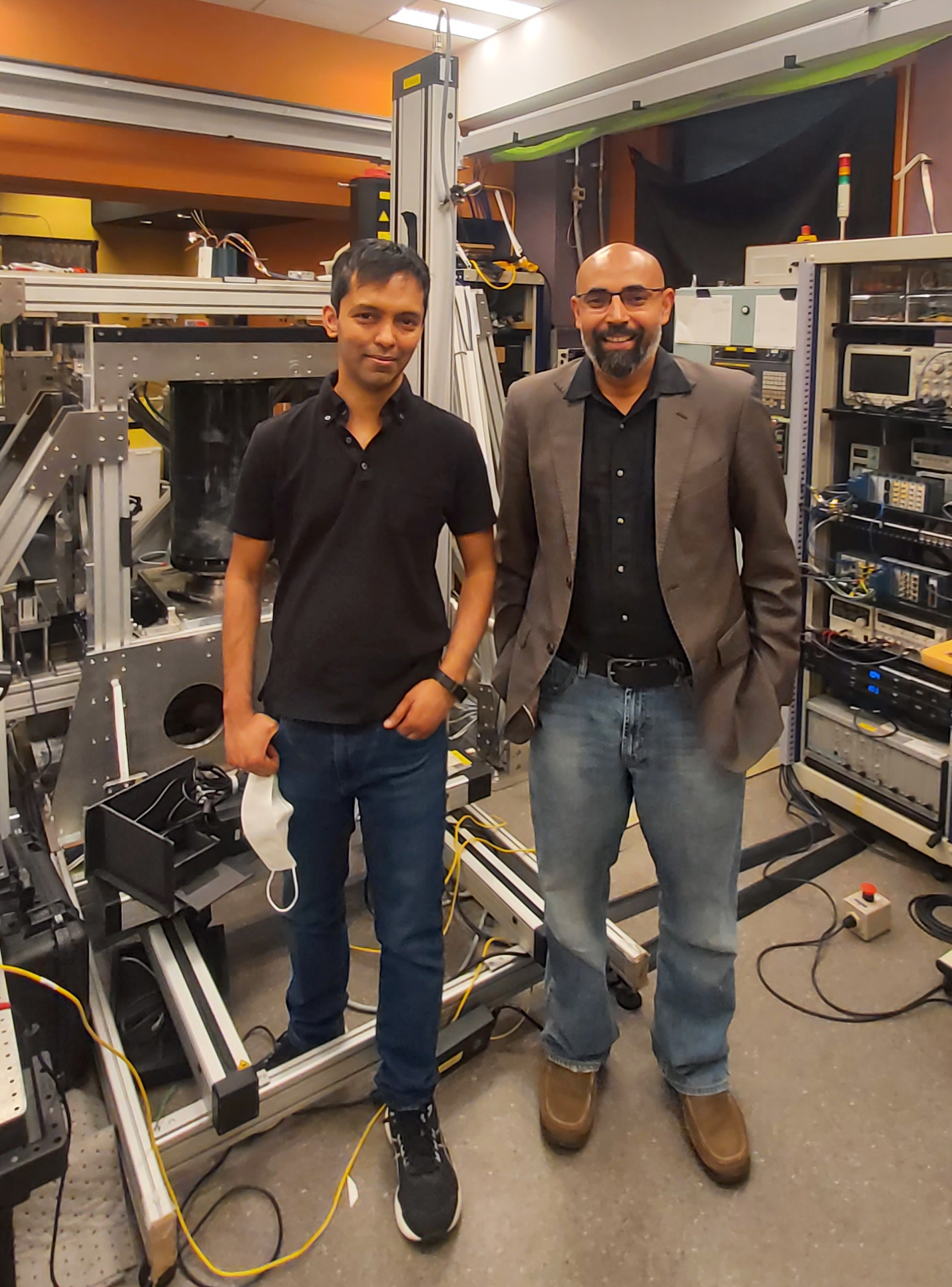
After my talk, I had illuminating discussion with Prof. Pinaki Chakraborty on thermal diffusion, fluid dynamics and history of science. I enjoyed visiting his lab, in which they have built one of the biggest Taylor-Couette flow set up I have ever seen (see the frame behind Pinaki in the picture below).

with Pinaki

Next day, I had an elaborate lab tour of Prof. Sile Nic Chormaic, who is an expert in various topics related to optics/photonics including optical trapping. As she was travelling, her post-doc Dr. Souvik Sil, hosted me and took me around to show various aspects of their lab. It was a great learning experience.

with Souvik

On the same day, I visited the cutting-edge lab of Prof. Keshav Dani. Since he was travelling, his team members gave me a brief tour and I was amazed by some of their experiments.

Another major highlight of my trip was to meet many IISER students. Specifically, I met Amit Bhunia (post-doc) and Saurav Raj (PhD student) who are IISER Pune alumnus. I also met many IISER Kolkata students (Souvik being one of them).

Overall, I was mighty impressed by the research infrastructure at OIST and the people working there. It is quite remarkable how they have been able to build such a great facility in such a short time (their campus started around 2010).

a corridor in OIST

Today, I have reached Osaka, and on Monday will be giving a talk and visiting a few groups at Osaka Unviersity. Prof. Hajime Ishihara is my host, and I look forward to plenty of interaction on optical manipulation.

Cup Noodles Museum – Food + Science + Technology + Inspiration

Here is the video blog on the Cup Noodles Museum at Yokohama. I visited this place recently, and was inspiring. Also, has some connections to history of science and scientists. Some notes/references at the end.

Notes & References :

CUPNOODLES MUSEUM YOKOHAMA (no date) CUPNOODLES MUSEUM YOKOHAMA. Available at: https://www.cupnoodles-museum.jp/en/yokohama/ (Accessed: 22 April 2023).

‘Hideki Yukawa’ (2023) Wikipedia. Available at: https://en.wikipedia.org/w/index.php?title=Hideki_Yukawa&oldid=1148467040 (Accessed: 22 April 2023).

‘Momofuku Ando’ (2023) Wikipedia. Available at: https://en.wikipedia.org/w/index.php?title=Momofuku_Ando&oldid=1143758937 (Accessed: 22 April 2023).

Space Noodles | Science and Education | Trends in Japan | Web Japan (no date). Available at: https://web-japan.org/trends01/article/020920sci_r.html (Accessed: 22 April 2023).

‘Cup Noodle’s Nissin develops space ramen, space curry rice for astronauts to eat among the stars’ (2020) SoraNews24 -Japan News-, 17 September. Available at: https://soranews24.com/2020/09/17/cup-noodles-nissin-develops-space-ramen-space-curry-rice-for-astronauts-to-eat-among-the-stars/ (Accessed: 22 April 2023).

The Nobel Prize in Physics 1949 (no date) NobelPrize.org. Available at: https://www.nobelprize.org/prizes/physics/1949/yukawa/biographical/ (Accessed: 22 April 2023).

Geo-fractal…somewhere over south India

I am always amazed to see fractal-like patterns….this one at a geographical scale…captured somewhere over south India..

I took the photo on my trip back to Pune from IIT Madras…

Thanks to IIT-M physics department for their invitation for colloquium…

Special thanks to Basudev Roy and Nirmala for hosting…. greatly enjoyed the discussion with many faculties and students..

In my talk, I mainly spoke on topics at the interface of statistical optics, Brownian motion and pattern formation..
Was delighted to see (and meet) Profs. Balki, Suresh Govindarajan Sunil Kumar Arnab Pal and many more in the audience.

The photo, retrospectively, captures the essence of the science discussed…

Soft Matter Optics – talk at ACS -India

About 2 years ago (22nd May 2020), when all the academic activities were online, I gave a talk on “Soft-Matter Optics: A Cabinet of Curiosities” organized by American Chemical Society as part of India Science Talks. Below is the embedded video of the online talk.

Link to ACS website can be found here.

In there, I give a broad overview of how interesting optical function can emerge from the complex world of soft matter. In addition to this, I have emphasized how optics can be harnessed to study structure and dynamics of soft-matter systems including colloids, liquid crystal and some biological matter. The target audience are new PhD students and anyone who is entering the field of light-soft matter interaction.

Hot Brownian Colloids – talk

On 19th Jan 2023, I gave a ~40 min talk on “Hot Brownian Colloids in Structured Optical Tweezers” in a very interesting conference on Frontiers in Non-Equilibrium Physics (FNEP) held at Institute of Mathematical Sciences, Chennai.

I mainly spoke about emergent Brownian dynamics of laser-heated colloids under optical confinement. Below is the link to the talk.

I concluded my talk quoting P W Anderson’s essay “More is Different

“The constructionist hypothesis breaks down when confronted with the twin difficulties of scale and complexity.  The behavior of large and complex aggregates of elementary particles, it turns out, is not to be understood in terms of a simple extrapolation of the properties of a few particles.

Instead, at each level of complexity entirely new properties appear, and the understanding of the new behaviors requires research which I think is as fundamental in its nature as any other.”

P.W. Anderson  ‘More is Different’
Science, 177, 4047 (1972)

More is not only different, but also wonderful !