15 years at IISER Pune – Journey so far

Today, I complete 15 years as a faculty member at IISER-Pune. I have attempted to put together a list of some lessons (based on my previous writings) that I have learnt so far. A disclaimer to note is that this list is by no means a comprehensive one, but a text of self-reflection from my viewpoint on Indian academia. Of course, I write this in my personal capacity. So here it is..

  1. People First, Infrastructure Next
    As an experimental physicist, people and infrastructure in the workplace are of paramount importance. When I am forced to prioritize between them, I have chosen people over infrastructure. I am extremely fortunate to have worked with, and continue to work with, excellent students, faculty colleagues, and administrative staff members. A good workplace is mainly defined by the people who occupy it. I do not neglect the role of infrastructure in academia, especially in a country like India, but people have a greater impact on academic life.
  2. Create Internal Standards
    In academia, there will always be evaluations and judgments on research, teaching, and beyond. Every academic ecosystem has its own standards, but they are generalized and not tailored to individuals. It was important for me to define what good work meant for myself. As long as internal standards are high and consistently met, external evaluation becomes secondary. This mindset frees the mind and allows for growth, without unnecessary comparisons.
  3. Compare with Yourself, Not Others
    The biggest stress in academic life often arises from comparison with peers. I’ve found peace and motivation in comparing my past with my present. Set internal benchmarks. Be skeptical of external metrics. Strive for a positive difference over time.
  4. Constancy and Moderation
    Intellectual work thrives not on intensity alone, but on constancy. Most research outcomes evolve over months and years. Constant effort with moderation keeps motivation high and the work enjoyable. Binge-working is tempting, but rarely effective for sustained intellectual output.
  5. Long-Term Work
    We often overestimate what we can do in a day or a week, and underestimate what we can do in a year. Sustained thought and work over time can build intellectual and technical monuments. Constancy is underrated.
  6. Self-Mentoring
    Much of the academic advice available is tailored for Western systems. Some of it is transferable to Indian contexts, but much of it is not. In such situations, I find it useful to mentor myself by learning from the lives and work of people who have done extraordinary science in India. I have been deeply inspired by many people, including M. Visvesvaraya, Ashoke Sen, R. Srinivasan, and Gagandeep Kang.
  7. Write Regularly—Writing Is Thinking
    Writing is a tool to think. Not just formal academic writing, but any articulation of thought, journals, blogs, drafts, clarifies and sharpens the mind. Many of my ideas have taken shape only after I started writing about them. Writing is part of the research process, not just a means of communicating its outcomes.
  8. Publication is an outcome, not a goal Publication is just one outcome of doing research. The act of doing the work itself is very important. It’s where the real intellectual engagement happens. Focus on the process, not just the destination.
  9. Importance of History and Philosophy of Physics
    Ever since my undergraduate days, I have been interested in the history and philosophy of science, especially physics. Although I never took a formal course, over time I have developed a deep appreciation for how historical and philosophical perspectives shape scientific understanding. They have helped me answer the fundamental question, “Why do I do what I do?” Reflecting on the evolution of ideas in physics—how they emerged, changed, and endured—has profoundly influenced both my teaching and research.
  10. Value of Curiosity-Driven Side Projects
    Some of the most fulfilling work I’ve done has emerged from side projects, not directly tied to funding deadlines or publication pressure, but driven by sheer curiosity. These projects, often small and exploratory, have helped me learn new tools, ask new questions, and sometimes even open up new directions in research. Curiosity, when protected from utilitarian pressures, can be deeply transformative.
  11. Professor as a Post-doc
    A strategy I found useful is to treat myself as a post-doc in my own lab. In India, retaining long-term post-docs is difficult. Hence, many hands-on skills and subtle knowledge are hard to transfer. During the lockdown, I was the only person in the lab for six months, doing experiments, rebuilding setups, and regaining technical depth. That experience was invaluable.
  12. Teaching as a Social Responsibility
    Scientific social responsibility is a buzzword, but for me, it finds its most meaningful expression in teaching. The impact of good teaching is often immeasurable and long-term. Watching students grow is among the most rewarding experiences in academia. Local, visible change matters.
  13. Teaching Informally Matters
    Teaching need not always be formal. Informal teaching, through conversations, mentoring, and public outreach, can be more effective and memorable. It is free of rigid expectations and evaluations. If possible, teach. And teach with joy. As Feynman showed us, it is a great way to learn.
  14. Foster Open Criticism
    In my group, anyone is free to critique my ideas, with reason. This open culture has been liberating and has helped me learn. It builds mutual respect and a more democratic intellectual space.
  15. Share Your Knowledge
    If possible, teach. Sharing knowledge is a fundamental part of academic life and enriches both the teacher and the learner. The joy of passing on what you know is priceless.
  16. Social Media: Effective If Used Properly
    Social media, if used responsibly, is a powerful tool, especially in India. It can bridge linguistic and geographical divides, connect scientists across the world, and communicate science to diverse audiences. For Indian scientists, it is a vital instrument of outreach and dialogue. My motivation to start the podcast was in this dialogue and self-reflection.
  17. Emphasis on Mental and Physical Health
    In my group, our foundational principle is clear: good health first, good work next. Mental and physical well-being are not optional; they are necessary conditions for a sustainable, meaningful academic life. There is no glory in research achieved at the cost of one’s health.
  18. Science, Sports, and Arts: A Trinity
    I enjoy outdoor sports like running, swimming, and cricket. Equally, I love music, poetry, and art from all cultures. This trinity of pursuits—science, sports, and the arts—makes us better human beings and enriches our intellectual and emotional lives. They complement and nourish each other.
  19. Build Compassion into Science
    None of this matters if the journey doesn’t make you a better human being. Be kind to students, collaborators, peers, and especially yourself. Scientific research, when done well, elevates both the individual and the collective. It has motivated me to humanize science.
  20. Academia Can Feed the Stomach, Brain, and Heart
    Academia, in its best form, can feed your stomach, brain and heart. Nurturing and enabling all three is the overarching goal of academics. And perhaps the goal of humanity.

My academic journey so far has given me plenty of reasons to love physics, India and humanity. Hopefully, it has made me a better human being.

Einstein – Science and its History & Philosophy

I have been interested in the views of Einstein related to the history and philosophy of science (HPS). The more I read about his work, the more I find that his inclination is to combine science with its historical and philosophical evolution. I am in search of his correspondence with fellow scientists and intellectuals, and have been looking at clues towards this combinational approach to science.

The above image is the title of the Physics Today article.

Recently, I came across an article in Physics Today1 that reproduced a part of Einstein’s letter2. Here it is:

I fully agree with you about the significance and educational value of methodology as well as history and philosophy of science. So many people today—and even professional scientists—seem to me like someone who has seen thousands of trees but has never seen a forest. A knowledge of the historic and philosophical background gives that kind of independence from prejudices of his generation from which most scientists are suffering. This independence created by philosophical insight is—in my opinion—the mark of distinction between a mere artisan or specialist and a real seeker after truth

It is clear that Einstein liked this combination and thought that it should be part of one’s scientific education. There is a lot more on this topic in the Physics Today article, and it is an excellent read to understand the thoughts of Einstein on this topic. More on this in a future blog…

  1. Howard, Don A. “Albert Einstein as a Philosopher of Science.” Physics Today 58, no. 12 (December 1, 2005): 34–40. https://doi.org/10.1063/1.2169442. ↩︎
  2. A. Einstein to R. A. Thornton, unpublished letter dated 7 December 1944
     (EA 6-574), Einstein Archive, Hebrew University, Jerusalem ↩︎

FOLLOW THE MONEY – A useful model

Our world is a place with complex ideas superimposed on people with ever-changing attention. Complex ideas are complex because they depend on multiple parameters. If something changes in the world, then that change can occur due to multiple reasons.

Unlike a carefully designed physics experiment, there are too many ‘hidden variables’ in human life and behavior, especially when they act collectively. In such a situation, it is pertinent to search for models to understand the complex world. Models, by definition, capture the essence of a problem and do not represent the complete system. They are like maps, zoomed out, but very useful if you know their limitations. I keep searching for mental models that will help me understand the complex world in which I live, interact, and comprehend.

Among many models, one of them that I use extensively is the follow-the-money model. This model explains some complex processes in a world where one does not have complete information about a problem. 

Take, for example, the incentives to choose a research project. This is a task that as scientists, we need to do very often. In the process of choosing a project to work on, researchers have to factor in the possibility of that research being funded prior to the start of the project. This is critical for scientific research that is dependent on infrastructure, such as experimental sciences, including physics, chemistry, and biology. Inherently, as researchers, we tend to pick a topic that is at the interface of personal interest, competence, relevance, and financial viability.

The viability is an important element because sustained funding plays a critical role in our ability to address all the contours of a research project. Thus, as scientists, we need to follow the money and ask ourselves how our research can be adapted to the financial incentives that a society creates. A case in point is research areas such as AI, where many people are aware of its potential and, hence, support from society and an opportunity to utilize the available incentive.

It is important for the public to be aware of this aspect of research where the financial incentive to execute a project plays a role in the choice of the project itself. The downstream of this incentive is the opportunity to employ more people. This means large funding projects and programs attract more researchers. More people in the research area generate more data, and more data, hopefully, will result in more knowledge in the chosen research area. This shows how financial incentives play a critical role in propelling a research area. In that sense, the ‘follow the money’ model has a direct correlation with more researchers flocking towards a research area.

The downside of this way of functioning is that it skews people towards certain areas of research at the cost of another research area which may not find financial support from the society. This is a topic that is generally not discussed in science classes, especially at the undergraduate and research level but I think we should discuss with students about this asymmetry as their futures are dependent on financial support that they can garner.

Broadening the scope further, the ‘follow the money’ model is useful to understand why a certain global trend rises or falls. A contemporary global upheaval is the situation of war in Ukraine and Gaza. At first sight, it looks like these wars are based on ideologies, but a closer look reveals that these wars cannot be fought without financial support. Such underpinning of the money running the war reveals patterns in geopolitics that are otherwise not easy to grasp.

Ideologies have the power to act as vehicles of human change, but these vehicles cannot be propelled without the metaphorical fuel – that is, money. The ‘follow-the-money’ model can show some implicit motivation and showcase how ideologies can be used as trojan horses to gain financial superiority either through captured resources or through showcasing the ability to capture that resource. Following money is also a very powerful and useful model for understanding many cultural, sociological and political evolution, even in a complex country like India and other South Asian countries. I leave it as an intellectual assignment for people who want to explore it 😊. You will be surprised how effective it can be in explaining many complex issues, provided we know the limitations of the model. 

As I mentioned earlier, a model is like a map. It is limited by resolution, the dimension and the viewpoint. But they are useful for navigating a complex world.

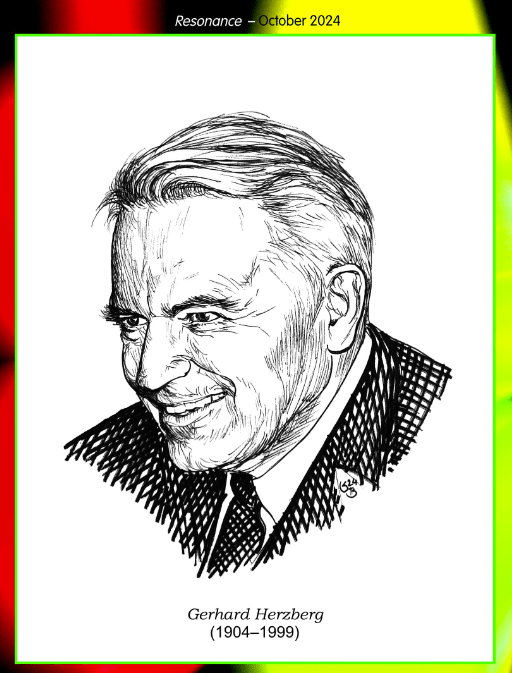
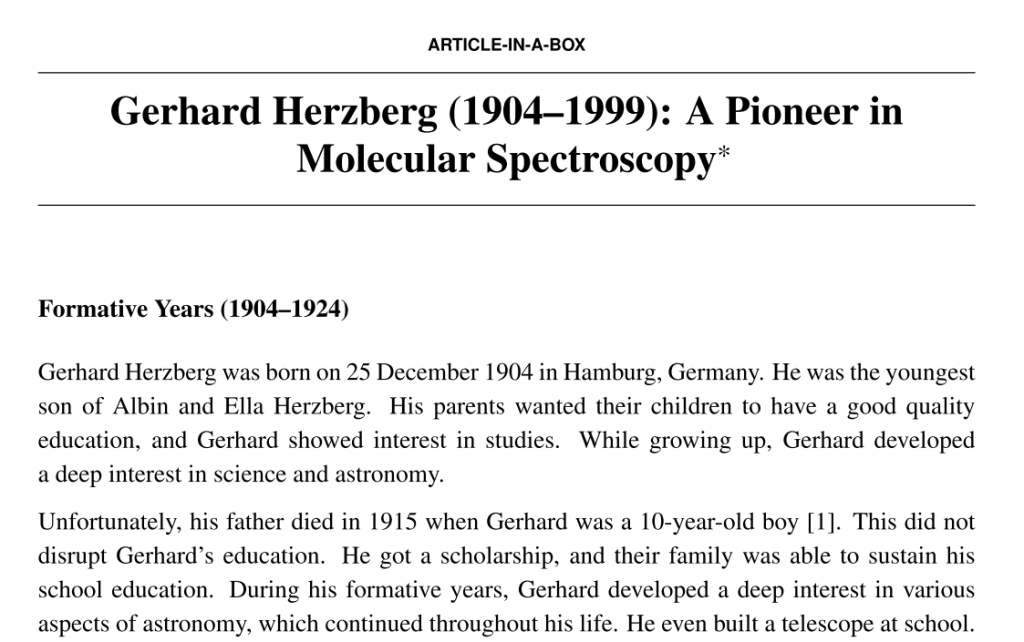
Article on Gerhard Herzberg

The October 2024 issue of Resonance, Journal of Science Education

highlights the life and science of Gerhard Herzberg.

He was one of the greatest molecular spectroscopists who laid the foundation of atomic and molecular quantum mechanics and deeply impacted molecular astrophysics and astrochemistry.

He lived an extraordinary life, first in Europe learning quantum mechanics and then escaping 1930s Germany as his wife was of Jewish origin. Then, he settled in Canada to build and lead his lab, which was considered the ‘mecca of spectroscopy’ at NRC, Ottowa.

I wrote a sci-biography article about him in this issue

Link to full edition: https://www.ias.ac.in/listing/articles/reso/029/10

If you don’t know – Resonance is a pedagogical journal published by the Indian Academy of Sciences. It is a true open-access journal. Free to read and does not charge the authors to publish.

Do explore the past editions. There are some absolute gems. https://www.ias.ac.in/listing/issues/reso

Academic Scientific Writing: A Case for Two Versions

Whenever one comes across an interesting debate in science communication, one will always find criticism about academic writing. Generally, it is considered opaque, jargon-filled and many times incomprehensible. So, when a person without a deep scientific background reads an academic paper or an academic book, they blame the writing and the writer for making it complicated.

I am the first person to admit that academic writing needs drastic improvement. But there is another point which I want to make in this essay. Being an academic: as a student, as a teacher, as a researcher and as an editor, I have read, heard, seen and discussed with so many academics who are very creative and have great clarity of thought. Over the past many years, I have seen outstanding science communicators who can express their thoughts and opinions in a comprehensible way, and this is always inspiring.

So, there is a disconnect between what people read, hear and see about academic scientific content and what academicians do to make themselves clear. So, this motivates two questions:  a) what academics can do to make sure that their writing and exposition are more comprehensible and cater to the public? b) how the public can consume academic scientific information? In this essay, I discuss these issues.

The Two Versions

One solution is to have two versions of their work at their disposal. The first version is for a specialized, scientific audience with whom they correspond as part of their research papers and academic books. In here, one uses rigorous analysis and sometimes unavoidable jargon to express precise thoughts and extract in-depth analysis. This is essential because if one is working at the forefront of knowledge, one must get to that point with minimum resistance and maximum efficiency. In the first version, the assumption is that the person reading the text has some basic scientific background and, with some effort, will be able to retrace all the assumptions made in the text. Again, I am not proposing the text to be complicated. But making a case for better communication at the forefront of knowledge. Writing a comprehensive yet academically rigorous argument is not easy. All of us, the academics, should strive to create a good text that can be understood with an in-depth reading.

Opening to Public

The second version is an explanation of the first version in plain language without the usage of jargon, acronyms and complicated equations. This also makes a strong case for bringing analogies where one can take the concepts that are abstract and convert them into everyday objects or relationships so that the public can comprehend the thought behind the abstraction.

The second version is not a very easy version to create because it needs a kind of translation of thought that is not straightforward and requires one to have a deeper understanding of the relationships within the abstraction. The advantageous fallout of the second version is that it forces an expert to think in such a way that they must really go into the core principles of their work and extract meaning. This means that the second version is helping the expert to understand things better, which is vital for their own sake.

Many times, when I have forced myself to create a second version of my primary work, I have ended up gaining more information and insight into my own abstract work, which I would have not obtained but for the initiation of the second version. Given that people are more interested in knowing what is happening in academic work and how it can be related to the public, there will always be interest among a large audience. So, this process of creating two versions is necessary nowadays. It also means that academics have a very nice way to make their work connected to a larger audience.

Public Consumption of Scientific Information

So, now I want to discuss about what the public can do when they come across academic work. First and the foremost aspect I want to emphasize is that research papers and academic books are not like reading novels. It needs engagement with the text, and generally, one will not come across a page-turner.  This means the general reader must spend more time on the assumptions and the questions discussed in the text. These texts are difficult to read in a single sitting. One will have to consult multiple sources and build the information which is presented in the text. This is how generally an academic text is written, and most of the time it is not compiled in one sitting. Therefore, one cannot expect a person to read academic text, especially if it is discussing some complex concepts in a single sitting. So, what I would suggest is whenever one comes across an academic work, please explore the work through a summary, if available. A summary of the abstract academic text is now becoming popular even among academic journals, and many of them publish a descriptive summary in a narrative style which is generally comprehensible to a broader audience. If the public finds the summary also to be complicated, the next best thing is to talk to a knowledgeable person who can explain things better. (Note: sometimes knowledgeable people may not explain things well. So be choosy)

The other important aspect is if you are interested in a scientific concept and you want to learn more, explore it in a gradual way – from a broader source to a specialized source. So, for example, if you want to learn something about climate change, do a cursory reading on Wikipedia about that concept and note down the primary references furnished. Listen to some podcasts and watch some YouTube videos related to that concept.

Thereafter, what is important is that you should extract good primary references from these platforms such as Wikipedia, podcasts and YouTube videos. This identification of primary sources and perhaps even a good book on this particular topic will help you to identify authentic information. This way of exploration gives you an advantage of first getting the big picture of the concept and then moving towards the specialized aspect that you are interested in. Therefore, this combination of the big picture and the narrow specialization will enrich your thoughts on that particular concept. So, what I would suggest you do is to explore tertiary and secondary sources such as Wikipedia articles, videos and podcasts to begin with, then extract good primary sources and secondary sources from that exploration, and then go deeper. All this depends on how deep you want to go into that topic.

Always remember that a Wikipedia article, a podcast or a video is a kind of a tertiary or a secondary source at its best. Most of the time, they are not the primary sources and therefore, it is always important to keep this in your mind when you are citing your sources in your discussion. To be more authentic, you will always have to go to the primary source and know the nuances of a particular concept from the original work.

Academic Thoughts with the Public in Mind

In conclusion, academic writing surely needs drastic change, especially in the way things are expressed in a journal or an academic book. Academics will also have to think about how to generate information that is not only applicable to a specialized audience but also to the public. Such information would be of very high value not only to the public but also to people in the peripheral research areas, and importantly it will add greater understanding to the expert who is generating this kind of information.

The public should also be a bit more patient to engage with the academic text and should explore the relevant information. This is getting easier, given that information is not at a premium nowadays. The availability of tertiary and secondary sources is abundant. How one makes use of that resource and how we connect those resources to primary data is both a craft and an art. It needs immersion with the sources.

At the end of the day, we need better communication between the specialized experts and the public. After all, academic thoughts should have a direct implication on thoughts of the society. We academics should also be cognisant about the vice versa.


Teaching and its impact

Recently I got this email from one of the students who took my optics course:


I don’t know what to say…I am humbled is only thing that comes to my mind..

Fyi: this student is deeply interested in theoretical high energy physics, and I had a great time interacting with him during my course..

Teaching is enriching.

Next day:


After I posted the email by the student, there has been a flood of messages from many other students (current+former) sharing their experience of our interaction. I want to thank them all🙏🏽 and reiterate some points :

1.I continue to learn through teaching.

2.Learning needs context. Historical viewpoint is one of the ways.

3.Teaching has positively impacted my research and writing.

4. Technology can positively aid classroom teaching, including teaching on the board. Strategically adapting audio-visuals can enhance discussion in the class.

5. A course is a starting point to learn something. Many a times, the actual learning happens long after a course is completed.

6. One of the greatest challenges in academia is to measure impact. In research or in teaching, it is not easy to quantify how our work can influence the society.

10 things I learnt from Chandrayan 3

On 23rd Aug 2023, ISRO made history by landing a spacecraft close to the south pole of the moon. For a long time in India, I have not seen such an enthusiasm for science and technology, and it was indeed heartening to experience this. In reference to the proceedings in recent times, below are some brief lessons I learnt :

  1. For space programs, strong foundations in computation coupled with deep understanding of computer-assisted hardware is vital. Traditionally, India had good strength in computational aspect, but this mission showcased its capability in computer-assisted hardware and manipulation. As expected, ISRO is leading the way, and it is important to emulate this software-hardware coherence in other sectors.
  2. Science and Technology need not be a zero-sum game. Collectively, they have a lot to offer to the Indian society. The mission shows how investing in scientific activities can positively influence a society. In an essence, collective scientific endeavors like Chandrayaan strengthens our democracy.
  3. ISRO’s ability to learn from past failure is commendable. It showcased how scientific experiments should be approached, and how missions should be accomplished.
  4. There was a significant proportion and contribution of women in Chandrayaan 3.
  5. A reasonable and sustained research-budget given to a dedicated set of people can, sometimes, achieve remarkable things. That should not be a reason to limit funding towards research. This should encourage our society to further support scientific research.
  6. Some parts of social media and online news portals played a better role in broadcasting and discussing the mission than Indian TV channels.
  7. Some news papers (I read Indian Express (in print) and non-paywalled parts of Hindu online) did a good job of explaining many scientific concepts.
  8. Global south has tremendous scientific potential. The Indian sub-continent must take up collective scientific endeavors to have a greater impact in the region. India can lead the way.
  9. Classical physics and Engineering Science is alive and kicking. There is still a lot to explore and understand nature at ‘macro’ scale. It also highlights the importance of strong foundations in science and mathematics.
  10. At the heart of all these things is human curiosity and rationality. Nurturing this curiosity and rationality is our collective responsibility. It not only offers transient joy, but also orients our collective action to make this world a better place. After all, it resonates with वसुधैव कुटुम्बकम (“The World Is One Family“).

Critical thinking in Indian STEM students