Bias for action…at what cost?

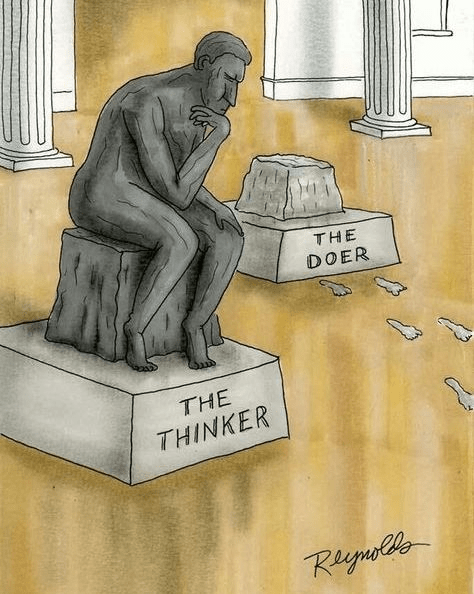
This image is a modern perception of ‘bias for action’ and is extensively used in advertisements. It frames thinking and doing as mutually exclusive tasks. In doing so, it takes a potshot at thinking as an activity.

Why is thinking not popular? Probably because taking time to think delays a decision. In commercial terms, it means the consumer does not ‘buy’ instantaneously, and hence affects the commerce.

But why not consider ‘doing’ as a good thing? Indeed, doing is important, and that is how the world moves. But the point here is to criticize ‘doing without thinking’. The world has many examples of this kind of ‘action without thinking’. The argument is that we can adapt as we go forward with the action. The problem with this approach is that it does not work without a reversibility clause. It works fine for actions that can have reversible consequences. If such a clause is absent, then you are forced to work on new problems that you are not prepared for.

Now go out and observe the world closely…

3 Thoughts on Scholarship in an AI-driven Age

One of the important issues to be addressed in recent (AI-driven) times is: how can research scholars acquire knowledge and simultaneously contribute to and communicate with society? Related to this question is: What is the role of scholarship in contemporary times?

Below are three thoughts that I wrote mainly with young researchers in mind. I am hoping that it may find use even among others.

1) Pursuit and utility of knowledge is the primary task of a scholar, and managing the perception of that knowledge is secondary. This means a scholar should use a majority of their time, resources and energy in enhancing scholarly knowledge, and in cases where there is utility, applying that knowledge in the outside ‘noisy’ world. This is your personal knowledge based on your efforts and experiences, and cannot be replaced instantaneously. This also brings uniqueness. Once you have this, you can venture into creating a realistic perception of your knowledge. Remember that learning and researching, to a large extent, are under your control; whereas how the outside world perceives your knowledge is not. Therefore, it would be prudent to pay more attention to learning and doing rather than creating a perception. Note that I am not saying that perception is unimportant. All I am saying is that perception is secondary in importance.

2) One of the key learnings in research and education is that the world is always open to good knowledge and ideas, be it in academia or industry. People are always interested in interacting with and hiring people with a sound knowledge base. It may take a while for somebody to discover your knowledge, but if you have a strong foundation and then go out to the world and interact with it, it is very difficult for the world to ignore you. This means that, having done good work, you should be able to share that work with the outside world. This can be a research paper or an engineering prototype, or any form of science, art or talent that you have. The crucial point here is to first do the hard work and then venture into the sharing of that work.

3) In your work, do not compromise on rigor. If you are a researcher, your first commitment should be towards addressing your scholarly peers or the specialized industry and then broadening your communication. Within scholarly communication, you will have to address questions within the research community. This means you will be basing your work on a large body of knowledge and subjecting yourself to internal and external criticism. This is where rigor comes in handy. Here, rigor does not mean unclear communication. It means to have thought through the questions, nuances and complications of a problem and have a broad and balanced view of the research problem. The general audience sometimes perceives rigorous scholarly communication as filled with jargon and complications. Therefore, it is always better to create two versions of your work: one for your peers and one for the general audience. In the age of AI, the second version is easier to create. Remember that your expertise will be vital in creating the second version for the general audience. That is where you can bring your authenticity and creativity. This can also broaden the scope of your knowledge without compromising your scholarship.

These are a few fleeting thoughts. You can criticize, edit, expand and adapt it to make your own version of it. After all, that is how knowledge moves forward 😊

AI hype..

A gentle reminder: Digital infrastructure is not equal to physical infrastructure.

The former is a smaller set of the four-dimensional space-time world we live in.

AI-based tech is fantastic for an upgrade in digital infrastructure and has already made tremendous progress. But the real deal is in the physical domain.

This also indicates where the future action is, and will be influenced by our understanding of physical sciences, including engineering domains beyond computer science.

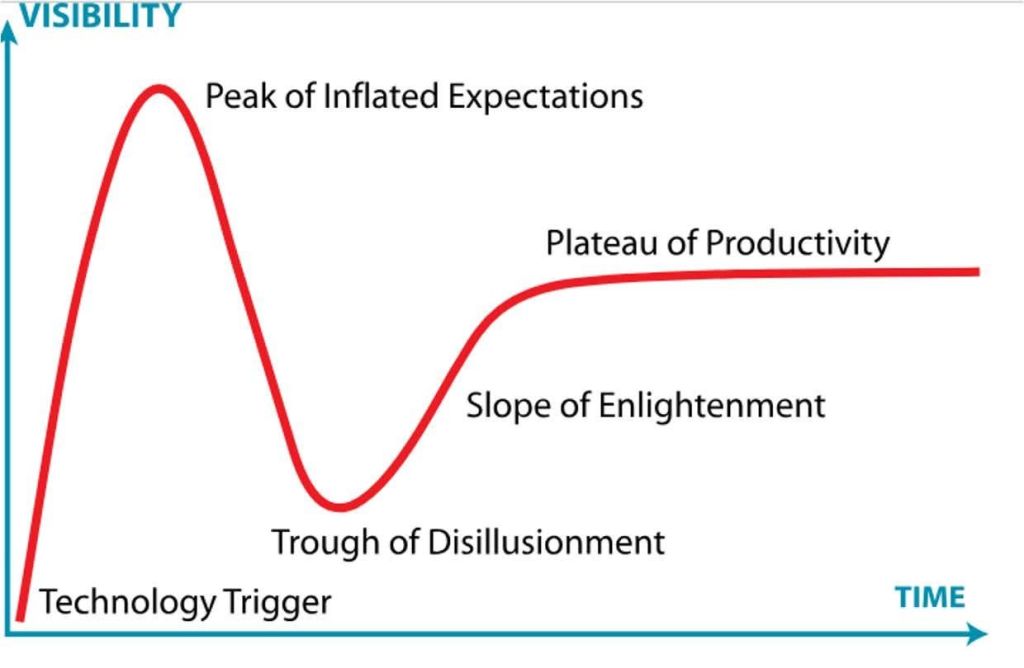
What we are witnessing in AI is probably the peak of Gartner’s hype cycle.

Five Aspects of the Fifth Pillar – A Philosophical Perspective

In reference to a recent article on higher education in the Economic Times, a well-known tech entrepreneur and philanthropist wrote the following on X/Twitter: “75% of Indian higher education institutions still not industry-ready. Lot of work left to transform. But the 21st century requires education, research, innovation, and startups as four pillars of a university.”

This is a thought I do support, but I think there is one more important meta-pillar, perhaps a ‘foundation’ on which all these pillars are standing, and that is called ethics. Below are five aspects of ethics that I think need further attention.

  1. If one observes some of the major contemporary and pressing problems in our world, they can be connected to the ethical aspects of how humans function. A vital part of our educational system should re-emphasize this connection and make it central to everything that is done in a society.
  2. Ethics has two important elements to it: first, it has a philosophical grounding and connects to how humans function in a society. Second, it has an important connection to how trust in a society can be developed. Most of the discussions on ethics generally focus on the first element from a morality perspective, whereas the second point has an equally important utility and an economic connection.
  3. Ethical principles have great utility. It is important that we never keep it as an implicit aspect of human endeavour. Instead, we should start everything on the ethical grounds and build it up from there, including businesses, because a strong ethical foundation probably would be the best thing to happen for economic progress in any society, because trust is so important among human beings, and it is one thing that probably brings humans together. In the long run, the meaning of ‘prosper’ critically depends on the meaning of ethics. Being prosperous without being ethical is detrimental to any human pursuit. Zero-sum games are exciting, but in the limit of many games, the number of people who lose will be far more than the people who win. Instead, cooperative games have much larger dividends to all players and are inherently connected to a concept called as double thank you moment.
  4. The philosophy of ethics is something which the world has to revisit in greater detail, especially in an era where technological implications are driving human life in directions which we have not anticipated. One may think that raising ethical issues might hinder progress, but my argument here is that, instead of hindrance, one should look at it as an important requisite for human societies to not only survive but also to flourish. Large human endeavours cannot sustain without trust, and that trust is reinforced through ethical behaviour.
  5. Without ethical implications being factored in, it would be hard to really design anything related to technology. A case in point is the social media restrictions in countries such as Australia. Technology has the amazing capability to move fast before the philosophical debates can come in, but it does not mean that philosophy has to be completely ignored. The downstream of a scientific idea can become a product in a market, and positively impact society, but this evolution has a fellow-traveller, and that is ethics. The feedback loop is incomplete without the ethical considerations, and therefore, it should be looked at as an important ingredient in any human design.

There is an inherent connection between cooperation and trust, and that is founded on an ethical principle. The world requires an ethical recap, and it should be part of individuals, institutions, and governments. There is a rich history of ethics in all the cultures across the world, and it is worth revisiting them in a new light. Perhaps it is high time that we “Make Ethics Great Again.”

How to Build Atomic LEGOs?

In ~8min, I try to explain how and why to build atomic Legos and their potential applications.

The video is for non-experts.

Reference for further reading:

Geim, A. K., and I. V. Grigorieva. ‘Van Der Waals Heterostructures’. Nature 499, no. 7459 (2013): 419–25. https://doi.org/10.1038/nature12385.

Physics Ideas for Entrepreneurs

Starting a new (ad)venture

A YouTube channel dedicated to discussing physics ideas for entrepreneurs

I bring ideas from an ocean of physics and present them to anyone interested in using them for business and entrepreneurship. These are not physics lectures, but discussions on ideas with a perspective of economic utility.

As with all my ventures, it is open source.

Join me in this journey, and please share and subscribe

The first video is out:

FOLLOW THE MONEY – A useful model

Our world is a place with complex ideas superimposed on people with ever-changing attention. Complex ideas are complex because they depend on multiple parameters. If something changes in the world, then that change can occur due to multiple reasons.

Unlike a carefully designed physics experiment, there are too many ‘hidden variables’ in human life and behavior, especially when they act collectively. In such a situation, it is pertinent to search for models to understand the complex world. Models, by definition, capture the essence of a problem and do not represent the complete system. They are like maps, zoomed out, but very useful if you know their limitations. I keep searching for mental models that will help me understand the complex world in which I live, interact, and comprehend.

Among many models, one of them that I use extensively is the follow-the-money model. This model explains some complex processes in a world where one does not have complete information about a problem. 

Take, for example, the incentives to choose a research project. This is a task that as scientists, we need to do very often. In the process of choosing a project to work on, researchers have to factor in the possibility of that research being funded prior to the start of the project. This is critical for scientific research that is dependent on infrastructure, such as experimental sciences, including physics, chemistry, and biology. Inherently, as researchers, we tend to pick a topic that is at the interface of personal interest, competence, relevance, and financial viability.

The viability is an important element because sustained funding plays a critical role in our ability to address all the contours of a research project. Thus, as scientists, we need to follow the money and ask ourselves how our research can be adapted to the financial incentives that a society creates. A case in point is research areas such as AI, where many people are aware of its potential and, hence, support from society and an opportunity to utilize the available incentive.

It is important for the public to be aware of this aspect of research where the financial incentive to execute a project plays a role in the choice of the project itself. The downstream of this incentive is the opportunity to employ more people. This means large funding projects and programs attract more researchers. More people in the research area generate more data, and more data, hopefully, will result in more knowledge in the chosen research area. This shows how financial incentives play a critical role in propelling a research area. In that sense, the ‘follow the money’ model has a direct correlation with more researchers flocking towards a research area.

The downside of this way of functioning is that it skews people towards certain areas of research at the cost of another research area which may not find financial support from the society. This is a topic that is generally not discussed in science classes, especially at the undergraduate and research level but I think we should discuss with students about this asymmetry as their futures are dependent on financial support that they can garner.

Broadening the scope further, the ‘follow the money’ model is useful to understand why a certain global trend rises or falls. A contemporary global upheaval is the situation of war in Ukraine and Gaza. At first sight, it looks like these wars are based on ideologies, but a closer look reveals that these wars cannot be fought without financial support. Such underpinning of the money running the war reveals patterns in geopolitics that are otherwise not easy to grasp.

Ideologies have the power to act as vehicles of human change, but these vehicles cannot be propelled without the metaphorical fuel – that is, money. The ‘follow-the-money’ model can show some implicit motivation and showcase how ideologies can be used as trojan horses to gain financial superiority either through captured resources or through showcasing the ability to capture that resource. Following money is also a very powerful and useful model for understanding many cultural, sociological and political evolution, even in a complex country like India and other South Asian countries. I leave it as an intellectual assignment for people who want to explore it 😊. You will be surprised how effective it can be in explaining many complex issues, provided we know the limitations of the model. 

As I mentioned earlier, a model is like a map. It is limited by resolution, the dimension and the viewpoint. But they are useful for navigating a complex world.