Polanyi’s quote

“…The example of great scientists is the light which guides all workers in science, but we must guard against being blinded by it. There has been too much talk about the flash of discovery and this has tended to obscure the fact that discoveries, however great, can only give effect to some intrinsic potentiality of the intellectual situation in which scientists find themselves…”

Michael Polanyi, in an essay titled  “My Time with X-Rays and Crystals” (1969)

More is Different – A Brief Overview

P.W. Anderson (image from wikipedia)

In 1972, P. W. Anderson wrote what is considered one of the most remarkable essays in the history of physics, and the title of that essay is “More is Different.” In the essay, Anderson was trying to make a case for emergence, where new, interesting physical properties can emerge by the combination of matter, which you would not anticipate if you had just kept it as an individual entity.

One of the aspects related to this essay is also the thought that reductionism has its limitations and that groups act very differently compared to individuals. The higher-level rules that can emerge from the combination of small entities are actually very different from the rules that are applicable to individual entities.

For example, if you consider electrons in a solid, you have the emergence of properties of electrons such as magnetism or superconductivity, or, for that matter, putting molecules inside a compartment and, lo and behold, life arises out of that. This has turned out to be one of the most influential ways of thinking in physics because it opened up a new avenue for understanding complex systems not as just combinations of simple systems but as the emergence of properties.

Very interestingly, this essay does not actually mention the word “emergence” at all, but the concept is so fascinating that it has turned out to be one of the most influential essays ever written in physics. The whole point about this particular essay is that the whole is more than the sum of its parts, and P. W. Anderson has to be remembered for this magnificent essay.

Physics Nobel 2024 – anywhere to everywhere

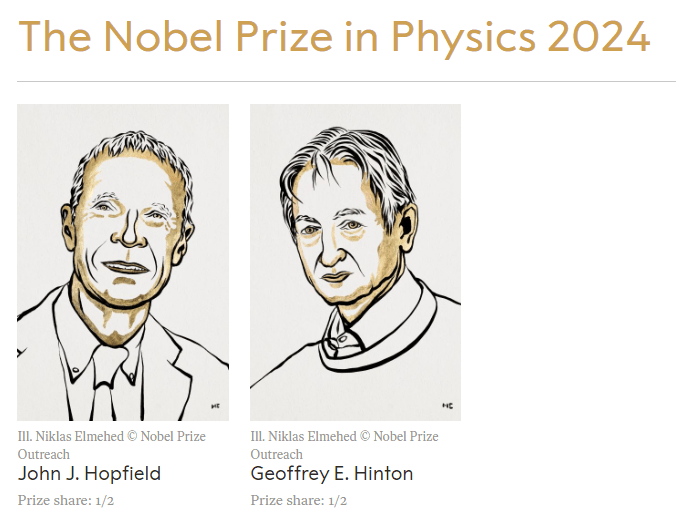
The Nobel Prize in Physics 2024 was awarded to John J. Hopfield and Geoffrey E. Hinton “for foundational discoveries and inventions that enable machine learning with artificial neural networks“. There has been much buzz surrounding this prize, especially in the context of whether these discoveries are indeed in the realm of mainstream physics. Many science commentators have questioned the choice and have provocatively dismissed it as ‘not part of mainstream physics’.

This has also brought into focus an important question: What is physics?

This question does not have a simple answer, given the rich history of the subject and its applicability over centuries. What we now call engineering is essentially an extrapolation of thinking in physics. New avenues have branched out from physics that cannot be readily identified as mainstream physics; a case in point is artificial intelligence and machine learning.

One of the aspects of mainstream physics is that the intellectual investment in the contemporary scenario is mainly driven by discoveries happening in the realm of quantum mechanics and general relativity. One of the mainstream problems in physics is to combine quantum mechanics and gravitation, which remains an unresolved task. Therefore, significant attention is paid to understanding these theories and verifying them through experimentation. Other areas and sub-disciplines in physics have become loosely connected to these two important theories.

There is another dimension to physics that is equally important and has vast applications: statistical physics. In statistical physics, the motivation comes from multi-particle systems and their applicability as models to understand our world, including biological systems. One utilizes knowledge from mathematics and statistics, combining them with physical laws to predict, invent and understand new forms and assemblies of matter. This thinking has been extrapolated to abstract assemblies and hence applied to a variety of situations. This approach has led to a revolution in how we can understand the realistic world because a statistical viewpoint is very useful for studying complex systems, such as many-body quantum mechanical aggregates (such as groups of electrons), dynamics of molecules inside a cell and the evolution of the stock market. Statistical physics plays a dominant role in all these situations. It has become a ubiquitous tool, making it difficult to directly connect it to basic principles of physics as taught in college textbooks and classrooms. It reminds me of a saying: if you are everywhere, then you are from nowhere.

This situation leads us back to the question: What is physics? John Hopfield himself offers an interesting definition related to this question, emphasizing that viewpoint is a crucial element. This perspective allows for greater freedom in using physics beyond conventional definitions. Among scientific disciplines, physics is always associated with its depth of understanding. This is a good opportunity to emphasize the breadth of physics, which is equally noteworthy.

In that light, the 2024 Nobel Prize in Physics should be welcomed as an expansion of the horizon of what constitutes physics. In a day and age where basic science has been questioned regarding its applicability to modern-day life and technology, this prize serves as a welcome change to showcase that basic science has played a fundamental role in establishing a contemporary tool of primary importance to society.

This point is particularly important because policymakers and politicians tend to focus on immediate issues and ask how they can influence them by using modern-day technology. Utility is central to this form of thinking. Given that basic sciences are often viewed as ‘not immediately useful’, this viewpoint diminishes the prominence of foundational disciplines: physics, chemistry, biology, and mathematics. In contrast, this prize reinforces the idea that building cutting-edge technology, which holds contemporary relevance and societal impact, has its roots in these foundational disciplines. In that sense, this prize is an important message because, like it or not, the Nobel Prize captures the attention not only of the scientific world but also of the public and, hence, of interest to politicians and policymakers.

Issac Asimov is attributed to have said: “There is a single light of science, and to brighten it anywhere is to brighten it everywhere.” The Nobel Prize in Physics 2024 fits that bill.

Physics is a point of view about the world

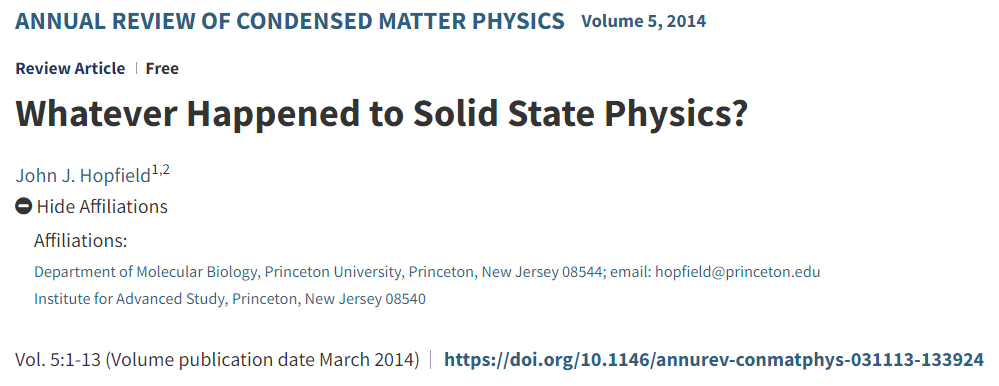
picture from : Hopfield, John J. “Whatever Happened to Solid State Physics?” Annual Review of Condensed Matter Physics 5, no. Volume 5, 2014 (March 10, 2014): 1–13. https://doi.org/10.1146/annurev-conmatphys-031113-133924.

The title of this blog is the closing line of an autobiographical essay written by John Hopfield (pictured above), one of the physics Nobel laureates today: “for foundational discoveries and inventions that enable machine learning with artificial neural networks.”

In this essay, he retraces his trajectory across various sub-disciplines of physics and how he eventually used his knowledge of physics to work on a problem in neurobiology that further connects to machine learning.

The title of the essay is provocative(see below) but worth reading to understand how physics has evolved over the years and its profound impact on various disciplines.

Reference: Hopfield, John J. “Whatever Happened to Solid State Physics?” Annual Review of Condensed Matter Physics 5, no. Volume 5, 2014 (March 10, 2014): 1–13. https://doi.org/10.1146/annurev-conmatphys-031113-133924.

Thanks to Gautam Menon for bringing the essay to my notice.

By the way, Hopfield and Deepak Dhar shared the 2022 Boltzmann medal, and after the award, he gave a wonderful online talk at IMSc, Chennai. Thanks to Arnab Pal of IMSc for bringing this to my notice on X.

Let me end this post quoting Hopfield from the mentioned essay:

What is physics? To me—growing up with a father and mother who were both physicists—physics was not subject matter. The atom, the troposphere, the nucleus, a piece of glass, the washing machine, my bicycle, the phonograph, a magnet—these were all incidentally the subject matter. The central idea was that the world is understandable, that you should be able to take anything apart, understand the relationships between its constituents, do experiments, and on that basis be able to develop a quantitative understanding of its behavior. Physics was a point of view that the world around us is, with effort, ingenuity, and adequate resources, understandable in a predictive and reasonably quantitative fashion. Being a physicist is a dedication to the quest for this kind of understanding.

Let that quest never die!

How confinement leads to emergence ?

New vlog post: I take, e.g. from the game of cricket (ft. Laxman, Dravid), soft matter physics, ants, Feynman’s seminar & a few other references to explain the emergence, self-organization and spontaneous order in our world

References:

“Second Test, 2000–01 Border–Gavaskar Trophy.” 2024. In Wikipedia. https://en.wikipedia.org/w/index.php?title=Second_Test,_2000%E2%80%9301_Border%E2%80%93Gavaskar_Trophy&oldid=1207694527.

Araújo, Nuno A. M., Liesbeth M. C. Janssen, Thomas Barois, Guido Boffetta, Itai Cohen, Alessandro Corbetta, Olivier Dauchot, et al. 2023. “Steering Self-Organisation through Confinement.” Soft Matter 19 (9): 1695–1704. https://doi.org/10.1039/D2SM01562E.

arxiv link : https://arxiv.org/abs/2204.10059

FeynmanChaser, dir. 2008. Feynman Chaser – Imagination in a Straitjacket. https://www.youtube.com/watch?v=IFBtlZfwEwM.

“Why Constraints Are Good for Innovation.” n.d. Accessed May 3, 2024. https://hbr.org/2019/11/why-constraints-are-good-for-innovation.

Tromp, Catrinel, and John Baer. 2022. “Creativity from Constraints: Theory and Applications to Education.” Thinking Skills and Creativity 46 (December): 101184. https://doi.org/10.1016/j.tsc.2022.101184.

Graviton modes in solids: Old Argentinian wine in new Bottle ?

Recently, there has been a buzz about a Nature paper titled Evidence for chiral graviton modes in fractional quantum Hall liquids. There has been some media reportage on the paper too.

The paper makes interesting claim on observation of ‘chiral graviton modes’ in certain ultra-cooled semiconductors (Gallium Arsenide – famously called GaAs). The cooled temperature is quite low (~50 mK), which is impressive, and the chirality of the mode is unveiled using polarization-resolved Raman scattering. The observation of this so-called ‘Graviton modes’ is essentially a quasiparticle excitation, and has created some buzz. In my opinion, graviton-like behavior is a bit of an exaggeration.

Anyway, this paper has set an interesting discussion among my colleagues (condensed matter and high energy physics) in our department. To add to their discussion, I wrote on 2 points (and an inference) from optics perspective, which I am sharing below :

  1. The measurement scheme used to unveil the chirality of the quasi-particles is a well-known trick in polarization optics. In fact, I teach it to our undergrads. Notice the use of quarter-wave plates (indicated by the arrow in the figure below). This is also the measurement at the heart of unveiling optical anisotropy. Experimentally, what is impressive is the ultra-low energy excitation captured via Raman scattering. This is again thanks to the excellent cooling of the sample (50 mK).
Figure from the Nature paper.

2. The last author of this paper, Aron Pinczuk, was a well-known expert in light scattering in solids. He was an Argentinian-American professor at Columbia University, and passed away in 2022.

Aron Pinczuk

He and the legendary Manuel Cardona were instrumental (pun intended) in laying the foundation for using inelastic light scattering methods in solids. The first edition of the series “Light Scattering in Solids”, written in 1976, has Pincuk discussing the very measurement scheme used in the paper (see picture).  

The first edition (1976) of a great series : Light Scattering in Solids

My initial inference on the paper : This is an old Argentinan wine of quasiparticles in a new GaAs bottle at ultra-low temperature….and NATURE is selling it as champagne de graviton made in China ! 

Two talks in Tokyo

Wonderful Japanese-Gothic architecture at The University of Tokyo

I gave two talks in Tokyo.

First was on 24th April at Department of Applied Physics, Faculty of Advanced Engineering, Tokyo University of Science. My host was Prof. Yutaka Sumino. I spoke about “Soft Matter in Opto-Thermal Gradients“. I gave a short introduction to opto-thermal perturbations and potentials, and discussed some of our work on opto-thermophoretic trapping and Brownian dynamics. The audience contained a few master students too, and I really enjoyed discussing some concepts related to Brownian motion in an optothermal trap, and related experiments. Also, I had a very interesting discussion with Sumino and his students on their experiments on Janus particles.

with Yutaka
with Yutaka”s group

The second talk was on 25th April at Department of Physics, University of Tokyo. My host was Prof. Kazumasa Takeuchi. I spoke about “Soft Matter in Opto-Thermal Gradients : Evolutionary Dynamics and Pattern Formation“.

This talk was also announced on Japan’s statphys mailing list, and also live-casted over zoom. I discussed about the origins of optothermal effects in a laser trap, and how it can lead to some interesting dynamics and pattern formation in soft-matter system. Specifically, I highlighted the concept of Hot Brownian motion, and how it can be influenced using thermo-plasmons. The talk and discussion went on for almost 2 hours, and I really loved it. Also, Takeuchi and his students gave an overview of their work including a live demonstration on turbulence in liquid crystals, and it was fantastic.

with Takeuchi
with Takeuchi’s group

Toys, Geim and Gupta

Recently I came across an editorial in Nature Physics, titled as Physics is our playground, which emphasized how playfulness has had an important role in some of the major inventions and discoveries in physics.

A particular example of this is the discovery of graphene, and how it has evolved into one of the most important topics in condensed matter science. Nowadays graphene is used as ‘Lego’ blocks to build higher order structures and the so-called ‘Van der Walls’ heterostructures are one of the most exciting applications of 2D materials. What started as a playful project in the lab has now turned out to be an important part of emerging technologies.

Two important inferences can be drawn from the playful attitude towards doing science :

First is that making modular elements and stacking them creatively can lead to emergence of new structures and function. Anyone who has used lego blocks can immediately relate to it.

Second is that toys are powerful research and teaching aids. Please note, that I emphasized research and teaching here. This is because toy-models are ubiquitous in research, and they help us create modular state of a problem in which unnecessary details are discarded and only the essential parts are retained. This way of thinking has been extremely powerful in science and technology (for example : see ball and stick models in chemistry and mega-construction models in civil engineering )

When it comes to toys and education, there is no better example than the remarkable Arvind Gupta (see his TED talk). His philosophy of using toys as thinking aids is very inspiring. Being in Pune, I have had a few opportunities to attend his talks and interact with him (as part of an event at science activity center at IISER-Pune), and I found his approach both refreshing and implementable. Importantly, it also showed me how creativity can emerge from constraints. To re-emphasize this, let me quote APS news article on Andre Geim :

“Geim has said that his predominant research strategy is to use whatever research facilities are available to him and try to do something new with the equipment at hand. He calls this his “Lego doctrine”: “You have all these different pieces and you have to build something based strictly on the pieces you’ve got.””

Now this is an effective research strategy for experiments in India !

Soft Matter Optics – talk at ACS -India

About 2 years ago (22nd May 2020), when all the academic activities were online, I gave a talk on “Soft-Matter Optics: A Cabinet of Curiosities” organized by American Chemical Society as part of India Science Talks. Below is the embedded video of the online talk.

Link to ACS website can be found here.

In there, I give a broad overview of how interesting optical function can emerge from the complex world of soft matter. In addition to this, I have emphasized how optics can be harnessed to study structure and dynamics of soft-matter systems including colloids, liquid crystal and some biological matter. The target audience are new PhD students and anyone who is entering the field of light-soft matter interaction.