Book alert – Science, Pseudoscience, and the Demarcation Problem

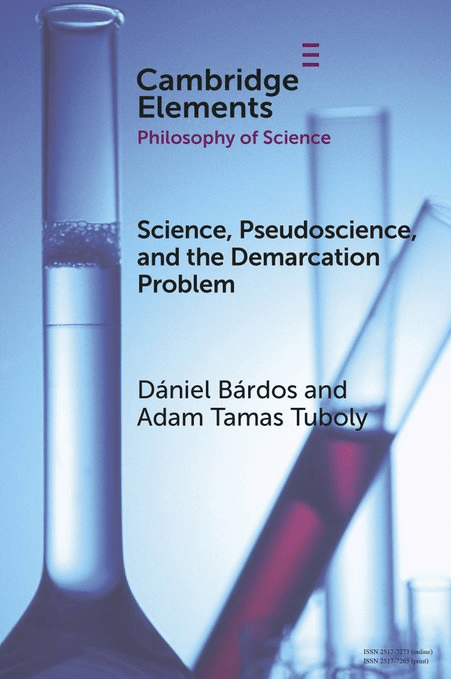
There is a new book (88 pages) on the philosophy of science that discusses the demarcation problem between science and pseudoscience. The topics look interesting, and have relevance in a day and age where science has been appropriated for various purposes, including spirituality.

One will have to ask how to differentiate science from something that may sound like science but, with further exploration, turns out to be a hoax?

This book tries to address this issue from a philosophical viewpoint.

The book is free to read for 2 weeks (starting 9th March 2025).

Gerhard Herzberg – scientific life


References:

Pavan Kumar, G. V. “Gerhard Herzberg (1904–1999): A Pioneer in Molecular Spectroscopy.” Resonance 29 (2024): 1339. https://www.ias.ac.in/describe/article/reso/029/10/1339-1345.

Stoicheff, Boris. Gerhard Herzberg: An Illustrious Life in Science. Ottawa : Montréal ; Ithaca N.Y.: Canadian Forest Service,Canada, 2002.

Stoicheff, Boris P. “Gerhard Herzberg PC CC. 25 December 1904 – 3 March 1999.” Biographical Memoirs of Fellows of the Royal Society 49 (December 2003): 179–95. https://doi.org/10.1098/rsbm.2003.0011.

Open access : a few thoughts and books

I think that knowledge, especially academic knowledge, should be openly accessible to fellow researchers and the public. Given that most of the academic research in India is public-funded, it is imperative that our work is made available for anyone interested in reading and utilizing the knowledge. This makes a strong case for making our work open to access. Unfortunately, the open-access publication venture has been hijacked by some commercial publishers, who have misused the enthusiasm of academic researchers by converting it into a money-making opportunity via so-called ‘gold’ open-access models, where authors pay exorbitant article processing charges (APCs) to publish their work in the journals.

I have been searching literature to understand the philosophy and economics of open-access publishing models, and recently, by chance, I came across a couple of books by Peter Suber.

First is an open-access book on Open Access. Peter Suber has been a philosopher & open-access advocate for a long time. In this book, he explains what it really means to have open access to knowledge & the related philosophy, including its economics. Link to the book.

Second is a collection of writings on open-access publication (link), and as the online blurb says :

Influential writings make the case for open access to research, explore its implications, and document the early struggles and successes of the open access movement.

The green open-access model is very interesting and pertinent to countries such as India, and as per wiki it is defined as :

Green OA, is the practice of placing a version of an author’s manuscript into a repository, making it freely accessible for the scientific community.

The primary motivation of Open Access was
to provide Open Access to Knowledge to the READER of Publications and; to allow Open Access to AUTHORS Publication (unbiased publication of Knowledge)

Open access in the true sense, should neither have barriers to knowledge consumption nor to knowledge generation and dissemination. Therefore, APCs are a major hurdle to researchers and authors who do not have monetary support. This is most of the global south, and hence, a fair policy is needed to make it more democratic.

Graviton modes in solids: Old Argentinian wine in new Bottle ?

Recently, there has been a buzz about a Nature paper titled Evidence for chiral graviton modes in fractional quantum Hall liquids. There has been some media reportage on the paper too.

The paper makes interesting claim on observation of ‘chiral graviton modes’ in certain ultra-cooled semiconductors (Gallium Arsenide – famously called GaAs). The cooled temperature is quite low (~50 mK), which is impressive, and the chirality of the mode is unveiled using polarization-resolved Raman scattering. The observation of this so-called ‘Graviton modes’ is essentially a quasiparticle excitation, and has created some buzz. In my opinion, graviton-like behavior is a bit of an exaggeration.

Anyway, this paper has set an interesting discussion among my colleagues (condensed matter and high energy physics) in our department. To add to their discussion, I wrote on 2 points (and an inference) from optics perspective, which I am sharing below :

  1. The measurement scheme used to unveil the chirality of the quasi-particles is a well-known trick in polarization optics. In fact, I teach it to our undergrads. Notice the use of quarter-wave plates (indicated by the arrow in the figure below). This is also the measurement at the heart of unveiling optical anisotropy. Experimentally, what is impressive is the ultra-low energy excitation captured via Raman scattering. This is again thanks to the excellent cooling of the sample (50 mK).
Figure from the Nature paper.

2. The last author of this paper, Aron Pinczuk, was a well-known expert in light scattering in solids. He was an Argentinian-American professor at Columbia University, and passed away in 2022.

Aron Pinczuk

He and the legendary Manuel Cardona were instrumental (pun intended) in laying the foundation for using inelastic light scattering methods in solids. The first edition of the series “Light Scattering in Solids”, written in 1976, has Pincuk discussing the very measurement scheme used in the paper (see picture).  

The first edition (1976) of a great series : Light Scattering in Solids

My initial inference on the paper : This is an old Argentinan wine of quasiparticles in a new GaAs bottle at ultra-low temperature….and NATURE is selling it as champagne de graviton made in China ! 

Asimov on lasers

Isaac Asimov is undoubtedly one of the greatest science fiction writer in English. He also wrote a lot of non-fiction science books that are interesting and accurate in their exposition. I recently came across an interesting book by him on lasers. Written around 1990s, this book discusses the origins of lasers and the basic physics and engineering aspects of lasers. True to his reputation, he weaves interesting history into the science, that makes an engaging read. Some grayscale (charcoal-kind) illustrations in the book are appealing, and makes it a smooth read.

The book also has a short discussion on applications of lasers, and eye surgery is one of them which is explained lucidly.

If you are not from a scientific background, or want to have a light read on lasers, then I would recommend this book. As usual, Asimov does not disappoint you !

Asimov was a biochemistry professor before he became a full time writer. His incliniation towards chemistry is evident when he discusses ‘chemical laser’. I reproduce a couple of paragraphs from his book:

This idea of the so called ‘chemical laser’ is still under exploration, and has not found its full potential. Perhaps there is an interesting research problem here for the interested.

Internet archives has a link to this book, but it is not complete. On the internet, you may find other links to this book.

What was surprising to me is that I found a Marathi translation of this book online. I don’t know how good is the translation, but I will urge you check it out if you know the language well.

Asimov was a unique person, as he blended science, storytelling and writing very efficiently. We need more of his kind in this world.