Raman essay and Open-Access

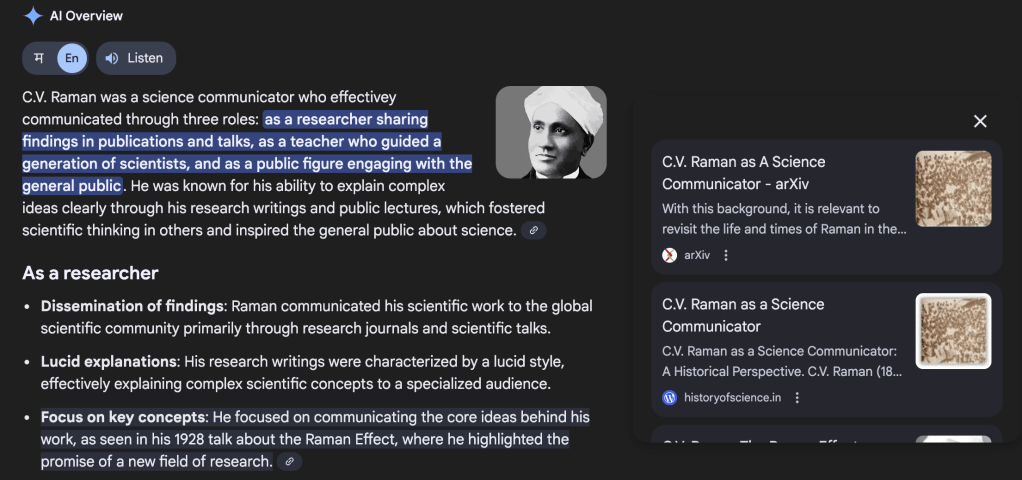
I see that the essay I wrote on CV Raman and made open access (thanks to Resonance, which published it) has been used by several educators on YouTube, including some in Indian languages. Also, the Google AI overview shows the published essay as the main reference for a search related to Raman’s science communication (see slideshow below).

I am glad to see that making one’s writing open to all has positive effects. Open-access, not just for readers, but also for authors, is beneficial. Especially in India, paywalls for science are a detriment.

My worry is that open-access publishing has been mainly driven by commercial publishers that extract huge funds from the publishing authors. This defeats the purpose of open science, especially when the research of an author is publicly funded. Added to that, Indian researchers and writers cannot afford to pay huge sums for publishing articles and books.

The publication landscape (including journals and books) across the world needs an introspection. Open-access model is effective only when the readers and authors have access to that model. Otherwise, the model becomes a paywall for authors.

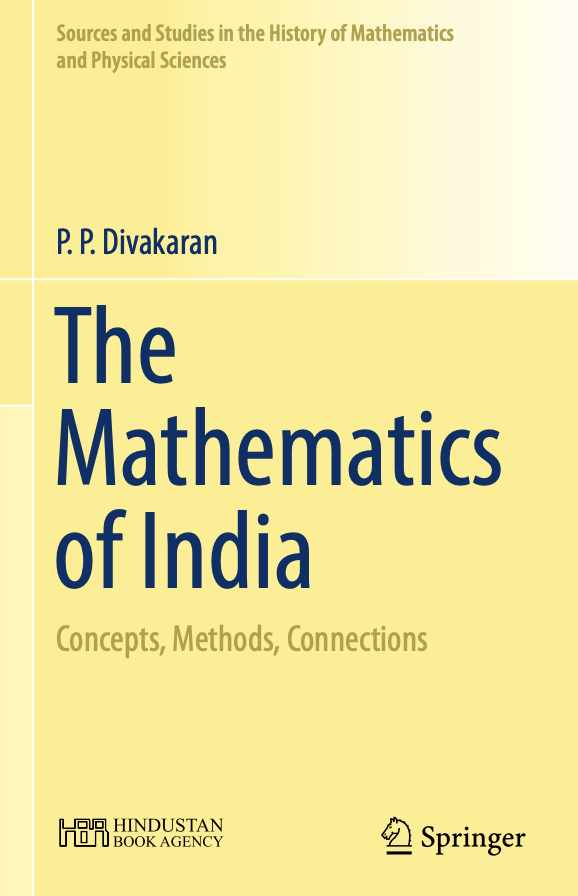
History of Maths in India – a good book

In recent years, this has been one of the best books on the history of mathematics in India. The late Prof. Divakaran was a theoretical physicist and a scholar.

This book is also an excellent example of how a scientist can present historical facts and analyse them with rigour and nuance. Particularly, it puts the Indian contribution in the global context and shows how ideas are exchanged across the geography. The writing is jargon-free and can be understood by anyone interested in mathematics.

Unfortunately, the cost of the book ranges from Rs 8800 to Rs 14,000 (depending on the version), which is a shame. Part of the reason why scholarly books, particularly in India, don’t get the traction is because of such high cost. This needs to change for the betterment and penetration of knowledge in a vast society such as India.

There is a nice video by numberphile on Prof. Divakaran and his book:

Meghnad Saha – lest we forget

Meghnad Saha (6 October 1893 – 16 February 1956), of the fame of Saha’s ionization formula, was born this day. In 1993, a postage stamp in India was released commemorating his birth centenary.

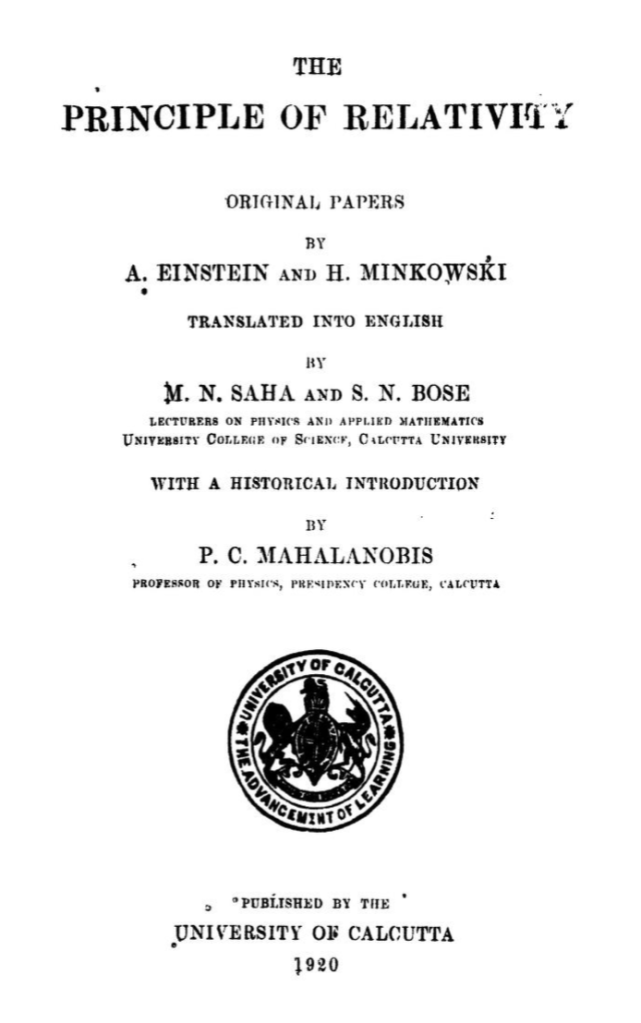
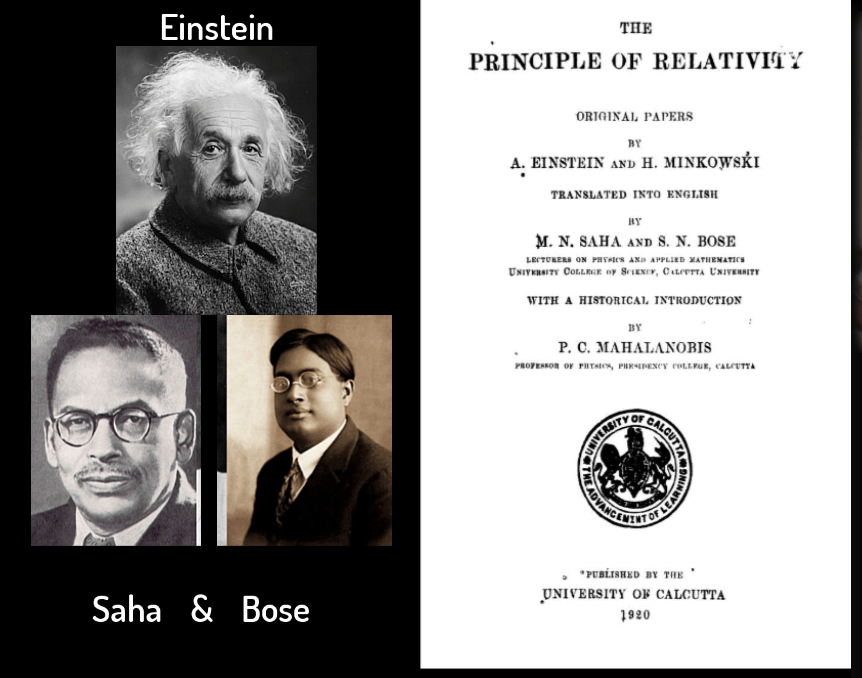
Saha was an astrophysicist with a broad knowledge and appreciation of various branches of physics. One of the earliest English translations (1920) of the papers on relativity by Einstein and Minkowski was written by Meghnad Saha and S.N.Bose.

At the beginning of the book, Mahalanobis introduces the topic with a historical introduction. He begins with a thoughtful discussion on experiments that eventually ruled out the presence of ether, and it sets the stage as follows:

Lord Kelvin writing in 1893 in hig preface to the English edition of Hertz’s Researches on Electric Waves, says many workers and many thinkers have helped to build up the nineteenth century school of plenum, one ether for light, heat, electricity, magnetism; and the German and English volumes containing Hertz’s electrical papers, given to the world in the last decade of the century, will be a permanent monument of the splendid consummation now realised.”

Ten years later, in 1905, we find Einstein declaring that “the ether will be proved to be superflous”. At first sight the revolution in scientific thought brought about in the course of a single decade appears to be almost too violent. A more careful even though a rapid review of the subject will, however, show how the Theory of Relativity gradually became a historical necessity.

Towards the beginning of the nineteenth century, the luminiferous ether came into prominence as a result of the brilliant successes of the wave theory in the hands of Young and Fresnel. In its stationary aspect, the elastic solid ether was the outcome of the search for a medium in which the light waves may “undulate.” This stationary ether, as shown by Young, also afforded a satisfactory explanation of astronomical aberration. But its very success gave rise to a host of new questions all bearing on the central problem of relative motion of ether and matter.

Saha, in various capacities, took a stance against British colonialism. Although it affected some opportunities, he continued to do science and was recognized for his outstanding contributions. As Rajesh Kochhar mentions:

Saha had wanted to join the government service, but was refused permission because of his pronounced anti-British stance. For the same reason, the British government would have liked The Royal Society to exclude Saha. It goes to the credit of the Society that it ignored the pressures and the hints, and elected him a fellow, in 1927. This recognition brought him an annual research grant of £300 from the Indian government followed by the Royal Society’s grant of £250 in 1929 (DeVorkin 1994, p. 164).

Saha led a tough life. He not only had to face suppressive British colonial rule but also academic politics and battles (versus Raman, no less). His knowledge of physics, his contributions to Indian science, and his commitment to people (he was a politician too) were significant. Let me end the blog with a few lines from Arnab Rai Choudhuri’s article, which nicely summarizes Saha’s work (specifically his ionization formula), and his scientific life:

Saha’s tale of extraordinary scientific achievements is simultaneously a tale of triumph and defeat, a tale both uplifting and tragic. Saha showed what a man coming from a humble background in an impoverished colony far from the active centres of science could achieve by the sheer intellectual power of his mind. But his inability to follow the trail which he himself had blazed makes it clear that there are limits to what even an exceptionally brilliant person could achieve in science under very adverse circumstances.

India and Indian science should remember Meghnad Saha.

Gandhi, Tagore and Celebration of Ideas

One of the books that I have enjoyed reading over the years is  The Mahatma and The Poet – Letters and Debates between Gandhi and Tagore 1915-1941’ compiled and edited by Sabyasachi Bhattacharya. The theme of the book is centered around the intellectual exchanges between M.K. Gandhi and Rabindranath Tagore on a variety of topics, including education, scientific outlook, philosophy and human dignity. Sabyasachi introduces the book with an overview of letters and debates and emphasizes that ‘The intellectual quality of the dialogue between Mahatma Gandhi and Rabindranath Tagore is such that it possesses an enduring interest. In these pages, I have tried to situate their debates, in private letters and in public statements, in the historical context of India’s national life and the cultural and political discourse of those times.’(page 20)

The book has a rich intellectual texture and showcases two minds that are open to ideas and not hesitant to express them. As Sabyasachi mentions that:‘…. the differences between them were real and at the same time they shared a common highground above the terrain of differences. Despite their differences on many crucial questions, they were willing to learn from each other.’(page 34) It shows what two engaging minds can reveal not only about themselves, but also about the place and time in which they live and operate. In there, we learn something that was a hallmark of Gandhi’s life: he was open to criticism and changed his mind in the light of evolving times and thoughts, as Sabyasachi indicates with an example:

‘Gandhi was equally open to candid criticism. It is possible that in some respects his outlook evolved, in response to the debates with Tagore. Consider, for instance, his: approach in Hind Swaraj: “I believe that the civilization India has evolved is not to be beaten in the world. Nothing can equal the seeds sown by our ancestors…. India remains immovable and that is her glory…. India has nothing to learn from anybody else and this is as it should be.” One can compare that with his later pronouncements, most notably his reply to Tagore in 1921, a truly memorable statement: “I do not want my house to be walled in all sides and my windows to be stuffed. I want the culture of all the lands to be blown about my house as freely as possible. But I refuse to be blown off my feet by any.’ (page 36)

A snapshot from the book: The Mahatma And The Poet.

Gandhi is many things to many people, some positive and some negative. For me, what stands out is his ability to utilize philosophical ideas such as ahimsa (non-violence) and satyagraha (pursuit of truth) for a political goal and effectively communicate it to a large population in that era. He may well have failed in this era, but he remains an excellent benchmark for human dignity across the world, even today. In that sense, he represents ‘the swadeshi’ in all of us and yet appeals to the whole world, just as Tagore does.

The book (freely available online) is a great read; it is a visit not only to the past, but also into the depths of two human minds, and perhaps into the depths of oneself. After all, ideas too need celebration.  

Sir MV on Education

In India, “National Engineers’ Day is celebrated every year on September 15 to honor the birth anniversary of Sir Mokshagundam Visvesvaraya, one of India’s greatest engineers”. Sir MV, as he was known, is one of the 20th-century Indians I admire. He was a forward-looking statesman who contributed immensely to building India (literally and figuratively). MV was a well-read and well-travelled person for his era, and wrote a few books and memos that are still pertinent to the current developments in India and the world.

Reconstructing India (1920)

One of his books, Reconstructing India (1920), reveals his thoughts on how and why India needs to reconstruct itself based on knowledge in science, technology and humanities. The title page is shown below, and the book is free to read online, thanks to the Internet Archive.

The book, as mentioned by MV in the preface, was written just after the First World War, and contemplates problems faced by India in light of geopolitical developments. In the 17 chapters of the book, divided into 4 parts, MV discusses specific issues faced by India, and proposes that political and administrative reforms can help India become a progressive society.

The largest part of the book is on economic reconstruction, in which he proposes contemporary methods (for the 1920s) to improve various sectors of manufacturing, including agricultural technology and communication media.

The third part of the book is on social reforms, and in there, he has a dedicated chapter on Education, which caught my attention, and I found it relevant even for today’s India.

Education, Humanities, and STEM

It is important that students of science and technology have a good exposure to some aspects of the humanities, including economics, history and philosophy. The pursuit and ability to choose good problems in science and technology critically depend on the social and economic structure in which they are practiced in universities and research institutions. MV anticipated this and highlights it as:

“Secondary and university education, though producing many able recruits for subordinate positions in the Civil Service, does not provide the men needed to carry on the work of agriculture, engineering, commerce and technology. The provision for training in economics and history is inadequate, and the study of those subjects is even discouraged. An attempt is actually made to teach economics in such a way as to render India’s emergence from a state of dependency difficult.”

Even in 2025, I would suggest that STEM students pay attention to economics, as it anchors them to understand the need and functions of a society, and therefore, their work can be calibrated accordingly. This is not to discourage open-ended research, but to understand how natural sciences are connected to the societal thoughts and needs. It gives us a broader understanding of the context, which is so important while understanding the evolution of ideas.

Comparative Education Systems

There is always a lot to learn from various societies and cultures. In order to do so, one needs comparative analysis. This helps one to choose some good elements from a society that can be emulated elsewhere. MV compares and comments on the 1900s British educational system in contrast to the German and Japanese counterparts. Note that India in the 1920s was still a British colony, and in a way, MV is critical of the system in which he himself was educated and trained. As he notes:

“Britain herself has had to pay a heavy price for her hand-to-mouth policy in regard to education. The educational chaos still existing there compares unfavourably with the great yet orderly progress made by Germany and Japan, both of which countries, after weighing and testing the educational systems of the world, absorbed the best of all.”

These were words written long before the Second World War, and give us a glimpse of how German and Japanese systems were functioning in the 1920s and had a lot to offer to the world. Of course, history took its own path, and German and Japanese society had other ideas.

Incidentally, I am writing this piece sitting in Leipzig (eastern Germany), and I am amazed by its architectural marvels that date back centuries. Indeed, German society had (and has) a lot to offer to the world. As MV indicates above, we need to absorb the best that is on offer. In doing so, we also need to reject that which is not good for any society.

Liberal Education and Financial Support

He further adds how liberal education adds value to a society, and calls not only the government but also the people to recognize the importance of financial support for education.

“Both the Government and the people must recognize that only by pursuing a liberal educational policy, and making generous financial provision for schools and colleges can they lift India out of her present low condition and ensure rapid progress.”

These words still hold good, and as a society, India has to re-emphasize modern education that helps us become not only better doctors and engineers, but also better human characters that can add value to the “modern” world.

Call to Action

In the final part of the book, MV makes a passionate appeal to the people of India, calling them to take action and move towards becoming a progressive nation:

“Do the people of India propose to profit by the lessons which world experience has to teach them, or will they be content to allow matters to drift and themselves grow weaker and poorer year by year?
This is the problem of the hour. They have to choose whether they will be educated or remain ignorant; whether they will come into closer touch with the outer world and become responsive to its influences, or remain secluded and indifferent; whether they will be organized or disunited, bold or timid, enterprising or passive ; an industrial or an agricultural nation ; rich or poor ; strong and respected, or weak and dominated by forward nations. The future is in their own hands.”

Indeed, the future is in our hands, and these words written more than 100 years ago still resonate loudly. We need more engineers like Sir MV. The reason he was so effective was that he combined thinking and doing. Importantly, the lesson we can learn from MV’s life and by reading this book, is that an open mind can grasp good ideas at any time and anywhere. Implementing those ideas is an equally important challenge, and MV was up to this in his own way. Are we, as Indians, open to this prospect and engineer our future?
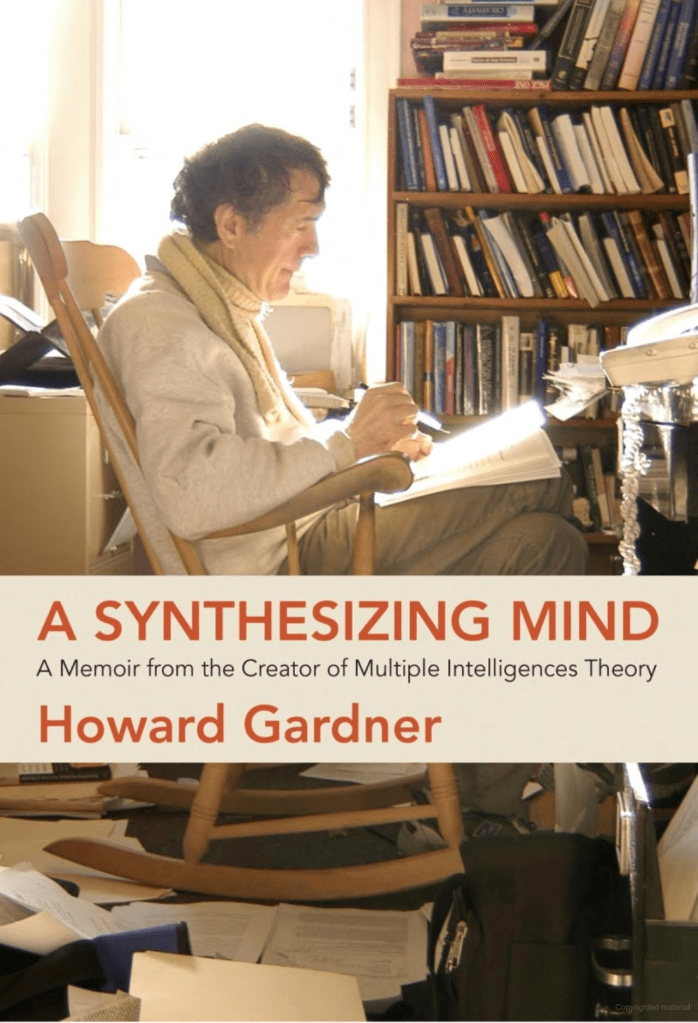
Gardner’s Synthesis

Once in a while, during my research, I come across writing by scholars from other disciplines that gives me a perspective that not only helps me to grasp the complexity of learning across disciplines, but also resonates with some thoughts on education.

Howard Gardner is one such academic who works on developmental psychology and has researched extensively on cognition and education. He has written ~30 books and ~1000 articles, and blogs regularly, even at the age of 82 or so. His recent book is titled A Synthesizing Mind.

Howard Gardner is a renowned Harvard academic and, as his book describes him as follows:

“Throughout his career, Gardner has focused on human minds in general, or on the minds of particular creators and leaders. Reflecting now on his own mind, he concludes that his is a ‘synthesizing mind’—with the ability to survey experiences and data across a wide range of disciplines and perspectives. The thinkers he most admires—including historian Richard Hofstadter, biologist Charles Darwin, and literary critic Edmund Wilson—are exemplary synthesizers. Gardner contends that the synthesizing mind is particularly valuable at this time and proposes ways to cultivate a possibly unique human capacity.”

While exploring the book and the related material, I came across an interview with Howard Gardner. In there, he is conversing about the theme of the book and discusses the synthesis of thought across disciplines. One of the pertinent aspects of learning is to know how innovation can be fostered by cross-disciplinary exploration without diluting disciplinary rigour. As Gardner says:

“I am not opposed to disciplinary learning—indeed I am an enthusiastic advocate. Any person would be a fool to try to create physics or psychology or political science from the start. But if we want to have scholars or professionals who are innovative, creative—and innovation is not something that we can afford to marginalize—then they cannot and should not be slaves of any single discipline or methodology.”

As a physicist, I can relate to this thinking within my discipline, and how innovative ideas, over the ages, have emerged by bringing ideas from mathematics, engineering and biology into physics. Particularly, the combination of biology, physics and mathematics is one of the most exciting frontiers of human exploration today, and Gardner’s words apply well in this scenario.

Going beyond science, I am always intrigued and amazed by artists (especially musicians) who can create art that simultaneously draws the attention of specialists and generalists. This is not a trivial achievement, and as a scientist, I am always trying to understand how artists resonate so well with the public. Gardner, in the abovementioned interview, frames this problem by looking at the goals of science and arts, and draws a contrast that is worth noting:

“Most scholars and observers like to emphasize the similarities between the arts and the sciences, and that is fine. But the goals of the two enterprises are different. Science seeks an accurate and well supported description of the world. The arts seek to capture and convey various aspects of experience; and they have no obligation other than to capture the interest and attention of those who participate in them.

Of course, there are some individuals who excel in both science and art (Leonardo is everyone’s favorite example). But most artists—great or not—would not know their way around a scientific laboratory. And most scientists—even if they like to play the violin or to draw caricatures or to dance the tango—would not make works of art or performances that would interest others.”

I partially agree with this assessment, as I know a few scientists who are deeply involved in various forms of art (including music) and do it very well, even at the professional level. In a way, Gardner is re-emphasizing the “two cultures” debate of C.P. Snow. My own thoughts on this viewpoint are ambivalent, as I see science, arts and sports as important pursuits that cater to different facets of the human mind. Of course, when it comes to expertise, the division may matter. There is a lot more to learn about the interface of art and science, at least for me.

Anyway, Gardner is a fabulous writer, and his blogs and books are worth reading (and studying) if one is seriously interested in understanding how to synthesize thought across disciplines.

Since we are discussing synthesis of thought, which is a kind of harmony, and coming together, let me end the blog with a line from Mankuthimmana Kagga by the Kannada poet-philosopher D.V. Gundappa:

ಎಲ್ಲರೊಳಗೊಂದಾಗು ಮಂಕುತಿಮ್ಮ” (Eladaralongodhagu manku thimma)

which loosely translates to: oh fool…be one among all (blend into world, living in harmony).

Harmony of disciplines and minds – how badly the world needs it today?

THE DIARY AND OBSERVATIONS OF THOMAS ALVA EDISON

Thomas Alva Edison was one of the greatest inventors we know about. Sometime ago, I stumbled upon a book titled THE DIARY AND OBSERVATIONS OF THOMAS ALVA EDISON, and it was an interesting read. In there, we obtain an insight into Edison’s view on many different subjects, including education, work, religion, etc. Edison was a person with strong views. His working methods were unconventional. Here are a few interesting facts I learnt from this book:

1) Edison had to recruit many executives to his labs; he always emphasized on a memory test and gave them a questionnaire to answer. He insisted that memory is very important for decision making, and he usually employed those people who had very good memory. Edison wrote “…Certainly the brain should have the facts. If a brain possesses an enormous number of facts, those facts, through action of the subconscious mind, will automatically keep themselves available when needed and will automatically keep themselves out of the way, not interfering when not required.”

2) Edison’s view on education was interesting and bold for his times, and he believed that learning through movies would be vital for future education. As early as the 1890s, he said that the best way to teach geography is either by taking the student on a tour or by showing them a movie. Edison wrote

…motion pictures can be applied to a scientific, systematic course of memory training in the schools, taking the children at an early age when the mind is plastic enough to adapt itself most readily to new habit of thought.

Most of our text books fail on two big counts. They are not sufficiently human, and their application is not sufficiently practical”

3) In the following lines, Edison gives an insight into how he worked: “When I want to discover something, I begin by reading up everything that has been done along that line in the past-that’s what all these books in the library are for. I see what has been accomplished at great labor and expense in the past. I gather the data of many thousands of experiments as a starting point, and then I make thousands more.”

“ …..The motive that I have for inventing is, I guess, like the motive of the billiard player, who always wants to do a little better-to add to his record. Under present conditions I use the reasonable profit which I derive from one invention to make experiments looking towards another invention…..”

4) Edison rates the phonograph as his greatest discovery. He writes, “Which do I consider my greatest invention ? Well, my reply to that would be that I like the phonograph best. Doubtless this is because I love music. And then it has brought so much joy into millions of homes all over this country, and , indeed, all over the world.”

5) The following quotation by Joshua Reynolds was hung in every room of Edison’s laboratory “ There is no expedient to which a man will not resort to avoid the real labor of thinking”

There are many more fascinating thoughts of Edison, many agreeable and a few disagreeable ones, in the above-mentioned book, and if you happen to find it, read it through…it’s a classic and insightful read.

The above text is from a 2011 post on my old blog.

Good books : Bohren & Huffman

Cover of ‘Absorption and Scattering of Light by Small Particles’ by Craig F. Bohren and Donald R. Huffman.

It is important to read good books. Astrophysics, quantum mechanics, and gravity (including attempts to combine them with quantum mechanics) have been at the forefront in terms of popular physics imagination. These are wonderful subtopics of physics, but there are a few others that need equal emphasis. So, here is my attempt to fill this gap with some book recommendations.

The first one in the optics community is just called ‘Bohren and Huffman’ and is one of the best technical books I have read and continue to read. It is humorous and filled with wonderful insights that still engage researchers and students alike.

Craig Bohren, a theoretical physicist, is a wonderful writer, and you will see more of his books discussed here.

The book introduces the scattering matrix from a ‘light scattering’ viewpoint, and has a direct connection to laboratory measurements.

Humour is one of the key aspects of this book (as with others from Bohren), and the title of chapter 8 gives a nice glimpse:
“A Potpourri of Particles”

There is a famous section in Chapter 11 with the heading – “Extinction = Absorption + Scattering” that wonderfully explains the physics behind it.

Overall, an outstanding book for understanding optics from an electromagnetics viewpoint and also to learn how electromagnetism is harnessed to understand interactions at the classical spatio-temporal scales.

Read this if you are interested in physics…It is a delight!


In audio-visual form:

He made physics more humane…

Today is Feynman’s birthday.

Part of my becoming a physicist is because of his books on lectures on physics.

Even today, as a professor of physics, and importantly as a student of physics, I go back to his lecture series to learn AND derive inspiration from his thinking. He made physics more humane.

Many people across the globe have fallen in love with physics because of his books and the ‘way he did physics’

Feynman was a physics genius, but he had his flaws. It is important for us to note the limitations of human beings; celebrate what is good, and be aware and critical of what is not.

There is a lesson in every human life.

It is up to us to learn from it.

Kyoto digital archives 01 – Yukawa’s book

Duff’s famous physics textbook from 1900 (5th edition) owned by Yukawa
Yukawa’s name on the book
Hideki Yukawa’s picture on the Nobel website

Apart from sipping the wonderful Japanese coffee and exploring the streets of Kyoto on foot, I have been looking into the archives of Kyoto University. I am mainly searching for records and books related to their physics department, and obviously, one of the names that pops out very often is Hideki Yukawa.

Yukawa was one of the Nobel laureates from this university. He obtained his Nobel Prize in Physics in 1949 for his prediction of the existence of mesons on the basis of theoretical work on nuclear forces. He is a big name in physics, and there is a physical potential named after him, which means one can understand the intellectual heft he carries as a physicist. Yukawa spent most of his scientific career at Kyoto, specifically at the Kyoto Imperial University (now, no more imperial :-) ), and is regarded as one of the inspirations for a battery of many excellent theoretical physicists to have emerged out of not only Kyoto but also Japan, and perhaps many parts of the world.
While looking through the archival records, I came across one of the textbooks owned by Yukawa, which has his signature on it. It made my day !

The textbook titled “A Text-Book of Physics,” edited by A. Wilmer Duff, is a classic. Yukawa had the 5th edition (1921), and this book went on to have 3 more editions. I hope to write more about this particular textbook because the author, Wilmer Duff, had a connection to Madras University (as a Professor) in India and was also on the faculty of my post-doc alma mater – Purdue University !

The scientific world is a small place with unanticipated, wonderful connections :-)