Stoicheff, Boris. Gerhard Herzberg: An Illustrious Life in Science. Ottawa : Montréal ; Ithaca N.Y.: Canadian Forest Service,Canada, 2002.
Stoicheff, Boris P. “Gerhard Herzberg PC CC. 25 December 1904 – 3 March 1999.” Biographical Memoirs of Fellows of the Royal Society 49 (December 2003): 179–95. https://doi.org/10.1098/rsbm.2003.0011.
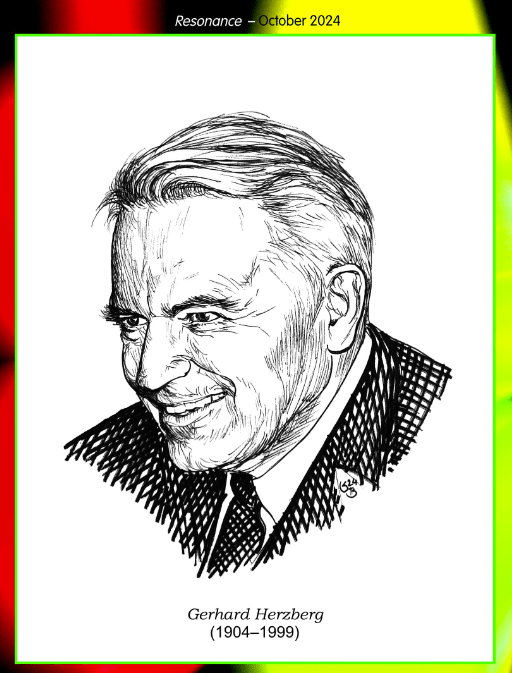
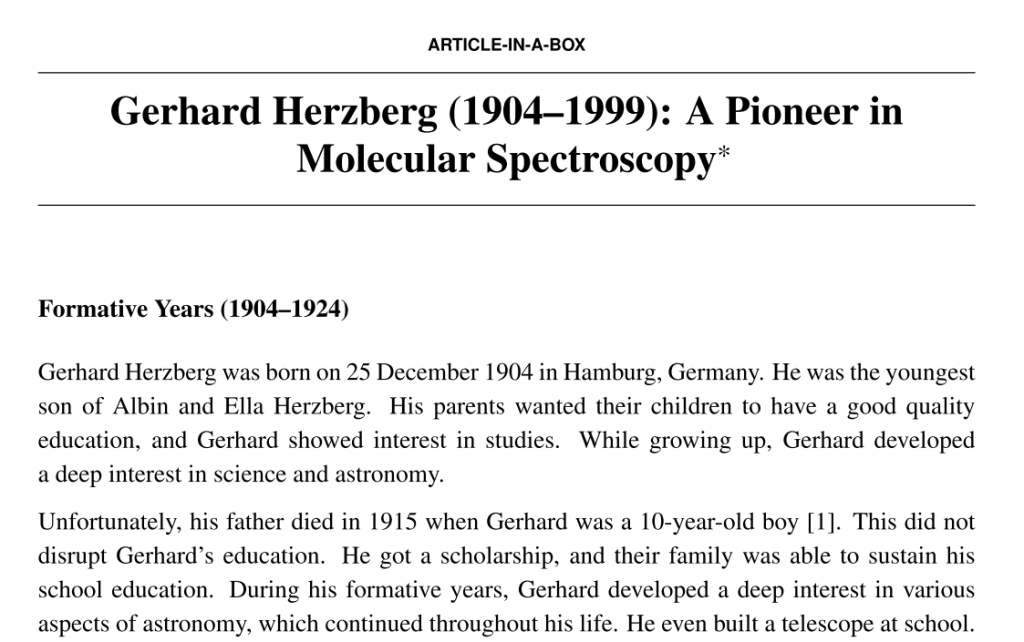
highlights the life and science of Gerhard Herzberg.
He was one of the greatest molecular spectroscopists who laid the foundation of atomic and molecular quantum mechanics and deeply impacted molecular astrophysics and astrochemistry.
He lived an extraordinary life, first in Europe learning quantum mechanics and then escaping 1930s Germany as his wife was of Jewish origin. Then, he settled in Canada to build and lead his lab, which was considered the ‘mecca of spectroscopy’ at NRC, Ottowa.
If you don’t know – Resonance is a pedagogical journal published by the Indian Academy of Sciences. It is a true open-access journal. Free to read and does not charge the authors to publish.
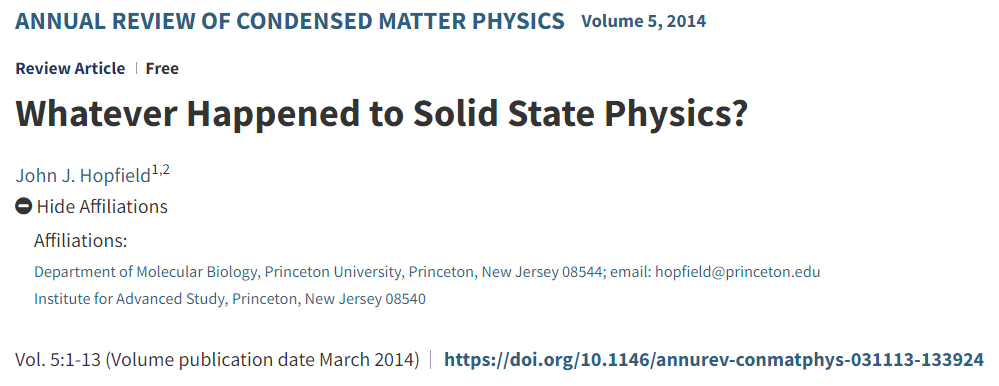
The title of this blog is the closing line of an autobiographical essay written by John Hopfield (pictured above), one of the physics Nobel laureates today: “for foundational discoveries and inventions that enable machine learning with artificial neural networks.”
In this essay, he retraces his trajectory across various sub-disciplines of physics and how he eventually used his knowledge of physics to work on a problem in neurobiology that further connects to machine learning.
The title of the essay is provocative(see below) but worth reading to understand how physics has evolved over the years and its profound impact on various disciplines.
Thanks to Gautam Menon for bringing the essay to my notice.
By the way, Hopfield and Deepak Dhar shared the 2022 Boltzmann medal, and after the award, he gave a wonderful online talk at IMSc, Chennai. Thanks to Arnab Pal of IMSc for bringing this to my notice on X.
Let me end this post quoting Hopfield from the mentioned essay:
What is physics? To me—growing up with a father and mother who were both physicists—physics was not subject matter. The atom, the troposphere, the nucleus, a piece of glass, the washing machine, my bicycle, the phonograph, a magnet—these were all incidentally the subject matter. The central idea was that the world is understandable, that you should be able to take anything apart, understand the relationships between its constituents, do experiments, and on that basis be able to develop a quantitative understanding of its behavior. Physics was a point of view that the world around us is, with effort, ingenuity, and adequate resources, understandable in a predictive and reasonably quantitative fashion. Being a physicist is a dedication to the quest for this kind of understanding.
(from G. Venkataraman, Journey into light: life and science of C.V. Raman. Indian Academy of Sciences in cooperation with Indian National Science Academy, 1988)
Walter Isaacson is a legendary biographer who has written great books on Einstein, Leonardo, Doudna, Jobs, Musk and many more. His work is remarkable because he blends depth and breath very efficiently. Recently, I came across an interview of his, and the below excerpt is worth reading :
HUMANITIES: For Einstein, you had to grapple with a large number of very technical subjects, and various language barriers, but still produced a generously sized and highly readable book about the most famous physicist of the twentieth century. How do you get so much work done, while also punching in at the office?
ISAACSON: I don’t watch TV. If you give up TV, it’s amazing how many hours there are between 7:00 p.m. and 1:00 a.m. in which you can do writing. More importantly, I work with a lot of people, Brian Greene, Murray Gell-Mann, people I knew who were tutoring me in physics.
When I tackled Einstein, I realized that science is totally beautiful. Nonscientists are often intimidated by it, but it’s not as hard when you can see the beauty in the tensor calculus that Einstein used for general relativity or the beauty in his thought experiments, which help him describe special relativity, gravity, and the curvature of the space-time fabric of the universe. Those are, to me, glorious, beautiful things. An outsider might think, Oh, that’s science and math. Isn’t that difficult? No, science and math can be really beautiful, especially if you have good people helping you learn it.




 VISMAYA - History & Philosophy of Physics