Five Aspects of the Fifth Pillar – A Philosophical Perspective

In reference to a recent article on higher education in the Economic Times, a well-known tech entrepreneur and philanthropist wrote the following on X/Twitter: “75% of Indian higher education institutions still not industry-ready. Lot of work left to transform. But the 21st century requires education, research, innovation, and startups as four pillars of a university.”

This is a thought I do support, but I think there is one more important meta-pillar, perhaps a ‘foundation’ on which all these pillars are standing, and that is called ethics. Below are five aspects of ethics that I think need further attention.

  1. If one observes some of the major contemporary and pressing problems in our world, they can be connected to the ethical aspects of how humans function. A vital part of our educational system should re-emphasize this connection and make it central to everything that is done in a society.
  2. Ethics has two important elements to it: first, it has a philosophical grounding and connects to how humans function in a society. Second, it has an important connection to how trust in a society can be developed. Most of the discussions on ethics generally focus on the first element from a morality perspective, whereas the second point has an equally important utility and an economic connection.
  3. Ethical principles have great utility. It is important that we never keep it as an implicit aspect of human endeavour. Instead, we should start everything on the ethical grounds and build it up from there, including businesses, because a strong ethical foundation probably would be the best thing to happen for economic progress in any society, because trust is so important among human beings, and it is one thing that probably brings humans together. In the long run, the meaning of ‘prosper’ critically depends on the meaning of ethics. Being prosperous without being ethical is detrimental to any human pursuit. Zero-sum games are exciting, but in the limit of many games, the number of people who lose will be far more than the people who win. Instead, cooperative games have much larger dividends to all players and are inherently connected to a concept called as double thank you moment.
  4. The philosophy of ethics is something which the world has to revisit in greater detail, especially in an era where technological implications are driving human life in directions which we have not anticipated. One may think that raising ethical issues might hinder progress, but my argument here is that, instead of hindrance, one should look at it as an important requisite for human societies to not only survive but also to flourish. Large human endeavours cannot sustain without trust, and that trust is reinforced through ethical behaviour.
  5. Without ethical implications being factored in, it would be hard to really design anything related to technology. A case in point is the social media restrictions in countries such as Australia. Technology has the amazing capability to move fast before the philosophical debates can come in, but it does not mean that philosophy has to be completely ignored. The downstream of a scientific idea can become a product in a market, and positively impact society, but this evolution has a fellow-traveller, and that is ethics. The feedback loop is incomplete without the ethical considerations, and therefore, it should be looked at as an important ingredient in any human design.

There is an inherent connection between cooperation and trust, and that is founded on an ethical principle. The world requires an ethical recap, and it should be part of individuals, institutions, and governments. There is a rich history of ethics in all the cultures across the world, and it is worth revisiting them in a new light. Perhaps it is high time that we “Make Ethics Great Again.”

ShuX in IISER Pune

Yesterday evening (10th Jan 2026), Shubhanshu Shukla, the recent Indian astronaut, was at IISER Pune as part of the ‘India Science Festival’. There was a huge crowd gathered to see and listen to him. Within IISER, it is rare to see such a massive gathering for a science event, and it was heartening to witness this on a Saturday evening. Thanks to schools and colleges in Pune, science and science-related activities get traction from the people of Pune (especially younger people). They enthusiastically participate in many events related to science.

 Such a gathering is very important for at least three reasons:

  1. It connects a scientifically oriented person to the public and thereby connects them to science.
  2. It showcases that there is some science-related activity happening within the Indian scene.
  3. It sends out a message to people that icons can be created out of people who do science funded by the public.

I would want to emphasize four other points:

  1. Scientific icons are as good as the science they represent. A major part of the credit should go to the organizations that supported and trained him, and this includes ISRO, NASA and the Indian Air Force.
  2. To put an astronaut in space, it takes a lot of effort at various levels of society. Public support is vital for such an effort. Public icons such as Shubhanshu Shukla are a good representation of what investment in science can do to the morale of the public, especially for young people.
  3. The created momentum should not be lost, given that recognizable people, such as astronaut Shubhanshu Shukla, have made an imprint on young people. This should be followed up with measures to recruit them for science and technology.
  4. Space science and technology, astronomy and astrophysics have always been among the most fascinating domains to attract people into science. Many Indian scientists and a past astronaut, Rakesh Sharma, have played an important role in this pursuit. One should not forget them.

Let me conclude with a word of appreciation for Pune city. It is not a capital city, but its enthusiasm for intellectual pursuits is high, and it attracts a lot of enterprising people (recently, there was a public policy conference that had some amazing people). If it can get a lift in its public infrastructure, it can create its own path in the landscape of science and technology.

On Criticism

How to criticize somebody’s work? This is a question we often ask in academia, especially while writing referee reports for articles in journals and theses submitted by students. It is important to learn constructive criticism of academic work, which makes criticism a tool that can lead to positive feedback. When we talk about positive feedback, it does not mean that you will have to applaud the work. It means that anybody who is receiving the feedback should be able to build on it and improve their work.

In this regard, the philosopher Daniel Dennett has come up with some thoughts on critical commentary of somebody’s work. One of the key points he notes: ‘You should attempt to re-express your target’s position so clearly, vividly, and fairly that your target says, “Thanks, I wish I’d thought of putting it that way”’.

This way of changing the perspective on a piece of work is one of the crucial aspects of constructive criticism. It helps you to understand the role as a reviewer in not only correcting somebody’s mistake but also helping them to build on their own thoughts. Many times, criticism is looked down on as a negative thing. But done this way, it is probably one of the most enriching processes, not only for the person who is receiving the feedback, but also for the person who is criticizing the work. The correct way to criticize is to think with different perspectives and add to the body of knowledge that the author has already presented. In that way, knowledge is progressed and corrected for mistakes, if any.

Teaching & Meaning

What adds meaning to my academic work?

Perhaps, an anonymous feedback on your teaching is one of them….

very well taught course at a well defined pace. The interesting way various different aspects and fields in Optics was introduced was fascinating, made us so very keen on knowing more! The mind maps at the beginning of every topic, the indexes professor made was a great way to keep the bigger picture in mind and helped us glide through it. The assignment was also a great way to make us go through materials without feeling it it be imposing, rather finding it more interesting! Thank you so much Sir for this amazing course, the enthusiastic way in which you taught, all the great conversations you engaged in with us, and opened our eyes to explore so much more in this field! thank you!!

I had a diverse class (BS-Physics majors, MS Quantum Tech, iPhD) with 110+ students, and I am glad a lot of students enjoyed the course this time.
I am a bit overwhelmed by the positive feedback I received on my teaching methods. For sure, I learnt about the subject as much as they did.

And as I always say: there is more to learn…for all of us..

Human interaction zindabad :-)

Physics Ideas for Entrepreneurs

Starting a new (ad)venture

A YouTube channel dedicated to discussing physics ideas for entrepreneurs

I bring ideas from an ocean of physics and present them to anyone interested in using them for business and entrepreneurship. These are not physics lectures, but discussions on ideas with a perspective of economic utility.

As with all my ventures, it is open source.

Join me in this journey, and please share and subscribe

The first video is out:

Humanizing Science – A Conversation with a Student

Recently, I was talking to a college student who had read some of my blogs. He was interested in knowing what it means to humanize science. I told him that there are at least three aspects to it.

First is to bring out the wonder and curiosity in a human being in the pursuit of science. The second was to emphasize human qualities such as compassion, effort, mistakes, wrong directions, greed, competition and humour in the pursuit of science. The third thing was to bring out the utilitarian perspective.

The student was able to understand the first two points but wondered why utility was important in the pursuit of humanizing science. I mentioned that the origins of curiosity and various human tendencies can also be intertwined with the ability to use ideas. Some of the great discoveries and inventions, including those in the so-called “pure science” categories, have happened in the process of addressing a question that had its origin in some form of an application.

Some of the remarkable ideas in science have emerged in the process of applying another idea. Two great examples came into my mind: the invention of LASERs, and pasteurization.

I mentioned that economics has had a major role in influencing human ideas – directly or indirectly. As we conversed, I told the student that there is sometimes a tendency among young people who are motivated to do science to look down upon ideas that may have application and utility. I said that this needs a change in the mindset, and one way to do so is to study the history, philosophy and economics of science. I said that there are umpteen examples in history where applications have led to great ideas, both experimental and theoretical in nature, including mathematics.

Further, the student asked me for a few references, and I suggested a few sources. Specifically, I quoted to him what Einstein had said:

 “….So many people today—and even professional scientists—seem to me like someone who has seen thousands of trees but has never seen a forest. A knowledge of the historic and philosophical background gives that kind of independence from prejudices of his generation from which most scientists are suffering. This independence created by philosophical insight is—in my opinion—the mark of distinction between a mere artisan or specialist and a real seeker after truth..”

The student was pleasantly surprised and asked me how this is connected to economics. I mentioned that physicists like Marie Curie, Einstein and Feynman did think of applications and referred to the famous lecture by Feynman titled “There is Plenty of Room at the Bottom(1959).

To give a gist of his thinking, I showed what Feynman had to say on miniaturization:

There may even be an economic point to this business of making things very small. Let me remind you of some of the problems of computing machines. In computers we have to store an enormous amount of information. The kind of writing that I was mentioning before, in which I had everything down as a distribution of metal, is permanent. Much more interesting to a computer is a way of writing, erasing, and writing something else. (This is usually because we don’t want to waste the material on which we have just written. Yet if we could write it in a very small space, it wouldn’t make any difference; it could just be thrown away after it was read. It doesn’t cost very much for the material).”

I mentioned that this line of thinking on minaturization is now a major area of physics and has reached the quantum limit. The student was excited and left after noting the references.

On reflecting on the conversation, now I think that there is plenty of room to humanize science.

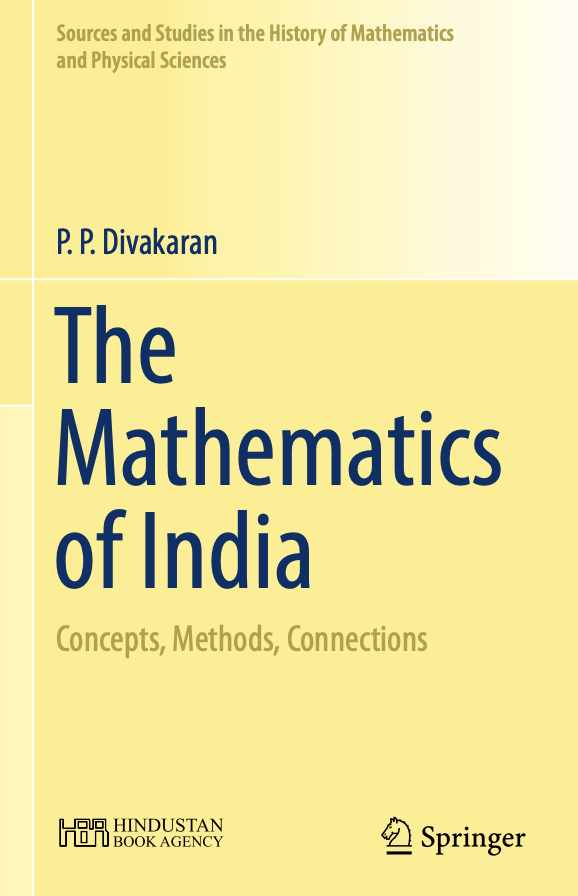
History of Maths in India – a good book

In recent years, this has been one of the best books on the history of mathematics in India. The late Prof. Divakaran was a theoretical physicist and a scholar.

This book is also an excellent example of how a scientist can present historical facts and analyse them with rigour and nuance. Particularly, it puts the Indian contribution in the global context and shows how ideas are exchanged across the geography. The writing is jargon-free and can be understood by anyone interested in mathematics.

Unfortunately, the cost of the book ranges from Rs 8800 to Rs 14,000 (depending on the version), which is a shame. Part of the reason why scholarly books, particularly in India, don’t get the traction is because of such high cost. This needs to change for the betterment and penetration of knowledge in a vast society such as India.

There is a nice video by numberphile on Prof. Divakaran and his book:

Some writing advice (mainly physics) for UG students

Some writing advice (mainly physics) I shared with my undergraduate class. This may be useful to others.

  1. Equations, data and figures make meaning when you include a context. This context is expressed using words. Symbols and data by themselves cannot complete the meaning of an argument, unless one knows the context. A common mistake undergraduates make in an exam is to answer questions using only symbols and figures and assume the reader can understand the context.
  2. One way to treat writing in physics (in this case, an exam paper or an assignment) is to imagine you are talking to a fellow physics student who is not part of the course you are writing about. This means you can assume some knowledge, but not the context. Anticipate their questions and address them in the text you are writing. This model also works while writing research papers with some caveats.
  3. While you refer to equations, data and figures in your assignment, make sure you cite the reference at the location of the content you are discussing. Merely listing the references at the end of the document does not make the connection. Remember, while talking, you never do this kind of referencing.
  4. It is useful to structure your arguments with headings, sub-headings and a numbered list. This gives a visual representation of your arguments. You may not find this kind of structured writing in novels, other forms of fictional writing and also in some literature related to social sciences, but in natural sciences with dense information, this will be very useful. Always remember, while writing science (or any form of nonfiction writing), clarity comes before aesthetics.

Also, below is another blog related to written assignments.

Satish Dhawan – truly a man for all seasons

Image credit: Current Science 119, no. 9 (2020): 1427–32

Today is the birth anniversary of Satish Dhawan (25 September 1920 – 3 January 2002). He was probably India’s best scientist-administrator who headed institutions such as the Indian Institute of Science and the Indian Space Research Organization. With a PhD from Caltech, he came back to India and set up a marvellous research enterprise on fluid mechanics, including aerospace science and engineering. He mentored some of the outstanding scientists of India and led scientific institutions with vision, openness and informality, which is still a great benchmark to emulate1.

Below are a couple of historical documents related to Dhawan:

The first one is a lecture note from 1979, on making a case for a national satellite system and how it influences science and scientific activity (a copy of this note has been reproduced in a wonderful tribute to Satish Dhawan written by P. Balaram on his birth centenary2).

The next one is a beautiful perspective article written by Dhawan on ‘Bird Flight’ from an aerodynamics perspective3. It is a detailed overview of the dynamics of bird flight and shows Dhawan’s interest and ability to bridge two facets of science. It is a prototypical example of interdisciplinary research.

Finally, let me end the blog with a quote from P. Balaram on Satish Dhawan4:

“Dhawan mentored some remarkable students and built the discipline of aeronautical engineering at the Institute. He influenced aeronautical research and industry in India in a major way. He shepherded the Indian space programme following Vikram Sarabhai’s untimely death. He served the Indian scientific community in many ways. His stewardship transformed IISc. How then do we describe such a man? Dhawan studied English literature obtaining a Master’s degree in his youth. It may therefore be appropriate for me to borrow a 16th century description of Sir Thomas More:


‘[Sir Thomas] More is a man of an angel’s wit and
singular learning. I know not his fellow. For where is
the man of that gentleness, lowliness and affability?
And, as time requireth, a man of marvelous mirth and
pastimes, and sometime of as sad gravity. A man for
all seasons.’

Satish Dhawan was truly a man for all seasons.”

Happy Birthday to Prof. Satish Dhawan!

References:

  1. Current Science, in 2020, had a section of a volume dedicated to the birth centenary of Satish Dhawan, and has a foreword by his daughter and articles by many of his students and co-workers. https://www.jstor.org/stable/e27139029 ↩︎
  2. P. Balaram, “Satish Dhawan: The Transformation of the Indian Institute of Science, Bangalore,” Current Science 119, no. 9 (2020): 1427–32. This reference has many interesting references, including a handwritten obituary of CV Raman written by Dhawan https://www.jstor.org/stable/27139041. ↩︎
  3. S. Dhawan, “Bird Flight,” Sadhana 16, no. 4 (1991): 275–352, https://doi.org/10.1007/BF02745345. ↩︎
  4. P. Balaram, Current Science 119, no. 9 (2020), page 1432. https://www.jstor.org/stable/27139041. ↩︎