Namaste, Hola & Welcome from G.V. Pavan Kumar.
I am a Professor of Physics at the Indian Institute of Science Education and Research, Pune, India.
My research interests are :
(1) Optics & Soft Matter: Optically Induced Forces – Assembly, Dynamics & Function;
(2) History and Philosophy of Science – Ideas in Physical Sciences.
I am interested in the historical and philosophical evolution of ideas and tools in the physical sciences and technology. I research the intellectual history of past scientists, innovators, and people driven by curiosity, and I write about them from an Indian and Asian perspective. My motivation is to humanize science.
In the same spirit, I write and host my podcast Pratidhvani – Humanizing Science.
Nowadays, collective motion in active matter is one of the happening topics in the science of condensed matter, with a motivation in understanding biology at scales spanning from molecules to flock of birds. There is also a lot of contemporary research in active and driven natural systems and soft-robots at various length scales. Of my own interest is to understand how light can drive collective motion in synthetic colloids and other soft-systems in a fluid, and how they can lead to emergence of new assemblies.
Today, when I was walking in the IISER Pune campus, I came across a group of ants carrying food (see video above). It is amazing to see how coordinated is the movement of ants when carrying an object which is much larger than their individual weight (see video). One of the observations you can make is that how ants change their collective direction with minimum communication. How they do it is a fascinating question to explore. Undoubtedly studying such collective motion can lead to deeper understanding of not only the behaviour of ants and non-equilibrium systems, but also in designing adaptable soft-robots for various environments.
IISER Pune campus is quite rich in flora and fauna, and there is a lot to learn just by looking around the natural resources on campus. I hope to explore this rich environment in the context of soft matter systems, and report to you in this blog.
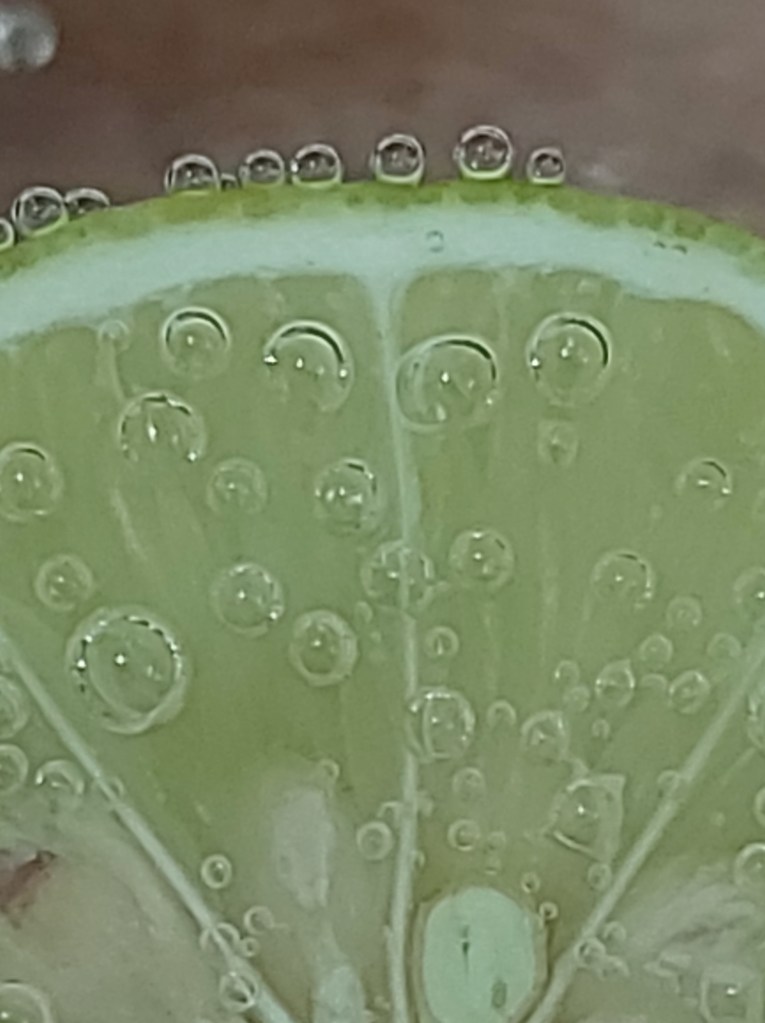
One of the fascinating things about liquid-solid interface is that it gives a platform for fluids to assemble in a variety of geometries that can be tailored by changing the properties of the interface. Among the formations, bubble generation and assembly are intriguing aspects. If you observe the bubbles at the interface of a lemon slice dipped in soda(image above), they are almost spherical in shape, indicating a large contact angle.
How fluids interact on a solid surface depends on an important concept called as wetting. Associated with this wettability is the contact angle between a droplet/bubble and the solid beneath it. Based on the measure of this contact angle, one can classify how well or otherwise a drop/bubble can wet on a solid.
For a water droplet resting on a solid surface, larger contact angles, close to 90 degree, indicates that the surface is hydrophobic in nature. A lotus leaf is an excellent example of a hydrophobic surface. If the angle happens to be, say around 10 degrees, then the liquid spreads very easily on the surface and hence it is called as hydrophilic surface.
This kind of classification of surfaces based on wetting has a huge implication in studying liquid-solid interfaces including blood flow, capillary phenomena in plants, and of course in paint and printing industry, and many more.
Recently, I came across a research paper-highlight which connects the formation of bubbles to the energy problem. It always amazes me how simple concepts in science can inspire research problems and lead to fundamental questions and applications.
Let the bubbles rise..
ps: thanks to wordpress app, I have been able to write and post this blog directly from my mobile phone. That makes it quick and easy 😬
Below is a video I took on falling water droplets from a tap at my home. Observe how a large drop detaches itself from the tap and falls down, not as a single drop, but as a series of droplets with certain degree of periodicity associated with it. The video was shot at around 960 frames per second.
Why does this happen ? A simple answer is : to minimize surface energy. Interestingly, the transition of a large drop to smaller droplets is mediated via formation of a liquid tread, which further breaks up into smaller droplets. This tread (not evident in my video) takes the form of an instability, and facilitates the process of minimizing the free energy. The nature of this breakup depends on parameters such as surface tension, viscosity, density and geometry of the liquid thread. The initial conditions, such as the opening of the tap and pressure of the flow, too play a critical role in determining the droplet formation.
Actually, the problem of falling droplets has a rich history, which dates back to the times of Leonardo da Vinci (who else ), who made innumerable observations on the fluid flow (see some comments from his notebook here). There are many other people who have contributed towards our understanding of this problem. In the current literature, this instability problem is generally know as Plateau-Rayleigh instability, name after the two who played a vital role in quantifying this phenomenon and generalizing it to fluid jets.
In recent times, thanks to high speed photography, our visualization and hence deeper understanding of this instability problem has enormously increased. This understanding is fantastically communicated in a public lecture titled “The life and death of a drop” (see embedded video below) given by Sidney Nagel. This video has some spectacular movies captured by high speed camera ( > 10,000 frames per second) and looks at the falling droplet problem from the viewpoint of basic physics.
Why is this interesting problem ? Apart from the aesthetic and curiosity, the problem of fluid jets and their evolution is of great relevance in understanding fundamental processes of fluid dynamics, including astrophysical situations. Also, the problem of fluid droplets, their instability and splashing is of huge relevance in applications such as ink jet printing, wall painting, water reservoir management, blood flow analysis and many other problems in physiology and biomedicine.
What strikes me about the falling droplets is its simplicity and universality. It reminds me of a poem by Emily Dickinson:
Simplicity
How happy is the little stone That rambles in the road alone, And doesn’t care about careers, And exigencies never fears; Whose coat of elemental brown A passing universe put on; And independent as the sun, Associates or glows alone, Fulfilling absolute decree In casual simplicity.
Crystal to time crystal : Periodic arrangement of atoms in the form of a crystal is well known to us. The periodicity in conventional crystal is with respect to its spatial co-ordinates. An interesting question is : what if the periodicity of a crystal is also considered in temporal co-ordinates, that is with respect to time ? Such crystals, in which atoms (or their equivalents) repeat both in space and time are called time-crystals (specifically space-time crystals).
Origins : Although the term “time crystal” was used in biological context in 1970s, it was a research paper by Alfred Shapere and Frank Wilczek in 2012 which brought this interesting concept into mainstream physics. Wilczek, a Nobel laureate, also postulated the concept of quantum time crystal, which has added great impetus to this exploration. These theoretical concepts were experimentally probed and verified by Zhang’s group at UC Berkeley using ions in a cylindrical arrangement. Since then, there is a lot of research activity in this area. My colleagues at IISER-Pune – Sreejith and Mahesh, have created a new variety of time crystals by subjecting periodic NMR pulses to spins in star-shaped molecules .
I should also mentioned that after Wilczek’s results were published, Patric Bruno criticized the quantum counterpart based on No-Go theorem argument. There are some interesting debates which are still going on regarding the thermodynamic aspects of these crystals. Also many new applications have been proposed and tested based on the initial predications. To know more about the history and current trends in time-crystals, I suggest a recent, comprehensive review article.
Choreographic (time) crystals : Dance is something inherent to humans, and may be to other living beings. As per google dictionary, the term choreography means the sequence of steps and movements in dance or figure skating, especially in a ballet or other staged dance. In a choreographic time crystal, the movement of atoms (or their equivalent) are in a sequence of steps and co-ordinated, just as in a dance sequence. This means the spatial and temporal co-ordinates of this crystal varies in a predictable way, and hence represents a space-time crystal. Such a concept was proposed in a paper in 2016. An interesting issue discussed in this theoretical paper is how Bragg’s diffraction law can be modified and adapted to probe such choreographic crystals. Modification of this law in necessary as atoms in a dancing lattice are in constant motion, and to obtain snapshots of the moving atoms one needs a capture protocol (diffraction in this case).
Colloidal dance : Atoms are tiny objects. If we need to probe the spatial and temporal evolution of atoms in a crystals, then we require sophisticated imaging tools (such as scanning tunneling microscope) to track atoms in space and time in an ultra-high vacuum condition. Is there any alternative, cheaper method to this approach? The answer is yes (with some caveats). One way is to utilize colloids (micron-scale objects floating in a fluid) and treat them as big atoms. This is of course an approximation, as colloids are classical objects, but many of the physical concepts that are applicable to atoms may be scaled up to colloidal size, and this scaling has been verified and harnessed to mimic and study collective behavior of atoms.
Coming back to choreographic time crystal, the obvious question to ask is: can we use colloids to visualize the dance of this crystal ? A recent paper in PRL (arxiv version) addresses this question with numerical simulations. The authors first propose an experimental scheme to create a choreographic optical lattice using light as a tool. They hypothesize optical potential wells that can evolve both in space and time, and numerically study the evolution of colloids in such a choreographic time crystal. An important finding from their study is that they identify three phases of dynamics, in which the interaction between the potential-well and the colloids is weak, medium and strong. In these three phases, they observe chiral looping of colloids, liquid-like behavior and colloidal choreography. I strongly recommend to have a look at the amazing simulation videos for the three simulated regimes of interaction : weak , strong , medium.
Summary : What I have described above is a metaphorical snapshot of how concepts in physics such as time crystals, optical lattice and colloids can come together on a single platform to collectively give something, which is not feasible to obtain by any of the individual entity. The concept of crystal itself is a manifestation of this ‘emergence’ philosophy. In an essence these ideas are both a tribute to, and reinforcement of, the concept: “More is Different”….. adieu Anderson….
Recently, I read an article titled The Quantum Poet. It is about Amy Catanzano, an academic poet amalgamating poetry with quantum physics. What is impressive is that she is trying to create a platform to communicate emerging trends in quantum world through poetry. She thinks poetry can bring something unique in terms of presentation which may help us understand science in a better way. In her own words she describes the power of poetic presentation :
“Poetry is a nuanced and complex form of language that goes beyond simple dictionary definitions of individual words. Poems use rhythm, visual structure, line breaks, word order, and other devices to explore invisible worlds, alter the flow of time, and depict the otherwise unimaginable”
Attempts to bring science and poetry together is an active effort now, as evidenced by projects such as “The Universe in Verse”, which is an emerging platform where scientist and poets not only exchange ideas but also get together to create something new. An early proponent of this philosophy is the poet Ursula K. Le Guin, who describes beautifully why science and poetry are necessary to understand the world that is overloaded with information :
“Science describes accurately from outside, poetry describes accurately from inside. Science explicates, poetry implicates. Both celebrate what they describe. We need the languages of both science and poetry to save us from merely stockpiling endless “information” that fails to inform our ignorance or our irresponsibility.”
Whereas the above examples show how poets are embracing science, I should mention that scientist too have been active in this endeavor. Roald Hoffmann, the Nobel prize winning chemist is one of the great examples of this.
The combination of science and poetry has interesting connection in ancient Indian tradition too. Specifically, many of the Sanskrit surtras essentially do this as evidenced in some old Indian texts. If you want to know more, I suggest you readthis article by Roddam Narasimha. His work, in my opinion, is a reliable source on topics related to science in ancient India. Interestingly, many languages in India do combine poetry with puzzles. One example that immediately comes to my mind is a lyrical puzzle in Kannada by Purandara Dasa called Mullu koneya mele.
A famous essay by C.P. Snow titled “Two Cultures” observed that arts and science, which are two endeavors of human activities, have to come together for a richer intellectual human experience. A lot has been debated on this topic. Perhaps, the above examples show that the two cultures indeed can inspire each other to create something neither of them can create individually. Of course, there is still a lot to achieve in this direction.
Science, arts and sports are three pursuits of human beings which are integral parts of our lives. Personally, I cannot imagine a world devoid of them. Let me conclude with a small poem I wrote sometime ago (this is a modified version that I had posted on facebook) :
Cycles of thought set question into motion,
it pours meaning into life as a cerebral conception.
Fathering an idea: a borrowed perception;
no endeavor is original, everything an inception.
Science, Arts and Sports are facets of inspiration;
after all, what is life without their juxtaposition.
ps : Disheartening to know the passing away of Indian actors Irrfan Khan and Rishi Kapoor. A lot of people are sad… reinforces the importance of art and artists in human society.
This semester I was teaching an advanced physics lab course (4th year BS-MS). Below is an email I sent to them. You may find it interesting :
Image of a plasma discharge experiment in the UG physics lab at IISER-Pune
Dear Students of PHY430,
I hope all of you are doing fine and staying safe where ever you are. Given that we are part of an advanced lab course, compensating for the lost time via internet is not feasible. To fill in the gap, I am writing to you about something you may find interesting and useful. So here it is:
Ventilators : By now you may be very familiar with this terminology. Essentially, it is a medical device that helps you to mechanically breathe, and has turned out be a vital component in fighting the extreme medical cases of COVID epidemic. In this regard, I want to inform about the efforts of my colleagues Sunil Nair and Umakant Rapol, who are actively involved in design and development of low-cost ventilators. As you may recognize, both of them are experimental physicists, and their knowledge and intuition has been put to excellent use during the pandemic. In an essence, their involvement in this venture shows how a strong foundation in physics can not only solve deep queries in fundamental aspects of science, but also can cater to an emergency situation. This is one of the important lesson of this course : the skills and knowledge that you gain as part of experimentation in a lab can be transferred and implemented to solve problems outside a lab.
A Book recommendation: Talking about experimental skills, I thought of recommending an excellent book by Matthew Crawford titled “Shop Class as Soulcraft: An Inquiry Into the Value of Work”. This is a kind of an autobiographical exposition by the author, who majored in Physics, obtained a Ph.D. in political philosophy, and worked in policy circles of Washington D.C. for a brief period, and quit this job to become a motorcycle mechanic and an academic author. This book dives deep into the philosophy of why working with hands (and brains) is a deeply satisfying venture as a career and life-style. If you are not able to read the book, here is an excellent excerpt by the author himself.
Lab reports: Do send me the report of the experiments that are due to be evaluated. I know some of you may or may not have good access to internet, so timelines can be flexible (2 weeks from today). Also, you may not have access to research material. In that case, do co-ordinate with your lab partners, and let me know if I can be of some help in this regard.
Finally, keep your experimental spirits high. After all, everything at home is a kind of lab equipment to explore
First of all, my condolences to all people who have lost someone directly or indirectly due to pandemic. Second, my salutations to all the health and essential workers who are striving hard to keep the world breathing. Third, my sympathies to all the free-willing minds who have been locked down. This outbreak has indeed changed our lives and life-style, and has confined most of the humankind spatially, and has metaphorically frozen us in time. Also, it has given us some time for self-introspection on what it is to be an individual in a society, and how actions of individuals and local community can affect the globe. In an essence, what we may be witnessing is a classic case of butterfly effect.
So, what am I up to in the past month or so ?
Research work: Now that all my research-group members are away from the institute, it has had an effect on our research. Although online platforms have kept us connected, and we are making slow progress in writing some papers and performing some computer simulations, it can never substitute two important things: experimental work in a lab, and the in-person interaction during research. On personal research front, I have been studying some interesting concepts on liquid crystals, and their related meso-photonics effects. That will be a topic of another blog in future.
COVID-related research: For the past year of so, I have been informally interacting with some researchers at Bharat Electronics Limited, Pune on topics related to nanphotonics and optofluidics. Thanks to the recent developments, we have initiated collaboration on research related to COVID. We will be exploring some on-chip optical microscopy and plasmonic methods to detect and interrogate pathogens in our local environment (including virus and virus-like particles). I will update you as we make some progress.
An interesting book: Over the past fortnight or so, I have been reading an interesting book titled : Fizzics – The Science of Bubbles, Droplets and Foams. It is a semi-technical/popular science book written by F. Roland Young, who has done considerable research on bubble cavitation and sonoluminescence. This book has some fascinating discussion on questions such as:
What is the origin of the sound when we crack our knuckles ?
Why and how do bubbles rise in a bottle of champagne ?
How to compute a math puzzle using a soap film ?
and many more…
My posts going further – Henceforth, I wish to post short blogs more frequently. Once in a while, I will post longer essays.
Endless it were to sing the powers of all, Their names, their numbers; how they rise and fall: Like baneful herbs the gazer’s eye they seize, Rush to the head, and poison where they please: Like idle flies, a busy, buzzing train, They drop their maggots in the trifler’s brain: That genial soil receives the fruitful store, And there they grow, and breed a thousand more.
Social media, such as Facebook, twitter, WhatsApp, Instagram, e-news platforms, blogs etc., are great tools to share information. It has been harnessed by humanity to not only “spread the word”, but also to share opinions, experiences, expressions and new ideas at an amazing pace across the globe.
On the social media, we generally consume information by three different means: read an article, listen to an audio clip or watch a photograph or a video. They have indeed elevated our experiences and are now an important part of our daily lives. As with all technological tools, social media too has its advantages and disadvantages. One of the main disadvantages of the social media is the authentication of an information. The problem of authentication becomes increasingly important when the news that we are consuming is related a vital situation (example: information on coronavirus epidemic). Therefore, it is critical that we identify the source of information that we are consuming.
In this blog let me give a brief outline on the kinds of source any information is based on.
I will be directly quoting from an excellent book titled – The Craft of Research (now in 4th edition)
There are 3 kinds of sources from which we consume our information:
Primary sources are “original” materials that provide you with the “raw data”
or evidence you will use to develop, test, and ultimately justify your
hypothesis or claim. What kinds of materials count as primary sources vary
significantly by field. In history, primary sources are artifacts or documents
that come directly from the period or event you are studying: letters, diaries,
objects, maps, even clothing. In literature or philosophy, your main primary
source is usually the text you are analyzing, and your data are the words on
the page. In arts criticism, your primary source would be the work of art you
are interpreting. In social sciences, such as sociology or political science,
census or survey data would also count as primary sources. In the natural
sciences, reports of original research are sometimes characterized as primary
sources (although scientists themselves rarely use that term).
2. Secondary sources
“Secondary sources are books, articles, or reports that are based on primary
sources and are intended for scholarly or professional audiences. The body of
secondary sources in a field is sometimes called that field’s “literature.” The
best secondary sources are books from reputable university presses and
articles or reports that have been “peer-reviewed,” meaning that they were
vetted by experts in the field before they were published. Researchers read
secondary sources to keep up with developments in their fields and, in this
way, to stimulate their own thinking…….”
3.Tertiary source
These are books and articles that synthesize and report on secondary sources
for general readers, such as textbooks, articles in encyclopedias (including
Wikipedia), and articles in mass-circulation publications like Psychology
Today. In the early stages of research, you can use tertiary sources to get a
feel for a topic. But if you are making a scholarly argument, you should rely
on secondary sources, because these make up the “conversation” in which
you are seeking to participate. If you cite tertiary sources in a scholarly
argument, you will mark yourself as either a novice or an outsider, and many
readers won’t take you—or your argument—seriously.
This response may seem unfair, but it’s not. Tertiary sources aren’t
necessarily wrong—many are in fact written by distinguished scholars—but
they are limited. Because they are intended for broad audiences who are
unfamiliar with the topics that they address, they can sometimes oversimplify
the research on which they are based, and they are susceptible to becoming
outdated. But if you keep these limitations in mind, tertiary sources can be
valuable resources: they can inform you about topics that are new to you, and
if they have bibliographies, they can sometimes lead you to valuable
secondary sources.
A majority of the information that we consume in social media is a tertiary source. When we consume information, we need to always ask questions such as:
On what kind of source is the information based on ?
Does this information cite appropriate source (primary, secondary or tertiary) ?
These are vital questions because it helps the reader to make a judgement on the information that they are consuming. For example, if you are reading an opinion piece or watching a video on e-news platform, the authors or the speakers will be making an argument as part of their opinion. Generally, this argument will be based on the three kinds of sources that I have quoted above. An important task of a serious reader/watcher is to seek the reference behind these sources, and identify the category of the source on which the opinion is based upon.
In the above quoted text on tertiary source, I have boldened the sentence related to bibliography to emphasize the importance of referencing. Given that hyperlinking is easy on social media, we should expect the author or the speaker to furnish their sources as part of their write-up or presentation.
Doing research should not be seen as an esoteric endeavor of human species. In fact, in this time and age of social media, it is not only our responsibility but also a necessity to do research on what we consume. So how should we do research ? To answer this, let me conclude by quoting the preface of the book again (page 13, 4th edition):
“…..Most current guides acknowledge that researchers rarely move in a straight line
from finding a topic to stating a thesis to filling in note cards to drafting and
revision. Experienced researchers loop back and forth, move forward a step
or two before going back in order to move ahead again, change directions, all
the while anticipating stages not yet begun. But so far as we know, no other
guide tries to explain how each part of the process influences all the others—
how developing a project prepares the researcher for drafting, how drafting
can reveal problems in an argument, how writing an introduction can prompt
you to do more research.”
To know more about how to do research, I strongly recommend you to read “The Craft of Research”. It is a rare combination of primary, secondary and tertiary source for this age.
28th Feb of every year is celebrated as National Science Day in India. I have previously written about the science behind the National Science Day. This day is associated with the discovery of Raman effect. Raman had a great legacy and influence on Indian science. In addition to being a great scientist, CV Raman encouraged the pursuit of science (with exceptions).
One of his legacies was the impression and influence he had on some close members of his family. Below is a small list of his illustrious nephews who made significant contributions in science.
Raman’s younger sister, Sitalakshmi, had 5 sons.
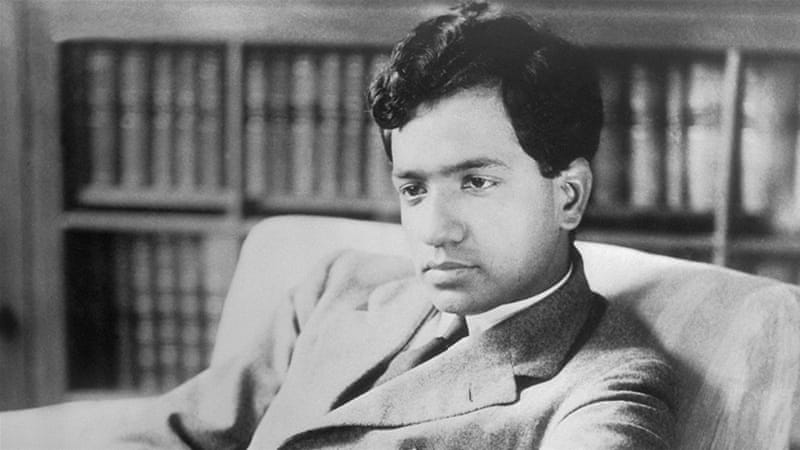
3 brothers : Pancharatnam, Ramseshan, Chandrasekhar. Image courtesy : Indian Academy of Sciences
S. Chandrasekhar was an astrophysicist who went to win the Nobel Prize in Physics
The real impact of science and technology, is not only in the materialistic gains of a society but also in the way it elevates the thought process of a society. Science as a pursuit of human knowledge influences thinking of human beings, and hence plays a vital role in shaping the character and culture of any individual, family, community, country and the world.
We should also remind ourselves that “impact of a scientist” cannot be judged merely by counting the number of papers/patents they publish nor by the high-office they hold in corridors of (scientific and political) power. If anything, such a judgment of impact should be left to the posterity.
On a related note, Kameshwar Wali, physicist and biographer of Subrahmanyan Chandrasekhar writes :
Chandra often quoted from a letter of his friend Edward A Milne during his Cambridge years:
“Posterity, in time will give us our true measure and assign to each of us our due measure and humble place; and in the end it is the judgement of posterity that really matters. He really succeeds who preserves accordingly to his lights, unaffected by fortune, good or bad. And it is well to remember there is no correlation between posterity and the judgement of contemporaries.”
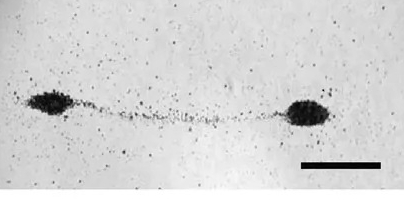
Optical microscopy image (scale bar 100 microns) of a metal colloidal chain assembled in a plasmofluidic potential in our lab at IISER-Pune (see https://www.nature.com/articles/ncomms5357 for more details)
Malleshwaram is one of the oldest parts of Bangalore. I studied BSc (Physics, Maths, Electronics) in MES College which is at the 15th cross of Malleshwaram. Apart from the college day memories of eating Dosae at CTR, other memorable aspects of my student life were playing cricket at Malleshwaram ground, and regularly visiting IISc and Raman Research Institute (RRI), which were not far from Malleshwaram. Particularly, the library at RRI was the place I spent most of my time during BSc and MSc. Two Professors at RRI with whom I interacted a lot were Prof. G.S. Ranganath and Prof. G. Srinivasan (both are retired now). I owe a lot of my interest in science to these two gentlemen. I was always interested in optical physics, and thanks to the interaction with Prof. G Srinivasan, I really got interested in optical phenomena in astronomy and astrophysics (I even did a rotation curve experiment using the radio telescope at RRI).
Thanks to this excitement, during my MSc Physics at Bangalore University, I did my summer research project at Indian Institute of Astrophysics, Bangalore with Prof. K.N. Nagendra, who introduced me to solar astrophysics. In fact, my project was on second solar spectrum and polarization of light in stars such as sun. Gradually, as I learnt more about optics in stellar environment, I increasingly became interested in optics of everyday life, and started exploring optics of rainbow, soap bubbles and other common objects.
Concomitantly, during BSc and MSc days, I and some of my classmates used to visit RRI and interact with Prof. G.S. Ranganath. He was the one who introduced us to soft-matter physics. Importantly, he impressed upon me the fascinating world at the interface of soft-matter physics and optics. I strongly recommend one of his books, which discusses some of these topics.
This introduction to soft-matter physics and interactions with Prof. Ranganath has had a profound impact on my research career. So much so, that I joined Prof. Chandrabhas’s lab at JNCASR for my Ph.D. to work on a (then) newly emerging topic of surface enhanced Raman scattering, which had a unique blend of colloids (a prototypical soft-matter) and light scattering, and it perfectly suited my research interest. During my Ph.D., I had a fantastic and thrilling experience of working on topics related to interaction of metal colloids with biological macromolecules using Raman scattering microscope as a tool. Thanks to the deep knowledge of Prof. Chandrabhas on optics and optical spectroscopy, and a variety of research at JNCASR, I got introduced to the fascinating field of optical microscopy, Raman scattering and soft-matter physics. Then during my post doc, first at ICFO-Barcelona, I got introduced to near-field optics and single-molecule imaging, and then at Purdue University, I learnt a bit of cell biology and used plasmonic light scattering to study some questions in bio-imaging.
Ever since I started my own research group in 2010 at IISER-Pune, my research interest evolved in topics such as nanowire plasmonics, spin and orbital angular momentum of light, whispering gallery modes in microspheres, single-molecule Raman scattering, and Fourier-plane optical microscopy and spectroscopy. As of Feb 2020, 6 Ph.D. students and around 9 MS students have graduated working on the abovementioned topics. The main focus, for about 10 years, has been on nanophotonics, and on some topics related to soft-matter physics, especially on colloids.
Starting Jan 2020, our emphasis and research orientation will be mainly towards ‘soft-photonics’. The motivation of this research is to explore some emerging questions at the interface of soft matter physics and micro- and nano-photonics. There are two important objectives to this research:
To study structure and dynamics of mesoscale soft-matter including colloids, liquid crystals, and complex fluids using a variety of techniques that we have developed for the past 10 years in the area of nanophotonics and single-nanoparticle optics.
To explore new opportunities in meso- and nano-photonics using soft-matter systems such as colloids, liquid crystals, droplets and bubbles, as a platform.
In a way, for the past 5 years or so, we have been implicitly working on these objectives. But from 2020 onwards, we will be mainly focusing on these objectives, and will be orienting all our efforts towards this direction.
This explicit reorientation is for the following reasons:
The interface of soft-matter physics and photonics provides some new opportunities to study some interesting questions in fundamental physics (such as topology, pattern formation, emergence and single-macromolecule dynamics) and applications (optofluidics, optical antennas, aerosol optics and gastronomy)
Light scattering and “quantitative” optical microscopy have emerged as powerful tools to study structure and dynamics of soft-matter. Given that our lab has laid a strong foundation in these tools for 10 years or so, it is an obvious extrapolation of our capabilities.
Thanks to the interaction with my soft-matter colleagues at IISER-Pune and many friends/researchers across India and outside, I have been “re-hooked” to soft matter physics. Given that the Indian research community on soft-matter is growing in number and has a good mix of experiments and theory, further motivates me to pursue this direction.
Perhaps the most important reason is that it renews my interest in science and reminds me of the fundamental reason of why I became a researcher: to enjoy what I do!
As a consequence of this renewed interest, I intend to write blogs oriented towards soft matter physics + photonics and wish to use this platform to educate myself and communicate my excitement with all of you.
Let me conclude by quoting “a poem from an experiment of soft matter” by Boudin, which is also the concluding part of the Nobel lecture of Pierre de Gennes:
 ), who made innumerable observations on the fluid flow (see some comments from his notebook



 VISMAYA - History & Philosophy of Physics