Namaste, Hola & Welcome from G.V. Pavan Kumar.
I am a Professor of Physics at the Indian Institute of Science Education and Research, Pune, India.
My research interests are :
(1) Optics & Soft Matter: Optically Induced Forces – Assembly, Dynamics & Function;
(2) History and Philosophy of Science – Ideas in Physical Sciences.
I am interested in the historical and philosophical evolution of ideas and tools in the physical sciences and technology. I research the intellectual history of past scientists, innovators, and people driven by curiosity, and I write about them from an Indian and Asian perspective. My motivation is to humanize science.
In the same spirit, I write and host my podcast Pratidhvani – Humanizing Science.
Marie Curie (7 November 1867 – 4 July 1934) and CV Raman (7 November 1888 – 21 November 1970) were born on this day. Both were extraordinary scientists and strong characters.
Marie Curie led an extraordinary life, and her dedication to science was unparalleled. She led a tough life in a male-dominated society and became a great scientist. Previously, I have written about her in one of my blogs on lab writing: https://backscattering.wordpress.com/2018/11/11/expression-as-exploration/
Scientists are human beings. For me, understanding their scientific life history in the context of their society & environment is fascinating. There is always something to learn from their past, not only from their achievements but also from their mistakes.
Today, I will be teaching the origins of LASERs in my optics class. Some of the content may interest science enthusiasts here. I present some snapshots from my notes. As expected, it starts with Einstein introducing his A and B coefficients and the stimulated emission.
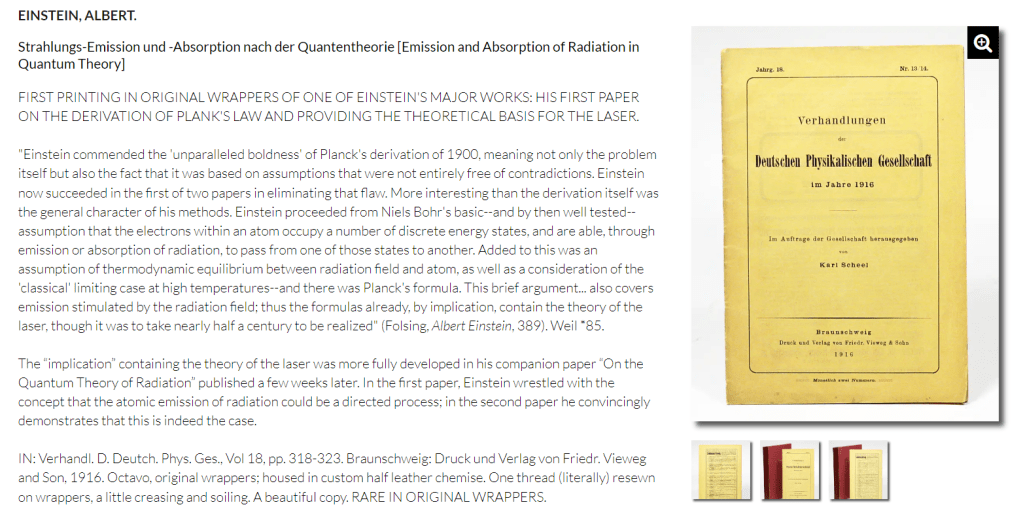
He introduced them in a paper written in German: Einstein, A. (1916). “Strahlungs-Emission und -Absorption nach der Quantentheorie”. Verhandlungen der Deutschen Physikalischen Gesellschaft. 18: 318–323.
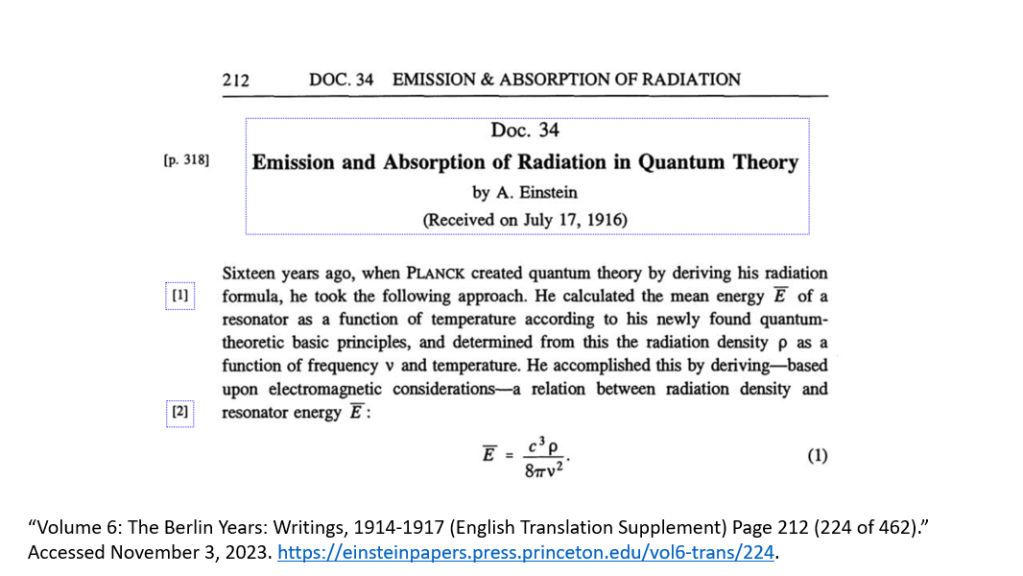
The English translation of the paper: “Volume 6: The Berlin Years: Writings, 1914-1917 (English Translation Supplement) Page 212 (224 of 462).” Accessed November 3, 2023. https://einsteinpapers.press.princeton.edu/vol6-trans/224.
Under thermodynamic equilibrium, the detailed balance gives us the connection between the coefficients…and amplification and stimulated emission of radiation become a measurable prospect.
The pic shows the leading characters behind the invention of the Light Amplification by Stimulated Emission of Radiation (LASER) Charles Townes was the intellectual pioneer behind microwave variety… and Maiman….the freak behind the optical version..
The history of the invention is fascinating and dramatic. I did a podcast on this a few months ago. Check it out..
Sourabh Dube is an experimental particle physicist interested in computation and machine learning. He is an Associate Professor at the physics department, Indian Institute of Science Education and Research, Pune.
“P-Quest Lab – Photonics and Quantum Enabled Sensing Technologies Lab, Department of Electrical Engineering, IIT-Bombay, Principal Investigator – Kasturi Saha.” Accessed October 14, 2023. http://www.ee.iitb.ac.in/~kasturis/.
Barry, John F., Jennifer M. Schloss, Erik Bauch, Matthew J. Turner, Connor A. Hart, Linh M. Pham, and Ronald L. Walsworth. “Sensitivity Optimization for NV-Diamond Magnetometry.” Reviews of Modern Physics 92, no. 1 (March 31, 2020): 015004. https://doi.org/10.1103/RevModPhys.92.015004.
His research includes solar astrophysics – sun spots, magnetohydrodynamics and the recent Aditya L1 mission.
In this episode, we discussed his biography, research and teaching astrophysics, his thoughts on science in India, a short segment in Bengali and many other things.
Nandy, Dibyendu, and Arnab Rai Choudhuri. “Explaining the Latitudinal Distribution of Sunspots with Deep Meridional Flow.” Science 296, no. 5573 (May 31, 2002): 1671–73. https://doi.org/10.1126/science.1070955.
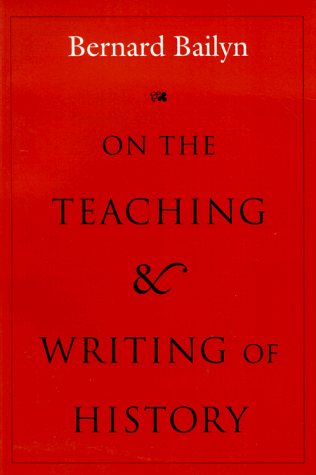
Recently, I came across a short but interesting book:
Bailyn, Bernard. On the Teaching and Writing of History: Responses to a Series of Questions. UPNE, 1994.
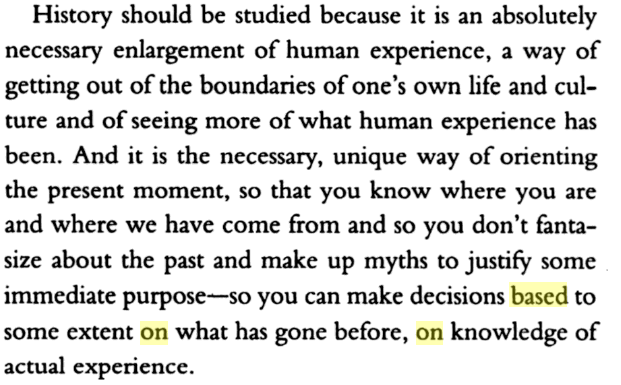
On page 12, there is an interesting discussion on why one should study history, both at the level of an individual and the collective. Below, I reproduce a paragraph related to this.
In this episode we discussed her biography, career trajectory, her current research interest, thoughts on science in India, a short segment in Bengali and her future plans.
Sinha, Sudeshna. “Noisy Uncoupled Chaotic Map Ensembles Violate the Law of Large Numbers.” Physical Review Letters 69, no. 23 (December 7, 1992): 3306–9. https://doi.org/10.1103/PhysRevLett.69.3306.
Sinha, Sudeshna, and William L. Ditto. “Dynamics Based Computation.” Physical Review Letters 81, no. 10 (September 7, 1998): 2156–59. https://doi.org/10.1103/PhysRevLett.81.2156.
One of the interesting aspects of the Nobel Prize in Sciences this time is that all the 8 laureates are experimentalists. This is not to underplay the contribution of theoreticians but to emphasize the point that experimental observations are central to the progress of sciences and follow-up technology. Also note that many of these laureates were equally well-versed in theoretical ideas, and hence were able to connect the abstract to the real. An effective way to do science.
Another aspect is that all the experimentalists are strongly anchored in the West. They have performed all their work in an ecosystem that has supported their efforts, even when their ideas were not well known. A case in point is Katalin Karikó (one of the medicine/physiology laureates). Although U Penn treated her badly, she was still able to sustain her research thanks to the research-driven business ecosystem in the West, including the USA and Germany, where she could establish herself in the biotech research industry. This means the Western research ecosystem, including its businesses, was open enough to allow someone who was almost discarded by the US academic system. Karikó’s is a great story, but we must not forget that eventually, the system in which she worked recognized her contribution.
Now, some things to ponder – what if Karikó had moved to a place such as India? Could she have survived and thrived in our research ecosystem? If she had moved, was our academic and market ecosystem open to welcome her, take her expertise, and utilize it effectively? Answers to these questions are not straightforward but may indicate where we are as a research ecosystem.




 VISMAYA - History & Philosophy of Physics