Author: G.V. Pavan Kumar
Namaste, Hola & Welcome from G.V. Pavan Kumar.
I am a Professor of Physics at the Indian Institute of Science Education and Research, Pune, India.
My research interests are :
(1) Optics & Soft Matter: Optically Induced Forces – Assembly, Dynamics & Function;
(2) History and Philosophy of Science – Ideas in Physical Sciences.
I am interested in the historical and philosophical evolution of ideas and tools in the physical sciences and technology. I research the intellectual history of past scientists, innovators, and people driven by curiosity, and I write about them from an Indian and Asian perspective. My motivation is to humanize science.
In the same spirit, I write and host my podcast Pratidhvani – Humanizing Science.
John Michell and ‘dark stars’
November 1783,
John Michell published a paper on ‘dark stars’.
This was kind of a preamble to the concept of black holes & interestingly, was based on Newton’s corpuscular theory of light and the slowing down of light due to gravity!
See this article for details:
Part of the original paper (the beginning) is reproduced below :

The first few lines of Michell’s 24-page paper elaborate on his idea. As you may observe, he makes a remarkable connection between the velocity of light and the measures related to stars (distance, magnitude, etc.)
Conversation with Angshuman Nag
Angshuman Nag is an experimentalist who combines physical and material chemistry to prepare advanced materials such as doped quantum dots and perovskite nanocrystals.
He is an Associate Professor at IISER Pune:
https://angshumaniiserpune.wixsite.com/grouppage/current-members
This episode discusses his intellectual journey from Silchar-IIT-Gauhati-IISc/JNCASR Bengaluru-U Chicago- IISER-Pune. Through this journey, we learn how he developed an interest and expertise in material chemistry and his emerging work on perovskite semiconducting nanocrystals and their use in cutting-edge technology.
Listen…as we humanize science…
Youtube (audio):
spotify :
References:
- “Current Members.” n.d. Grouppage. Accessed November 28, 2023. https://angshumaniiserpune.wixsite.com/grouppage/current-members.
- “Angshuman Nag – Google Scholar.” n.d. Accessed November 28, 2023. https://scholar.google.co.in/citations?user=fAwle2oAAAAJ&hl=en.
- “Angshuman Nag (@AngshumanNag4) / X.” 2023. X (Formerly Twitter). November 6, 2023. https://twitter.com/AngshumanNag4.
- “HOME.” n.d. Grouppage. Accessed November 28, 2023. https://angshumaniiserpune.wixsite.com/grouppage.
- “Dipankar Das Sarma.” 2023. In Wikipedia. https://en.wikipedia.org/w/index.php?title=Dipankar_Das_Sarma&oldid=1169361872.
- “C. N. R. Rao.” 2023. In Wikipedia. https://en.wikipedia.org/w/index.php?title=C._N._R._Rao&oldid=1184106736.
- “Nag.” talk American Chemical Society. Accessed November 28, 2023. https://www.acs.org/international/india/events/india-science-talk-recordings/nag.html.
Podcast and metrics
I am sceptical about ranks/metrics.
Someone informed me that my podcast was rated highly in a database of science-related podcasts from India. It seems perplexity AI also shows similar results (see images)

My learning: Open-source, non-commercial, individual ventures can have some impact
Let me reiterate :
Value of knowledge cannot be captured entirely using metrics, ranks, views, likes and number of subscribers on social media platforms.
The quality & depth of engagement are hard to measure & the world is nonlinear
I have done zero adverts./marketing 😀
But I must thank
a) ppl who have been guests on the podcast. They have been very generous with their time & knowledge.
b) listeners who engage with long-form content (even when I talk solo😆)
They deserve more credit.
Science zindabad!
Conversation with Jasjeet Singh Bagla
Jasjeet is an astrophysicist exploring the cosmos and is intrigued by the learning process.
He is a Professor at IISER-Mohali: https://web.iisermohali.ac.in/Faculty/jasjeet/index.html
In this 2 hour+ conversation, we discuss his biography – a journey through Agra, Delhi, IUCAA-Pune, Cambridge, Harvard and back to India.
We discuss his work on N-body simulations in the context of cosmology, TreePM, teaching, mentorship and learning process. Also, a short segment in Punjabi.
Listen as we humanize science..
Youtube (audio)
spotify :
References :
(1)Welcome to the home page of Jasjeet Singh Bagla. https://web.iisermohali.ac.in/Faculty/jasjeet/index.html (accessed 2023-11-18).
(2)Jasjeet Bagla – Google Scholar. https://scholar.google.co.in/citations?user=LKThFAoAAAAJ&hl=en (accessed 2023-11-18).
(3)Jasjeet Singh Bagla (@jsbagla) / X. X (formerly Twitter). https://twitter.com/jsbagla (accessed 2023-11-18).
(4)Jasjeet Bagla – Professor – IISER Mohali | LinkedIn. https://in.linkedin.com/in/jasjeet-bagla-9665a714 (accessed 2023-11-18).
(5)Jasjeet Singh Bagla : me, my life, and all that.https://web.iisermohali.ac.in/Faculty/jasjeet/me.html (accessed 2023-11-18).
(6)Home – IUCAA. https://www.iucaa.in/en/ (accessed 2023-11-18).
(7)Homepage of Padmanabhan. https://web.iucaa.in/~paddy/ (accessed 2023-11-18).
(8)Institute of Astronomy. https://www.ast.cam.ac.uk/ (accessed 2023-11-18).
(9)Home – IISER Mohali. https://www.iisermohali.ac.in/ (accessed 2023-11-18).
(10)Bagla, J. S. TreePM: A Code for Cosmological N-Body Simulations. J Astrophys Astron2002, 23 (3), 185–196. https://doi.org/10.1007/BF02702282.
(11) Bagla, J. S. Cosmological N-Body Simulation: Techniques, Scope and Status. Current Science2005, 88 (7), 1088–1100.
Thinking in a Classroom
As I conclude my Optics course this week (40+ hrs, ~80 physics majors ), I have an opinion to express. There is no substitute for in-person human interaction and learning. This form of interaction is not to downplay the role of technology in education, but somehow, as humans, we still connect better in reality than in virtual space.
I have been formally teaching for the past 14 years or so, and for a couple of semesters, I have also taught online courses during the pandemic. During these years, I have learnt that technology can add significant value to teaching but cannot be a substitute for a teacher or a student. As we teach a class with a reasonable number of students, we experience live feedback from each other, which has no equivalent during an online interaction. Humans take this feedback for granted and assume we can replicate it in a virtual space with limited success. Such feedback may have a deeper connection to the evolutionary biology of human beings.
This feedback loop in a live class does not make teaching or learning a perfect act of communication. But it brings in a form of dissipative coherence, which indicates that the whole class, including the teacher, is thinking synchronously at the moment of exposition. I have deliberately used the word ‘dissipative’ because there is always some intellectual noise in the background. The beauty of this noise is that it adds up with the information under discussion and amalgamates with the topic of exposition. This combination is the uniqueness of learning. At that moment in the class, we are all thinking about a topic, but noise in an individual mind combines with the issue at large and possibly emerges as a new thought. This divergence of thinking at a personal level, combined with real-time feedback, makes a live class alive.
And at that hour, it becomes a single living entity with a single meta-brain.
Conversation with Nirmalya Kajuri
Nirmalya is an Assistant Professor at IIT Mandi : https://sites.google.com/view/nirmalya-kajuri/
He is a theoretical physicist and an excellent science communicator who writes in various social media forums. In this ’emergence’ conversation, we discussed his research interest and what draws him towards science communication.
Listen as we humanize science…
youtube (audio):
spotify:
References :
- X (formerly Twitter). “Nirmalya Kajuri (@Kaju_Nut) / X,” December 26, 2022. https://twitter.com/Kaju_Nut.
- “Nirmalya Kajuri.” Accessed November 10, 2023. https://sites.google.com/view/nirmalya-kajuri/.
- “Nirmalya Kajuri – Writing and Outreach.” Accessed November 10, 2023. https://sites.google.com/view/nirmalya-kajuri/writing-and-outreach.
- “Welcome to Jadavpur University Website.” Accessed November 10, 2023. http://www.jaduniv.edu.in/view_department.php?deptid=80.
- “Nirmalya Kajuri – YouTube.” Accessed November 10, 2023. https://www.youtube.com/user/nirmalyaz.
- Kajuri, Nirmalya. “Oppenheimer: Remembering the Physics That First Made Him Great.” The Hindu, July 29, 2023, sec. Science. https://www.thehindu.com/sci-tech/science/oppenheimer-snyder-stellar-collapse-black-hole-formation/article67131932.ece.
- “Remembering A.K. Raychaudhuri: Transformed Relativity, Almost Got Fired.” The Hindu, July 21, 2023, sec. Science. https://www.thehindu.com/sci-tech/science/amal-kumar-raychaudhuri-birth-centenary-general-relativity-iacs/article67097221.ece.
- “When Einstein Thought He Was Wrong but Feynman Convinced Physicists Otherwise.” The Hindu, May 30, 2023, sec. Science. https://www.thehindu.com/sci-tech/science/einstein-gravitational-waves-feynman-thought-experiment/article66900109.ece.
- “Nirmalya Kajuri – Google Scholar.” Accessed November 10, 2023. https://scholar.google.co.in/citations?user=5FJAaF8AAAAJ&hl=en.
- Online Talk Series:”A Brief History of Black Holes Physics” by Dr. Nirmalya Kajuri, 2023. https://www.youtube.com/watch?v=nPfACaa9VCI.
- “School of Physical Sciences-IIT Mandi.” Accessed November 10, 2023. https://sps.iitmandi.ac.in/faculty_personal.php?id=13.
- “The Character of Physical Law.” In Wikipedia, October 29, 2023. https://en.wikipedia.org/w/index.php?title=The_Character_of_Physical_Law&oldid=1182414252.
Kumar Patel and CO2 laser- Baramati-Pune to Bell Labs
Happy Deepavali: let’s celebrate (laser) light! Did you know there is a connection b/w Baramati, Pune city & the first-ever CO2 lasers? Kumar Patel, the inventor of one of the most powerful lasers, was born in Baramati & did his BE at the College of Engineering, Pune!
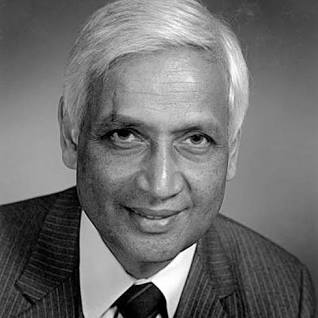
Chandra Kumar Naranbhai Patel had an illustrious career. From Pune, he moved to Stanford University for his PhD and then worked at Bell Labs, where he created his CO2 laser. See him describe the invention:
In Nov 1964 (around the time of the Diwali festival :)), he published his invention: https://journals.aps.org/pr/abstract/10.1103/PhysRev.136.A1187

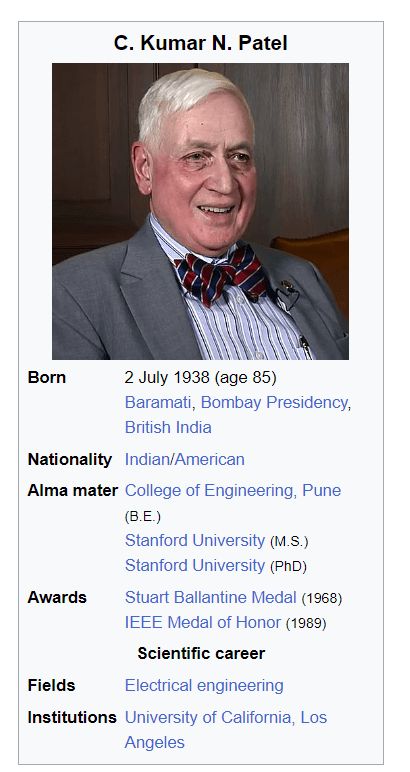
Wikipedia has a good profile of his work, including a video :
https://en.wikipedia.org/wiki/C._Kumar_N._Patel
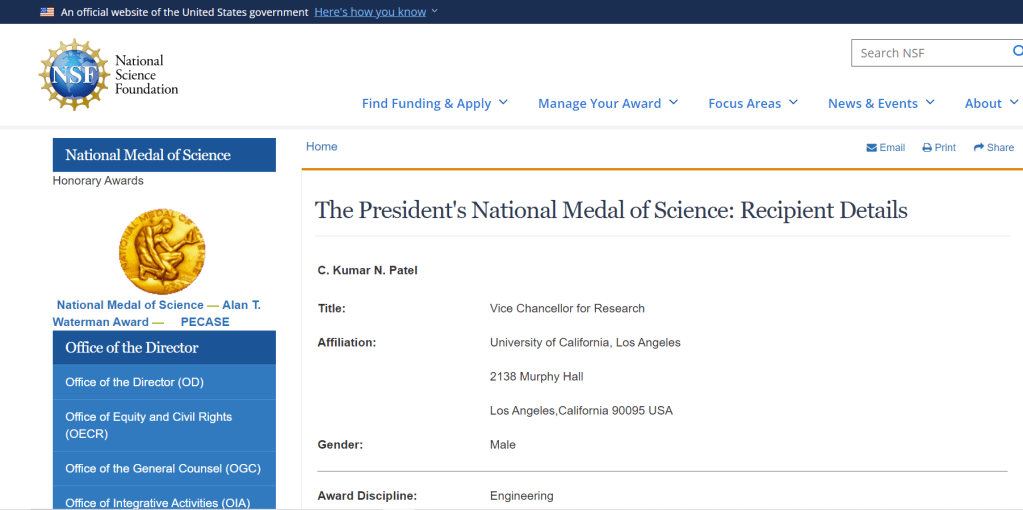
Kumar Patel went on to win many laurels, including US President’s National Medal of Science. https://www.nsf.gov/od/nms/recip_details.jsp?recip_id=270
Kumar was a rare engineering scientist who also served as the president of the American Physical Society in 1995.
https://www.aps.org/about/governance/presidents.cfm

One of the reasons to celebrate Diwali is the move from darkness(ignorance) to light(knowledge). I hope humanity moves toward peace, knowledge and harmony with nature guided by compassion and science. Baramati-born Kumar Patel has shown us one of the ways.
Kannada – ನಿಮಗೆಲ್ಲರಿಗೂ ದೀಪಾವಳಿಯ ಶುಭಾಶಯಗಳು
Marathi – तुम्हा सर्वांना दीपावलीच्या हार्दिक शुभेच्छा
Sanskrit – सर्वेभ्यः दीपावली शुभकामना
Hindi – आप सभी को दीपावली की शुभकामनाएँ
I wish you all a happy Deepavali.
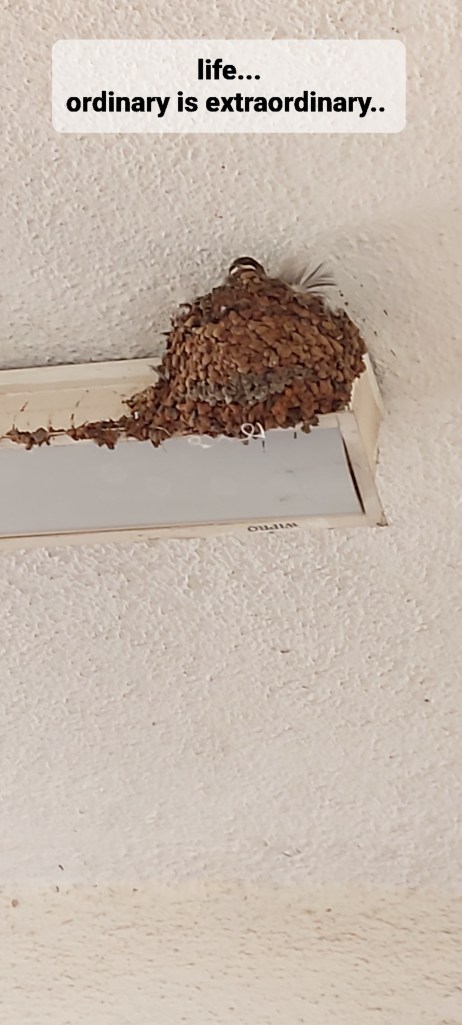
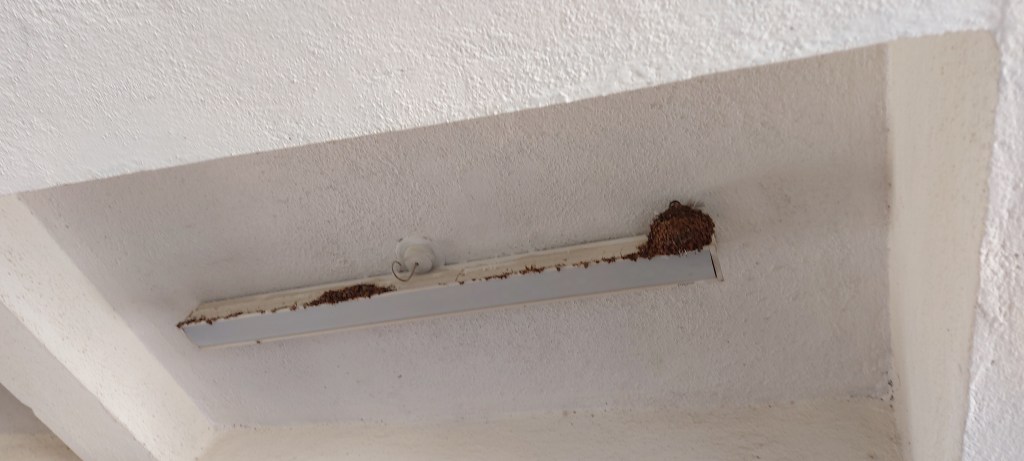
Natural home…at a parking lot in IISER Pune
Conversation with Srabanti Chaudhury
Srabanti is a theoretical chemist interested in biophysics and chemical physics.
She is an Associate Professor at IISER-Pune.
Her webpage : https://sites.google.com/site/srabantic01/home
In this episode we discuss her:
•biography and career trajectory
•interest in mathematics followed by chemistry
•Work during MSc, PhD and postdoc
•Current research
•Motherhood and her life lessons
•Many other interesting things…
Listen, as we humanize science…
apple podcast : https://podcasts.apple.com/us/podcast/ep-27-conversation-with-srabanti-chaudhury-journey/id1687861465?i=1000634068835
References :
1.“Srabanti Chaudhury.” Accessed November 7, 2023. https://sites.google.com/site/srabantic01/.
2.“Durgapur.” In Wikipedia, November 2, 2023. https://en.wikipedia.org/w/index.php?title=Durgapur&oldid=1183066399.
3.“The University of Burdwan.” Accessed November 7, 2023. https://www.buruniv.ac.in/Demo/index_bucc.php.
4.“Group Members.” Accessed November 7, 2023. https://ipc.iisc.ac.in/~bjc/page3.html.
5.“Home.” Accessed November 7, 2023. https://ipc.iisc.ac.in/~bjc/.
6.“Inorganic and Physical Chemistry.” Accessed November 7, 2023. https://ipc.iisc.ac.in/.
7.Punia, Bhawakshi, Srabanti Chaudhury, and Anatoly B. Kolomeisky. “Microscopic Mechanisms of Cooperative Communications within Single Nanocatalysts.” Proceedings of the National Academy of Sciences 119, no. 3 (January 18, 2022): e2115135119. https://doi.org/10.1073/pnas.2115135119.
8.X (formerly Twitter). “Srabanti Chaudhury (@srabantichaudh2) / X,” September 7, 2023. https://twitter.com/srabantichaudh2.
•
 VISMAYA - History & Philosophy of Physics