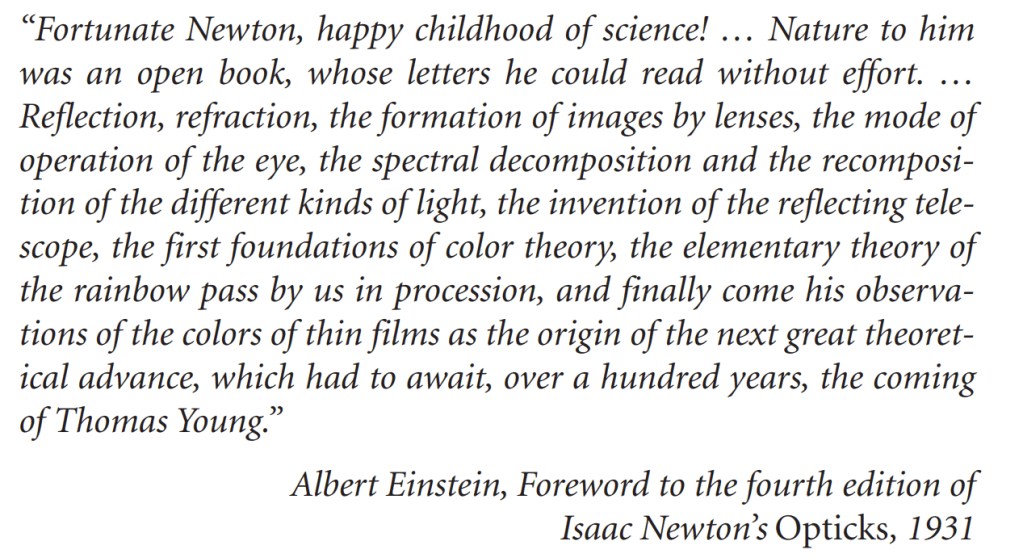
Einstein on Newton’s OPTICKS
Interesting that he ends the sentence with Thomas Young, who, in a way, disproved Newton’s corpuscular theory…
oh, how science evolves..
Einstein on Newton’s OPTICKS
Interesting that he ends the sentence with Thomas Young, who, in a way, disproved Newton’s corpuscular theory…
oh, how science evolves..

The Italian painter Tomaso Barisini da Modena (1325-1379) was one of the first to depict a person wearing a spectacle. The above painting dates back to 1352.
There has been a bit of debate on the first painting to have a person wearing spectacle as discussed in the below reference. The history of spectacles itself is interesting, and their origins is also hotly debated among historians of science.
To give you a flavor of the debate, let me quote E. Rosen, “The Invention of Eyeglasses,” Journal of the History of Medicine and Allied Sciences 1 1 (1956), p.13. :
“Much has been written, ranging from the valuable to the worthless, about the invention of eyeglasses; but when it is all summed up, the fact remains that the world has found lenses on its nose without knowing whom to thank.”
Similarly, the origins of telescope are also under debate [1]:
“if victory has a thousand fathers, as it is commonly said, then the invention of spectacles and of its derivative, the telescope (another nominee listed among the top inventions of the last two millennia), must have just as many.”
[1] Ilardi, Vincent. 2007. Renaissance Vision from Spectacles to Telescopes. Philadelphia, PA : American Philosophical Society. http://archive.org/details/bub_gb_peIL7hVQUmwC.
Susmita Adhikari is an Assistant Professor in the Physics Department at IISER Pune.
She obtained her PhD in Astronomy from the University of Illinois Urbana Champaign and has held postdoctoral positions at The Kavli Institute of Particle Astrophysics and Cosmology, Stanford University, and the Department of Astronomy & Astrophysics at The University of Chicago & Fermilab.
Her research focuses on cosmology, astrophysics, dark matter halos, and structure formation. She studies the formation and structure of dark matter halos, the co-evolution of galaxies within them, and the connection between cosmic structure formation and the sources of gravitational waves. She uses theory and simulations to interpret observations of gravitationally bound objects, aiming to understand the underlying nature of dark matter and gravity.
In this conversation, we discussed how she got interested in physics and how it evolved into a research career in astrophysics. We discussed her study and research experience in India and the USA and her work on dark-matter halos and cosmology. Also, we discussed her interest in Odissi and other forms of classical dance.
Listen as we humanize science.
spotify :
References :
In 1980s, every Friday morning, Akaashvani Bengaluru (a local radio channel of the state; language Kannada) woke me up with Bhimsen Joshi’s famous rendition – Bhaagyada laxmi baaramma. This song has stayed with me and somehow makes me nostalgic for the times we lived – a simple, lower-middle-class life. More than the devotional undertone of this song, what captured my attention was how it was beautifully adapted in a movie by Shankar Nag without compromising its authenticity. It showed me how art can be inclusive yet distinct.
I went to a local private English school. Those were the times when school education was affordable even for a lower-income family like ours, and now, if I look back, I did get a relatively decent primary education. Some of the teachers I remember had names: Firdoos, Christy and Geeta.
An interesting aspect of my upbringing was my exposure to various sports. It included cricket (of course), cycling, eye-spies, lagori, buguri, goli and bachha. The last three sports are unique. Buguri is playing with a top, where you spin the top with a tied rope. By releasing the rope skillfully, one can make the top rotate at a location of interest, be it on the floor or in the palm of your hand.
Goli is playing with marbles, where you compete with an opponent by hitting a marble with another. There were several games within the umbrella of this fascinating meta-game, and it was one of the most competitive sports I have played.
Bachha will be the most unfamiliar sport to many of you reading. It was typically played by children who grew up in lower-middle income surroundings, and the game was to use well-polished granite slabs that can fit your hand. This was made to sail over a tar road. The sailing of the stone had to be smooth, and the target of this throw was to dislodge a pile of old cigarette carrying paper boxes (without cigarettes) that had been collected over a long period of time. The whole point of the game was to hit the piled-up packs of these folded boxes and win them as a collection. Different boxes of cigarette brands had different values. Talk about capitalism !
Through the 1990s, the teenage years were memorable. Riding a two-wheeled motor vehicle made you feel you had evolved into an adult. It gave you the freedom to go to a petrol bunk and fill up the tank full of fuel (with tinge of kerosene) on a gear(care)less TVS 50. The picture that has stayed with me is the skilful handling of a bunch of currency notes by the guys who filled the petrol. They used to double up as cashiers (as they do even now), but then everything was to be dealt in cash, and the human processing speeds had to be good. Similar skills were evident with BTS bus conductors. A fascinating thing about them was that they had a whistle. This made their presence felt, and they were the representatives of the unique city culture of Bangalore. Their images are so iconic that many Kannada movies then had bus conductors as characters of their movies. Rajnikanth was one of the early ones to play this role. And yes, he started in Kannada movies, as did a few other Tamil superstars.
Deccan Herald was and is a newspaper that most of the Bengalurians are aware of. It had some wonderful commentaries on history and geography. Thanks to some of these articles by well-known writers, I was interested in these subjects. I was so motivated and encouraged by them that, as a school kid, I wrote them a letter. They published it. I remember it was a Saturday, and I spent my whole weekend staring at my article on paper. It was also a time when I learned about the great H. Narasimiaha distributing puffed rice to local people during a solar eclipse. His writings and thoughts sowed the seeds of rationality in me. Gradually, I transformed into an atheist, and over the years, I have adapted compassionate rationality as a way of living and thinking. This way has allowed me to appreciate my culture’s deep roots without compromising on rational thinking. It has given me a balance.
What was out of balance in my life was the pressure of education. The worst part of the late 90s was my pre-university education. Then, 11 and 12-grade education was part of pre-university college, and this exposed one to a life of partial independence. Unlike a bachelor’s degree, this time in college is boring, and everything is done to crack some silly exams that have ‘not so silly’ consequences on one’s career. With great fortune, I escaped a turbulent time and found myself doing BSc (Physics, Maths, Electronics), with a healthy amount of languages, including Sanskrit and English. Throughout this period, the wonderful libraries across the city were central to my education. There were many old public libraries in Bangalore, and one did not need any membership to read a book. I saw so many people preparing for civil service exams in such libraries.
In 2000s, I fell in love with physics. Astrophysics gripped my life and took me through an intellectual journey that has not stopped ever since. Intellectual pursuits are that way. One can vaguely remember their origins, but one will realize the effect on one’s life only after a while. Interestingly, it changes the character of a person. That is the power of education.
I went to Bangalore University to do my Masters in physics. This state-funded university’s semester fees were less than present-day woodland shoes. For the first time, I saw how education can be aspirational, inspirational, political, liberating, suffocating and fun. All at once. This was also the time I discovered that economics and politics have far-reaching consequences in scientific research.
This was also the era of my PhD at JNCASR. I started as a serious student of physics and ended my PhD as a serious student of science. This was transformative not only because I was exposed to new knowledge but also because I could contribute to knowledge. At the end of the first year of my PhD, I got an excellent opportunity to travel to the US. I attended a summer school at University of California, Santa Barbara.
Interestingly, this journey was the first time I took a flight on an aeroplane, and the trajectory was long and interesting as I flew around the globe (Bangalore to Bangkok to Osaka to Los Angeles) thanks to the limited funding. The biggest realization of my arrival in LA was a massive billboard of an iconic iPod silhouette advertisement. It is etched in my inner eye. My first travel within the US was a road trip from LA to Santa Barbara. What a ride!
After I finished my PhD, I moved to Barcelona and lived in Castelldefels. I shared my apartment with an Uruguayan (Spanish: uruguayos) couple and a cute dog. It was interesting that we were all immigrants. They spoke Spanish, but I did not, which impacted how we assimilated into the society. Although we did not speak similar languages, we could communicate very well with each other. That was an interesting lesson for me.
Then I moved to the US, and this was a time when Obama had just been elected into office. I have never seen a country undergoing economic recession and yet was so enthusiastic politically as the US. The ‘Yes We Can’ was an iconic campaign; I could see how it touched so many lives in the US. It was also a time when I was exposed to American professionalism and their excellent work culture. This has deeply impacted my thinking and how I look at work. It also made me realize the (positive and negative) powers of a free market economy. Again, it was an education.
In 2010, I got married, and started looking at life from a slightly long-term perspective. At the cusp of the decade, I moved back to India, and this time to Pune. Culturally, this is one of the wealthiest places in India. The flux of thought is high, and the people you get exposed to is often fascinating. It was also a time when I was building my lab, and I found how essential teamwork is. You always realize this when you are doing your PhD, but when you set up your group, you get a different grasp of how highly educated humans behave and coordinate for the greater good with a common goal.
Interestingly, these common goals can also align with personal career goals and growth. From a close quarter, I see how five years of focused work can transform people’s lives and thoughts. We need to pay more attention to the long-term work.
One of my life moments was to see my wife delivering my daughter. It made me feel human. I was there in that ward beside my wife, and those few minutes has transformed me forever. It also made me realize the power of human bonds. The day’s images are etched in my memory, and I thank biology for all that!
Now, we are in 2020s, and the pandemic has eaten away a few years. The early years also led to an explosion of information, and understanding the world is a continued challenge. An astonishing aspect has been that we, as humans, are still fighting wars. It indicates that we still do not understand each other, and cooperation is still a major goal to achieve. More work to do.

All through this journey, what has remained with me is reading, writing and talking to people. All people from all walks of life. Writing and talking has also encouraged me to use them as tools to look at the world. A lesson that I derive from all this: human cultures should use knowledge from the past and present and move towards the future. A forward-looking culture distills the best from every cultural exposure and adapts them to move forward. This is also a lesson from evolutionary biology, and perhaps a lesson for a beautiful country like India, that is Bharat, and many other magnificent things.
We are the people, and the wheel – the chakra, represents us on the move. This is the life I want to travel on : riding on a chakra of a forward-looking culture.
More than 300 years ago, Robert Boyle made a wish list of research projects, and some of them are still relevant and interesting. Below is the list reproduced from archives of Royal society

Atikur Rahman is an Associate Professor of Physics at IISER Pune, where he leads the Nano Energy & Quantum Transport Lab. https://atikurrahmanl.wixsite.com/scientist-site
His research focuses on understanding fundamental charge transport properties and applications of quasi-1D (nanowires and nanotubes), 2D materials, and mixed-dimensional van der Waals heterostructures. His group studies electronic transport properties under varying temperature, magnetic field, and light conditions to understand the effects of interactions and disorders on the charge transport properties of quantum confined systems. They use various experimental techniques, including electrical, optical, and optoelectrical measurements, to characterize nanodevices. The group has extensive experience in synthesizing 2D and 1D materials, nanodevice fabrication, and tuning materials properties through nanotexturing. They are also involved in building new experimental setups and encouraging students to set up new measurement capabilities.
In this conversation we discuss research journey and how and why he got interested in condensed matter physics and related technologies ?
Listen..as we humanize science…
Spotify :
References :
“Atikur Rahman – Google Scholar.” n.d. Accessed January 13, 2024. https://scholar.google.co.in/citations?user=ue65bNkAAAAJ&hl=en.
“Atikur Rahman – IISER Pune.” n.d. Accessed January 13, 2024. https://www.iiserpune.ac.in/research/department/physics/people/faculty/regular-faculty/atikur-rahman/321.
“Atikur Rahman (@atikur321) / X.” n.d. X (Formerly Twitter). Accessed January 23, 2024. https://twitter.com/atikur321.
“Home.” n.d. Scientist-Site. Accessed January 13, 2024. https://atikurrahmanl.wixsite.com/scientist-site.
Any physics buff would know Bose-Einstein condensation and the statistics named after them. An interesting fact is Satyendra Nath Bose (SN Bose) also served as a member of the Indian parliament.
SN Bose was a member of the Rajya Sabha. Notably, he participated in some debates on bills, mainly in the second term, circa 1955 onwards. He was part of the earliest formulation of THE UNIVERSITY GRANTS COMMISSION BILL, 1954. See this link for the bills in which he was involved.
On page 95 of brief biographies of Rajya Sabha members, you will find the following information (snapshot below). These documents are freely available on the Rajya Sabha website and are worth exploring.

Bose also participated in some debates in the Rajya Sabha, mainly regarding education/research.
Below is an excerpt of his speech related to UGC bill, and shows his interest in the then university/academic system of India (emphasis added) :
It has, of course, been suggested that this particular Commission would be able to solve the problem of education in this country. I may, however, point out that in this task we will ultimately have to depend upon the responsible people that are in charge of education inside the Universities. I also know, Sir, that every teacher in our country is alive to his responsibility, and the corporate bodies that we have set up in our land are also serious about their tasks. I do not feel, Sir, that the standard of our universities has gone down to a very ludicrous level. I do not feel so, because I remember the long list of persons that have been turned out by these universities who had served the national cause, and who have been and who still continue to be the leaders of thought in our country. We also remember. Sir, that in many of these universities, there are young people and workers who have achieved fame and distinction, who have contributed substantially to the cause of learning, and who have made the name of India respected in different lands. Therefore, Sir, you need not have any misgivings about the way in which, work is being done in our universities. All that is wanted is that you should be generous, and you should set up an efficient machinery which should be able to get in touch with the people who work at different centres, and should find out what they need. And you should be able to supply those needs in the form of grants, which may either be given out of the Consolidated Fund of the Government or out of the fund set apart for this purpose, which would be administered by the Commission.
As you can observe, SN Bose is making a case for increased funding to the Indian research community and is emphasizing the availability of excellent human resources in universities. As researchers in India, we must ask ourselves whether we have lived up to his confidence and effectively addressed these issues over the past several decades. I believe we have not. Bose’s optimism motivates us to relook at our system and self-reflect on pursuing scientific and technological research in India. A good starting point is to ask for ‘ease of doing research and teaching’.
A few Indian scientists of the past, including Meghnad Saha and MGK Menon, were also members of the Indian parliament. Still, this representation needs to be improved, as discussed by my colleague MS Santhanam. Scientists inclined to take politics to influence society must openly express their opinions on policies related to science and technology. If they do get elected to the office, it is their imperative to actively participate in parliamentary debates and ask and address relevant questions, especially about education and research.
After all, the foundation of democracy is based on ‘questions and answers’, and interestingly, that is also the foundation of scientific method.
Shivakumar Jolad made a unique transition in his research career. He transformed from a theoretical physicist to a social scientist with a quantitative mind. How and why did he make a transition? Listen in as we humanize science.
spotify :
References :
Jolad, Shivakumar. 2023a. “Demography in Service of ‘Other’ Social Sciences.” Medium (blog). May 22, 2023. https://shiva-jolad-46811.medium.com/demography-in-service-of-other-social-sciences-6cfef9fae568.
———. 2023b. “The Constitution and Its Gandhian Alternative.” Medium (blog). October 7, 2023. https://shiva-jolad-46811.medium.com/the-constitution-and-its-gandhian-alternative-b2599c9ed4c4.
“Prof. Shivakumar Jolad | Faculty – FLAME University.” n.d. Accessed January 16, 2024. https://www.flame.edu.in/faculty/shivakumar-jolad.
“Shivakumar Jolad – Google Scholar.” n.d. Accessed January 16, 2024. https://scholar.google.com/citations?user=Yp43tdkAAAAJ&hl=en.
“Shivakumar Jolad (@shivakjolad) / X.” 2023. X (Formerly Twitter). December 6, 2023. https://twitter.com/shivakjolad.
I narrate a short, peculiar career story of Eric Betzig..one of the scientists behind super-resolution optical microscope
 VISMAYA - History & Philosophy of Physics