link to the blog: https://backscattering.wordpress.com/2023/09/15/oliver-heaviside-a-maxwellian/
Author: G.V. Pavan Kumar
Namaste, Hola & Welcome from G.V. Pavan Kumar.
I am a Professor of Physics at the Indian Institute of Science Education and Research, Pune, India.
My research interests are :
(1) Optics & Soft Matter: Optically Induced Forces – Assembly, Dynamics & Function;
(2) History and Philosophy of Science – Ideas in Physical Sciences.
I am interested in the historical and philosophical evolution of ideas and tools in the physical sciences and technology. I research the intellectual history of past scientists, innovators, and people driven by curiosity, and I write about them from an Indian and Asian perspective. My motivation is to humanize science.
In the same spirit, I write and host my podcast Pratidhvani – Humanizing Science.
Meditation on Questioning
Why do humans ask questions?
This question fascinates me.
Here is what I have been learning from my observations :
1) Children tend to ask questions that are driven by curiosity. If these questions are refined, they turn out to be philosophical. Eg: Why do we live?
2) Adults tend to ask questions that are generally connected to economics. On average, their questions are more on ‘how’ than on ‘why’.
3) A dialogue is actually a volley of questions and answers. We somehow tend to under-appreciate this. What we generally ascribe to Socrates is something present in all cultures. It is worth exploring this questioning tradition in all cultures. Eg.: Tarka shastra.
4) A great way to engage with a book is to read it as a series of answers to implicit questions. I am amazed to see how interesting and active reading becomes. This also works for research papers and sometimes even on fiction.
5) A collection of questions is a sub-set of knowledge. The answers derived from these questions can lead to further questions. Following this process will give you a ‘body of knowledge’. There is some fractal nature to this.
6) Scientific thinking is essentially a systematic way of asking questions. The operational word here is ‘systematic’. The structure of these questions is such that it fosters further enquiry, but it is also open-ended. That way, it gives us room for creative thinking.
7) Creative thinking, in essence, is a question of effective combination. It becomes ‘creative’ when the sum of parts creates something new AND relevant. The conjunction is its vitality.
8) Finding an error in our thinking also originates in questioning. In fact, error analysis is a form of questioning from a different viewpoint. It requires us to shift our perspective, and the central question is where and when to shift?
9) Questioning is an inherent human quality. Fostering this is not only existential but also very useful. Etymologically “systematic treatment of an art, craft, or technique” means technology. If you observe, its roots are connected to scientific thinking (see 6).
10) Questioning is generally considered a part of the means to an end. If you observe, it is a means that never ends. Worth asking – Why?
Conversation with Jayant Murthy
Jayant Murthy is a distinguished Senior Professor at the Indian Institute of Astrophysics, Bengaluru. His research focuses on space missions, interstellar dust, and diffuse radiation fields. With a rich scientific background, a deep love for teaching and notable contributions to the discipline, Murthy’s work exemplifies excellence in astrophysical research.
Explore further at Jayant Murthy’s website: https://www.iiap.res.in/people/personnel/murthy/Jayant_Murthy/Home.html
In this episode we discuss his biography. He explained how and why he became interested in astronomy and astrophysics. His ventures in teaching and a freewheeling discussion on science, rationality and society.
Jayant was recently commemorated with the naming of asteroid “(215884) Jayantmurthy” by the IAU, acknowledging his significant advancements in ultraviolet astronomy and space missions. We explore how that happened.
There are many other interesting strands in the conversation. Listen, as we humanize science.
References :
- Jayant Murthy [WWW Document], n.d. URL https://www.iiap.res.in/people/personnel/murthy/Jayant_Murthy/Home.html (accessed 4.2.24).
- Jayant Murthy – Google Scholar [WWW Document], n.d. URL https://scholar.google.co.in/citations?user=Gdv6OEsAAAAJ&hl=en (accessed 4.2.24).
- Bureau, T.H., 2024. Asteroid named after Bengaluru Professor. The Hindu.
- Henry, R.C., 2005. The mental Universe. Nature 436, 29–29. https://doi.org/10.1038/436029a
- IIAstrophysics [@IIABengaluru], 2024. We are happy to announce that the asteroid 2005 EX296 has been named as “(215884) Jayantmurthy” by @IAU_org in honour of Prof Jayant Murthy! He is Honorary Prof & former acting director at IIA. @dstindia @doot_iia @asipoec @fiddlingstars @SPG_IIA https://t.co/E1k6MytYsY. Twitter.
- International Astronomical Union | IAU [WWW Document], n.d. URL https://www.iau.org/ (accessed 4.2.24).
- Jayant’s Class Presentations [WWW Document], n.d. URL https://www.iiap.res.in/people/personnel/murthy/Jayant_Murthy/Teaching.html (accessed 4.2.24).
- Kumar, A., Ghosh, S.K., Hutchings, J., Kamath, P.U., Kathiravan, S., Mahesh, P.K., Murthy, J., Nagbhushana, S., Pati, A.K., Rao, M.N., Rao, N.K., Sriram, S., Tandon, S.N., 2012. Ultraviolet imaging telescope (UVIT) on ASTROSAT, in: Space Telescopes and Instrumentation 2012: Ultraviolet to Gamma Ray. Presented at the Space Telescopes and Instrumentation 2012: Ultraviolet to Gamma Ray, SPIE, pp. 455–466. https://doi.org/10.1117/12.924507
- Latest Updates | Astronomical Society of India [WWW Document], n.d. URL https://www.astron-soc.in/ (accessed 4.2.24).
- Murthy, J., Henry, R.C., Overduin, J., 2023. Dust scattered radiation in the galactic poles. J Astrophys Astron 44, 82. https://doi.org/10.1007/s12036-023-09973-5
- Professor Richard Conn Henry [WWW Document], n.d. URL https://henry.pha.jhu.edu/rch.html (accessed 4.2.24).
- Singh, K.P., et al., 2014. ASTROSAT mission, in: Space Telescopes and Instrumentation 2014: Ultraviolet to Gamma Ray. Presented at the Space Telescopes and Instrumentation 2014: Ultraviolet to Gamma Ray, SPIE, pp. 517–531. https://doi.org/10.1117/12.2062667
- Slide 1 [WWW Document], n.d. URL https://www.iiap.res.in/people/personnel/murthy/Jayant_Murthy/Teaching_files/history_of_astronomy/siframes.html (accessed 4.2.24).
- Zachariah, P., 2024. ‘Our world is built on basic science, and part of basic science is rationality.’ The Hindu.
- ಡಾ. ನಳಿನಿಮೂರ್ತಿ | Dr. Nalini Murthy – Hemanth Sahitya, n.d. URL https://hemanthsahitya.com/book-author/d-nalinimurthy/ (accessed 4.3.24).
Graviton-like modes – link and some questions
Recently, I wrote a blog on Graviton-like modes in solids.
There is a nice report from the Columbia Quantum Initiative on the Nature paper.
It highlights the role of Aron (a key author in the paper, who passed away in 2022) and his legacy.
Undoubtedly, the graviton-like connection has created a buzz. As the above report mentions, it has also taken a lot of time and effort on the part of the authors to measure it.
Thanks to my colleague Surjeet Singh, I also learnt about the importance of heterostructures in this work and that authors do not oversell the connection to gravitons in the paper.
For me, as an outsider to the field(s), a few questions remain:
- What lessons can we learn from graviton-like modes in solids that will help us understand the actual undetected graviton?
- How is it different from the collective excitation of quasiparticles, such as exciton-polaritons in semiconductor heterostructures? Similar experimental methods are used to study them.
- Is the prominence only due to spin-2 collective excitation?
- Finally – applying Occam’s razor – can there be a simple explanation without evoking graviton-like modes?
It would be great to know the answers, hopefully, in the coming days.
Some policies of my research
In the past 14 yrs of my research group, I have made a few policies for myself, which may be helpful to others:
1) Any group member is free to criticize my input with reason. This has been one of the most liberating experience. Importantly, it has helped me learn.
2) Physical and mental health of group members is of primary importance. Good health and good research is not a zero sum game.
3) Constancy of thought and work is vital. We overestimate work that can be done in short term and underestimate the long term. Constant effort, spread over months and years, can build intellectual and technical monuments.
4) Set internal standards. Let this standard be reasonable and focused towards oneself. The biggest stress in work comes from comparison with others. Instead, compare your past with present, & strive for a +ve difference. Be sceptical of external metrics.
5) Write regularly. Writing is not only about publication in a journal or a book. It is a way to reflect, learn, revise and communicate. Writing is the process. A publication is one of the outcomes, a temporary goal. Focus on the process, goals will follow.
6) Share your knowledge. If possible – TEACH. Teaching informally is very enjoyable. It is devoid of judgements. In the longer run, it is perhaps the most impactful thing you will do, and will be remembered for. Remember Feynman.
7) None of the above points matter if your work does not make you a better human being. Be compassionate to others. The biggest strength of scientific research, if done well is it elevates the individual & collective – both local & global.
8) Academia, in its good form, can feed your stomach, brain and heart. Nurturing and enabling all the three is the overarching goal of academics. And perhaps the goal of humanity.
Graviton modes in solids: Old Argentinian wine in new Bottle ?
Recently, there has been a buzz about a Nature paper titled Evidence for chiral graviton modes in fractional quantum Hall liquids. There has been some media reportage on the paper too.
The paper makes interesting claim on observation of ‘chiral graviton modes’ in certain ultra-cooled semiconductors (Gallium Arsenide – famously called GaAs). The cooled temperature is quite low (~50 mK), which is impressive, and the chirality of the mode is unveiled using polarization-resolved Raman scattering. The observation of this so-called ‘Graviton modes’ is essentially a quasiparticle excitation, and has created some buzz. In my opinion, graviton-like behavior is a bit of an exaggeration.
Anyway, this paper has set an interesting discussion among my colleagues (condensed matter and high energy physics) in our department. To add to their discussion, I wrote on 2 points (and an inference) from optics perspective, which I am sharing below :
- The measurement scheme used to unveil the chirality of the quasi-particles is a well-known trick in polarization optics. In fact, I teach it to our undergrads. Notice the use of quarter-wave plates (indicated by the arrow in the figure below). This is also the measurement at the heart of unveiling optical anisotropy. Experimentally, what is impressive is the ultra-low energy excitation captured via Raman scattering. This is again thanks to the excellent cooling of the sample (50 mK).

2. The last author of this paper, Aron Pinczuk, was a well-known expert in light scattering in solids. He was an Argentinian-American professor at Columbia University, and passed away in 2022.

He and the legendary Manuel Cardona were instrumental (pun intended) in laying the foundation for using inelastic light scattering methods in solids. The first edition of the series “Light Scattering in Solids”, written in 1976, has Pincuk discussing the very measurement scheme used in the paper (see picture).

My initial inference on the paper : This is an old Argentinan wine of quasiparticles in a new GaAs bottle at ultra-low temperature….and NATURE is selling it as champagne de graviton made in China !
Conversation with Umakant Rapol
Umakant is an atomic physicist who is innovating on quantum optical technologies. What motivated him to study this fascinating area ? What has been his journey in atomic physics, quantum optics and the resultant technologies. We discuss this and many other things in this episode.
Umakant Rapol, an accomplished experimental physicist, is known for his innovative research in quantum technologies.
He is currently Professor of physics at IISER. Pune, Physics Department, Pune – India. http://sites.iiserpune.ac.in/~umakant.rapol/team/
His research interests are in the area of Atomic Physics and Quantum optics. He has an active research group at IISER – Pune, working in the areas of Ultra-cold atoms and ions for precision Optical Metrology, Quantum Information processing and Quantum optics and in Quantum technologies ranging from Quantum computing to Quantum sensors.
His work explores the dynamics of quantum systems, focusing on atom optics and quantum information processing. Leading a research group at IISER Pune, Umakant conducts pioneering experiments in quantum information processing and quantum optics, advancing the field of quantum technologies. With a solid foundation in fundamental physics and extensive experience in experimental research, Umakant Rapol is a key figure in the realm of quantum research, making significant contributions to the development and application of quantum technologies.
Listen as we humanize science.
References :
- Umakant Rapol (@RapolUmakant) / X [WWW Document], 2021. . X (formerly Twitter). URL https://twitter.com/RapolUmakant (accessed 3.23.24).
- Atomic physics and quantum optics Lab – Team [WWW Document], n.d. URL http://sites.iiserpune.ac.in/~umakant.rapol/team/ (accessed 3.23.24).
- Indian Institute of Science, n.d. URL https://iisc.ac.in/events/remembering-prof-vasant-natarajan-1965-2021/ (accessed 3.23.24).
- Umakant D. Rapol – Google Scholar [WWW Document], n.d. URL https://scholar.google.co.in/citations?user=VaQjNL8AAAAJ&hl=en (accessed 3.23.24).
- Umakant Rapol’s lab – Home [WWW Document], n.d. URL http://sites.iiserpune.ac.in/~umakant.rapol/ (accessed 3.23.24).
Asimov on lasers

Isaac Asimov is undoubtedly one of the greatest science fiction writer in English. He also wrote a lot of non-fiction science books that are interesting and accurate in their exposition. I recently came across an interesting book by him on lasers. Written around 1990s, this book discusses the origins of lasers and the basic physics and engineering aspects of lasers. True to his reputation, he weaves interesting history into the science, that makes an engaging read. Some grayscale (charcoal-kind) illustrations in the book are appealing, and makes it a smooth read.

The book also has a short discussion on applications of lasers, and eye surgery is one of them which is explained lucidly.
If you are not from a scientific background, or want to have a light read on lasers, then I would recommend this book. As usual, Asimov does not disappoint you !
Asimov was a biochemistry professor before he became a full time writer. His incliniation towards chemistry is evident when he discusses ‘chemical laser’. I reproduce a couple of paragraphs from his book:
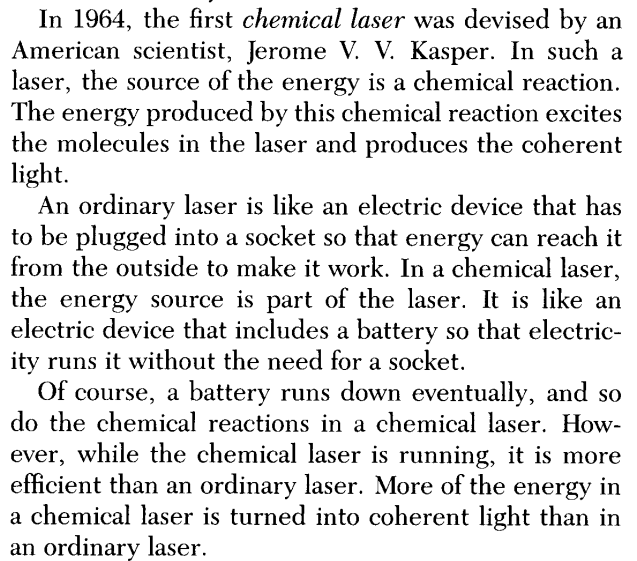
This idea of the so called ‘chemical laser’ is still under exploration, and has not found its full potential. Perhaps there is an interesting research problem here for the interested.
Internet archives has a link to this book, but it is not complete. On the internet, you may find other links to this book.
What was surprising to me is that I found a Marathi translation of this book online. I don’t know how good is the translation, but I will urge you check it out if you know the language well.
Asimov was a unique person, as he blended science, storytelling and writing very efficiently. We need more of his kind in this world.
Conversation with Sandhya Koushika
Sandhya Koushika is a Neurobiologist and a faculty member at Department of Biological Sciences, Tata Institute of Fundamental Research, Mumbai : https://www.tifr.res.in/~dbs/faculty/koushika/people.html
Her research focuses on understanding cargo transport in neurons, a critical process for nervous system development and the prevention of neurodegenerative diseases.
In this free-wheeling conversation, we discuss about her biographical journey of how she got interested in science and became a biologist. We discuss story of trials and tribulations while exploring this path. There are many interesting strands in this conversation, including thoughts on science in India, science careers, perseverance, curiosity, and many other facets of philosophy of science.
There is a nice segment in Tamil and Hindi and a discussion on books that has influenced her.
Listen, as we humanize science….
REFERENCES:
- Sandhya Koushika (@WormlockHolmes) / X [WWW Document], 2024. . X (formerly Twitter). URL https://twitter.com/WormlockHolmes (accessed 3.20.24).
- Home: The Koushika Lab [WWW Document], n.d. URL https://www.tifr.res.in/~dbs/faculty/koushika/index.html (accessed 3.19.24).
- Menon, G., Koushika, S., 2010. Takes two to tango. Nature India. https://doi.org/10.1038/nindia.2010.30
- Koushika, S., Barua, D., 2010. Removing barriers in Indian biosciences. Nature India. https://doi.org/10.1038/nindia.2010.51
- People: The Koushika Lab [WWW Document], n.d. URL https://www.tifr.res.in/~dbs/faculty/koushika/people.html (accessed 3.19.24).
- Research: The Koushika Lab [WWW Document], n.d. URL https://www.tifr.res.in/~dbs/faculty/koushika/research.html (accessed 3.19.24).
- Sandhya Koushika, 2024. . Wikipedia.
- Sandhya Koushika, Department of Biological Sciences, TIFR, Mumbai [WWW Document], n.d. URL https://www.tifr.res.in/~dbs/faculty/S_Koushika.html (accessed 3.19.24).
- Sandhya P. Koushika – Google Scholar [WWW Document], n.d. URL https://scholar.google.co.in/citations?hl=en&user=c4zDSQ8AAAAJ&view_op=list_works&sortby=pubdate (accessed 3.19.24).
- Thattai, M., Koushika, S., 2009. Life sciences in India: looking back, looking forward, looking great. natindia. https://doi.org/10.1038/nindia.2009.84
- 46 Years Later, This Iconic Pair Of NASA Spacecraft Are Still Sending Signals Home [WWW Document], n.d. URL https://www.inverse.com/science/nasa-voyagers-spacecraft-still-working (accessed 3.21.24).
Questions: Substance and Form

To wonder is to be human. At the heart of wondering is questioning. As an individual and a collective, encouraging people to ask questions is one of the most important things we can do. Start with your children or young people around you. Encourage them to question you. Try to answer them honestly. If you do not know the answer, explore the answer with them. Emphasize that no answer is complete and is subject to revision upon new evidence and ideas.
In my opinion, this process is the safest training you can give them as an adult and help them become informed citizens.
Along the way, teach them two things: 1) how to formulate a question and 2) pay attention to the tone of the question they ask.
Formulating a good question is a challenging task and requires iteration. Iterations mean patience. So, asking a good question is a training in patient thinking. Discourage rushing through. That does not mean the upper time bound is infinite. This means you shouldn’t settle for the default question. Question the question.
Next is the tone of the question. It is the tone which determines the intention of the question. If your intention is grounded in humility, curiosity and transparency, you will have a better chance of obtaining an answer. A question asked in a condescending tone generally discourages people from answering, even if their intention is not to conceal.
Of course, these are not general rules but guidelines that may be useful.
Conclusion:
Pay attention not only to the substance of your question but also to the form of your question. A questioning mindset can be extrapolated to your everyday thinking. Gradually, it will become a way of life.
Learning is more important than ego. When you realise this, questions become a great tool to explore the world.
 VISMAYA - History & Philosophy of Physics