There is an important connection between quantum optics and radio astronomy. Hanbury Brown and Twiss in the 1950s devised the intensity interferometer. Particularly, they were interested in measuring the ‘diameter of discrete radio sources’. The title of their seminal paper reads “A new type of interferometer for use in radio astronomy”. As the authors claimed in their paper: “The principle of the instrument is based upon the correlation between the rectified outputs of two independent receivers at each end of a baseline, and it is shown that the cross-correlation coefficient between these outputs is proportional to the square of the amplitude of the Fourier transform of the intensity distribution across the source.”(Brown and Twiss, 1954)
First, they tested their technique in a laboratory situation and followed it up with a measurement of the diameter of Sirius. Their technique was a game-changer in measuring the diameter of bright stars.
As the intensity interferometers were being developed, the laser was realized in the early 1960s. Unlike conventional light sources, laser light is coherent, and this brings in unique features that can be used to understand the nature of light. In the context of laser optics, intensity interferometers had immediate utility in studying coherence through correlation measurement. It was logical to combine lasers with intensity interferometers and study the correlation. This combination is what led to the discovery of some fascinating aspects of quantum properties of light, including anti-bunching.
If the book by Born and Wolf is considered a classic on the electromagnetic theory of light, the quantum extrapolation is the book by Leonard Mandel and Emil Wolf titled Optical Coherence and Quantum Optics. This book discusses the interface of statistical optics, optical coherence, and quantum optics. The core argument of the book starts with probability theory and its connection to fluctuations of light and builds optical coherence, polarization, and eventually quantum optical effects of light. It is a well-written treatise on light with a flavor of experiments (Mandel did some pioneering experiments in quantum optics) and theoretical explanation (a hallmark of Wolf).
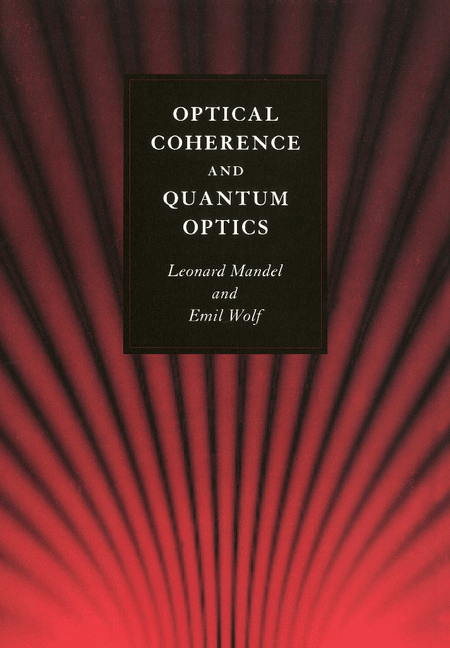
In the preface of the book, they bring together the importance of intensity interferometers and the discovery of lasers and explain how and why it led to a deeper understanding of quantum optics:
“Prior to the development of the first lasers in the 1960s, optical coherence was not a subject with which many scientists had much acquaintance, even though early contributions to the field were made by several distinguished physicists, including Max von Laue, Erwin Schrodinger and Frits Zernike. However, the situation changed once it was realized that the remarkable properties of laser light depended on its coherence. An earlier development that also triggered interest in optical coherence was a series of important experiments by Hanbury Brown and Twiss in the 1950s, showing that correlations between the fluctuations of mutually coherent beams of thermal light could be measured by photoelectric correlation and two-photon coincidence counting experiments. The interpretation of these experiments was, however, surrounded by controversy, which emphasized the need for understanding the coherence properties of light and their effect on the interaction between light and matter.” (Mandel and Wolf, 1995, p. 1)
This further led to a series of studies on light-matter interaction from a coherence perspective, and included analysis of the fluctuation of light by understanding the randomness and the associated statistics of the fluctuations. Mandel, Wolf, Glauber, E.C.G. Surdarshan and many others across the world laid the foundation and connection between optical coherence and quantum optics. What started as a technical development in radio astronomy turned out to be a vital tool in quantum optics.
This blog is part of my course blog on Quantum Optics.
References:
Brown, R. Hanbury, and R. Q. Twiss. ‘LXXIV. A New Type of Interferometer for Use in Radio Astronomy’. Philosophical Magazine 45, no. 366 (1954): 663–82. https://doi.org/10.1080/14786440708520475.
Brown, R. Hanbury, and R. Q. Twiss. ‘Correlation between Photons in Two Coherent Beams of Light’. Nature 177, no. 4497 (1956): 27–29. https://doi.org/10.1038/177027a0.
Hanbury Brown, R., and R. Q. Twiss. ‘A Test of a New Type of Stellar Interferometer on Sirius’. Nature 178, no. 4541 (1956): 1046–48. https://doi.org/10.1038/1781046a0.
Mandel, Leonard, and Emil Wolf. Optical Coherence and Quantum Optics. 1st edn. Cambridge University Press, 1995. https://doi.org/10.1017/CBO9781139644105.

 VISMAYA - History & Philosophy of Physics