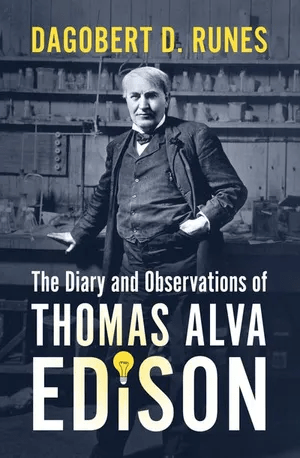
Thomas Alva Edison was one of the greatest inventors we know about. Sometime ago, I stumbled upon a book titled THE DIARY AND OBSERVATIONS OF THOMAS ALVA EDISON, and it was an interesting read. In there, we obtain an insight into Edison’s view on many different subjects, including education, work, religion, etc. Edison was a person with strong views. His working methods were unconventional. Here are a few interesting facts I learnt from this book:
1) Edison had to recruit many executives to his labs; he always emphasized on a memory test and gave them a questionnaire to answer. He insisted that memory is very important for decision making, and he usually employed those people who had very good memory. Edison wrote “…Certainly the brain should have the facts. If a brain possesses an enormous number of facts, those facts, through action of the subconscious mind, will automatically keep themselves available when needed and will automatically keep themselves out of the way, not interfering when not required.”
2) Edison’s view on education was interesting and bold for his times, and he believed that learning through movies would be vital for future education. As early as the 1890s, he said that the best way to teach geography is either by taking the student on a tour or by showing them a movie. Edison wrote
“…motion pictures can be applied to a scientific, systematic course of memory training in the schools, taking the children at an early age when the mind is plastic enough to adapt itself most readily to new habit of thought.
Most of our text books fail on two big counts. They are not sufficiently human, and their application is not sufficiently practical”
3) In the following lines, Edison gives an insight into how he worked: “When I want to discover something, I begin by reading up everything that has been done along that line in the past-that’s what all these books in the library are for. I see what has been accomplished at great labor and expense in the past. I gather the data of many thousands of experiments as a starting point, and then I make thousands more.”
“ …..The motive that I have for inventing is, I guess, like the motive of the billiard player, who always wants to do a little better-to add to his record. Under present conditions I use the reasonable profit which I derive from one invention to make experiments looking towards another invention…..”
4) Edison rates the phonograph as his greatest discovery. He writes, “Which do I consider my greatest invention ? Well, my reply to that would be that I like the phonograph best. Doubtless this is because I love music. And then it has brought so much joy into millions of homes all over this country, and , indeed, all over the world.”
5) The following quotation by Joshua Reynolds was hung in every room of Edison’s laboratory “ There is no expedient to which a man will not resort to avoid the real labor of thinking”
There are many more fascinating thoughts of Edison, many agreeable and a few disagreeable ones, in the above-mentioned book, and if you happen to find it, read it through…it’s a classic and insightful read.
The above text is from a 2011 post on my old blog.

 VISMAYA - History & Philosophy of Physics