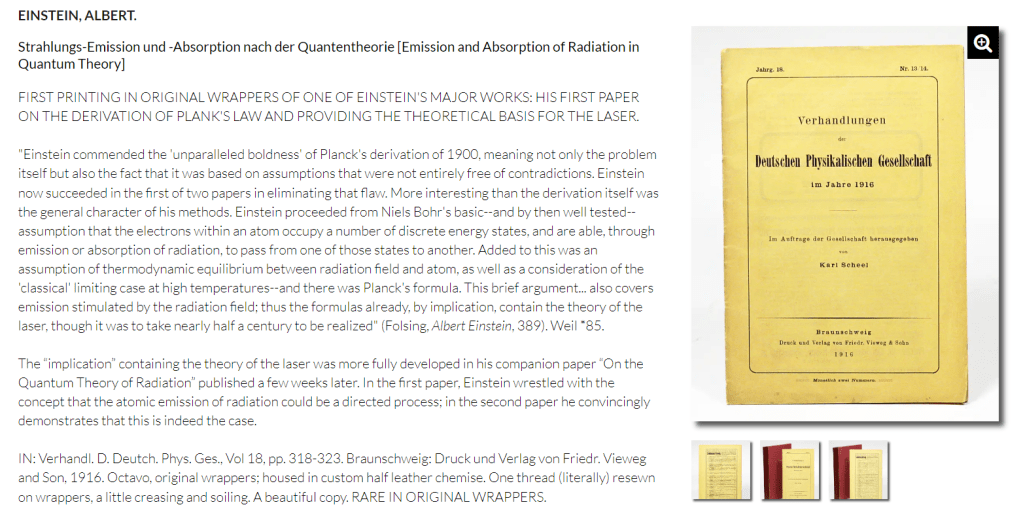
Today, I will be teaching the origins of LASERs in my optics class. Some of the content may interest science enthusiasts here. I present some snapshots from my notes. As expected, it starts with Einstein introducing his A and B coefficients and the stimulated emission.

He introduced them in a paper written in German: Einstein, A. (1916). “Strahlungs-Emission und -Absorption nach der Quantentheorie”. Verhandlungen der Deutschen Physikalischen Gesellschaft. 18: 318–323.
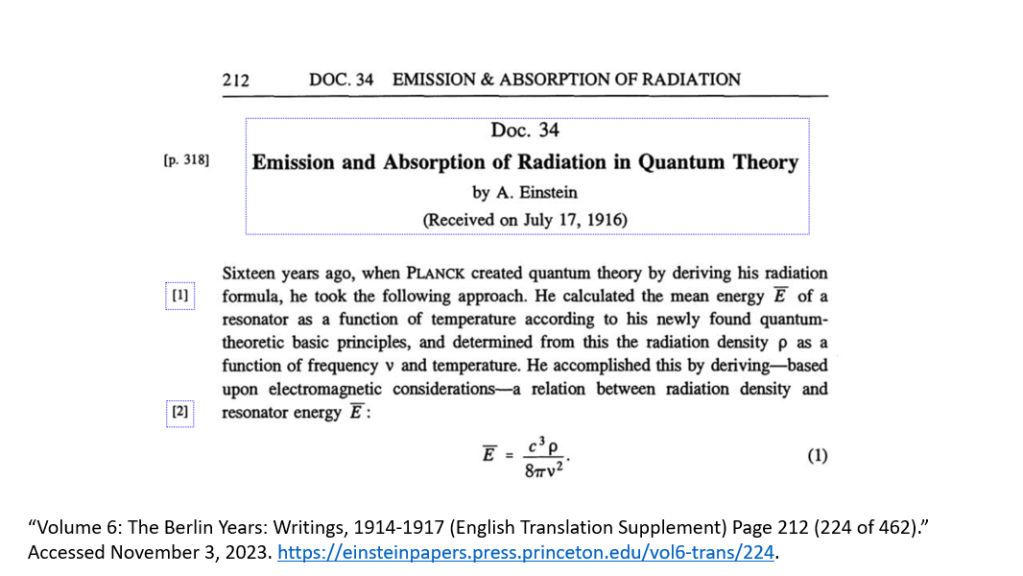
The English translation of the paper: “Volume 6: The Berlin Years: Writings, 1914-1917 (English Translation Supplement) Page 212 (224 of 462).” Accessed November 3, 2023. https://einsteinpapers.press.princeton.edu/vol6-trans/224.
Under thermodynamic equilibrium, the detailed balance gives us the connection between the coefficients…and amplification and stimulated emission of radiation become a measurable prospect.


The pic shows the leading characters behind the invention of the Light Amplification by Stimulated Emission of Radiation (LASER) Charles Townes was the intellectual pioneer behind microwave variety… and Maiman….the freak behind the optical version..

The history of the invention is fascinating and dramatic. I did a podcast on this a few months ago. Check it out..

 VISMAYA - History & Philosophy of Physics