25. Ants@IISER as Active Matter

Nowadays, collective motion in active matter is one of the happening topics in the science of condensed matter, with a motivation in understanding biology at scales spanning from molecules to flock of birds. There is also a lot of contemporary research in active and driven natural systems and soft-robots at various length scales. Of my own interest is to understand how light can drive collective motion in synthetic colloids and other soft-systems in a fluid, and how they can lead to emergence of new assemblies.


Today, when I was walking in the IISER Pune campus, I came across a group of ants carrying food (see video above). It is amazing to see how coordinated is the movement of ants when carrying an object which is much larger than their individual weight (see video). One of the observations you can make is that how ants change their collective direction with minimum communication. How they do it is a fascinating question to explore. Undoubtedly studying such collective motion can lead to deeper understanding of not only the behaviour of ants and non-equilibrium systems, but also in designing adaptable soft-robots for various environments.

IISER Pune campus is quite rich in flora and fauna, and there is a lot to learn just by looking around the natural resources on campus. I hope to explore this rich environment in the context of soft matter systems, and report to you in this blog.
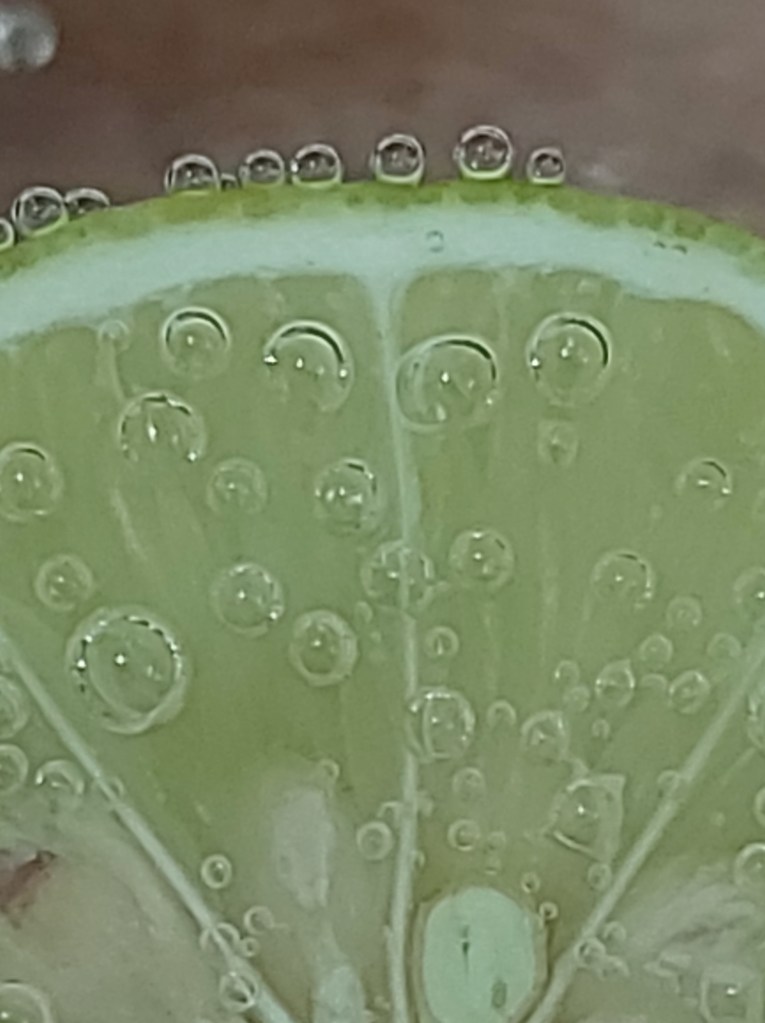
 

24. Bubbles in nimboo soda

Bubble assembly at a curved lemon-soda interface

One of the fascinating things about liquid-solid interface is that it gives a platform for fluids to assemble in a variety of geometries that can be tailored by changing the properties of the interface. Among the formations, bubble generation and assembly are intriguing aspects. If you observe the bubbles at the interface of a lemon slice dipped in soda(image above), they are almost spherical in shape, indicating a large contact angle.

How fluids interact on a solid surface depends on an important concept called as wetting. Associated with this wettability is the contact angle between a droplet/bubble and the solid beneath it. Based on the measure of this contact angle, one can classify how well or otherwise a drop/bubble can wet on a solid.

For a water droplet resting on a solid surface, larger contact angles, close to 90 degree, indicates that the surface is hydrophobic in nature. A lotus leaf is an excellent example of a hydrophobic surface. If the angle happens to be, say around 10 degrees, then the liquid spreads very easily on the surface and hence it is called as hydrophilic surface.

This kind of classification of surfaces based on wetting has a huge implication in studying liquid-solid interfaces including blood flow, capillary phenomena in plants, and of course in paint and printing industry, and many more.

Recently, I came across a research paper-highlight which connects the formation of bubbles to the energy problem. It always amazes me how simple concepts in science can inspire research problems and lead to fundamental questions and applications.

Let the bubbles rise..

ps: thanks to wordpress app, I have been able to write and post this blog directly from my mobile phone. That makes it quick and easy 😬

Continue reading “24. Bubbles in nimboo soda”