Ocean, Okinawa and OIST…

I had a memorable visit to Okinawa Institute of Science and Technology – OIST (27th and 28th April 2023). Prof. Mahesh Bandi was my host, I had a fabulous time interacting with him and a few other groups. Below are some (of many) highlights.

First, the geography : located in the midst of the ocean(s), away from the mainland Japan, Okinawa is the southern most part of Japan. I took a 2.5 hrs. flight from Tokyo and reached the destination when it was dark.

In the morning, I woke up and opened the window to be pleasantly surprised to see the beautiful ocean in my field of view. Below is a photo I took from the balcony of the room.

At the outset, I had a fabulous discussion. Mahesh and I had a excellent free-wheeling discussion on various topics including science, arts and history. Also, I visited his lab to see very creative experiments on non-equilibrium physics including some fascinating experimental designs to probe dynamics at liquid-air interface. He has a fabulous set of students working on interesting problems. It was both refreshing and stimulating.

with Mahesh Bandi

In the afternoon, I gave my seminar and below is an interesting announcement (because it spells out my full name :-)). I discussed about some non-equilibrium aspects of our work, and towards the end emphasized some interesting prospects of statistical optics in an optothermal-assembly.

After my talk, I had illuminating discussion with Prof. Pinaki Chakraborty on thermal diffusion, fluid dynamics and history of science. I enjoyed visiting his lab, in which they have built one of the biggest Taylor-Couette flow set up I have ever seen (see the frame behind Pinaki in the picture below).

with Pinaki

Next day, I had an elaborate lab tour of Prof. Sile Nic Chormaic, who is an expert in various topics related to optics/photonics including optical trapping. As she was travelling, her post-doc Dr. Souvik Sil, hosted me and took me around to show various aspects of their lab. It was a great learning experience.

with Souvik

On the same day, I visited the cutting-edge lab of Prof. Keshav Dani. Since he was travelling, his team members gave me a brief tour and I was amazed by some of their experiments.

Another major highlight of my trip was to meet many IISER students. Specifically, I met Amit Bhunia (post-doc) and Saurav Raj (PhD student) who are IISER Pune alumnus. I also met many IISER Kolkata students (Souvik being one of them).

Overall, I was mighty impressed by the research infrastructure at OIST and the people working there. It is quite remarkable how they have been able to build such a great facility in such a short time (their campus started around 2010).

a corridor in OIST

Today, I have reached Osaka, and on Monday will be giving a talk and visiting a few groups at Osaka Unviersity. Prof. Hajime Ishihara is my host, and I look forward to plenty of interaction on optical manipulation.

New paper : Optothermoelectric trapping of single nano-diamonds

Fluorescent video imaging of trapping a single fluorescent nano-diamond on a gold nanoparticle

We have a new paper appearing in Optics Letters on optical manipulation of fluorescent nano-diamonds. This experimental work (with some simulations) was performed by our group member Ashutosh Shukla in collaboration with the group of Prof. Kasturi Saha (IIT-Bombay). Our alumni, Sunny Tiwari, gave vital inputs to perform the experiments.

Fluorescent nano-diamonds have emerged as important (quantum) imaging agents in biological applications. It remains a challenge to manipulate them in complex fluidic environments.

Herein, we have come up with an optical trapping method based on opto-thermoelectric effect (see Fluorescence imaging video above). By using opto-thermal potentials created by a single gold nanoparticle (~200nm) on a glass surface, we have been able to trap individual nano-diamonds, and capture their spectral signatures. The Brownian motion in the trap can be tracked, and this leads to the measurement of effective trap stiffness. Furthermore, we extrapolate this thermo-plasmonic trapping method to trap and track individual nano-diamonds on silver nanowires.

As mentioned in the abstract of the manuscript, we envisage that our drop-casting platform can be extrapolated to perform targeted, low-power trapping, manipulation, and multimodal imaging of FNDs inside biological systems such as cells.

arxiv link to the paper : https://arxiv.org/abs/2210.02874

below is the snapshot of the abstract of the paper from journal’s early posting :

Two talks in Tokyo

Wonderful Japanese-Gothic architecture at The University of Tokyo

I gave two talks in Tokyo.

First was on 24th April at Department of Applied Physics, Faculty of Advanced Engineering, Tokyo University of Science. My host was Prof. Yutaka Sumino. I spoke about “Soft Matter in Opto-Thermal Gradients“. I gave a short introduction to opto-thermal perturbations and potentials, and discussed some of our work on opto-thermophoretic trapping and Brownian dynamics. The audience contained a few master students too, and I really enjoyed discussing some concepts related to Brownian motion in an optothermal trap, and related experiments. Also, I had a very interesting discussion with Sumino and his students on their experiments on Janus particles.

with Yutaka
with Yutaka”s group

The second talk was on 25th April at Department of Physics, University of Tokyo. My host was Prof. Kazumasa Takeuchi. I spoke about “Soft Matter in Opto-Thermal Gradients : Evolutionary Dynamics and Pattern Formation“.

This talk was also announced on Japan’s statphys mailing list, and also live-casted over zoom. I discussed about the origins of optothermal effects in a laser trap, and how it can lead to some interesting dynamics and pattern formation in soft-matter system. Specifically, I highlighted the concept of Hot Brownian motion, and how it can be influenced using thermo-plasmons. The talk and discussion went on for almost 2 hours, and I really loved it. Also, Takeuchi and his students gave an overview of their work including a live demonstration on turbulence in liquid crystals, and it was fantastic.

with Takeuchi
with Takeuchi’s group

Cup Noodles Museum – Food + Science + Technology + Inspiration

Here is the video blog on the Cup Noodles Museum at Yokohama. I visited this place recently, and was inspiring. Also, has some connections to history of science and scientists. Some notes/references at the end.

Notes & References :

CUPNOODLES MUSEUM YOKOHAMA (no date) CUPNOODLES MUSEUM YOKOHAMA. Available at: https://www.cupnoodles-museum.jp/en/yokohama/ (Accessed: 22 April 2023).

‘Hideki Yukawa’ (2023) Wikipedia. Available at: https://en.wikipedia.org/w/index.php?title=Hideki_Yukawa&oldid=1148467040 (Accessed: 22 April 2023).

‘Momofuku Ando’ (2023) Wikipedia. Available at: https://en.wikipedia.org/w/index.php?title=Momofuku_Ando&oldid=1143758937 (Accessed: 22 April 2023).

Space Noodles | Science and Education | Trends in Japan | Web Japan (no date). Available at: https://web-japan.org/trends01/article/020920sci_r.html (Accessed: 22 April 2023).

‘Cup Noodle’s Nissin develops space ramen, space curry rice for astronauts to eat among the stars’ (2020) SoraNews24 -Japan News-, 17 September. Available at: https://soranews24.com/2020/09/17/cup-noodles-nissin-develops-space-ramen-space-curry-rice-for-astronauts-to-eat-among-the-stars/ (Accessed: 22 April 2023).

The Nobel Prize in Physics 1949 (no date) NobelPrize.org. Available at: https://www.nobelprize.org/prizes/physics/1949/yukawa/biographical/ (Accessed: 22 April 2023).

OMC 2023

We had a great discussion after the talk… spoke on how temperature gradients can be harnessed for optical manipulation in colloidal fluids… which further leads to some interesting Brownian dynamics

The 10th Optical Manipulation and Structured Materials Conference (OMC2023) was superb….learnt a lot.
This was part of Optics & Photonics International Congress 2023

Thanks to Prof. Takashige Omatsu for the invitation and amazing Japanese hospitality…

Halina Rubinsztein-Dunlop – History of Optical Manipulation

Below is a video blog featuring Halina Rubinsztein-Dunlop as part of history of optical manipulation. Also pictured in the blog are : Giorgio Volpe (UC, London) and Agnese Callegari (University of Gothenburg). Pictures taken at OMC 2023 in Yokohama, Japan.

Some relevant links at the end :

Notes :

Professor Halina Rubinsztein-Dunlop (2023). Available at: https://smp.uq.edu.au/profile/204/halina-rubinsztein-dunlop (Accessed: 19 April 2023).

Halina Rubinsztein-Dunlop‬ – ‪Google Scholar‬ Available at: https://scholar.google.se/citations?user=4_sqVfYAAAAJ&hl=en (Accessed: 19 April 2023).

‘Halina Rubinsztein-Dunlop’ (2023) Wikipedia. Available at: https://en.wikipedia.org/w/index.php?title=Halina_Rubinsztein-Dunlop&oldid=1145639271 (Accessed: 19 April 2023).

seminal papers :

Friese, M.E.J. et al. (1998) ‘Optical alignment and spinning of laser-trapped microscopic particles’, Nature, 394(6691), pp. 348–350. Available at: https://doi.org/10.1038/28566.

He, H. et al. (1995) ‘Direct Observation of Transfer of Angular Momentum to Absorptive Particles from a Laser Beam with a Phase Singularity’, Physical Review Letters, 75(5), pp. 826–829. Available at: https://doi.org/10.1103/PhysRevLett.75.826.

Crepuscular rays in Pune and a surprise from Western Ghats

What you see in this image (observed on 6th April 2023, 7.13am, Pune, India) is the emergence of sunlight from clouds in a peculiar expanding beam of rays. Such rays are called crepuscular rays.

The etymology of the word –

crepuscular (adj.)

figurative use, “dim, indistinct,” is attested from 1660s; literal use, “pertaining to or resembling twilight,” from 1755, from Latin crepusculum “twilight, dusk,” related to creper “obscure, uncertain,”

source : “Crepuscular | Search Online Etymology Dictionary.” Accessed April 7, 2023. https://www.etymonline.com/search?q=crepuscular&ref=searchbar_searchhint.

These rays are generally observed during the twilight and persist for a short time. The location of observation is close to the horizon, although I sighted it at a reasonable angle above the horizon (on Dr. Homi Bhabha road, in front of IISER-Pune Pashan gate). 

There is a large class of optical phenomena including sunbeams and moonshines, which are exclusively observed at twilight. For more details read this article by Shields, Janet. “Sunbeams and Moonshine.” Optics and Photonics News 5, no. 7 (July 1, 1994): 57. https://doi.org/10.1364/OPN.5.7.000057.

One may think this phenomenon is related to some kind of diffraction, but it is not. It mainly arises due to the linear perspective of how we visualize this optical effect in an open sky. Of course light scattering has some interesting role in this observation. A very nice discussion on this can be found in an article by Bohren, Craig, and Mark L. Sowers. “Simple Experiments in Atmospheric Physics.” Weatherwise 45, no. 2 (May 1, 1992): 34–38. https://doi.org/10.1080/00431672.1992.9925919.

A Surprise in Western Ghats

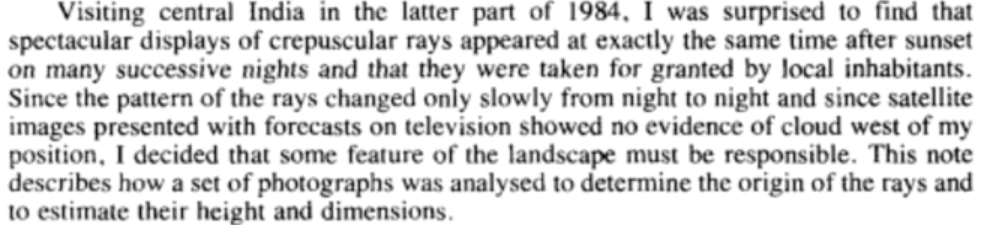
Western ghats are known to show this optical effect. In the year 1984, J. L. Monteith, a researcher who was visiting India from Goddard space center, USA (which is part of NASA) made an interesting and surprising observation. Below I reproduce his text –

For more details on this observation, read this paper by Monteith, J. L. “Crepuscular Rays Formed by the Western Ghats.” Weather 41, no. 9 (September 1986): 292–99. https://doi.org/10.1002/j.1477-8696.1986.tb03862.x.

Interestingly, such rays have also been periodically found in China and was reported as early as 1888 ! See this remarkable observation by Doberck, W. “Crepuscular Rays in China.” Nature 37, no. 959 (March 1888): 464–464. https://doi.org/10.1038/037464b0. Doberck also makes a connection to a historical text by Homer, in which Greek mariners describe the beautiful skies with peculiar rays. 

Around 2011, the crepuscular rays were simulated in a laboratory and further corroborated using numerical simulations. In order to mimic the behavior of clouds, “artificial fogs and milk–water solutions” were used and interesting quantitative observations were made.  For more details read : Gedzelman, Stanley David, and Michael Vollmer. “Crepuscular Rays: Laboratory Experiments and Simulations.” Applied Optics 50, no. 28 (October 1, 2011): F142–51. https://doi.org/10.1364/AO.50.00F142.

Atmospheric and meteorological optics are fascinating topics with some historical connections. For interested readers I highly recommend the following (fascinating and readable) books : 

  • Bohren, Craig F. Clouds in a Glass of Beer: Simple Experiments in Atmospheric Physics. Courier Corporation, 2001.
  •  What Light Through Yonder Window Breaks?: More Experiments in Atmospheric Physics. Courier Corporation, 2006.
  •        Minnaert, M. The Nature of Light and Colour in the Open Air. Revised ed. edition. New York,       N.Y: Dover Publications, 1954.
  • Minnaert, Marcel. Light and Color in the Outdoors. Translated by L. Seymour. Corrected edition. New York: Springer, 1993.

Science + History —> better Science

I recently read an interview of Lorraine Daston, a reputed historian of science on “Does Science Need History?”
She was interviewed by the philosopher Samuel Loncar

The long-form discussion is about history of science and how and why it is relevant not only to the public but also to the practicing scientists.

In the later part of the interview , I found an interesting and important observation made by Lorraine :

“One of the greatest achievements of science, contrary to what anyone would have thought not just circa 1700 but circa 1800, is the creation of the only effective international governance system that we have. In the face of two planetary crises—climate change and a global pandemic—it has not been the UN, it has not been the G8, that got together to diagnose the problem and suggest a solution. It has been the international community of scientists, and I would be extremely loath in any way to undermine the only example of semi-effective international governance we have.”

This is probably one of the important comments on science I have come across in recent times. In an age where nation-states are still fighting (big and small) wars, this is indeed a profound reminder on what truly is the instrument of effective (inter)national governance.

Do check out the whole interview. It has many interesting strands, branches and discussion including philosophy of science, publishing and some great references to explore.
As I have mentioned previously in my blogs, part of the reason why I blog is to bring out the human side of doing science. Interviews like these reinforces this thought, and encourages me as scientist to look into the history of science as not something decoupled from the science itself, but as a part of ones research in understanding why we, as human beings, are interested in science. In my opinion, our science education (and research) will be vastly enriched by including and emphasizing history of science as integral part of science. Frequently, I have also found that some of the best commentaries and criticism on science as human endeavor emnating from historians of science.

After all, it was history of science which opened our eyes towards understanding the structure of scientific revolutions. Hence Science + History —> better Science, and perhaps better human beings !